BANCO BILBAO VIZCAYA ARGENTARIA (BBVA)·Q4 2025 Earnings Summary
BBVA Posts Record €10.5B Profit, Stock Drops 6% on Capital-Intensive Growth
February 5, 2026 · by Fintool AI Agent
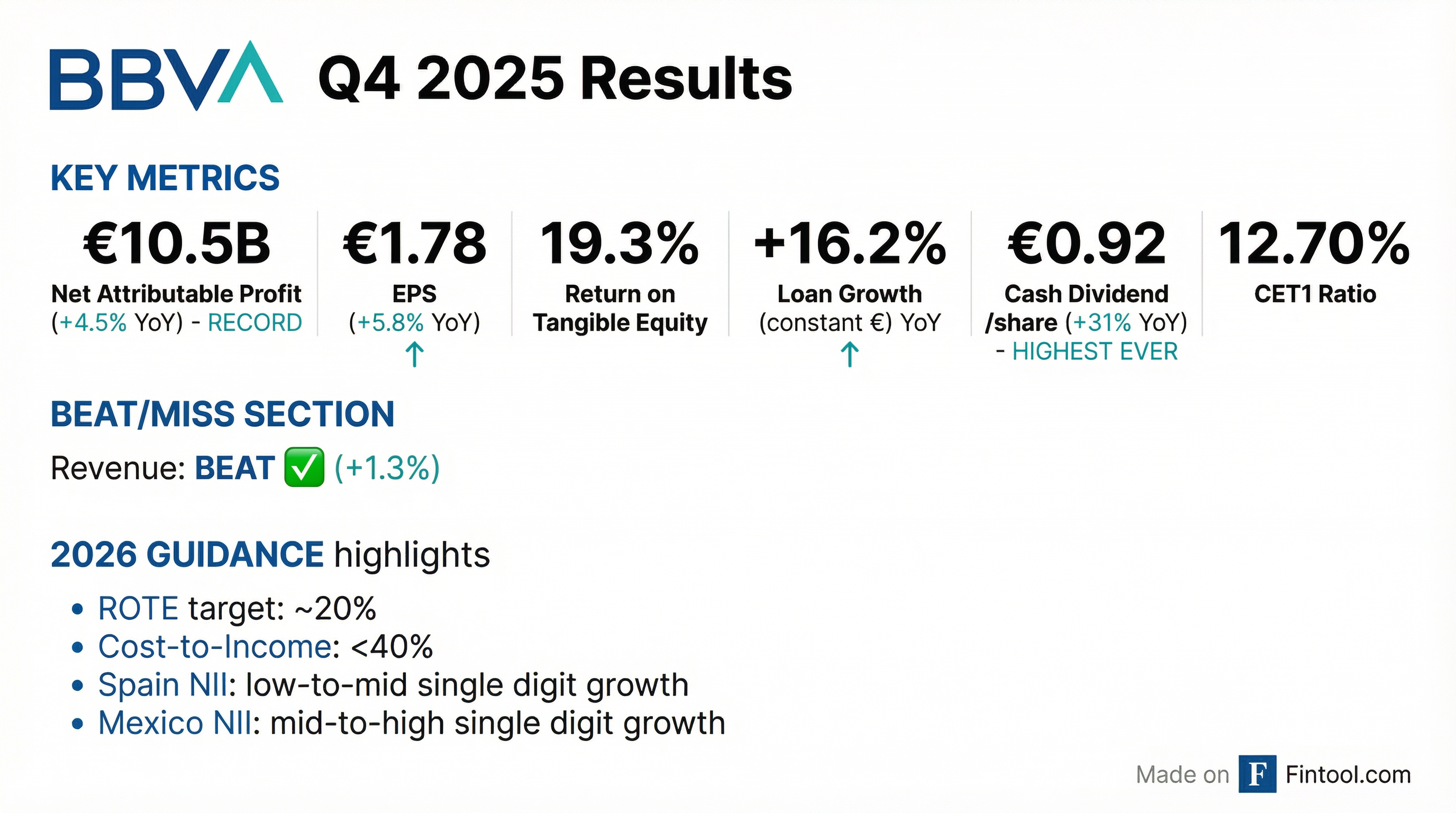
BBVA delivered record full-year profit of €10.5 billion, up 4.5% year-over-year, driven by exceptional loan growth of 16.2% and industry-leading profitability metrics. The Spanish bank beat revenue consensus by 1.3% and announced its highest-ever cash dividend of €0.92 per share. However, the stock dropped approximately 6% in aftermarket trading as investors digested heavy capital consumption from aggressive growth and regulatory headwinds.
Did BBVA Beat Earnings?
*Values retrieved from S&P Global
The Bottom Line: BBVA delivered on all key metrics despite falling interest rates in core markets. CEO Onur Genç called 2025 "one of our best years ever" and confirmed the bank is "fully on track" for its ambitious 2025-2028 strategic plan targets.
How Did the Stock React?
The stock's sharp decline despite record results reflects investor concerns about:
- Heavy capital consumption: RWA growth consumed 57 bps of CET1 in Q4 (vs. typical 4-5 bps)
- Regulatory impacts: 56 bps of additional capital requirements from portfolio reversion to standard/foundation approaches
- Turkey tax hit: Surprise tax code change in December created ~€42M hit
What Changed From Last Quarter?
Positives:
- Loan growth accelerated to 16.2% YoY at constant euros (vs. guidance of high single digits)
- Spain loan growth hit 8% YoY, with Q4 alone growing 2.5%
- Mexico accelerated to 3.7% QoQ loan growth, outpacing annual run-rate
- Customer acquisition reached record 11.5 million gross new customers
- Customer spreads in Spain bottomed at 280 bps — "we have touched bottom"
Concerns:
- Capital-intensive quarter: 57 bps RWA consumption vs. 4-5 bps normal
- Turkey provisioning remains elevated at 194 bps cost of risk
- Mexico cost of risk guidance raised to 340 bps for 2026 (mix effect from retail growth)
 Ask Fintool AI Agent
What Did Management Guide?
Mid-Term Targets (2025-2028):
- €48 billion cumulative profits
- €36 billion capital distribution to shareholders
- 22% average ROTE
- 35% cost-to-income ratio by 2028
Geographic Performance Breakdown
Spain — €4.1B Net Profit, Best-in-Class Efficiency
Key highlights:
- Gained 60 bps of market share in enterprise segment
- New production up 9% QoQ
- Customer spreads expected stable going forward after touching bottom at 280 bps
- Acquired 1 million new customers in 2025
Mexico — Outperforming in Challenging Macro
Why Mexico matters: BBVA's Mexican franchise has a structural cost of funding advantage — one-third of deposits are in the 0-30K EUR bucket with average balance of just €790, driven by payroll dominance. This is "the best insurance policy against any cost of funding challenges."
On neobank competition, CEO Genç emphasized: "What customers care about is the service... If the digital experience is provided by an incumbent bank versus a neobank, they don't care about that tag." BBVA acquired 4.7 million new customers in Mexico in 2025, with 81% through pure digital channels.
Turkey — Recovery Underway, But Volatile
Upside potential: Management believes Turkey fair value is "more than €2 billion in profits" (current: <€1B), contingent on inflation/rate normalization. Sensitivity: each 1% change in inflation = €15-20M P&L impact; each 1% rate change = €40M impact.
South America — Strong Momentum
Peru and Colombia driving growth with mid-single digit core revenue increases.
Ask Fintool AI AgentCapital Allocation and Shareholder Returns
Capital Position: CET1 at 12.70% after buyback deductions, above 11.5-12% target range. Management confirmed commitment to distribute all excess capital above 12%. Expect additional extraordinary distributions in 2026.
SRT Pipeline: Expanding to Mexico and Turkey in 2026, targeting 30-40 bps annual capital release.
Key Management Quotes
On Growth vs. Capital Trade-off:
"This capital consumption is for the right reason — it is driven by profitable growth... Every single loan granted, at any part of the world, capital is deployed profitably above the respective cost of equity." — Onur Genç, CEO
On Share Buybacks:
"Given the appreciation of the share price, the attractiveness of share buyback has come down. But in our view, as compared to the intrinsic value, still there is value." — Onur Genç, CEO
On Mexico Outlook:
"Are we being too conservative on this number? Maybe a bit on the conservative side... We are very positive on Mexico." — Onur Genç, CEO
On Customer Spreads Bottoming:
"We have touched bottom. We expect that number not to go any further down. From here on, if the rate policy evolves as we are expecting, it's gonna be going up." — Onur Genç, CEO
Q&A Highlights
On capital intensity concerns (Francisco Riquel, Alantra): Management acknowledged RWA growth was "much higher than usual" at 57 bps, but emphasized it reflects profitable growth above cost of equity. The bank remains committed to €48B profit and €36B distribution targets.
On Mexico deposit competition (Maksym Mishyn, JB Capital): BBVA's Mexican peso funding cost is 2.5% vs. 4.11% industry average. This advantage comes from payroll dominance and transactional deposit base.
On neobank threat (Benjamin Toms, RBC): CEO dismissed the distinction between incumbents and neobanks: "What customers care about is the service... our digital experience in Mexico is amazing." 81% of new customer acquisition is purely digital.
On AI and efficiency (Sophie Petersen, Goldman Sachs): "We are still at the early innings... but we are quite positive on what we have been seeing." AI savings factored into 35% cost-to-income target by 2028.
On Turkey upside (Seamus Murphy, Carraighill): Fair value "more than €2 billion" if macro normalizes. Currently operating below potential due to hyperinflation accounting. No plans to buy out minorities in Garanti.
Risks and Concerns Flagged
- Capital-intensive growth model: Q4 RWA consumption of 57 bps (vs. 4-5 bps normal) raises sustainability questions
- Turkey uncertainty: Macro assumptions conservative; January inflation at 4.84% monthly remains concerning
- Mexico cost of risk rising: 340 bps guidance for 2026 (from ~330 bps) due to retail mix shift
- Regulatory headwinds: 56 bps capital impact from portfolio reversion to standard approaches
- Slight negative jaws in Spain 2026: Costs growing ~4% vs. low-to-mid single digit NII
Ask Fintool AI Agent