BREAD FINANCIAL HOLDINGS (BFH)·Q4 2025 Earnings Summary
Bread Financial Q4 2025: Credit Quality Improves, Tangible Book Up 23% as Turnaround Gains Traction
January 29, 2026 · by Fintool AI Agent
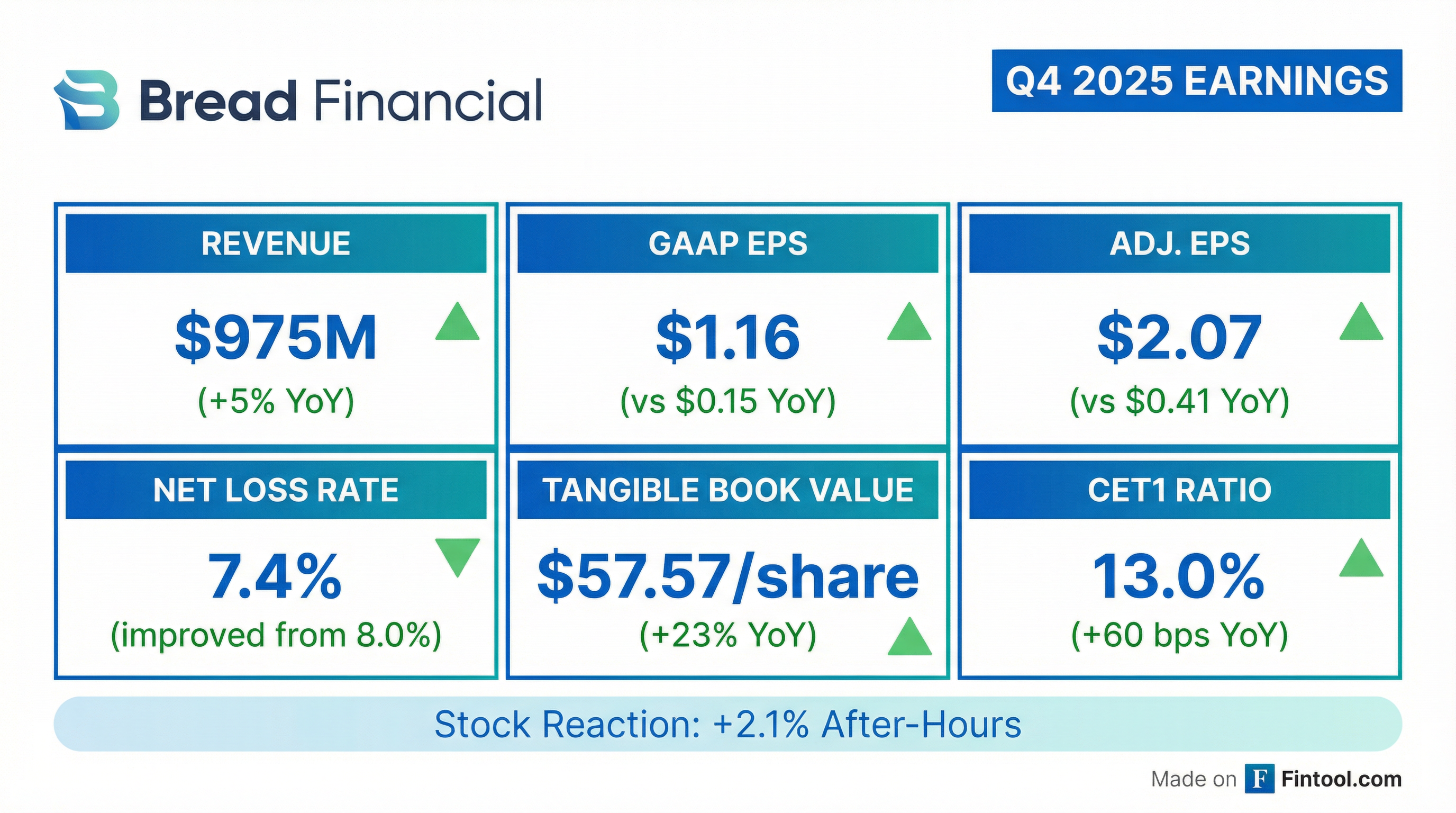
Bread Financial delivered Q4 2025 results that showcased continued progress in its turnaround story, with improving credit metrics, strengthened capital ratios, and a 23% surge in tangible book value per share. Revenue of $975M beat consensus by 0.8%, while adjusted EPS of $2.07 narrowly missed estimates due to debt repurchase costs. The stock rose 2.1% after-hours to $70.91, signaling investor confidence in the company's trajectory.
Did Bread Financial Beat Earnings?
Mixed quarter: Revenue beat, EPS missed on debt repurchase noise.
The EPS miss was driven by $42M post-tax impact from debt repurchases ($0.91/share). Excluding this, adjusted income from continuing operations increased $74M YoY.
Full Year 2025 highlights:
- Revenue: $3,845M (flat YoY)
- Net income: $518M vs $277M (+87% YoY)
- Adjusted EPS: $12.09 vs $7.69 (+57% YoY)
 Ask Fintool AI Agent
What Did Management Guide?
2026 outlook signals continued recovery with modest growth and improving credit.
CEO Ralph Andretta emphasized the company is "nearing an inflection point for loan growth" with all top 10 programs renewed into at least 2028, including the recent Caesars Entertainment extension.
How Did the Stock React?
After-hours up 2.1% as investors embrace improving fundamentals.
The positive reaction suggests investors are looking past the EPS miss (driven by one-time debt costs) and focusing on the structural improvements: better credit, stronger capital, and returning growth visibility.
What Changed From Last Quarter?
Key delta: Credit metrics continue normalizing while capital position strengthens.
The sequential CET1 decline reflects $120M in share repurchases and $42M in debt repurchase impacts. Despite capital deployment, BFH's 13.0% CET1 remains well above regulatory minimums.
Credit Quality Deep Dive
Delinquencies and losses trending toward normalized levels.
The 5-year average net loss rate is ~6.7%, and BFH's current 7.4% rate shows continued convergence. Management expects 2026 to reach 7.2%-7.4%, representing near-full normalization.
Credit Risk Distribution (VantageScore):
- 660+: 59% of revolving loans (up from 58% in Q3)
- 601-660: 27% (stable)
- ≤600: 14% (down from 15%)
CFO Perry Beberman noted: "Improved credit performance and higher-quality new account acquisitions drove the 70 basis point year-over-year improvement in our reserve rate which ended the year at 11.2%."
Capital Allocation & Returns
$350M returned to shareholders in 2025; tangible book value surged 23%.
Balance Sheet Strengthening:
- Retired convertible notes and 9.75% senior notes
- Issued 8.375% subordinated notes and 6.75% senior notes (300 bps rate reduction)
- Completed $75M 8.625% preferred stock offering
- Direct-to-consumer deposits up 11% YoY to $8.5B (48% of total funding vs 43% prior year)
Credit rating upgrades from Moody's and Fitch, with positive outlooks from both Moody's and S&P, validate the capital structure improvements.
Ask Fintool AI AgentPartner & Business Highlights
Diversified partner wins; top 10 programs locked through 2028+.
New partnerships signed in 2025:
- Technology: Cricket Wireless, Crypto.com
- Home: Bed Bath & Beyond, Furniture First, Raymour & Flanigan, Vivint
- Travel & Entertainment: Caesars Entertainment (multi-year extension)
Product Mix (Q4 2025):
Credit sales increased 2% YoY to $8.1B for Q4 and 3% to $27.8B for full year 2025, driven by new partner growth and increased general-purpose spending.
New product: Personal Loans
BFH is now offering personal loans through its website, held on balance sheet. Currently a small portion of total loans but positioned as a growth vector and customer acquisition channel. Management noted they will "enter into it responsibly and manage it and be thoughtful about how we grow personal loans."
Technology & AI Transformation
BFH's AI-first operational excellence strategy is driving efficiency gains.
Three focus areas for 2026:
- Personal productivity tools — Content summarization, contract review, personalized marketing, intelligent search
- Platform modernization — Leveraging AI to modernize code and accelerate cloud migration
- Agentic applications — Developing intelligent applications for commerce and personalized customer service
CFO Beberman emphasized disciplined value tracking: "There's a lot of investments being made, but they're backed by disciplined value tracking, and we have a strong ROI that we're going to make sure we can deliver."
Key Management Quotes
CEO Ralph Andretta on the inflection point:
"Consumer financial health remained resilient throughout the year, driving a 3.0% year-over-year increase in credit sales with higher transaction sizes and increased transaction frequency. The positive trajectory of our credit sales and credit performance metrics, along with our new business additions and stable partner base, gives us confidence that we are nearing an inflection point for loan growth as we enter 2026."
CFO Perry Beberman on margin expansion:
"Revenue increased 5% year-over-year with net interest margin improving to 18.9%. Our net interest margin increased over the fourth quarter of last year as a result of the continued gradual build of pricing changes, as well as lower funding costs reflective of our opportunistic debt actions and growth in direct-to-consumer deposits."
Risks & Watchpoints
- Rate sensitivity: Fed rate cuts will "modestly pressure total net interest income" per guidance
- Trade policy uncertainty: Management monitoring "potential effects that trade and other government policies have on our consumers"
- Regulatory overhang: Late fee and interchange regulation remains a sector risk
- Consumer credit normalization: While improving, loss rates remain above 5-year averages
- Loan growth inflection: Management confident but not yet proven in numbers
- Deposit beta uncertainty: Range widened to 60-80% (from prior ~80%), market-dependent
Forward Catalysts
- Q1 2026 earnings (~late April): First read on 2026 loan growth inflection
- Fed rate decisions: Impact on NIM vs funding cost benefit
- Partner renewals: Continued extension of major programs
- Credit normalization: Path toward 7.2% net loss rate target
- Continued buybacks: $240M remaining authorization
Ask Fintool AI AgentQ&A Highlights
On underwriting discipline (Sanjay Sakhrani, KBW):
"We are not doing anything out of the ordinary. We underwrite the way we've always underwritten. We underwrite for profit... there's not a general loosening. It's a gradual look as credit improves." — CEO Ralph Andretta
On AI transformation (Reggie Smith, J.P. Morgan):
CFO Perry Beberman detailed BFH's AI roadmap:
- 200+ ML models deployed across underwriting, fraud, and servicing
- 60+ AI initiatives currently in motion
- 1M+ hours of manual work eliminated through automation bots
- Focus areas: code modernization, agentic applications, personalized service
On reserve rate trajectory (John Hecht, Jefferies):
"As credit quality delinquency improves, the reserve rate should come down accordingly... we'll get somewhere around that 10% area over time. I'm not sure we get all the way back to day one because it's a different portfolio." — CFO Perry Beberman
On deposit strategy (John Hecht, Jefferies):
Long-term DTC deposit target is 70%+ of total funding (vs 48% currently), in line with larger peers. The company will maintain competitive pricing without brick-and-mortar branch overhead.
On roll rate improvement (Sanjay Sakhrani follow-up):
"Our early entry rate that we see is now below the pre-pandemic levels... we're also observing improvement in our late-stage roll rates, and that's what we called out early on. In order for our losses to continue to improve, we need to see that improve. So we're seeing that improvement." — CFO Perry Beberman
On Q1 2026 tax refund tailwind (Vincent Caintic, BTIG):
Management expects the 2026 tax refund season to be a net positive, though consumer behavior (pay down debt vs spend vs save) remains uncertain. Potential government shutdown could create timing delays.
The Bottom Line
Bread Financial's Q4 2025 results demonstrate meaningful progress in its multi-year turnaround. Credit metrics are normalizing, the balance sheet has been strengthened through proactive refinancing, and the company is returning substantial capital to shareholders. The 23% YoY surge in tangible book value to $57.57 reflects the compounding benefits of these actions.
While the EPS miss on debt repurchase noise disappointed headline scanners, the underlying business trajectory is clearly improving. Management's confidence in reaching a "loan growth inflection point" in 2026 will be the key narrative to watch.
At ~6x adjusted earnings and trading below tangible book value, BFH offers value if credit normalization continues and growth returns.
Data sourced from Bread Financial 8-K filed January 29, 2026 and S&P Global estimates.