BILL Holdings (BILL)·Q2 2026 Earnings Summary
BILL Surges 13% After Hours on Strong Q2 Beat, AI Investment Narrative
February 5, 2026 · by Fintool AI Agent
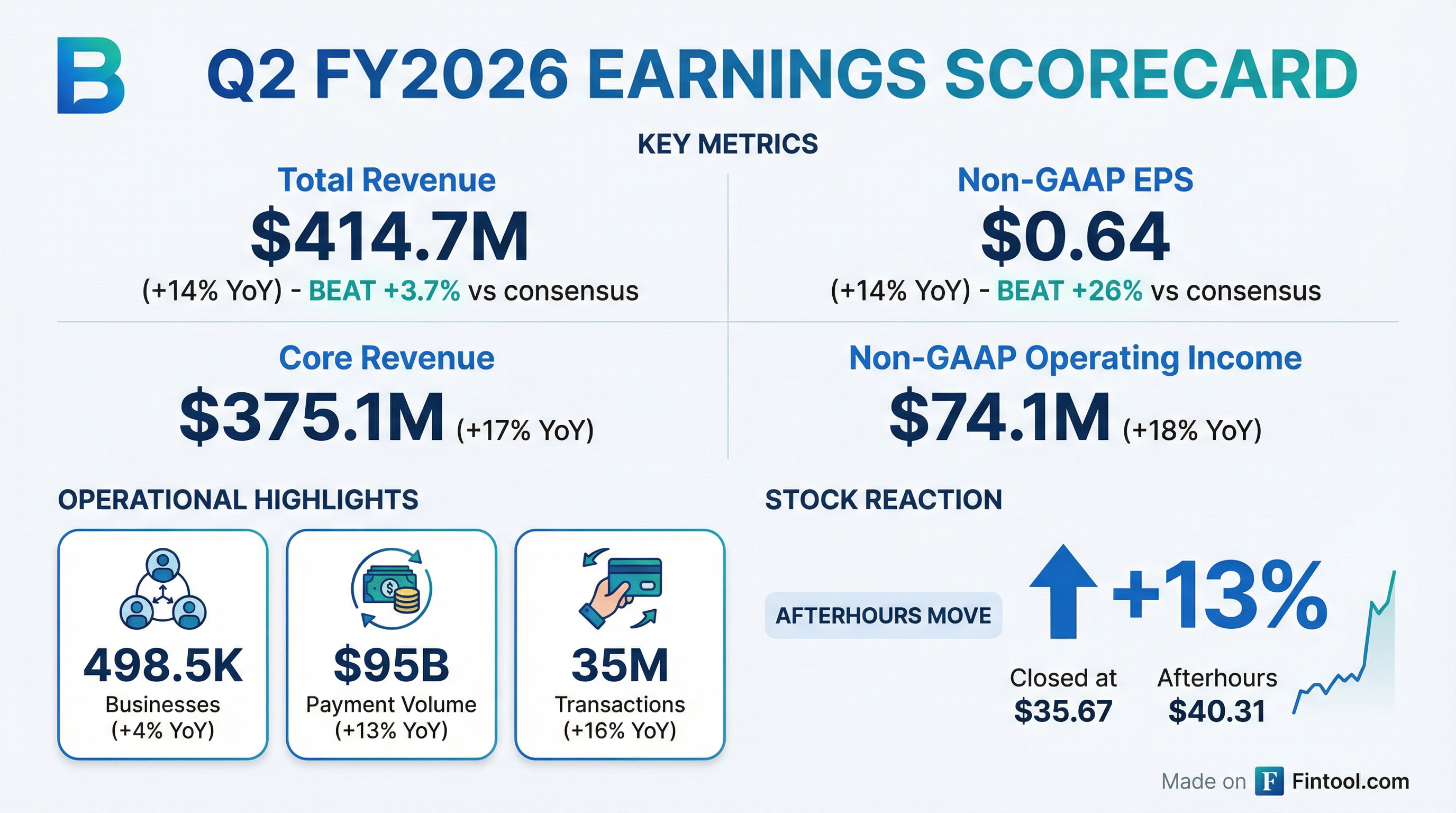
BILL delivered a strong Q2 FY2026, beating consensus on both revenue and EPS while accelerating core revenue growth to 17% YoY. The stock jumped 13% in after-hours trading to $40.31, recovering from a -32% decline over the prior month. Management emphasized AI-driven automation as a key differentiator for the intelligent finance platform, which now serves nearly 500,000 businesses.
Did BILL Beat Earnings?
Yes, BILL beat on both revenue and EPS, extending its 8-quarter streak of EPS beats:
Core revenue growth accelerated to 17% YoY from 12% in Q3 FY25, driven by strong transaction fee growth of 20% YoY. Transaction fees of $303.1M now represent 73% of core revenue, while subscription fees of $72.1M grew 6% YoY.
8-Quarter Beat/Miss History:
BILL has beaten EPS estimates for 8 consecutive quarters and has beaten or matched revenue in 7 of 8 quarters (the only slight miss was Q3 FY25 at -0.5%).
 Ask Fintool AI Agent
What Did Management Say?
CEO René Lacerte emphasized BILL's competitive moat and AI strategy:
"We delivered a strong Q2, with a significant beat on revenue and profitability, and continued our track record of rapid innovation. With a leading position in a large market, strong brand recognition, and a differentiated platform and distribution ecosystem, we are leveraging our unique assets alongside AI to eliminate unnecessary workflows and shape the future of touchless B2B transactions."
CFO Rohini Jain highlighted margin expansion and investment discipline:
"We accelerated core revenue growth while strengthening our margin profile. Our Q2 performance underscores the durability of our business and the discipline of our investment approach. Looking ahead, we are focused on extending differentiation, driving efficiency, and delivering long‑term shareholder value."
Key themes from management:
- AI investment for touchless B2B transactions and workflow automation
- Platform differentiation with integrated AP, AR, Spend & Expense, and forecasting tools
- Distribution ecosystem through 9,500+ accounting firms and financial institution partnerships
- Capital return via $133M in share buybacks during Q2 (~2.5M shares)
AI Competitive Moat — Addressing Disruption Concerns
When asked about AI disruption risk, CEO René Lacerte gave a detailed response on BILL's defensibility:
"Our assets are scarce, they're unique. Our platform is at the intersection of both software and payments. It's carefully built, it's honed with expertise, and these assets are not easy, and they may be even impossible to replicate."
He outlined three key differentiators:
- Proprietary data at scale — "$1 trillion in spend and payments across our network. Hundreds of millions of transactions, over 1 billion documents... This is not something five guys in a garage can just build on their own."
- Trust — "When the precision bar is 100%, which it is for money, the consequences of failure can be catastrophic for an SMB."
- Network effects — "8 million entities on our network. No one connects and understands how buyers and suppliers transact better than BILL."
What Did BILL Guide?
BILL provided guidance for Q3 FY26 and full-year FY26:
Q3 FY26 guidance midpoint of $402.5M is roughly in line with consensus of ~$395M, suggesting modest conservatism. Full-year FY26 revenue midpoint of $1,641M implies ~12.5% growth.
Guidance raised from prior: Full-year core revenue guidance increased ~170 bps from prior guide, and operating margin guidance reflects 130+ bps of additional margin improvement vs. initial FY26 outlook. Float revenue guidance raised by $7.5M due to higher expected yields.
Key assumptions underlying guidance:
- AP/AR: Modest payment volume growth per customer assumed; take rate expected to increase 0.4 bps for the year
- Spend & Expense: Card payment volume growth expected in low 20% range; take rate ~250 bps
- Stock-based compensation expected at ~$255M, below prior guidance
How Did the Stock React?
BILL shares surged 13% after hours to $40.31 from a regular session close of $35.67.
The stock had been under significant pressure heading into earnings:
- Down 32% over the prior month (from $52 in early January)
- Down 64% from 52-week high of $100.19
- Trading near 52-week lows of $35.46
The strong beat and guidance appears to have reassured investors concerned about SMB spending headwinds and fintech competition.
Ask Fintool AI AgentWhat Changed From Last Quarter?
Improving trends:
- Core revenue growth accelerated to 17% YoY from 12% in Q3 FY25 and 15% in Q1 FY26
- Transaction fee growth accelerated to 20% YoY from 18% in Q1 FY26
- Payment volume growth steady at 13% YoY ($95B TPV vs $84.5B in Q2 FY25)
- Transactions processed up 16% YoY to 35M
- Same-store sales grew 4% YoY (up from 3% in Q1), with manufacturing strong and construction rebounding
- AP card payments (using Divvy for traditional AP) grew 160%+ YoY
- Multi-product adoption (AP/AR + Spend & Expense) up 28% YoY
AI Agent Progress:
- W-9 agent: ~10K customers activated, 40K W-9s collected; targeting 3M W-9s by year-end
- Invoice coding agent: Reduces steps required by 90%
- BILL Assistant agent: Self-serve rate tripled from 13% to 40%
- Fraud detection: Stopped 5.3M fraudulent attempts in H1, reduced manual fraud reviews by 40%
Areas of modest pressure:
- Non-GAAP gross margin compressed to 83.9% from 85.2% in Q2 FY25
- Float revenue declined to $39.5M from $42.9M in Q2 FY25 (lower interest rates)
- Spend & Expense rewards expense increased to 52% of S&E transaction fees (from 48% YoY)
- Embedded Solutions customer count declined slightly to 277K from 283K in Q2 FY25
Segment Performance
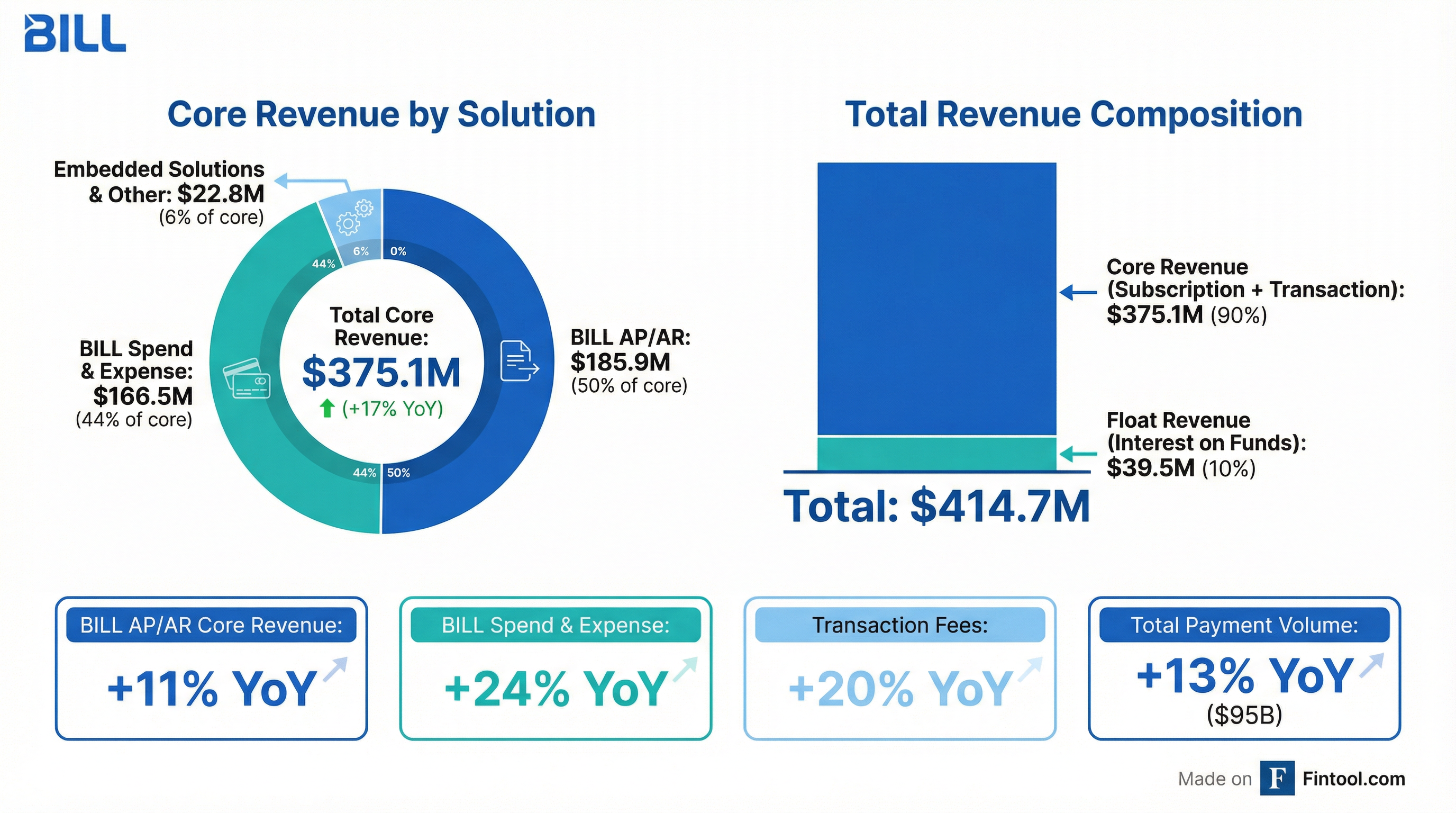
BILL AP/AR (Core accounts payable and receivable platform):
- Revenue: $185.9M (+11% YoY) — acceleration driven by transaction revenue +14% YoY
- Customers: 177,500 (+11% YoY); net adds ~4,000 (expected to trend lower as focus shifts to larger customers)
- TPV: $79.9B (+11% YoY)
- Subscription ARPU grew 1% sequentially, reflecting move upmarket
- Invoice financing customers +50% YoY, origination volume +30% YoY
BILL Spend & Expense (Corporate cards and expense management):
- Revenue: $166.5M (+24% YoY) — fastest growing segment, upside from accelerated card volume and better take rate
- Spending businesses: 44,000 (+16% YoY)
- TPV: $6.5B (+25% YoY)
- Card spend per business hit record high of $148,000
- Take rate: 255 bps, driven by higher-interchange verticals (advertising, healthcare)
- Advertising and retail spend rebounded after being muted in prior quarters
- Card spend is growing faster than AP/AR
Embedded Solutions & Other (FI channel, Invoice2go):
- Revenue: $22.8M (+21% YoY)
- Customers: 277,000 (-2% YoY)
- TPV: $8.7B (+18% YoY)
Margin Profile
The gross margin compression is largely driven by higher interchange costs in the Spend & Expense segment and increased rewards expense. However, operating leverage is improving as BILL scales, with non-GAAP operating income growing 18% YoY on 14% revenue growth.
Capital Allocation
- Share repurchases: $133M in Q2 (~2.5M shares at ~$53 average price)
- Cash position: Remains strong with ongoing buyback authorization
- No dividend: Consistent with growth-stage fintech profile
Management noted they repurchased shares throughout Q2 but did not provide updated authorization details.
Forward Catalysts
- AI agent expansion — W-9 agent targeting 3M W-9s by year-end; invoice coding, Smart Response, and Pay For You agents in market
- Embed 2.0 scaling — NetSuite, Acumatica, and Paychex partnerships live; ~1M business reach potential from these three alone
- SPP adoption — $400M annual TPV committed from early adopters; enterprise sales motion ramping
- BILL Cash Account — Launched in Q2; 70%+ of users have increased spend volumes on network
- Pricing optimization — Holistic pricing strategy rollout expected in FY27 with less churn than expected from initial changes
- Cost efficiency program — Multi-year roadmap with initial benefits expected in FY27
Q&A Highlights
On AI agent strategy and customer feedback:
"Agentic AI will allow us to dive deeper into the stack of transactional confusion and simplify it... Our ability with the BILL Assistant agent that we just launched, we've gone from a 13% self-serve rate to over 40%. That means customers get back to doing what they love."
On improving spend trends: CFO Rohini Jain noted same-store sales grew 4% on AP/AR (up from 3% last quarter), with construction showing a "nice rebound" and Spend & Expense seeing "resurgence of spend going into advertising and retail."
On invoice financing traction: Invoice financing customers grew ~50% YoY with origination volume up 30%+. Management emphasized this product enables suppliers to get paid "4-6 weeks earlier" by leveraging BILL's proprietary data and risk models.
On Supplier Payments Plus (SPP): Early adopting suppliers have committed ~$400M in annual TPV, including Fortune 500 companies. SPP is positioned as a complement to virtual cards and an upgrade from vanilla ACH, offering "enhanced reconciliation tools, more data, more efficiency."
On Embed 2.0 partnerships: All three new partnerships (NetSuite, Acumatica, Paychex) are now live in market — just 3 months after signing. CEO Lacerte noted Acumatica's CEO mentioned BILL in his keynote at their annual conference, with strong interest from mid-market construction customers.
On pricing power: Management noted they implemented targeted subscription price increases for new and existing direct channel customers and saw "less churn than we were expecting." A more holistic pricing optimization is expected to roll out in FY27.
On operational efficiency roadmap: President John Rettig outlined a multi-year cost optimization plan including geographical diversification, AI-driven productivity improvements, and customer unit economic optimization. Initial benefits expected in FY27.
Key Risks
- SMB spending sensitivity — Revenue tied to SMB transaction volumes and spending levels
- Interest rate headwinds — Float revenue declined 8% YoY as rates declined
- Competition — Banks, accounting software providers, and fintech peers expanding into B2B payments
- Margin pressure — Rewards costs rising faster than Spend & Expense revenue
- Embedded Solutions decline — Customer count in FI channel declining slightly
Ask Fintool AI AgentSummary
BILL delivered a clean beat-and-raise quarter, accelerating core revenue growth to 17% YoY while maintaining operating discipline. The 13% after-hours surge reflects relief after a 32% decline heading into earnings. Key positives include accelerating transaction fee growth (+20% YoY), record Spend & Expense card spend per business ($148K), improving same-store sales (+4%), and tangible AI agent progress (W-9 agent, 40% self-serve rate). Management made a compelling case for competitive defensibility despite AI disruption concerns, citing proprietary data from $1T+ in payments, trust built moving 1% of U.S. GDP, and 8M-entity network effects.
Near-term catalysts include Embed 2.0 partnership scaling (NetSuite, Acumatica, Paychex all live), SPP adoption from large suppliers ($400M committed), and pricing optimization in FY27. Key concerns remain around gross margin compression, float revenue headwinds, and customer count headwinds as BILL shifts upmarket. The multi-year cost efficiency roadmap and AI-driven productivity gains could support continued margin expansion.
Analysis based on BILL Q2 FY2026 earnings call transcript and press release published February 5, 2026. Stock prices and after-hours trading data as of market close February 5, 2026.