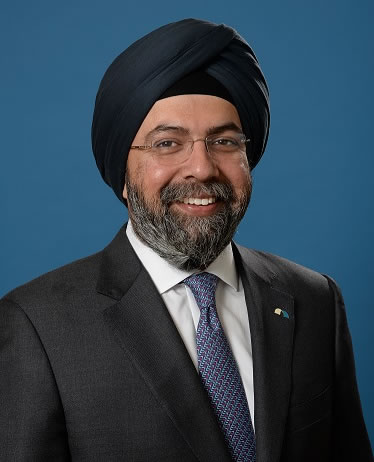
Rajinder Singh
 BankUnited
About Rajinder Singh
Rajinder P. Singh is Chairman, President and Chief Executive Officer of BankUnited, Inc., and a founding organizer. He became CEO and President in January 2017, and Chairman in January 2019; he has served on the board since July 2013 and previously was COO from October 2010 to 2017. Singh’s background spans executive roles at Invesco’s WL Ross & Co., Capital One Financial, North Fork Bancorporation, and FleetBoston; he holds an MBA from Carnegie Mellon and a BS in Chemical Engineering from IIT Delhi. In 2024 BKU delivered net income of $232.5 million and diluted EPS of $3.08, with TSR value of $123.54 on an initial $100 five-year investment; the ratio of non-interest DDA to total deposits rose to 27.3%, and NIM expanded, supporting pay-for-performance alignment for incentives .
Past Roles
| Organization | Role | Years | Strategic Impact |
|---|---|---|---|
| BankUnited, Inc. | Chairman | January 2019–present | Board leadership over strategy, risk, governance |
| BankUnited, Inc. | President & CEO | January 2017–present | Margin expansion, improved funding mix, core profitability enhancements |
| BankUnited, Inc. | COO | October 2010–2017 | Operations leadership; foundation for post-crisis growth |
| Invesco’s WL Ross & Co. | Executive leadership positions | Not disclosed | Financial services investing/operations expertise |
| Capital One Financial Corp. | Executive leadership positions | Not disclosed | Banking operations and strategy experience |
| North Fork Bancorporation; FleetBoston | Executive leadership positions | Not disclosed | Banking, M&A and integration experience |
External Roles
| Organization | Role | Years | Notes |
|---|---|---|---|
| Federal Reserve Bank of Atlanta | Board of Directors | Current | Regulatory perspective and macro policy insights |
| Mid-Size Bank Coalition of America (MBCA) | Board; Chairman | Chairman in 2023 | Industry leadership; peer insights |
| Federal Advisory Council (Federal Reserve Board) | Member (Atlanta Region) | Jan 2020–Dec 2022 | Macro risk and policy input |
Fixed Compensation
| Year | Base Salary ($) | Perquisites and Other ($) | Notes |
|---|---|---|---|
| 2024 | 1,050,000 | 185,648 (401k $15,525; deferred comp match $109,333; auto $14,219; driver $34,473; aircraft $9,393; split-dollar life insurance service cost $2,705) | Base unchanged; second-to-die split-dollar life insurance maintained |
| 2023 | 1,050,000 | 169,062 | — |
| 2022 | 1,037,500 | 211,672 | — |
Performance Compensation
Annual Incentive Plan (AIP) – 2024 Structure and Outcomes
| Component | Metric | Weight | Target | Actual | Payout (% of target) | Resulting Cash Payout ($) |
|---|---|---|---|---|---|---|
| Absolute | Ratio of NIDDA to Total Deposits | 25% | ≥22.5% | 27.3% | 200% | Included in total below |
| Absolute | Wholesale Funding Ratio | 25% | ≤30% | 23.4% | 200% | Included in total below |
| Relative | NPA Ratio (excl. guaranteed SBA portion) vs peer set | 25% | ≥25th percentile (threshold grid) | 10th percentile | 0% | Included in total below |
| Strategic | Committee assessment of strategic objectives | 25% | Pre-set objectives | Maximum achieved | 200% | Included in total below |
| Total | AIP payout | — | Target $1,575,000 | — | 150% | 2,362,500 |
AIP payout grid: Relative criteria based on percentile ranking (<25%: 0%; 25%: 50%; 50%: 100%; 75%: 200%), Absolute criteria: threshold 50%, target 100%, maximum 200% .
Long-Term Incentive Plan (LTIP) – 2024 Grants and PSU Design
| Award | Grant Date | Target Shares | Grant-Date Fair Value ($) | Vesting |
|---|---|---|---|---|
| RSU | Mar 29, 2024 | 53,907 | 1,509,396 | 1/3 on 12/31/2024; 1/3 on 12/31/2025; 1/3 on 12/31/2026 |
| PSU (2024–2026) | Mar 29, 2024 | 53,907 | 1,509,396 (target) | Earned at end of performance period per metrics below |
PSU 2024–2026 metrics and weights:
- Relative metrics (60% total; 20% each): average 3-year net charge-off ratio, average 3-year improvement in ROAA, 3-year TSR vs KBW Regional Bank Index; APR grid: <25% = 0%; 25% = 50%; 50% = 100%; 75% = 200% .
- Absolute metrics (40% total; 20% each): (i) Total loan commitments + total deposits in new geographies (Threshold ≥$2.0B; Target ≥$2.5B; Max ≥$2.75B), (ii) Retention rate for high-performing SVP+ officers (Threshold ≤9.0%; Target ≤6.0%; Max ≤3.5%) .
PSU share outcomes grid (Rajinder Singh): Threshold 26,954; Target 53,907; Maximum 107,813 .
Prior LTIP PSU Cycle (2021–2024) Outcomes
| Metric | Percentile Ranking | APR | Payout vs Target |
|---|---|---|---|
| TBV per share CAGR | 37.60% | 31.87% (composite) | 63.73% of target (above threshold, below target) |
| Net charge-off ratio (avg) | 20.30% | — | — |
| 4-year TSR vs KBW Index | 37.70% | — | — |
Shares vested: Singh 20,845; Cornish 9,194; Lunak 5,212; Bansal 5,420 .
Summary Compensation (multi-year)
| Year | Stock Awards ($) | Non-Equity Incentive ($) | Total ($) |
|---|---|---|---|
| 2024 | 3,018,792 | 2,362,500 | 6,616,940 |
| 2023 | 3,018,764 | 1,724,625 | 5,962,451 |
| 2022 | 3,018,821 | 1,400,962 | 5,668,955 |
Equity Ownership & Alignment
| Item | Detail |
|---|---|
| Total beneficial ownership | 348,297 shares (includes 67,890 RSUs) |
| Ownership as % of outstanding | <1% (per proxy denotation) |
| Unvested RSUs | 67,890 (49,921 vest 12/31/2025; 17,969 vest 12/31/2026) |
| Unearned PSUs at max assumption | 264,475 (2022–2024 and 2024–2026 PSU tranches) |
| Stock ownership guidelines | CEO: 6× base salary; Singh is in compliance (approx. requirement $6.3M) |
| Hedging/pledging | Prohibited for directors and executive officers; margin accounts prohibited |
| Deferred compensation | 2024 executive contributions $766,925; registrant contributions $109,333; year-end balance $6,823,941 |
No options outstanding are disclosed; equity mix is RSUs and PSUs .
Employment Terms
| Provision | Key Terms |
|---|---|
| Agreement term | 3 years commencing Jan 1, 2023; auto-renews annually from Jan 1, 2026 unless notice given ≥90 days before anniversary; extends to 2 years post change-in-control upon public announcement |
| Severance (no CiC) | 2× (base + target AIP); prorated AIP based on actual; full vest RSUs; PSUs vest based on actual achievement; 24 months health coverage; continuation of split-dollar life insurance |
| Severance (post CiC) | 3× (base + target AIP); prorated AIP at target; PSUs convert to time-based RSUs and fully vest on later of CiC or termination upon Public Announcement; full RSU vest; 24 months health; life insurance |
| Excise tax gross-up | None; best-net cutback to avoid 4999 excise tax if beneficial |
| Non-compete / non-solicit | 18 months following termination for Cause or voluntary resignation without Good Reason |
| Clawback policy | SEC/NYSE-compliant compensation recovery policy for restatements |
| Estimated payouts (as of 12/31/2024) | Without Cause/Good Reason: total $15,545,021; post CiC: total $18,170,021; Change in Control equity cash-out value $8,635,543 |
Board Governance
- Dual role: Chairman + CEO; Board uses a Lead Independent Director (Douglas J. Pauls) for enhanced independent oversight and executive sessions; all other directors are independent; Singh is not independent per NYSE standards .
- Committees: Singh serves on none; Audit, Risk, Compensation, NCG committees comprised solely of independent directors .
- Attendance: In 2024, Board held 6 meetings and acted by consent 5 times; each director attended ≥75% of Board/committee meetings; directors attended the 2024 annual meeting .
- Executive sessions: Non-management directors met in executive session 4 times in 2024 .
Director Compensation (context)
Employee-directors (e.g., Singh) do not receive director fees. Non-employee directors received $70,000 cash retainer (committee chair/member additional retainers) and annual restricted stock (generally 2,320 shares; Lead Independent Director additional grant); director stock retention requirement is 5× annual retainer; hedging/pledging prohibited .
Compensation Peer Group and Say-on-Pay
- 2024 peer group (unchanged from 2023) includes: Ameris, Associated Banc-Corp, BOK, Cadence, F.N.B., Fulton, Hancock Whitney, Pinnacle Financial, Prosperity, SouthState, Synovus, Texas Capital, UMB, United Bankshares, Valley National, Webster .
- Committee does not target a fixed percentile for total pay; relative metrics generally use median (50th percentile) as target in PSU/APR grids .
- Say-on-Pay: 78% approval at 2024 meeting (down from ~99% average over prior 3 years). BKU conducted shareholder outreach; investors recommended enhanced disclosure; Committee retained structure and emphasized macro headwinds’ impact on 2023 TSR .
Performance & Track Record
- 2024 operational highlights: EPS progression and NIM expansion through year; improved funding mix (NIDDA +$781M to 27% of deposits; wholesale funding −$2.3B); asset composition shift to higher-margin segments; spot APY down; CET1 12.0% (pro-forma including AOCI 10.9%); tangible BVPS accretion .
- 2025 Q2 update: Continued NIM expansion to 2.93%, NIDDA to 32% of deposits, ROE 9.4%, TBVPS $38.23; authorized $100M share repurchase and redemption of $400M 4.875% 2025 notes .
- Pay-versus-performance: Compensation Actually Paid aligns directionally with TSR and net income over five years; 2024 TSR outperformed index (Company 22% vs index 13%) .
Revenues and EBITDA (last 3 fiscal years)
| Metric | FY 2022 | FY 2023 | FY 2024 |
|---|---|---|---|
| Revenues ($USD) | 77,636,000 | 86,838,000 | 99,155,000 |
| EBITDA ($USD) | — | — | — |
Values retrieved from S&P Global.
Investment Implications
- Pay-for-performance alignment strengthened in 2024: AIP paid at 150% of target driven by maximum performance on funding mix metrics (NIDDA ratio and wholesale funding ratio), while relative credit metric paid zero—indicating discipline in risk balancing; long-term PSU mix emphasizes ROAA improvement and TSR vs peers, with clear thresholds and two absolute strategic/HC metrics .
- Equity ownership and retention: Singh meets robust 6× salary ownership guideline; significant unvested RSUs/PSUs suggest alignment and potential selling pressure moderation; pledging/hedging prohibited mitigates misalignment risk .
- Contract and change-in-control economics: Double-trigger features and PSU conversion mechanics limit windfalls; excise tax gross-up excluded; non-compete and non-solicit provisions add retention protection but also potential succession transition frictions .
- Governance considerations: CEO-Chairman dual role offset by strong Lead Independent Director and fully independent key committees with regular executive sessions; attendance and shareholder engagement processes look robust .
- Trading signals: Ongoing NIM expansion, NIDDA growth, capital accretion and authorized buyback may support near-term stock; office CRE credit migration remains a monitored risk; PSU and AIP metrics continue to focus management on profitability and deposit mix improvements .