Builders FirstSource (BLDR)·Q4 2025 Earnings Summary
Builders FirstSource Misses Q4 as Housing Slump Deepens, Stock Falls 5%
February 17, 2026 · by Fintool AI Agent
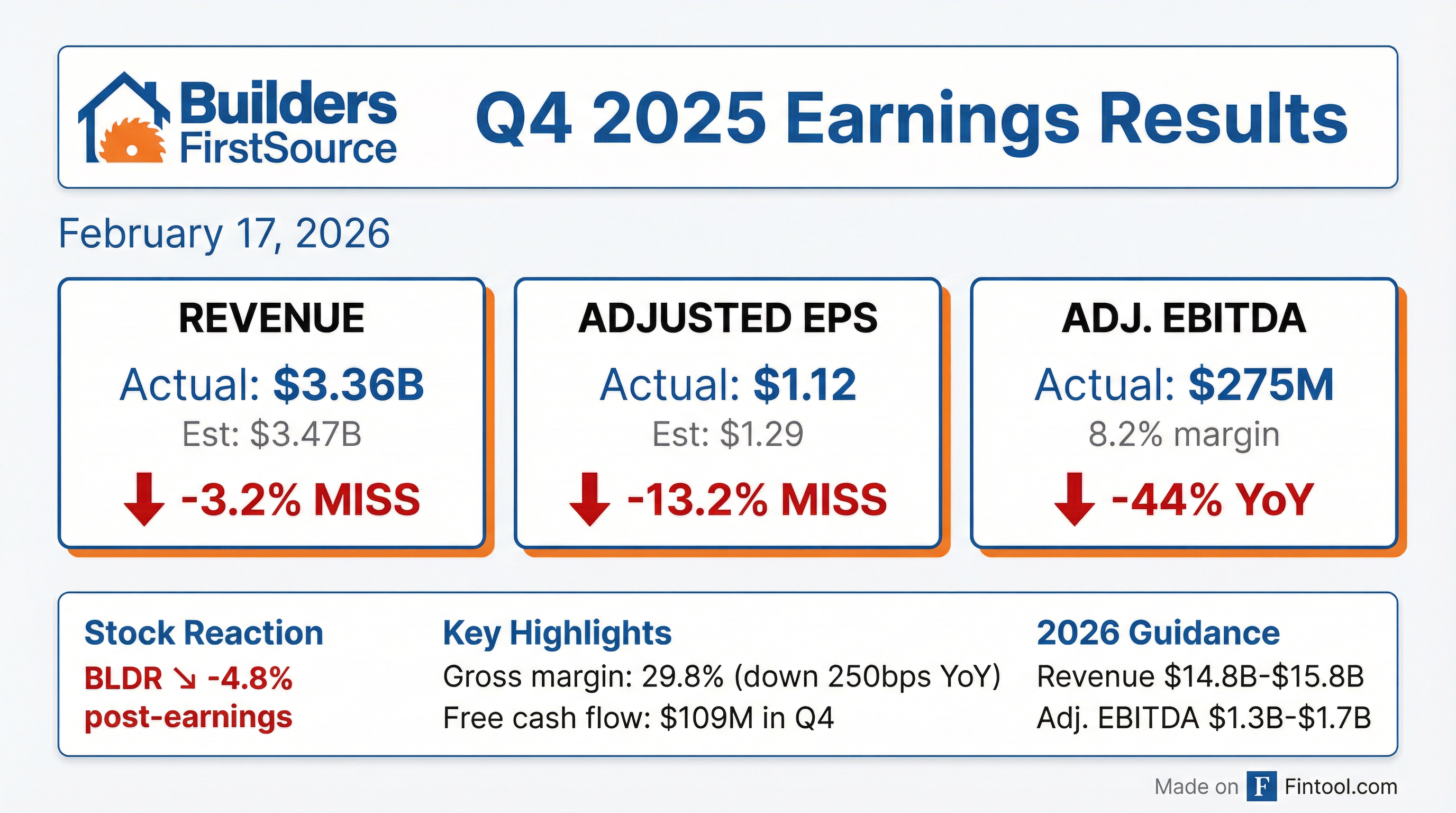
Builders FirstSource delivered a disappointing Q4 2025, missing Wall Street estimates on both the top and bottom line as the housing market slump continued to pressure the nation's largest building materials supplier. Revenue fell 12% year-over-year to $3.36 billion, missing consensus by 3.2%, while adjusted EPS of $1.12 missed estimates by 13.2%. The stock dropped nearly 5% following the release, trading at $114.73.
This marks BLDR's first earnings miss in five quarters after beating estimates throughout 2025. Management attributed the shortfall to a "below-normal starts environment" and commodity deflation, while guiding cautiously for 2026 with expectations of continued housing affordability challenges.
Did Builders FirstSource Beat Earnings?
No — BLDR missed on both revenue and EPS for Q4 2025.
The miss breaks a streak of four consecutive beats. For context, BLDR beat Q3 2025 EPS estimates by 9% ($1.88 vs $1.72), and had averaged a 4% beat over the trailing four quarters.
Full Year 2025 Results:
 Ask Fintool AI Agent
How Did the Stock React?
BLDR shares fell 4.8% on earnings day, closing at $114.73 — their lowest level since early January. The stock opened at $121.42 and sold off throughout the session as investors digested the miss and cautious guidance.
The decline extends BLDR's underperformance over the past year:
- 52-week range: $94.35 - $153.91
- YTD 2026: Down ~15% from January highs
- 1-year return: -21% vs S&P 500 +17%
After-hours trading showed modest recovery, with shares at $116.32 — suggesting some investors may be viewing the selloff as overdone.
What Changed From Last Quarter?
The deterioration from Q3 to Q4 was pronounced across all key metrics:
*Values retrieved from S&P Global
Key drivers of Q4 weakness:
- Single-family sales down 15% YoY — the core driver
- Multi-family sales down 20% YoY amid muted activity
- R&R/Other down 7% given consumer uncertainty
- Commodity deflation weighed on pricing
CEO Jackson explained the sharper-than-expected Q4 decline:
"The dynamic in 2025 came in hot, and the year ended very slowly on the builder side. They pulled back, had too much inventory of new homes as they got through the end of the summer and pulled back very, very hard on their starts volume at the end of the year. Harder even than we expected."
The value-added product mix — BLDR's key differentiator — slipped to 48.3% of sales from 50.0% a year ago, as manufactured products (-18%) and windows/doors/millwork (-13%) both saw steeper declines than commodity products.
What Did Management Guide?
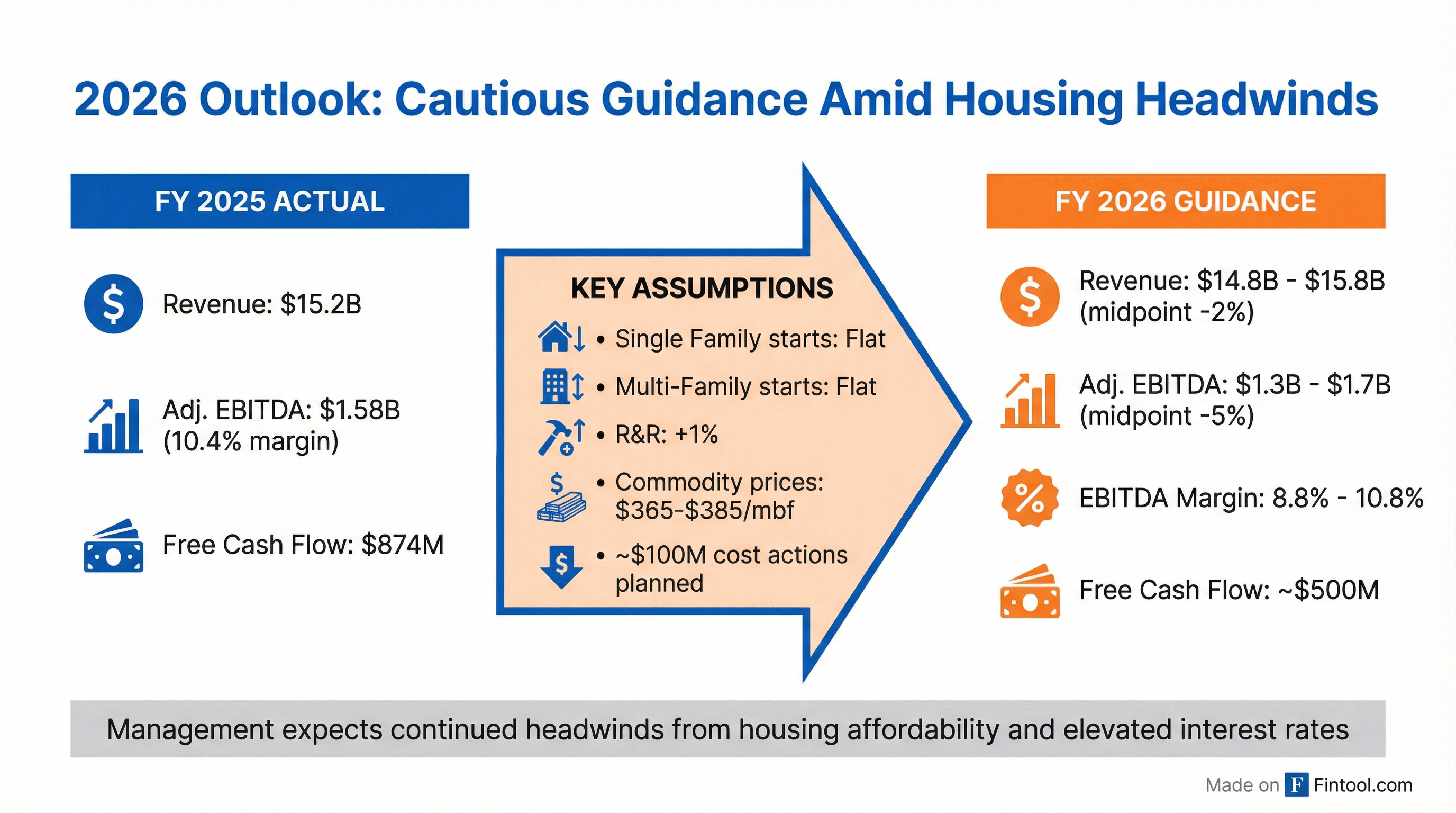
Management's 2026 outlook signals another challenging year:
Key 2026 assumptions:
- Single-family starts: Flat
- Multi-family starts: Flat
- R&R growth: +1%
- Commodity prices: $365-$385 per thousand board feet
- ~$100M in SG&A cost actions planned (75% year-over-year reductions, 25% cost avoidance)
The guidance midpoint implies continued pressure, with Adjusted EBITDA potentially declining another 5-10% if housing conditions don't improve. The free cash flow guidance of $500M represents a 43% decline from 2025, reflecting lower earnings and a **$300M swing in working capital** from a source of cash in 2025 (inventory reduction in a declining market) to a use of cash in 2026 (rebuilding inventory for expected back-half growth).
Management noted their rule of thumb is 9-10% incremental/decremental working capital tied to the year-end sales trajectory — meaning growth requires inventory investment, but the returns are attractive.
Ask Fintool AI AgentWhat Did Management Say?
CEO Peter Jackson struck a cautious but resilient tone:
"Driven by focused execution and close customer partnerships, we successfully navigated 2025 despite ongoing housing affordability challenges, weak consumer confidence, and depressed commodity prices... I am confident in our ability to manage through near-term uncertainty and build exceptional long-term value for our shareholders."
CFO Pete Beckmann emphasized the company's financial flexibility:
"Our fourth quarter and full-year performance reflects disciplined execution in a weak housing market... Supported by a fortress balance sheet and strong free cash flow through the cycle, we continue to manage capital with rigor."
Notable operational highlights:
- Delivered $48M in productivity savings in 2025
- Completed 8 acquisitions for $1.14B
- Value-added product mix reached ~48%
- Repurchased 48% of shares outstanding since Aug 2021 (~$8B total)
Capital Allocation & Balance Sheet
BLDR maintained aggressive capital deployment despite the challenging environment:
FY 2025 Capital Allocation (~$1.9B deployed):
- M&A: $1.14B across 8 acquisitions
- Share repurchases: $404M (3.4M shares at avg $118.65)
- Organic growth/sustaining capex: $342M
Balance Sheet Position (Dec 31, 2025):
- Total debt: $4.4B
- Cash: $182M
- Net debt: $4.3B
- Net leverage: 2.7x (up from 1.5x YoY)
- Liquidity: ~$1.7B (revolver + cash)
- Remaining buyback authorization: $500M
The leverage increase to 2.7x reflects both lower EBITDA and acquisition-related debt. Management noted they're focused on "prudently managing cash" and will moderate buyback activity as they balance capital deployment with deleveraging priorities.
Segment Performance
Q4 2025 Sales by Product Category:
The key concern: value-added products — which carry higher margins and differentiate BLDR from commodity distributors — saw steeper declines than the overall business. This reflects reduced home size/complexity and multi-family weakness.
Bright spot: Specialty Building Products & Services held up relatively well (-2.1%), with installation services driving outperformance despite weakness in siding, metal, and roofing.
Key Risks & Concerns
-
Housing affordability remains constrained — Elevated mortgage rates and home prices continue to suppress starts activity
-
Leverage has increased meaningfully — Net debt/EBITDA at 2.7x vs 1.5x a year ago limits flexibility
-
Value-added mix declining — Core differentiator under pressure as builders simplify homes
-
Interest expense headwind — Net interest expense up $66M YoY to $274M, consuming a larger share of cash flow
-
Multi-family exposure — Down 20-24% and likely to remain pressured given construction pipeline
Looking Ahead: Catalysts to Watch
Potential positives:
- Fed rate cuts improving affordability and housing demand
- ~$100M cost actions providing margin support
- M&A synergies from 8 acquisitions completed in 2025
- SAP implementation progressing (pilots launched July 2025)
Key dates:
- Q1 2026 earnings: ~May 2026
- NAHB International Builders' Show (Feb 18): Management meetings
- Loop Capital Conference (Mar 9): Virtual presentation
Wall Street maintains a cautious stance, with the average price target at $130 (implying ~13% upside), though several analysts have recently lowered targets.
Q&A Highlights
The earnings call Q&A provided additional color on key investor concerns:
On the Year's Shape and Q1 Softness:
"We started slow... That weather was as bad as advertised. It shut down big swaths of the home building markets that generally build through those winter months. Texas, Carolinas, parts of Florida, it just was very disruptive... It was about $30-40 million in sales impact for the last week of January."
On Gross Margin Stability:
CEO Jackson emphasized margins remain healthy despite the wide guidance range:
"I think they've been pretty stable, pretty strong. The team has worked very hard to find that sort of equilibrium to ensure that we're not losing share, that we're in a position to gain share, but at the same time, protecting profitability... By and large, we're expecting a fairly stable year around gross margins, right around just sub that 30 level."
On Normalized Earnings Power:
CFO Beckmann confirmed their long-term framework remains intact:
"We haven't changed our thinking on it... that earnings power with a normal environment. We're gonna continue to look at that through the course of this year and share more expectations around that when we get to Investor Day."
Management's normalized scenario assumes 1.0-1.1 million single-family starts would support $2.1B-$2.4B in Adjusted EBITDA with 30-33% gross margins.
On Install Business Momentum:
"The install business... it's largely on par with where we were from a percent of our overall business, around 16-17% of overall. It outpaced, so it didn't decline as much as the single-family overall business. So it was outpacing the market, which means we're gaining more inroads with the install capabilities."
On the Pleasant Valley Homes Acquisition Strategy:
CEO Jackson explained the modular housing experiment:
"Our vision is to reach out to our home builder partners around the country to say, where does it make sense for you to have access to manufactured modular, high quality in your market that helps you fill, particularly that sort of lower-end, affordable home category... I think we can do more of that capacity filling by really working with our partners."
On Incremental Margins in a Recovery:
"Generally, our incrementals are quite good on the way up, primarily because of the tremendous leverage we get in the business... In general, yes, I think we do see higher than average when we're growing, particularly as the adoption of that value add tends to accelerate in a growing market."
Digital Platform Progress
A notable bright spot management highlighted: the digital platform processed nearly $7 billion in quotes through 2025, representing a 130%+ year-over-year increase since launching in early 2024.
The company also consolidated 25 facilities in 2025 (55 over the past 2 years) while maintaining a 92% on-time and in-full delivery rate, demonstrating operational efficiency despite the challenging environment.
Ask Fintool AI AgentData sourced from Builders FirstSource Q4 2025 earnings presentation, press release, transcript, and S&P Global. Consensus estimates from Yahoo Finance and Investing.com.