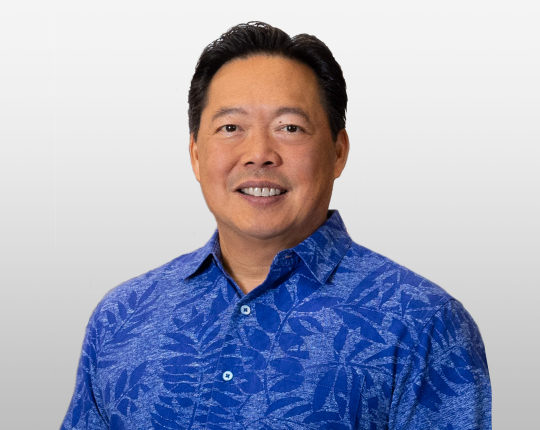
Peter S. Ho
 BANK OF HAWAII
About Peter S. Ho
Peter S. Ho, age 59, is Chairman and Chief Executive Officer of Bank of Hawaii Corporation and has served as a director since 2009; he became Chairman and CEO in July 2010 and previously served as President from April 2008 to July 2024 . He holds a BS in business administration and an MBA from the University of Southern California and completed Harvard Business School’s Advanced Management Program in 2008 . Company performance under his leadership in 2024 included net income of $149,994,000, ROCE of 10.85%, and total assets of $23.6B; the company TSR value on a fixed $100 investment was $92 versus the peer index at $114, and diluted EPS was $3.46 . In 2024, the FDIC confirmed Bank of Hawaii had the largest share of FDIC‑insured deposits in Hawai‘i, and the bank earned recognition as Newsweek’s No. 24 “Most Trustworthy Companies in America” in the banking category and Hawai‘i Tribune‑Herald’s “Best Bank” for the 9th consecutive year .
Past Roles
| Organization | Role | Years | Strategic Impact |
|---|---|---|---|
| Bank of Hawaii Corporation | Chairman & CEO | July 2010–present | Led brand and customer experience initiatives; sustained strong asset quality and leadership in Hawai‘i market |
| Bank of Hawaii Corporation | President | Apr 2008–Jul 2024 | Oversaw companywide operations; accelerated modernization efforts |
| Bank of Hawaii Corporation | Vice Chair & Chief Banking Officer | Jan 2006–Apr 2008 | Led commercial and retail banking; drove core growth |
| Bank of Hawaii Corporation | Vice Chair, Investment Services Group | Apr 2004–Dec 2005 | Led investment services |
| Bank of Hawaii Corporation | EVP, Hawai‘i Commercial Banking Group | Feb 2003–Apr 2004 | Managed commercial banking in core market |
External Roles
| Organization | Role | Years | Notes |
|---|---|---|---|
| Federal Reserve Bank of San Francisco | Board Member | Completed second 3‑year term in 2018 | Regional economic oversight |
| Hawai‘i Community Foundation | Chair (Board) | Current | Philanthropy leadership |
| State of Hawai‘i House Select Committee on COVID‑19 Economic & Financial Preparedness | Vice Chair | Current | Public policy and crisis response |
| East‑West Center Foundation; Hawaii Bankers Association; Punahou School; Strong Foundation | Board/Advisory roles | Current | Community leadership |
| Advisory Boards (American Red Cross Hawai‘i; Catholic Charities Hawai‘i; Mental Health America of Hawai‘i; UH Mānoa TIM School) | Advisory Board Member | Current | Community engagement |
| Public Company Directorships | — | Last 5 years | None |
Fixed Compensation
| Metric ($) | 2022 | 2023 | 2024 |
|---|---|---|---|
| Salary | 860,000 | 878,258 | 885,800 |
| Stock Awards (Grant-date FV) | 3,000,075 | 3,000,067 | 1,800,014 |
| Non-Equity Incentive Plan (Cash Bonus) | 2,000,000 | 600,000 | 1,500,000 |
| Change in Pension Value | — | 365 | 1,215 |
| All Other Compensation | 196,449 | 149,228 | 98,272 |
| Total Compensation | 6,056,524 | 4,627,918 | 4,285,301 |
All Other Compensation (2024 components):
- 401(k) match $13,800; Value Sharing $3,450; Excess Plan Value Sharing $11,408; Executive Deferred Compensation contribution $44,574; Other Compensation $25,040; total $98,272 .
CEO pay ratio for 2024: 54.4 to 1 (CEO $4,285,301 vs median employee $78,843) .
Performance Compensation
Short-Term Incentive (EIP – 100% performance-based)
| Metric | Weight | Target | Actual | Score |
|---|---|---|---|---|
| Pre‑Provision Net Revenue (vs budget) | 20% | Budget | <2.5% below budget | 0% |
| Non‑Performing Assets vs Peers | 20% | 2nd quartile | Top quartile; 0.14% NPA | 50% |
| ROCE vs Peers | 20% | 3rd quartile | 2nd quartile; ROCE 10.85% | 49% |
| Customer Experience (Forrester CX) | 20% | 73 | 79.6 | 50% |
| Individual/Strategic (community, succession, initiatives) | 20% | Outstanding | Outstanding | 50% |
| Total | 100% | — | — | 199% |
- 2024 target bonus for CEO: 100% of base salary; threshold 50% of target; max 250% of target . Final incentive payout for Ho: 169% of base salary, equating to $1,500,000 .
Long-Term Incentive (PSUs – performance-based; three-year cycle)
| Grant Date | Award Type | Target Shares | Max Shares | Grant-date FV ($) | Vesting |
|---|---|---|---|---|---|
| Feb 23, 2024 | PSU | 29,412 | 58,824 | 1,800,014 | Vests upon certification after FY2026 based on 3‑yr average ROCE and TSR percentile; double-trigger acceleration on CoC |
| Prior PSU tranches | PSU | 39,937 (2026 certify) | — | 2,845,112 MV at 12/31/24 | Vest on certification in 2026 |
| Performance RS (2019–2021) | RS | 34,373 | — | 2,448,733 MV at 12/31/24 | Performance achieved; vested Feb 21, 2025 |
LTI metrics and structure:
- 70% “First Category Units” tied to 3‑year ROCE percentile vs S&P Supercomposite Regional Bank Index (excluding banks >$50B assets); vest at 50%/100%/200% for 25th/median/top quartile .
- 30% “Second Category Units” tied to 3‑year TSR percentile vs same index; vest at 50%/100%/200% for 25th/median/top quartile .
- Grants timed ~45 days after fiscal year end; no option repricing; no options granted around MNPI windows .
Equity Ownership & Alignment
| Item | Detail |
|---|---|
| Total beneficial ownership | 281,366 shares; less than 1% of outstanding |
| Shares outstanding | 39,786,931 as of Feb 28, 2025 |
| Unvested/equity incentive outstanding | 39,937 PSUs (certify 2026) and 29,412 PSUs (certify 2027); performance RS 34,373 (vested Feb 21, 2025) |
| Options | None outstanding |
| Ownership policy | CEO required to hold 5x base salary; formal clawback policy; anti‑hedging and anti‑pledging policy |
| Pledging/Hedging | Prohibited for directors and employees |
| Director fees | CEO receives no fees for Board service |
Vesting schedule implications:
- 2026 certification for prior PSUs; 2027 certification for 2024 PSUs; vesting may increase free‑trading share supply around those certification dates; double‑trigger acceleration applies on change‑in‑control .
Employment Terms
- No individual employment or severance agreements with NEOs; compensation governed by plans and committee oversight .
- Change‑in‑Control Retention Plan: double‑trigger required; severance equal to 2× base salary and bonus; additional 1× base salary and bonus payable for compliance with 12‑month non‑compete; includes non‑disclosure, non‑solicit, non‑disparagement .
- Equity awards fully accelerate on change‑in‑control with double‑trigger termination; STI prorated at 2× incentive allocation for prorated period upon change‑in‑control .
- No excise tax gross‑ups; plan caps benefits to avoid excise tax .
- Formal clawback policy .
Board Governance
- Board service: Director since 2009; not independent; no committee memberships .
- Combined Chairman/CEO structure with a Lead Independent Director (Raymond P. Vara, Jr., appointed April 2024) to strengthen independence and oversight; regular executive sessions and defined LID duties .
- Board meetings: 13 meetings in 2024; all directors attended at least 75% of Board and committee meetings .
- Committee meeting cadence in 2024: Audit & Risk Committee (18); Human Resources & Compensation (9); Nominating & Corporate Governance (8) .
Director Compensation
- Standard director compensation: cash retainers and committee fees apply to independent directors; LID retainer $35,000; Board retainer $55,000; committee retainers per charter; additional travel pay for mainland-based directors .
- Ho receives no director compensation .
Say‑on‑Pay & Shareholder Feedback
| Year | Say‑on‑Pay Support (%) |
|---|---|
| 2022 | 80% |
| 2023 | 74% |
| 2024 | 94% |
- 2024 redesign introduced balanced STI scorecard and TSR‑influenced LTI; reduced CEO target equity value while allowing higher payout for superior performance; eliminated overlapping price‑to‑book metric .
Compensation Structure Analysis
- Cash vs equity mix: 2024 stock awards decreased (from $3.0M to $1.8M) while cash STI rose (from $0.6M to $1.5M), reflecting tighter equity grants and higher performance payout; total comp declined YoY (2023→2024) .
- Shift to PSUs over options continues; formal plan prohibits repricing and restricts timing around MNPI .
- Performance metrics emphasize risk‑balanced outcomes (PPNR discipline, NPA vs peers, ROCE vs peers, CX) with equal weighting and caps; CEO scorecard 199% despite PPNR miss, supported by top‑quartile NPA and strong CX .
- Policy controls: anti‑hedging/pledging, clawback, no tax gross‑ups; double‑trigger CIC vesting limits windfalls absent termination .
Related Party Transactions and Risk Indicators
- Audit Committee reviews related‑party transactions; no HRC interlocks or insider participation reported in 2024 .
- Prohibitions: hedging/pledging; no repricing; clawback in place .
- No employment agreements; CIC plan avoids excise tax gross‑ups .
Performance & Track Record
| Metric | 2022 | 2023 | 2024 |
|---|---|---|---|
| Total Shareholder Return (Value of $100) | 91 | 89 | 92 |
| Peer TSR (Value of $100) | 107 | 94 | 114 |
| Net Income ($) | 225,804,000 | 171,202,000 | 149,994,000 |
| ROCE (%) | 17.83% | 13.89% | 10.85% |
- 2024 highlights: largest FDIC‑insured deposit share in Hawai‘i; Newsweek trust recognition; local “Best Bank” award .
Investment Implications
- Alignment: Significant personal share ownership (281,366 shares) with strict anti‑hedging/pledging and a 5× salary ownership guideline indicates long‑term alignment; no director fees further ties compensation to shareholder value .
- Vesting overhang: PSU tranches scheduled for certification in 2026 and 2027 could create periodic liquidity/selling pressure; monitoring Form 4s around vesting/certification dates is prudent .
- Retention risk: Strong CIC protections (up to 3× base+bonus including non‑compete payment) and double‑trigger vesting reduce near‑term retention risk; absence of employment agreement adds flexibility for board but places emphasis on performance plans .
- Pay‑for‑performance: 2024 STI payout at 169% reflects mixed fundamentals (PPNR below plan) offset by top‑quartile credit quality, strong CX, and improved ROCE vs peers; shareholder support rebounded to 94% after program redesign, reducing governance overhang from prior lower votes .
- Governance: Combined Chair/CEO mitigated by robust Lead Independent Director role and independent committees; nonetheless, dual role remains a watchpoint for independence and oversight, especially through cycles .
