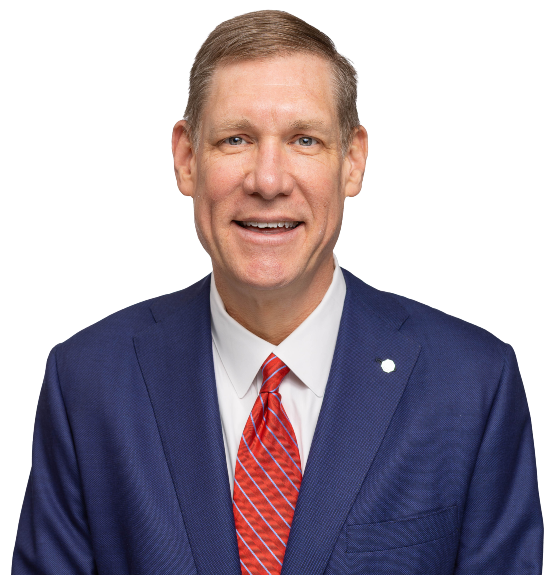
Stacy C. Kymes
 BOK FINANCIAL
About Stacy C. Kymes
Stacy C. Kymes, age 54, is President and Chief Executive Officer of BOK Financial, appointed January 1, 2022; he joined BOK Financial in 1996 and previously served as Chief Operating Officer, Executive Vice President over several specialized banking areas, and earlier as Chief Auditor, Corporate Controller, Treasurer, and Chief Credit Officer . He has served as a director since 2021 and sits on the Board’s Credit Committee . Company performance indicators disclosed in the proxy include 2024 EPS of $8.14 and a five‑year TSR index of 138 (vs. 131 for the peer group), with the CEO’s 2‑year relative EPS rank at 78% for 2024 (47% in 2023; 11% in 2022) .
Past Roles
| Organization | Role | Years | Strategic Impact |
|---|---|---|---|
| BOK Financial | President & CEO | 2022–present | Leads diversified banking/wealth platform across 8 states; oversight of national lines incl. energy, healthcare, brokerage, mortgage, and TransFund . |
| BOK Financial | Chief Operating Officer | –2021 | Oversaw all revenue‑generating divisions, driving operating execution across segments . |
| BOK Financial | EVP (Energy, CRE, Healthcare, Treasury, Commercial Strategies, TransFund) | Prior to COO | Built and managed specialized banking franchises and national platforms . |
| BOK Financial | Chief Auditor; Corporate Controller; Treasurer; Chief Credit Officer | 1996–prior roles | Strengthened control, finance, treasury, and credit risk foundations . |
External Roles
| Organization | Role | Years | Notes |
|---|---|---|---|
| — | — | — | No other public company directorships disclosed for Kymes . |
Fixed Compensation
| Metric | 2022 | 2023 | 2024 |
|---|---|---|---|
| Base Salary ($) | 980,000 | 1,016,667 | 1,062,333 |
| Target Annual Incentive (% of Base) | — | — | 120% |
| Base Pay vs Peer Median | — | — | 101% |
Perquisites (2024): 401(k) match $41,400; executive life insurance $1,936; executive wellness $3,600; medical supplement $3,040; trip earnings $3,793 .
Performance Compensation
Annual Incentive (2024)
| Component | Weight | Target | Actual/Payout | Notes |
|---|---|---|---|---|
| EPS Growth vs Performance Peers | 80% | 100% at 50th pct; 200% at ≥80th pct | 194% payout (78.1% percentile) | Core financial driver of bonus . |
| Strategic Objectives | 20% | 0–120% range | 115% achievement | CEO objectives approved by Committee . |
| Business Performance | — | — | Not applicable to CEO | CEO does not have a Business Performance component . |
| Final Annual Incentive | — | 120% of base | 214% of base; $2,284,664 | Approved Feb 18, 2025 . |
Long-Term Incentive (LTI) Structure
| Metric | 2024 Policy |
|---|---|
| LTI Target (% of Base) | 250% |
| Mix | 100% performance‑based (no service‑based) |
| Performance Measure | 3‑year EPS growth vs peers; 0–200% earned via interpolation; reviewed at the second anniversary; two‑year post‑vest holding requirement . |
2024 Equity Awards (Grants of Plan‑Based Awards)
| Grant Date | Type | Threshold (#) | Target (#) | Max (#) | Grant‑Date Fair Value ($) |
|---|---|---|---|---|---|
| 2/20/2024 | Performance Shares | 10,793 | 32,706 | 65,412 | 2,675,024 |
Vesting/holding: Performance shares vest when earned (after the review point) and are subject to a two‑year holding period; executives must also comply with stock ownership guidelines .
Options
No option awards are disclosed for Kymes in 2022–2024; no options exercised in 2024 .
Stock Vested (2024)
| Shares Vested (#) | Value Realized ($) |
|---|---|
| 2,410 | 205,236 |
Equity Ownership & Alignment
| Item | Detail |
|---|---|
| Beneficial Ownership | 136,463 shares; <1% of outstanding . |
| Ownership Breakdown (Footnote) | Includes 82,936 restricted stock; 9,361 shares in BOKF Thrift Plan; 22,500 shares indirectly via Angel D. Kymes Revocable Trust . |
| Unvested/Unearned Performance Shares (12/31/2024) | 73,911 shares total across 2022–2024 grants; est. value $7,867,826 at $106.45/share . |
| Service‑based RSUs/Shares Outstanding | None for Kymes (consistent with 100% performance‑based LTI) . |
| Options | None outstanding . |
| Stock Ownership Guidelines | 6x base salary; achieve by Jan 1, 2027 (five years from CEO appointment) . |
| Post‑Vesting Holding | Two‑year hold on vested performance awards . |
| Hedging/Pledging | Company permits hedging (no anti‑hedging ban); no pledging disclosed for Kymes; majority holder Kaiser has 18,073,394 shares pledged (contextual governance risk) . |
Employment Terms
Potential Payments Upon Termination (as of 12/31/2024)
| Scenario | Salary/Severance ($) | Equity Acceleration ($) | Other ($) | Total ($) |
|---|---|---|---|---|
| Termination without Cause | 1,810,491 | 7,867,826 unvested restricted stock continue subject to restrictions (no acceleration) | 3,000 | 9,681,317 |
| Termination without Cause following Change of Control | 2,140,000 (2x salary) | 7,867,826 (all unvested service/performance shares vest within one year upon termination other than for cause) | 3,000 | 10,010,826 |
| Termination for Cause | — | — | 6,000 | 6,000 |
- Change‑of‑control definition includes loss of control by George B. Kaiser and affiliates, or BOK Financial ceasing to own >50% of BOKF; equity vesting is effectively double‑trigger (termination other than for cause within one year after CoC) .
- Restrictive covenants: non‑solicitation for 2 years (for‑cause) or 1 year (other reasons), with $3,000 per year paid in arrears; cause defined to include failure to perform, acts injuring BOKF, certain criminal/dishonesty acts, or refusal to obey lawful orders .
- Clawback: Board may require forfeiture/restoration of incentive pay for incorrect financials; formal Clawback Policy filed with 2023 Annual Report (Feb 21, 2024) .
Board Governance
- Board service: Director since 2021; currently President & CEO .
- Committee roles: Member of the Board’s Credit Committee (oversight of credit portfolio and related policies) .
- Independence/structure: BOK Financial is a “controlled company” under NASDAQ (Kaiser beneficially owns ~59.08%), exempting it from certain independence requirements; Audit Committee is fully independent; the Compensation Committee includes non‑officer directors and the controlling shareholder; the Board lacks a standing nominating committee (director nominations by consensus) .
- Executive sessions: Held after regularly scheduled Board meetings; presiding director is Mr. Kaiser .
- Director compensation: Only non‑officer directors receive director fees/equity; as an executive officer, Kymes does not receive separate director compensation .
Director Compensation (Context)
| Category | Policy |
|---|---|
| Annual Retainer (non‑officer directors) | $20,000 shares + $20,000 cash; plus meeting/committee fees; chair premia . |
Performance & Track Record (Disclosed)
| Year | Company TSR Index (start $100) | Peer Group TSR Index | EPS ($) | 2‑Yr Relative EPS Percentile | CEO “Compensation Actually Paid” ($) |
|---|---|---|---|---|---|
| 2022 | 128 | 116 | 7.68 | 11% | 2,770,850 |
| 2023 | 109 | 116 | 8.02 | 47% | 3,966,853 |
| 2024 | 138 | 131 | 8.14 | 78% | 9,675,184 |
Say‑on‑Pay: The Compensation Committee reported “significant support” at the April 30, 2024 annual meeting and made no direct changes to program design as a result .
Compensation Structure Analysis
- Mix and leverage: 2024 pay heavily performance‑oriented—CEO LTI target at 250% of base, 100% performance‑based; annual bonus formula driven 80% by relative EPS and 20% by strategic objectives; CEO does not have a Business Performance component (reduces self‑assessment bias) .
- Metric rigor: Annual EPS Growth vs peers paid at ~194% for 2024 (78.1 percentile), indicating strong relative earnings momentum; LTI also uses 3‑yr relative EPS, aligning long‑term equity with sustained peer outperformance .
- One‑time award: Committee approved a special one‑time equity award in Feb 2025 citing strong Company performance not captured in formulaic payouts; CEO received $208,932 (aggregate NEOs ~$350k) based on $111.49 share price—useful retention but a potential slippery slope if repeated .
- Peer positioning: Base salary at ~101% of peer median; targets generally medians of “Pay Peers,” with distinct “Performance Peers” for metrics .
- Risk controls: Two‑year holding period post‑vesting and ownership guidelines (6x salary by 2027) support alignment; however, the company permits hedging, which is a governance negative unless actively monitored .
Related Party Transactions and Governance Flags
- Controlled company: Kaiser owns 59.08% and also chairs the Board; BOKF leases Tulsa office space from Kaiser affiliates ($661k in 2024) .
- Pledging: Kaiser has 18,073,394 shares pledged as collateral; no pledging disclosed for Kymes .
- Hedging: Company permits hedging by insiders (no anti‑hedge prohibition) .
Equity Vesting Schedules and Insider Selling Pressure
- Performance shares: Reviewed for performance as of the second year‑end anniversary; once earned, subject to a two‑year hold; this structure staggers realizable liquidity, moderating near‑term sell pressure and extending alignment .
- 2024 vesting: 2,410 shares vested for Kymes ($205,236); no options exercised .
- Overhang: 73,911 unearned performance shares outstanding (as of 12/31/24) may convert to shares based on 3‑yr relative EPS outcomes, with subsequent holding requirements .
Compensation Committee and Peer Group (Benchmarking)
- Committee members: Craft (Chair), Cadieux, Griffin, Kaiser, Malcolm, Richards, San Pedro; non‑officers but includes controlling shareholder Kaiser (permitted under controlled company rules) .
- Peer sets: Distinct “Performance Peers” (broader, asset‑size based) vs “Pay Peers” (geographic filter) for benchmarking; PacWest excluded post‑acquisition from EPS ranks .
Director/Board Service Details for Kymes (Dual‑Role Implications)
- Board service history: Director since 2021; CEO since Jan 1, 2022 .
- Committees: Serves on the Credit Committee (oversight of credit risk/portfolio) .
- Independence/leadership: As CEO‑director within a controlled company chaired by the controlling shareholder, independence safeguards rely on independent Audit Committee composition and broader board composition, not on CEO/Chair separation alone; no Lead Independent Director disclosed; executive sessions are presided over by the Chair (Kaiser) .
- Director compensation: As an executive officer, Kymes receives no separate director fees or stock awards for board service .
Investment Implications
- Alignment and pay leverage: Heavy emphasis on relative EPS (annual and 3‑yr) plus 100% performance‑based LTI and two‑year post‑vest holding underpin strong pay‑performance alignment and reduce short‑termism; ownership guideline of 6x salary further supports alignment .
- Retention and supply/demand for shares: Meaningful unearned performance awards (73,911 shares) and holding requirements stagger future liquidity; 2024 vesting was modest (2,410 shares), suggesting limited near‑term selling pressure from Kymes; option overhang is zero (no options outstanding) .
- Contract risk and CoC economics: Severance is salary‑based (1x without cause; 2x salary on CoC termination) with double‑trigger equity vesting—moderate change‑of‑control cost structure that avoids cash windfalls while still protecting the executive .
- Governance watch‑items: Controlled‑company status (59% owner as Chair) and permissive hedging policy are notable governance risks; related‑party leases and significant pledging by the controlling shareholder warrant monitoring, though no pledging is disclosed for Kymes .
- Execution track record: Relative earnings momentum improved materially in 2024 (78% EPS percentile) with TSR rebounding vs 2023; compensation outcomes for 2024 (194% EPS component; 214% total bonus as % of base) are directionally consistent with that performance, though the 2025 one‑time award should be treated as non‑recurring and monitored to prevent pay inflation drift .