Bowhead Specialty Holdings (BOW)·Q4 2025 Earnings Summary
Bowhead Specialty Beats on EPS, Digital Strategy Gains Traction
February 24, 2026 · by Fintool AI Agent
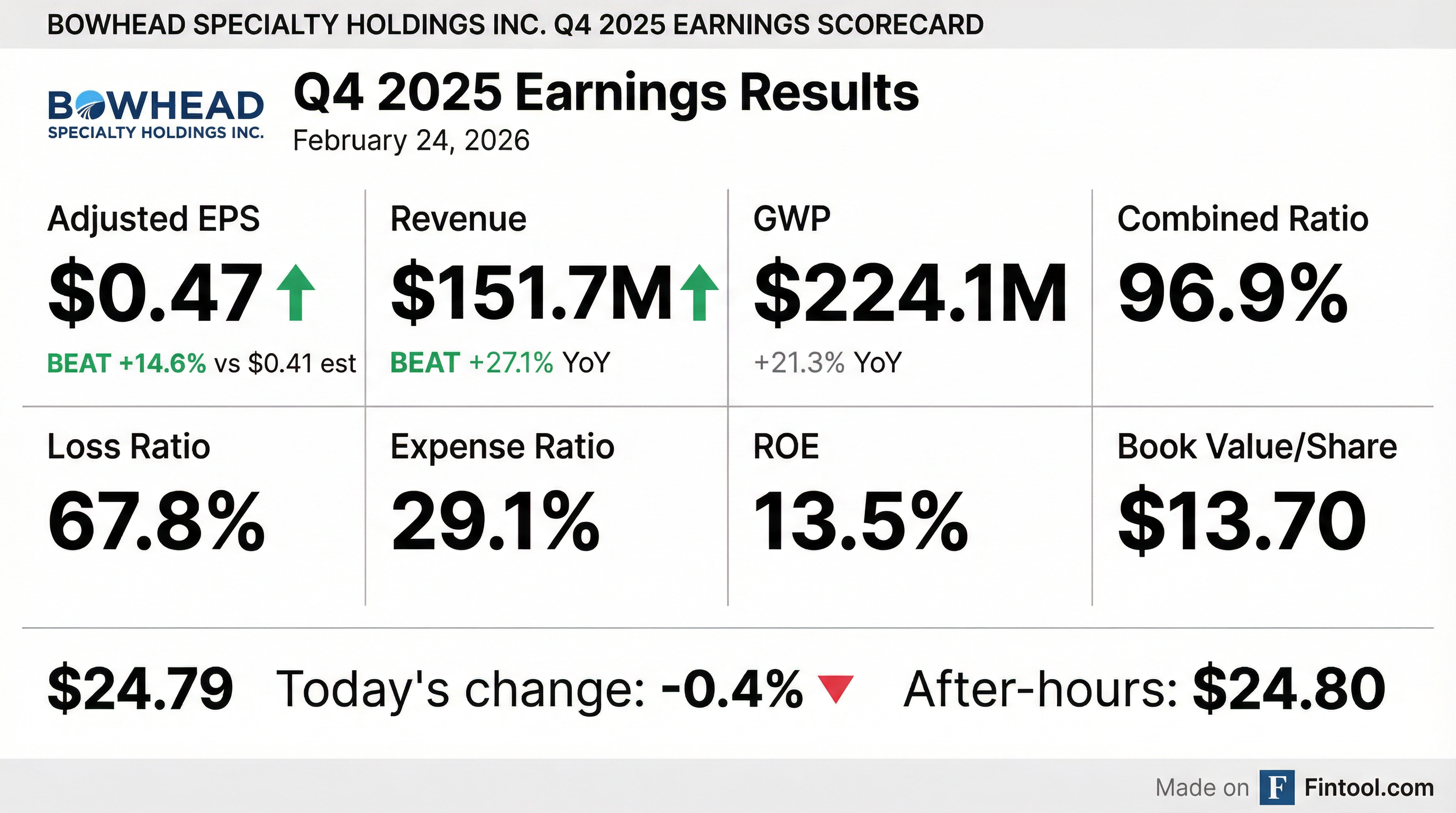
Bowhead Specialty Holdings (NYSE: BOW) delivered a solid Q4 2025, beating EPS estimates by 14.6% while gross written premiums grew 21.3% year-over-year. The specialty insurer's digital expansion through Baleen Specialty showed strong momentum, with that segment's premiums surging 666% YoY. Management guided to approximately 20% GWP growth for 2026.
Did Bowhead Beat Earnings?
Yes — Bowhead beat on both EPS and revenue.
*Values retrieved from S&P Global
Bowhead has now beaten EPS estimates in six consecutive quarters since its May 2024 IPO. The Q4 beat was driven by strong premium growth across all divisions, expense ratio improvement, and rising investment income.
 Ask Fintool AI Agent
What Did Management Guide?
CEO Stephen Sills provided clear forward guidance: approximately 20% GWP growth in 2026, driven primarily by the Casualty division.
CFO Brad Mulcahey provided detailed 2026 expectations:
Key guidance commentary:
"With a strong year behind us, I'm even more excited about Bowhead's future. As we've said before, Bowhead was built to deliver sustainable and profitable growth across market cycles." — Stephen Sills, CEO
Capital & Investment Updates:
- Issued $150M of 7.75% senior unsecured notes in November 2025, maturing December 2030
- Plan to extend investment portfolio duration from 3 to 4 years to match liability duration
- Renewed cyber quota share treaty at 65% (up from 60%) with higher ceding commissions
What Changed From Last Quarter?
Positive Developments
-
Digital acceleration: Baleen Specialty grew 666% YoY in Q4, generating $21M in full-year premiums — exceeding management's initial expectations
-
Expense efficiency: Expense ratio dropped to 29.8% for the full year (vs. 31.4% in 2024), achieving the sub-30% target ahead of schedule. Headcount grew just 19% (249→296 employees) while GWP grew 24%. In Q4 alone, headcount increased <3% while GWP grew 21%.
-
Investment income surge: Net investment income up 35.8% QoQ to $16.6M, driven by higher balances and yields
Areas of Concern
-
Loss ratio pressure: Full-year loss ratio increased 2.3 points to 66.7% (vs. 64.4% in 2024) due to portfolio mix shift toward Casualty and higher expected loss ratios in Professional and Healthcare Liability
-
Combined ratio deterioration: Q4 combined ratio of 96.9% was 4.2 points worse than Q4 2024's 92.7%
-
ROE compression: Adjusted ROE declined to 13.6% from 15.2% in 2024, reflecting the higher loss ratios
What's the Casualty Market Outlook?
Derek Broaddus, Head of Casualty and winner of the Insurers' 2025 E&S Underwriter of the Year award, provided color on market conditions:
"It has never been a better time to be a casualty underwriter." — Derek Broaddus, Head of Casualty
Key market observations:
-
Limit discipline remains intact: Average excess limit deployed is just over $5M versus $25M blocks that were common pre-2020. Large excess towers now require many more markets to complete.
-
Pricing favorable: Directionally seeing rate exceed loss trend. Some deals with prior adverse development still seeing rate increases, while others with 5 years of compounded double-digit rate and good experience seeing moderation.
-
Competitive dynamics: Admitted markets moving into the E&S space, and non-risk-bearing MGAs and broker sidecars bringing more capacity. Management noted concern about "fundamental misalignment of interests in some non-risk-bearing underwriting facilities."
-
Submission growth outpacing capacity: "Submissions are growing faster than we can quote" — Bowhead historically couldn't get to 90% of submissions under $50K premium. Express technology will unlock this.
How Did Revenue Break Down?
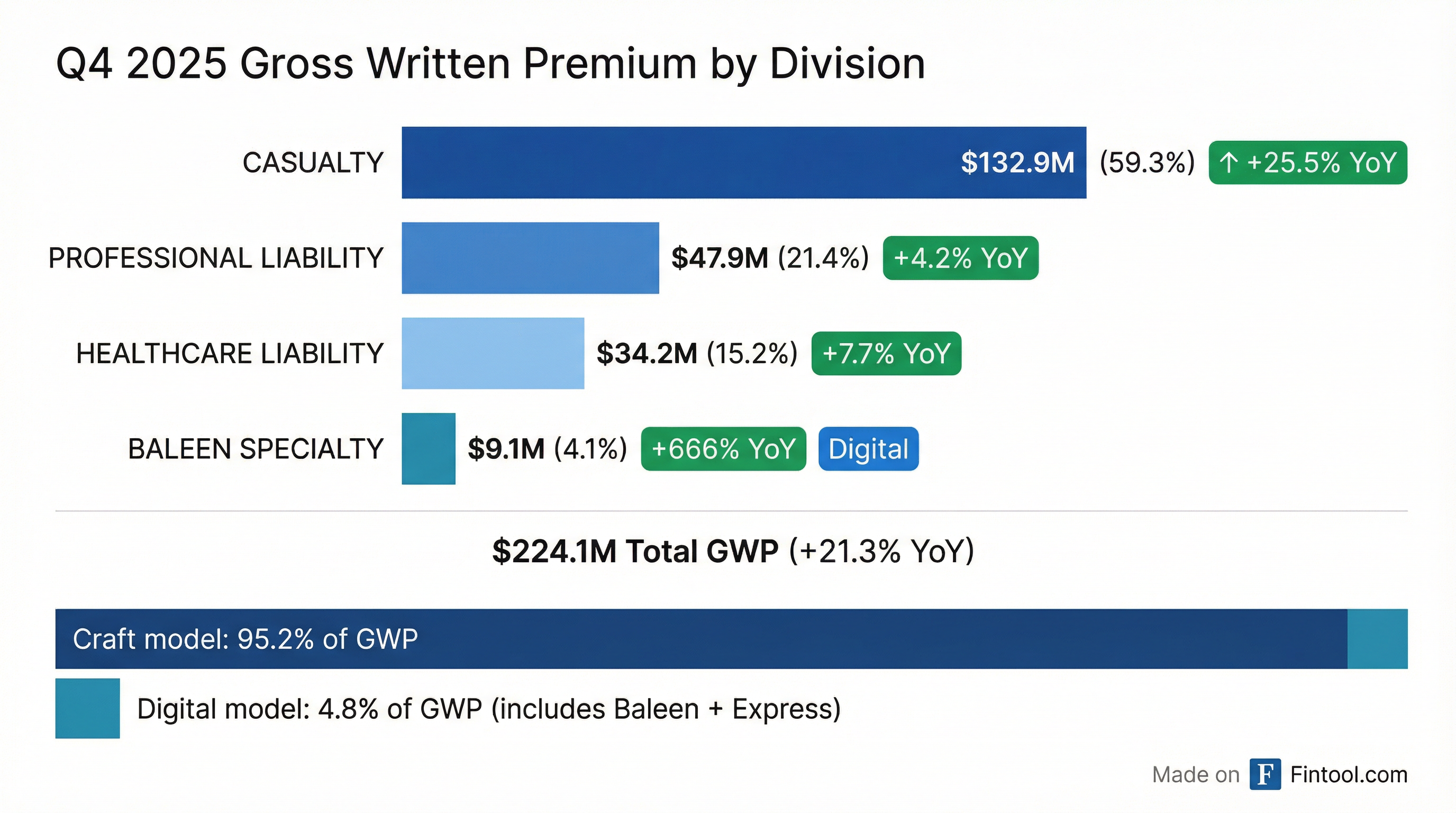
The business continues to shift toward Casualty, which delivered 64% of FY 2025 GWP. The "Craft" underwriting model (large, complex risks) delivered over 97% of GWP in 2025, while "Digital" (Baleen + Express) is still scaling.
Q4 Casualty tailwind: Construction project risks quoted earlier in the year but delayed due to macro factors closed in Q4, adding just under 30% to Q4 Casualty premiums. Management noted this non-recurring business may create lumpiness in future quarters.
Ask Fintool AI AgentHow Did the Stock React?
Stock down 0.4% to $24.79 on earnings day. The muted reaction suggests the beat was largely expected given the company's consistent execution.
The stock is trading near its 52-week low, down ~41% from its peak. This reflects broader insurance sector rotation and concerns about loss ratio trends, despite consistent earnings beats.
Key Financial Metrics
Quarterly Comparison:
Full Year 2025 Summary:
Balance Sheet Highlights
Bowhead maintains a conservative, clean balance sheet with no legacy reserves from pre-2020 accident years.
Investment Portfolio:
- Book yield: 4.6%
- New money rate: 4.5%
- Weighted average duration: 3.0 years (targeting 4 years in 2026)
- Average credit rating: AA
- IBNR as % of total reserves: 90%
Q&A Highlights
Meyer Shields (KBW) — Reserve methodology: Management confirmed no pricing concerns from reserve adjustments. These were "nipping and tucking around the edges" reflecting conservative reserving, not a pricing issue.
Meyer Shields (KBW) — Baleen loss ratio: CEO Sills expects Baleen's loss ratio to be "superior to the general large casualty business" due to the restricted nature of coverage. Express casualty will likely mirror the broader casualty book.
Roland Mayer (RBC) — Reserve data sources: CFO Mulcahey explained they use proprietary third-party actuarial data, not just Schedule P industry data. This allows them to tailor benchmarks to their specific portfolio (e.g., excluding Fortune 1000 exposures).
Bob Huang (Morgan Stanley) — Broker disintermediation: CEO Sills pushed back on any plans to disintermediate brokers: "The type of specialty insurance we do is not homogenous... I think the broker brings a lot to the table." The biggest tech advantage is speed, not distribution change.
Kaveh Montazeri (Deutsche Bank) — Baleen acceleration: Second-half momentum driven by growing broker acceptance, more infrastructure/marketing investment, and success breeding success. "They see that what we've done has been worth the effort to try us."
Cameron Bianchi (Piper Sandler) — Expense ratio drivers: The improvement from low-30s to sub-30% is attributed to technology initiatives (both digital platform and craft business tools), not just scale.
What to Watch Going Forward
-
Loss ratio trajectory: Will the uptick in expected loss ratios stabilize, or continue pressuring combined ratios?
-
Digital scaling: Can Baleen maintain triple-digit growth while remaining profitable? Management noted it targets "restrictive casualty" — smaller, harder-to-place risks.
-
Casualty cycle: With 64% of FY 2025 GWP in Casualty , Bowhead is heavily exposed to pricing and loss trends in that segment.
-
Reserve adequacy: The company holds expected loss ratios based primarily on industry data given limited loss experience.
Ask Fintool AI Agent