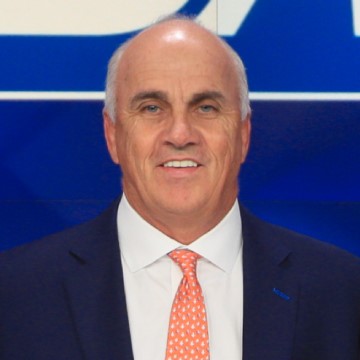
Thomas Travis
About Thomas Travis
Thomas L. Travis, age 67, is Vice Chairman and CEO of Bank7 (the bank) and President & CEO of Bank7 Corp. (the company), serving on the company board since 2018 and the bank board since 2014; he brings 36+ years of banking experience across Texas and Oklahoma and holds a General Business degree from Schreiner University . Under his leadership tenure, the company reports three-year cumulative TSR of $219.20 on $100 invested as of 12/31/2021 and 2024 net income of $45.7m versus $28.3m in 2023, supporting pay-versus-performance alignment disclosures . Governance is characterized by a separated Chair/CEO structure (Chairman Haines), independent-only executive sessions, and controlled-company status via the Haines family trusts, with Travis classified as a non-independent executive director .
Past Roles
| Organization | Role | Years | Strategic impact / scope |
|---|---|---|---|
| Bank7 (Bank) | President | 2014–2022 | Led commercial banking, insurance agency, swap desk; co-managed multi-billion MBS portfolio; negotiated/closed/integrated eight M&A transactions . |
| IBC Bank (Texas-based) | President, IBC Bank San Antonio and IBC Bank Oklahoma; prior leadership roles | 1991–2014 | Managed commercial banking functions; broad operating and market leadership across TX/OK . |
External Roles
| Organization | Role | Years | Strategic impact |
|---|---|---|---|
| United Way | Trustee | Not disclosed | Community leadership and stakeholder engagement . |
| Southwest Research Institute | Trustee | Not disclosed | Oversight in research-focused institution . |
| San Antonio, Oklahoma City, Oklahoma State Chambers; Oklahoma Business Roundtable; Paseo Del Rio Association | Board member/participant | Not disclosed | Civic, business and philanthropic leadership; regional network building . |
Fixed Compensation
Multi-year summary (Named Executive Officer “PEO”)
| Year | Salary ($) | Bonus ($) | Stock Awards ($) | Other ($) | Total ($) |
|---|---|---|---|---|---|
| 2023 | 550,000 | 242,000 | 605,000 (RSUs) | 37,281 | 1,434,281 |
| 2024 | 684,615 | 637,500 | 456,497 (RSUs) | 38,174 | 1,816,787 |
Base salary and incentive targets
| Year | Base Salary | Max Short-term Incentive (% of salary) | Max Long-term Incentive (% of salary) | Notes |
|---|---|---|---|---|
| 2023 | $550,000 | 55% | 110% | Committee retained Hunt Financial Group; annual ST bonus discretionary (ROA/ROTCE considerations) . |
| 2024 | $750,000 (agreement); salary rate increased by $100k in Q1 and $100k in Q3 2024 | 85% | 110% | Mix of base, discretionary cash bonus, and equity; Chairman excluded from LTI due to ownership . |
Perquisites and benefits (2024)
- Auto/cell and country club fees; 401(k) match; life insurance. Total “Other” comp $38,174 (Perqs $14,066; 401k $17,250; Life $6,858) .
Performance Compensation
Short-term incentive (annual cash)
- Structure: Discretionary awards set each January; assessed on overall company performance (including ROA and ROTCE) with qualitative overlays (market, regulatory, tax/accounting changes) . Actual bonus paid to Travis: $637,500 (2024); $242,000 (2023) .
Long-term incentive (equity RSUs; 3-year vesting)
| Element | Metric | Weighting | Target/Potential | Vesting | Notes |
|---|---|---|---|---|---|
| 2024 LTI framework for 2025 awards | ROA top quartile (3-yr avg 2022–2024) | 27% | Base LTI potential 80% of salary; Additional 30% discretionary (Total potential 110%) | RSUs vest 33% per year beginning first anniversary | Committee retains positive/negative discretion -. |
| 3-yr avg Net Charge-offs < 25 bps | 27% | — | — | ||
| TSR > 50% of peers (3-yr avg 2022–2024; TSR formula defined) | 26% | — | — | TSR = (Δ tangible capital + dividends) / prior-year tangible capital . |
Outstanding equity and vesting schedules (as of 12/31/2024)
| Grant type | Grant date | Unvested units/shares (#) | Vesting schedule | Year-end value ($) |
|---|---|---|---|---|
| RSU | 1/6/2020 | 1,000 | 20% per year beginning 1st anniversary | 46,660 (at $46.66) |
| RSU | 1/4/2021 | 2,500 | 20% per year beginning 1st anniversary | 116,650 |
| RSU | 12/17/2021 | 3,750 | 25% per year beginning 1st anniversary | 174,975 |
| RSU | 2/14/2023 | 13,535 | 33% per year beginning 1st anniversary | 631,543 |
| RSU | 2/15/2024 | 16,486 | 33% per year beginning 1st anniversary | 769,237 |
Stock options
- 2018 grant: 30,000 options exercisable at $19.00 (exp. 9/19/2028) outstanding at 12/31/2023 .
- 2021 grant: 5,000 exercisable and 5,000 unexercisable at $14.39 (exp. 1/4/2031) at 12/31/2023; at 12/31/2024, 2,500 unexercisable remained (implying 2,500 exercisable) .
- Acceleration value on death/disability/change in control (as of 12/31/2024): RSUs $1,739,065; options $80,675; total $1,819,740 .
- 2024 stock awards (grant-date fair value): $456,497 (RSUs granted 2/15/2024, 16,486 units) .
Equity Ownership & Alignment
| Item | Detail |
|---|---|
| Beneficial ownership | 261,584 shares; 2.77% of outstanding (record date 3/20/2025; shares o/s 9,448,237) . |
| Options exercisable within 60 days | 2,500 shares subject to presently exercisable options . |
| Pledging | 100,000 unrestricted common shares pledged to secure a bank loan related to tax obligations from RSU grants (pledging = alignment risk) . |
| Prior-year pledge status | In 2024 proxy, all of Mr. Travis’s shares were pledged to secure a tax loan (superseded by 2025 disclosure) . |
| Ownership concentration | Haines family trusts held ~49.42% as of 12/31/2024; company is a controlled company under Nasdaq rules . |
Employment Terms
| Provision | Terms |
|---|---|
| Agreement | Employment agreements effective March 2022; initial 2-year term; auto-renewing 1-year periods unless either party gives 180 days’ notice before term end . |
| Base salary | $750,000 per year for Mr. Travis; subject to increase (not decrease) on annual review . |
| Severance (termination without cause / for good reason, incl. following CoC) | Lump sum within 30 days: (i) earned salary + accrued vacation through termination; (ii) 3× base salary; (iii) 3× average annual bonus over prior 3 years. As of 12/31/2024, estimated $3,782,000 . |
| Equity acceleration | All unvested RSUs and options vest upon earlier of death, disability, or immediately prior to a “Change in Control” (single-trigger equity acceleration) . |
| Definitions of CoC | Beneficial ownership ≥50%; sale of substantially all assets; board turnover; or merger where legacy holders own <50% post-deal . |
| Non-compete / non-solicit | Not disclosed in proxy summary -. |
Board Governance
- Board service: Company director since 2018; bank director since 2014; Travis is a management director (not independent) .
- Committee roles: Audit, Compensation, and Nominating/Governance committees are fully independent; Travis is not listed as a member of these committees -.
- Independence/structure: Company separates Chair and CEO roles; independent-only executive sessions held (presided by Audit Chair) .
- Attendance: Board met 10 times in 2024; all directors attended >75% of meetings; all attended 2024 annual meeting .
- Controlled company: Haines family trusts control a majority; while exempt from some Nasdaq requirements, BSVN states full compliance with Nasdaq independence standards for board and committees .
- Director pay: Proxy discloses compensation only for non-employee directors; Travis is not listed among paid non-employee directors .
Compensation Committee Analysis
- Composition: Independent directors J. Michael Sanner (Chair), William M. Buergler, and Edward P. Gray; met 3 times in 2024 (5 times in 2023) - -.
- Consultant: The Hunt Financial Group (banking compensation specialist) engaged to assist with program design .
- Program levers: Short-term bonus is discretionary with emphasis on ROA/ROTCE; LTI RSUs tied to ROA, credit quality (NCOs), and relative TSR, with committee discretion for an additional award component -.
Pay vs Performance (Company disclosures)
| Year | PEO “Compensation Actually Paid” ($) | Avg NEOs “Compensation Actually Paid” ($) | 3-yr Cumulative TSR (Base $100 at 12/31/2021) | Net Income ($) |
|---|---|---|---|---|
| 2022 | 1,453,714 | 925,785 | 113.73 | 29,637,743 |
| 2023 | 1,404,851 | 822,411 | 125.16 | 28,274,696 |
| 2024 | 2,988,450 | 1,428,503 | 219.20 | 45,695,795 |
Company notes CAP is generally aligned with cumulative TSR and net income over the period .
Related Party and Risk Indicators
- Clawback policy: Adopted Aug 17, 2023; “no-fault” recoupment of excess incentive comp for 3 completed fiscal years preceding a required accounting restatement; applies to current/former executive officers; company will not indemnify executives for clawbacks -.
- Pledging: Travis has 100,000 pledged shares as of the 2025 proxy (previous proxy noted all shares pledged), indicating potential margin-call risk and insider selling pressure if collateral calls occur .
- Controlled-company dynamics: Majority voting control by founder family; multiple related-party leases disclosed with entities managed by Chairman Haines, vetted as arm’s-length; no performance issues flagged by audit committee -.
Investment Implications
- Alignment improving but with red flags: The shift toward RSU-based LTI tied to ROA, credit quality, and relative TSR improves pay-performance linkage; however, the continued use of discretionary cash bonuses and the pledging of 100,000 shares introduce governance and potential selling-pressure risks - .
- Retention secured; dilution manageable: Three-year vesting RSUs and sizable severance (3× salary + 3× average bonus) underpin retention, with single-trigger equity acceleration on change-in-control that could influence M&A dynamics; remaining LTI pool capacity under the 2018 plan appears adequate (660,743 shares issuable at 2025 record date) -.
- Governance quality mitigants: Separate Chair/CEO roles, fully independent key committees, and a formal clawback policy temper controlled-company concerns; nevertheless, insider concentration and pledging warrant continued monitoring, especially around vesting dates and market stress - .
- Performance backdrop: Strong 2024 profitability and rising TSR underpin higher CAP in 2024; continued delivery on ROA and charge-off targets will be critical to earn LTI awards and sustain investor confidence .