CINCINNATI FINANCIAL (CINF)·Q4 2025 Earnings Summary
Cincinnati Financial Beats on Q4 But Wildfires, Rising Losses Weigh on Stock
February 9, 2026 · by Fintool AI Agent
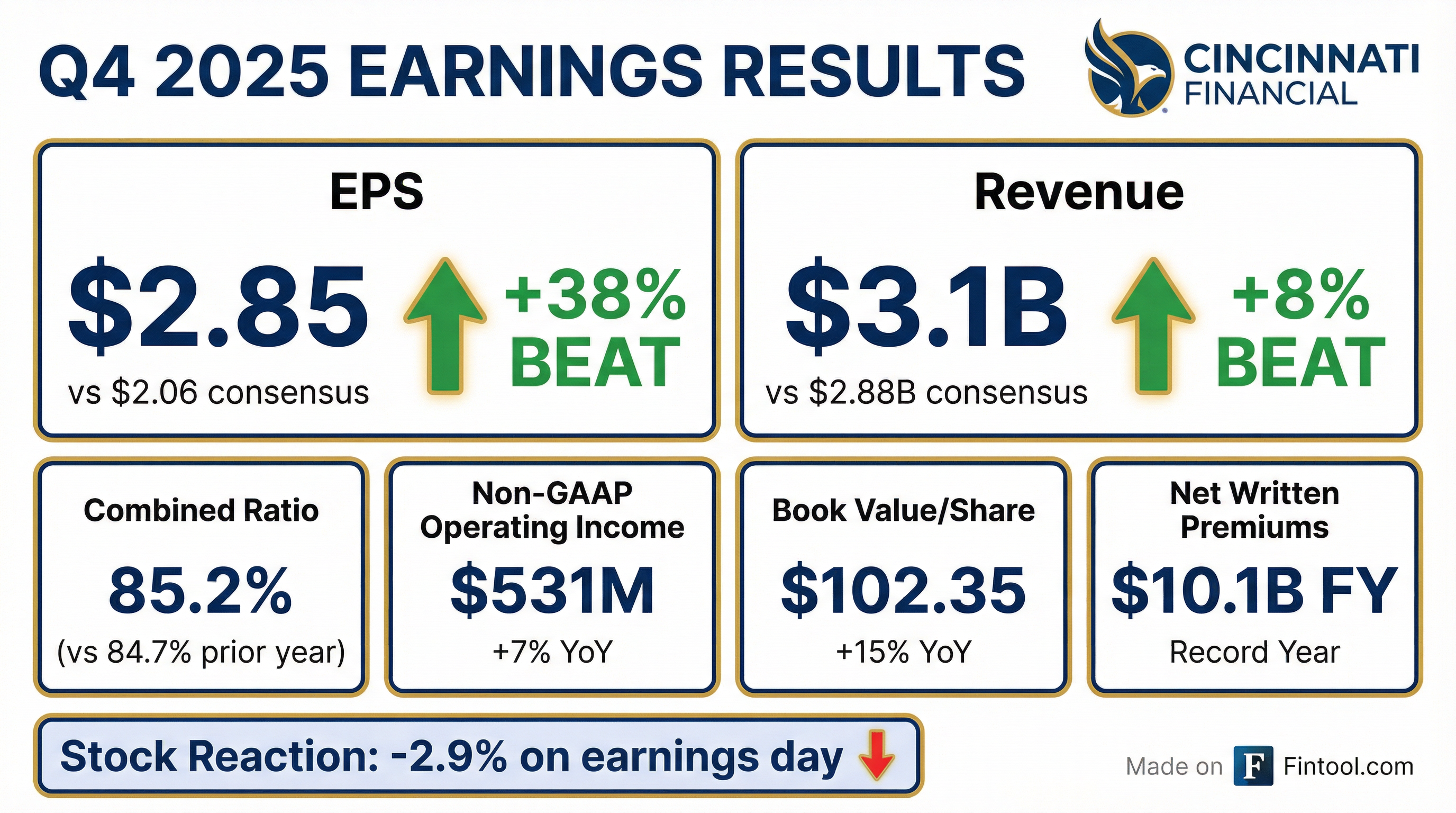
Cincinnati Financial (CINF) delivered a strong Q4 2025 with non-GAAP operating income of $531M ($3.37/share), handily beating consensus estimates by 38% . Net income surged 67% year-over-year to $676M ($4.29/share), driven by investment gains and improved underwriting results . Despite the beat, shares fell 2.9% as investors weighed the lingering impact of California wildfires and full-year combined ratio deterioration.
Did Cincinnati Financial Beat Earnings?
Yes — decisively. Q4 2025 was one of the company's best quarters in a decade:
The Q4 combined ratio of 85.2% was notable — CEO Stephen Spray called it "one of our best fourth quarters in the last decade" . The strong quarter helped offset a challenging start to the year when California wildfires inflicted the worst catastrophe losses in company history.
 Ask Fintool AI Agent
How Did Full-Year 2025 Compare?
Full-year results showed resilience despite the catastrophe headwinds:
The $10B net written premium milestone was a first in the company's 75-year history . The 94.9% combined ratio marked the 14th consecutive year of underwriting profit, comfortably within management's 92%-98% target range .
What Drove the Beat?
Three factors powered Q4 outperformance:
1. Investment Gains Surge Net investment gains of $183M in Q4 (vs -$116M loss in Q4 2024) contributed significantly to the 67% net income jump . The equity portfolio rose 13% for the full year, with total investments reaching $33B .
2. Premium Growth Momentum Earned premiums grew 10% in Q4 and 12% for the full year, reflecting pricing discipline and new agency appointments . Commercial lines saw mid-single-digit renewal price increases, while personal lines achieved high-single-digit increases .
3. Favorable Reserve Development Prior accident year reserve releases contributed 0.8 percentage points to the Q4 combined ratio improvement .
How Did Each Segment Perform?
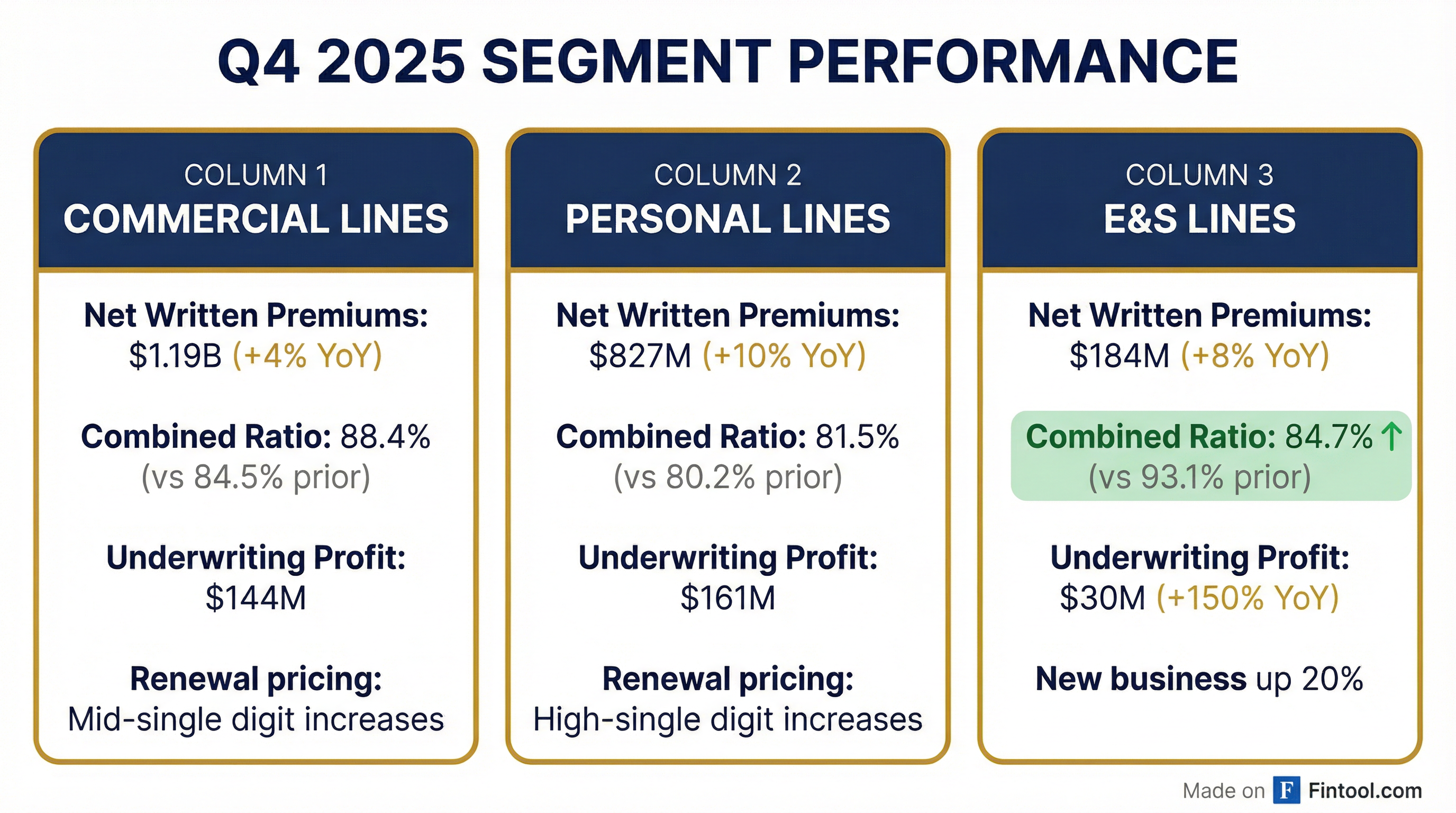
Commercial Lines — The core business delivered solid but mixed results:
- Net written premiums: $1.19B (+4% YoY)
- Combined ratio: 88.4% (vs 84.5% prior year)
- New business premiums up just 1% as management maintained underwriting discipline
Personal Lines — Strong premium growth but catastrophe-impacted:
- Net written premiums: $827M (+10% YoY)
- Combined ratio: 81.5% in Q4 (vs 80.2% prior year)
- Full-year combined ratio: 103.6% due to wildfire losses
- New business down 40% as California exposure reduced
Excess & Surplus Lines — Standout performer:
- Net written premiums: $184M (+8% YoY)
- Combined ratio: 84.7% (vs 93.1% prior year) — 8.4 point improvement
- New business up 20%
Ask Fintool AI AgentWhat Did Management Say About California?
CEO Stephen Spray acknowledged the difficult start to 2025: "After beginning the year with the worst catastrophe loss in our company's history, it took persistence and focus to record a 4% increase in full-year net income" .
Key wildfire-related impacts:
- $52M in reinsurance reinstatement premiums related to January 2025 California wildfires
- Full-year catastrophe losses added 10.8 percentage points to the combined ratio (vs 9.6 pts in 2024)
- Personal lines new business in California cut by $8M in Q4 alone
Management emphasized the current accident year combined ratio before catastrophes improved 0.4 percentage points to 86.1%, demonstrating underlying profitability improvements even excluding the wildfire volatility .
How Did the Stock React?
Despite the earnings beat, CINF shares fell 2.9% on the day to $168.70, retreating from the 52-week high of $174.27 set just days earlier.
Likely concerns:
- Full-year combined ratio deterioration from 93.4% to 94.9%
- Ongoing California exposure — the wildfires occurred in January 2025, so the costs will weigh on Q1 results
- New business slowdown — agency new business premiums down 13% in Q4 and 4% for the full year
The stock has still performed well over the past year, trading near all-time highs with book value up 15% to $102.35 .
What Changed From Last Quarter?
The sequential improvement in Q4 demonstrates the company's ability to deliver strong underwriting results when catastrophes normalize.
Capital Allocation and Balance Sheet
Cincinnati Financial maintains a conservative but shareholder-friendly capital strategy:
- Dividend: $0.87/share quarterly (+7% YoY), marking continued dividend growth
- Book Value: $102.35/share, up 15% from $89.11
- Value Creation Ratio: 18.8% for full-year 2025, well above the 10-13% target
- Parent Company Cash: $5.57B in cash and marketable securities (+7% YoY)
- New Credit Facility: $400M unsecured revolving credit agreement established in Q4
The debt-to-total-capital ratio improved to 4.9% from 5.5% .
Ask Fintool AI AgentForward Outlook
Management did not provide explicit guidance but highlighted several positives:
Growth Drivers:
- 420 new agency appointments in 2025, including 71 personal lines-only agencies
- E&S lines continuing strong momentum with 17% full-year new business growth
- Investment income expected to benefit from 10% growth in bond interest income
Challenges:
- California wildfire exposure management ongoing
- Competitive pressure on new business in highly competitive market
- Social inflation and third-party litigation funding mentioned as risks
CEO Spray emphasized the company's competitive advantages: "Our hallmarks of strong agency relationships and fast, fair and empathetic claims service will continue to encourage appointed agents to place their high-quality business with Cincinnati Insurance" .
Key Takeaways
- Beat estimates decisively — EPS +38% vs consensus, revenue +8%
- Q4 combined ratio excellent — 85.2%, one of best quarters in a decade
- Full-year pressured by catastrophes — 94.9% combined ratio still profitable but higher than 2024
- Book value at record — $102.35/share, up 15%
- Premium milestone — Crossed $10B net written premiums for first time
- Stock sold off — Down 2.9% despite beat, likely on wildfire/new business concerns
View Cincinnati Financial Company Profile | Read Full Q4 2025 Transcript | View Q3 2025 Earnings