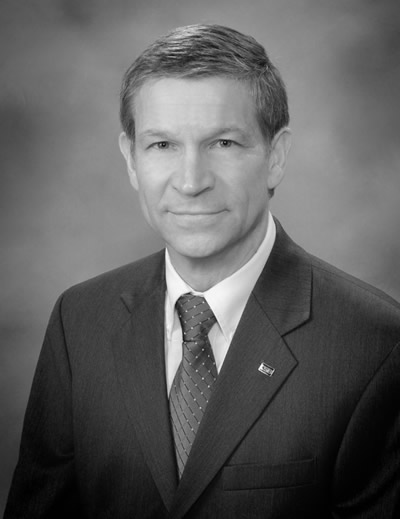
Eddie Steiner
About Eddie Steiner
Eddie L. Steiner (age 69) is President & CEO of CSB Bancorp, Inc. (since 2006), Chairman of the Bank’s board (since 2006), CEO of the Bank (since Dec 2011), and a director of CSB since 2001; he is a licensed CPA in Ohio and a graduate of the ABA Stonier Graduate School of Banking . Under his leadership, CSB’s recent performance includes 2024 net income of $10.0 million and EPS of $3.76 versus 2023 net income of $14.8 million and EPS of $5.51; cumulative TSR proxy tracking values show $100 growing to $106 in 2024 (vs $101 in 2023 and $105 in 2022) . Governance structure separates the holding company Chair (independent) from the CEO role, while Steiner chairs the Bank’s board, mitigating CEO/Chair concentration at the parent level .
Past Roles
| Organization | Role | Years | Strategic Impact |
|---|---|---|---|
| CSB Bancorp, Inc. | President & CEO | 2006–present | Leads corporate strategy execution at the holding company level; reports to an independent Chair, supporting balanced oversight . |
| The Commercial and Savings Bank | Chairman of the Board | 2006–present | Chairs subsidiary bank board; oversight of lending and balance sheet via committee workstreams . |
| The Commercial and Savings Bank | Chief Executive Officer | Dec 2011–present | Operational leadership of the bank franchise . |
| CSB Bancorp, Inc. | Director | 2001–present | Long-tenured director through multiple cycles . |
External Roles
| Organization | Role | Years | Notes |
|---|---|---|---|
| WRG Mutual Insurance Holding Company (Western Reserve Group) | Director; Investment Committee member; Audit Committee Chair | Current (as of 2025 proxy) | Property & casualty mutual insurer governance and audit leadership . |
| Federal Reserve Bank of Cleveland | Class A Director; Audit Review Committee Chair | 2019–2024 | Completed term Dec 2024 . |
| Wayne Economic Development Council | Board of Directors Executive Committee | Current | Regional economic development leadership . |
| Heartland Education Community, Inc. | Board of Trustees | Current | Community education non-profit governance . |
| Bankers Electronic Crimes Task Force | Member | Current | Industry cybersecurity and fraud forum convened by CSBS . |
| Ohio Bankers League | Director | 2018–2022 | State industry association leadership . |
| State of Ohio Banking Commission | Member | 2013–2018 | State-level banking oversight advisory body . |
Fixed Compensation
| Year | Base Salary ($) | All Other Compensation ($) | Notes |
|---|---|---|---|
| 2023 | 315,962 | 24,711 (incl. 401(k) match/profit sharing $23,925; group term life $786) | Benefits/perqs per proxy footnote . |
| 2024 | 330,000 | 21,788 (incl. 401(k) match/profit sharing $21,563; group term life $215) | Benefits/perqs per proxy footnote . |
Performance Compensation
| Year | Incentive Type | Target | Performance Metrics (plan) | Company Actuals | Payout ($) | Vesting |
|---|---|---|---|---|---|---|
| 2023 | Annual Cash Bonus | 30% of actual base salary for NEOs | Net income; ROAA; ROAE; Efficiency ratio; regulatory/audit compliance | Net income $14.8m; ROAA 1.27%; ROAE 14.69%; Efficiency 55.95% (106%–109% of plan) | 95,000 | Cash (paid after year-end) |
| 2024 | Annual Cash Bonus | 30% of actual base salary for NEOs | Net income; ROAA; ROAE; Efficiency ratio; regulatory/audit compliance | Net income $10.0m; ROAA 0.85%; ROAE 8.96%; Efficiency 55.77% (67%–101% of plan) | 47,500 | Cash (paid after year-end) |
Notes
- The Compensation Committee retains discretion to adjust payouts up or down; no equity awards are used (the Committee has not used stock options in 18 years and uses cash incentives) .
Pay vs Performance (Context)
| Year | CEO SCT Total Compensation ($) | Compensation Actually Paid to CEO ($) | TSR: $100 Base | Net Income ($000) | EPS ($) |
|---|---|---|---|---|---|
| 2022 | 411,938 | 411,938 | 105 | 13,313 | 4.91 |
| 2023 | 435,673 | 435,673 | 101 | 14,756 | 5.51 |
| 2024 | 399,278 | 399,278 | 106 | 10,012 | 3.76 |
Equity Ownership & Alignment
| As of Date | Sole Voting Shares | Shared Voting Shares | Total Beneficial Ownership | % of Outstanding | Pledged? | Notes |
|---|---|---|---|---|---|---|
| Mar 5, 2024 | 49,079 | 8,443 | 57,522 | 2.2% | None reported | No margin accounts allowed by policy . |
| Mar 4, 2025 | 60,041 | 8,785 | 68,826 | 2.6% | None reported | Code prohibits maintaining securities in margin accounts; annual reporting showed no credit secured by CSB stock as of 12/31/2024 . |
Additional alignment items
- Equity awards outstanding: None disclosed; the company does not utilize stock options and has no equity award adjustments impacting “compensation actually paid” .
- Deferred compensation: No CEO participation/balance reported (zero in plan table) .
- Ownership group: All directors and executive officers held 7.1% as a group as of March 4, 2025 .
- Insider trading policy: Prohibits trading with MNPI and trades during blackout periods .
Employment Terms
| Item | Disclosure |
|---|---|
| Employment agreement | No CEO employment agreement disclosed in the proxy; only CFO’s agreement is summarized . |
| Severance / Change-in-control | Not disclosed for the CEO; CFO example indicates 2x base salary CoC cash and limited benefits, subject to 280G cutback . |
| Non-compete / Non-solicit | Not disclosed for the CEO; CFO agreement includes non-compete provisions . |
| Start dates / tenure | Director since 2001; President & CEO of CSB since 2006; Chairman of Bank board since 2006; CEO of the Bank since Dec 2011 . |
Board Service and Governance
- Committee roles: Member of the Bank’s Executive/Loan, Asset Liability (ALCO), and Trust Committees, supporting credit risk and balance sheet oversight .
- Independence and leadership: CSB’s holding company Chair (Robert K. Baker) is independent; Steiner serves as management director and chairs only the Bank’s board, which addresses CEO/Chair dual-role concentration at the parent level .
- Attendance: In 2024, each director attended >75% of Board and committee meetings; non-employee directors held two executive sessions in 2024 .
- Director compensation: Employee directors receive no additional director pay; outside directors are paid cash retainers/meeting fees .
Compensation Committee and Peer Benchmarking
| Year | Committee Members | Consultant Used | Named Peer Institutions (subset) |
|---|---|---|---|
| 2023 | Coblentz (Chair), Baker, Briggs | None | LCNB; Middlefield Banc; SB Financial; Ohio Valley Bancorp; Consumers Bancorp; United Bancshares Inc.; United Bancorp |
| 2024 | Coblentz (Chair), Baker, Briggs | None | LCNB; Middlefield Banc; SB Financial; Ohio Valley Bancorp; Consumers Bancorp; United Bancorp |
Notes
- Target base salaries are set “below median” relative to peers for 2024; target annual incentives at 30% of base .
- Committee is fully independent per NASDAQ definitions .
Performance & Track Record
- 2023 highlights included record assets ($1.2bn), record deposits ($1.0bn), and net income of $14.8m, with ROAA 1.27% and ROAE 14.69% .
- In 2024, the Company underperformed plan on net income, ROAA, and ROAE but exceeded efficiency ratio target; the CEO’s cash bonus decreased accordingly (from $95k in 2023 to $47.5k in 2024) .
Risk Indicators & Red Flags
- Pledging/hedging: No pledging; margin accounts are prohibited; no credit secured by CSB stock reported as of 12/31/2024 .
- Pay mix: Absence of equity-based LTI (no options used in 18 years) reduces near-term insider selling pressure but places more emphasis on annual cash metrics .
- Related party: No Steiner-specific related-party transactions disclosed; standard insider lending policy applies; one unrelated family hire disclosure pertains to another director .
- Say-on-Pay: Advisory vote presented in 2025; historical approval percentages not disclosed in proxies reviewed .
Investment Implications
- Alignment: Steiner’s beneficial ownership is sizable at 2.6% with no pledging, and increased year-over-year, signaling alignment and low forced-selling risk .
- Incentive design: With no equity awards, incentive leverage resides in cash bonuses tied to profitability/efficiency and risk/compliance, which translated into a materially lower bonus when 2024 results missed plan—evidence of pay-for-performance discipline .
- Governance: Independent holding company Chair and robust committee structure mitigate CEO/Chair concentration risk; Steiner’s bank-level chair role maintains operational oversight while preserving independent Board leadership at the parent .
- Retention risk: No disclosed CEO employment/severance protections could imply lower contractual retention frictions versus peers; however, long tenure and material ownership reduce turnover risk indicators .