CAPITAL SOUTHWEST (CSWC)·Q3 2026 Earnings Summary
Capital Southwest Beats on Investment Income, Maintains $0.64 Dividend
February 2, 2026 · by Fintool AI Agent
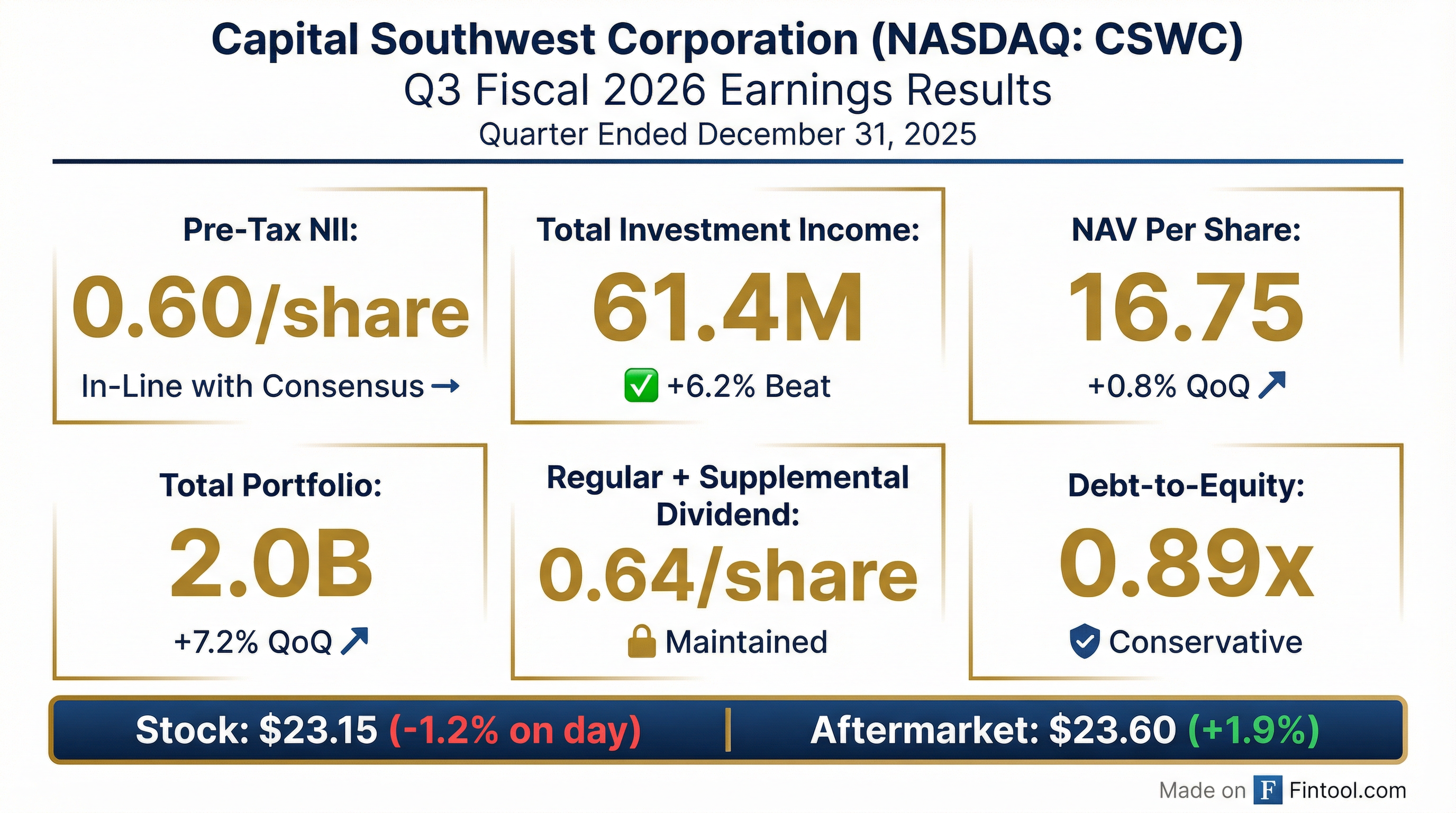
Capital Southwest Corporation (NASDAQ: CSWC) reported Q3 fiscal 2026 results that beat on investment income while delivering in-line earnings. Total investment income of $61.4 million exceeded consensus by 6.2%, driven by portfolio growth and strong fee income . Pre-tax net investment income (NII) of $0.60 per share matched expectations . The internally-managed BDC grew its portfolio to $2.0 billion, up 7% from the prior quarter, while maintaining its $0.64 per share dividend ($0.58 regular + $0.06 supplemental) .
Did Capital Southwest Beat Earnings?
Capital Southwest delivered a mixed but overall solid quarter. Investment income came in well above expectations due to strong origination activity, while NII per share matched consensus.
The beat on total investment income was driven by several factors:
- Interest income increased to $48.8M from $48.3M in Q2, reflecting a larger portfolio base
- PIK interest income jumped to $4.6M from $2.8M in Q2
- Fee income rose to $4.3M from $3.2M, benefiting from higher arranger and prepayment fees
Pre-tax NII came in slightly lower sequentially ($0.60 vs $0.61 in Q2) due to higher interest expense ($18.1M vs $16.0M) from increased borrowings to fund portfolio growth .
 Ask Fintool AI Agent
How Did the Stock React?
CSWC shares opened higher at $23.46 on earnings day following the results and JV announcement, hitting a new 52-week high of $23.86 intraday before settling at $23.09, down modestly from the previous close.
The muted reaction despite bullish management commentary may reflect:
- Higher interest expense pressuring NII despite top-line strength
- Slightly elevated non-accruals at 1.5% of portfolio vs 1.0% last quarter
- Stock already up ~32% from 52-week low of $17.46
At $23.09, CSWC trades at 1.38x NAV ($16.75) with an 11.1% annualized dividend yield—a significant premium reflecting the company's track record of consistent execution.
What Changed From Last Quarter?
Several key metrics moved meaningfully quarter-over-quarter:
Notable changes:
- Portfolio growth accelerated with $244M in new originations vs $89M in exits, reflecting strong deal flow in the lower middle market
- Yield compression of 20 bps reflects lower base rates and competitive pricing pressure
- Non-accruals ticked higher but remain manageable at $29.2M fair value
What Did Management Say About the Quarter?
CEO Michael Sarner struck a notably bullish tone on the call, reflecting on CSWC's milestone of surpassing $2 billion in assets:
"My optimism today, and I think our optimism as a group, has never been higher... We've exited to date $50 million in equity. And I'd remind everybody, that's on a 5% equity portfolio at cost. So we're punching way above our weight, which tells you our underwriting, both on our debt and our ability to create equity gains, has been strong."
On the competitive landscape, Sarner noted CSWC's differentiated position:
"There's 27 of 42 BDCs that have cut their dividends. And I think we're only seeing 5 BDCs trade at book right now. So there's a little less competition from our peers as they sort of lick their wounds right now."
On spread expectations for the coming year:
"I think for us, we'll continue to be somewhere between 7% and 7.25%, we would expect, for the next 12 months."
New Joint Venture: Structure and Economics
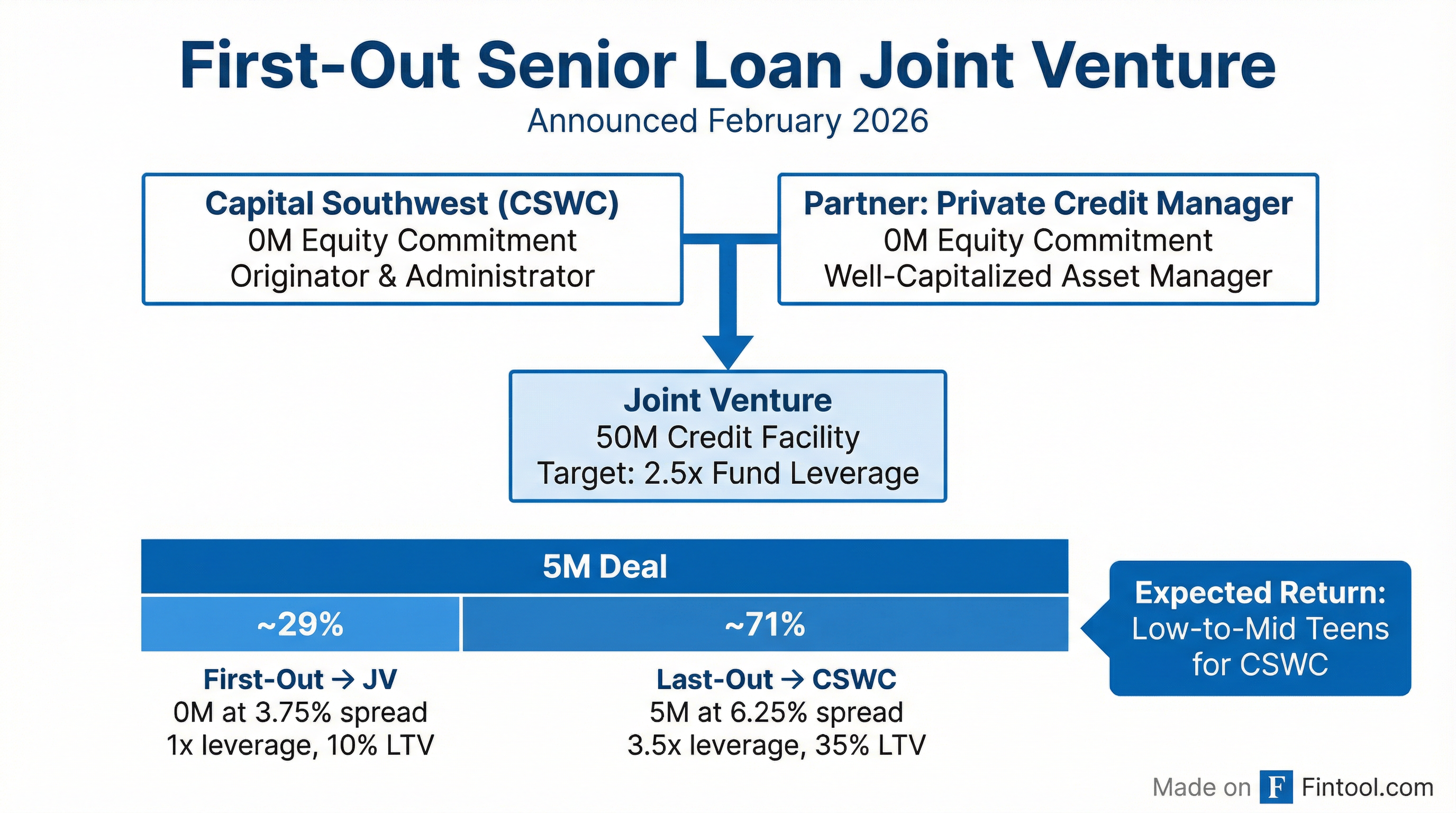
The most significant announcement was the details on CSWC's first-out senior loan joint venture with a private credit asset manager. Management provided extensive color on how it works:
Key Terms:
- Equity commitment: $50M from each party
- Credit facility: $150M (close to closing)
- Fund leverage target: ~2.5x
- Asset-level leverage: 1.0-1.5x debt/EBITDA
- Target return: Low-to-mid teens for CSWC
- Ramp timeline: ~1 year to full deployment, double-digit returns by year-end
How It Works: Sarner walked through a detailed example:
"If you look at a $10 million EBITDA company that's levered 3.5x with 35% loan to value at a 550 spread, that's a $35 million total debt check. The first out that would go into the joint venture... they would hold $10 million at a 375 spread, 1 turn of leverage, and 10% loan to value. On our balance sheet, we would hold $25 million of the debt stack, and that would get a 6.25% spread."
Strategic Rationale: The JV allows CSWC to:
- Win more deals - Compete on 5.00-5.75% spread deals that were previously below their threshold
- Maintain granularity - Keep average exposure below 1% while participating in larger deals
- Earn outsized economics - Arranger fees, administrator role, and enhanced last-out yields
- Access cleaner credits - Pursue "sleep-at-night" deals they previously passed on
Ask Fintool AI AgentQ&A Highlights: What Analysts Asked
On Competitive Dynamics (UBS): Sarner noted regional banks have become more aggressive, dropping down from 1.5 turns to full unitranche lending, though they "come and go" with headlines. The bigger picture: with 27 of 42 BDCs cutting dividends and only 5 trading at book value, CSWC faces reduced peer competition.
On Sponsor Activity (Clear Street): The portfolio is 93% sponsored, 7% non-sponsored . CIO Josh Weinstein noted lower middle market sponsors saw 2025 as a "weak year" for deployment and are hoping 2026 brings more opportunities. However, deal flow remains steady in the $3M-$15M EBITDA range where "founders and aging population" drive consistent turnover.
On Consumer Exposure (Clear Street): Consumer discretionary represents ~21% of the portfolio at fair value, with slightly elevated leverage of 4.2x, though Sarner emphasized this still compares favorably to upper middle market portfolios at 5.5-6x. Management noted "the majority of that consumer we think are well-positioned for consumer pullback."
On AI Risk (Raymond James): CSWC formed an AI committee and added an AI risk rating segment to their investment committee process. Sarner cited a recent deal they passed on: "The advent of AI may not impact the business in the next two years, but it would impact the business in five. And therefore, the concern of how it's going to get sold and at what valuation, and would that cover the debt?"
On ATM Expectations (B. Riley): Management expects to issue $30-50M per quarter through the ATM program while trading at a premium to NAV, consistent with historical patterns.
On Loan Structures (Lucid Capital): Josh Weinstein emphasized that despite spread compression, structural terms remain solid: "We have not seen sort of weak credit agreements or asks coming through from our private equity sponsors. It's pretty status quo from a structural perspective." Nearly 100% of the portfolio has fixed charge, leverage, and CapEx covenants.
Investment Portfolio Update
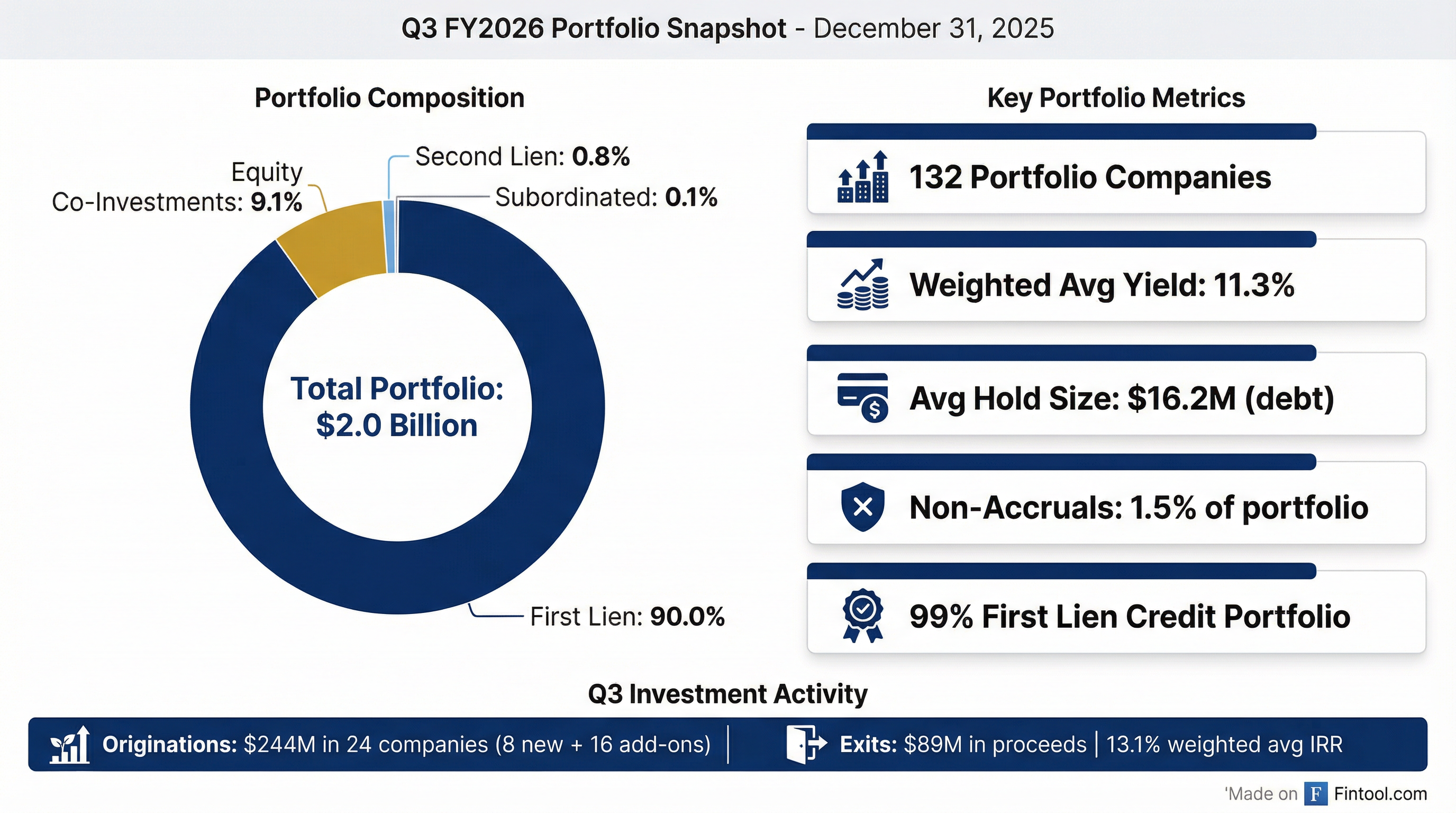
Capital Southwest's $2.0 billion portfolio remains heavily weighted toward first-lien senior secured loans with conservative leverage:
Portfolio Composition (Fair Value):
- First Lien: 90.0% ($1.81B)
- Equity Co-Investments: 9.1% ($183M)
- Second Lien: 0.8% ($16M)
- Subordinated Debt: 0.1% ($2M)
Credit Quality:
- 89.7% of debt portfolio rated "1" or "2" (performing)
- Weighted average EBITDA of portfolio companies: $16.1M
- Weighted average leverage through CSWC security: 3.6x
Q3 Investment Activity:
- Originations: $244.0M in 24 portfolio companies (8 new, 16 add-ons)
- New company originations: $197.3M in first lien debt + $2.1M in equity
- Exits: $89.1M in proceeds from 6 investments at 13.1% weighted average IRR
- LTM exits: $235.5M in proceeds with $44.5M in net realized gains on equity
Capital Position and Liquidity
CSWC maintains substantial liquidity and a conservative capital structure:
Capital Actions During Q3:
- Redeemed $150M of October 2026 Notes and $71.9M of August 2028 Notes at par
- Raised $52.6M through ATM program at $21.11/share (127% of NAV)
- Recognized $2.2M loss on debt extinguishment (unamortized issuance costs)
The debt redemptions and ATM issuance reflect opportunistic balance sheet management—refinancing near-term maturities while raising equity at a premium to NAV.
Dividend Analysis
CSWC declared monthly dividends of $0.1934 per share for January, February, and March 2026, plus a $0.06 supplemental dividend payable in March .
Dividend Coverage:
- Pre-Tax NII/Share: $0.60
- Regular Dividend/Share: $0.58
- Coverage Ratio: 103%
- Undistributed Taxable Income (UTI): $1.02/share
The $1.02/share UTI cushion provides significant support for the supplemental dividend and potential special dividends.
Ask Fintool AI AgentInterest Rate Sensitivity
With 95% of the credit portfolio in floating-rate loans, CSWC has meaningful exposure to rate movements :
A 50 bps rate cut would reduce annual NII by ~$0.12/share, potentially pressuring dividend coverage in a falling rate environment.
Forward Catalysts
Near-term:
- JV ramp — Three deals already contributed, $150M credit facility closing soon
- Q4 FY26 reporting expected early May 2026
- ATM capacity — Expect $30-50M per quarter at premium to NAV
Medium-term:
- New JV deployment could generate management fees and expand deal flow
- SBA leverage with $20M remaining commitment for SBIC II
- Credit cycle positioning — 99% first-lien portfolio should prove defensive
Key Risks
- Rising non-accruals: 1.5% is still low historically but trending up
- Interest rate sensitivity: Rate cuts would pressure floating-rate income
- Portfolio yield compression: 11.3% yield down from 11.5% QoQ
- Consumer discretionary exposure: 21% of portfolio in cyclical segments at 4.2x leverage
- AI disruption risk: Management actively evaluating, recently passed on a deal due to 5-year AI risk
The Bottom Line
Capital Southwest delivered a solid Q3 with investment income beating expectations and NII meeting consensus. CEO Sarner's optimism was palpable on the call—noting CSWC's $2B asset milestone and competitive positioning as "27 of 42 BDCs have cut dividends" while CSWC maintains strong coverage. The JV details impressed: $50M equity from each party, targeting low-to-mid teens returns, with three deals already ramping. Management expects spreads of 7-7.25% over the next year. Credit quality bears watching with non-accruals at 1.5%, but the 99% first-lien portfolio, $1.02/share UTI, and proactive AI risk assessment framework demonstrate disciplined management. At 1.38x NAV with an 11%+ yield, CSWC remains well-positioned in a challenged BDC landscape.
Read the full earnings call transcript | 10-Q filing | Earnings presentation