COGNIZANT TECHNOLOGY SOLUTIONS (CTSH)·Q4 2025 Earnings Summary
Cognizant Beats on EPS but Stock Plunges 10% as Growth Decelerates
February 4, 2026 · by Fintool AI Agent
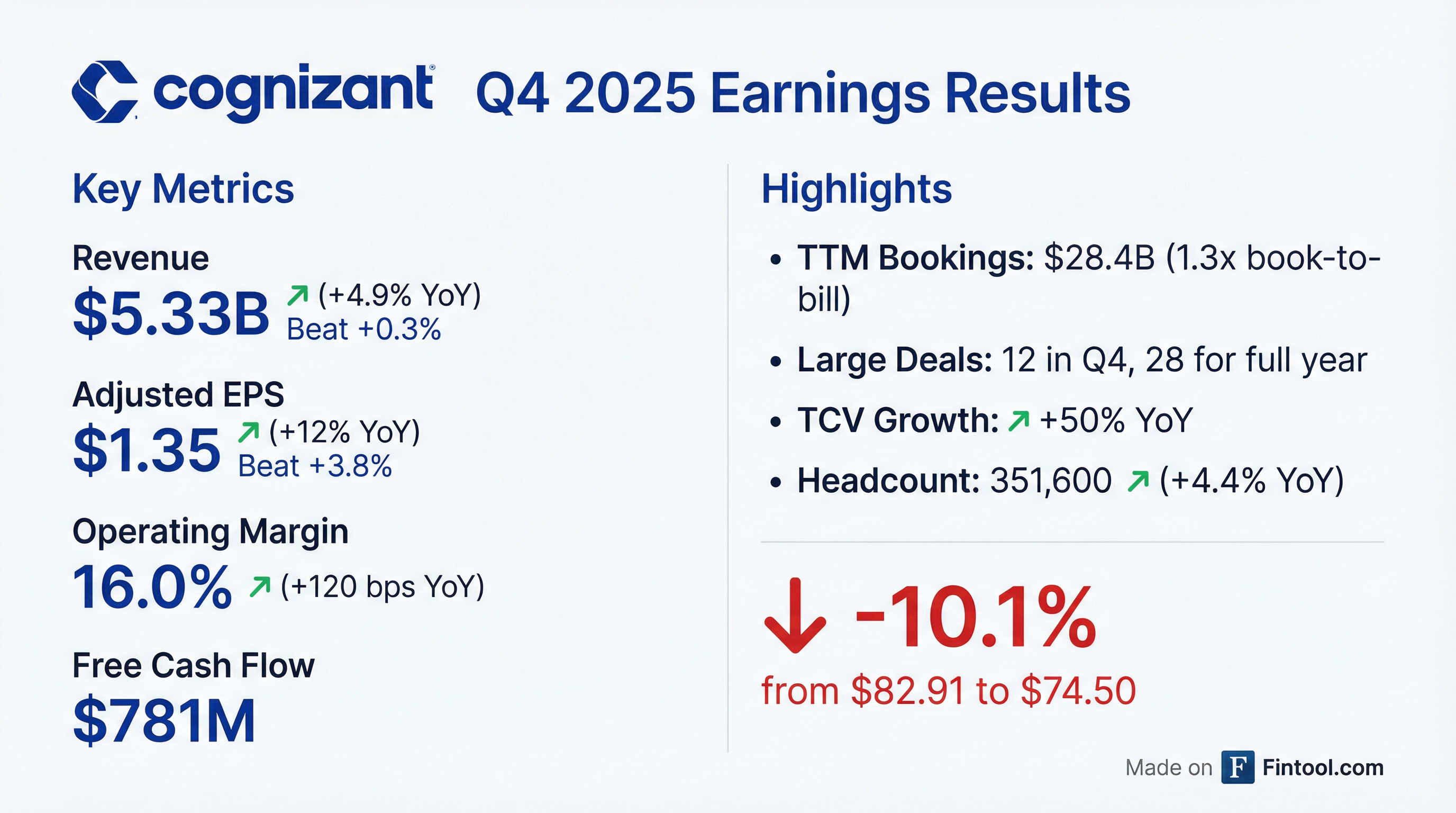
Cognizant delivered a mixed Q4 2025, beating both revenue and EPS estimates but seeing shares tumble over 10% as investors focused on decelerating organic growth and cautious 2026 guidance. The IT services company reported revenue of $5.33 billion (+4.9% YoY) and adjusted EPS of $1.35 (+12% YoY), exceeding Wall Street expectations on both metrics.
However, organic growth slowed to just 3.8% in constant currency—down sharply from 6.5% in Q3 2025—as the Belcan acquisition anniversary removed the inorganic tailwind. The Communications, Media & Technology segment declined for the first time, and 2026 guidance implies further deceleration at the midpoint.
Did Cognizant Beat Earnings?
Yes. Cognizant exceeded consensus estimates on both revenue and adjusted EPS, marking its ninth consecutive quarter of beats on earnings.
*Values retrieved from S&P Global
For full-year 2025, Cognizant exceeded the high end of all guidance ranges:
CEO Ravi Kumar noted the company reached its "Winner's Circle" target of top-tier revenue growth "two years ahead of plan" set at the March 2025 Investor Day.
 Ask Fintool AI Agent
How Did the Stock React?
Despite beating estimates, CTSH shares fell 10.1% on earnings day—opening at $81.21 and closing at $74.50. After-hours trading showed partial recovery to $77.00.
The sharp selloff reflects three key investor concerns:
-
Organic growth deceleration: Q4 constant currency growth of +3.8% was the slowest since Q1 2024, down from +6.5% in Q3 and +7.2% in Q2
-
CMT segment decline: Communications, Media & Technology revenue fell 0.4% YoY (first decline in four quarters)
-
Guidance midpoint implies slowing: 2026 CC growth guidance of 4.0%-6.5% has a midpoint of 5.25%, below 2025's 6.4%
What Did Management Guide for 2026?
Cognizant provided initial 2026 guidance that implies continued growth but at a modestly slower pace than 2025:
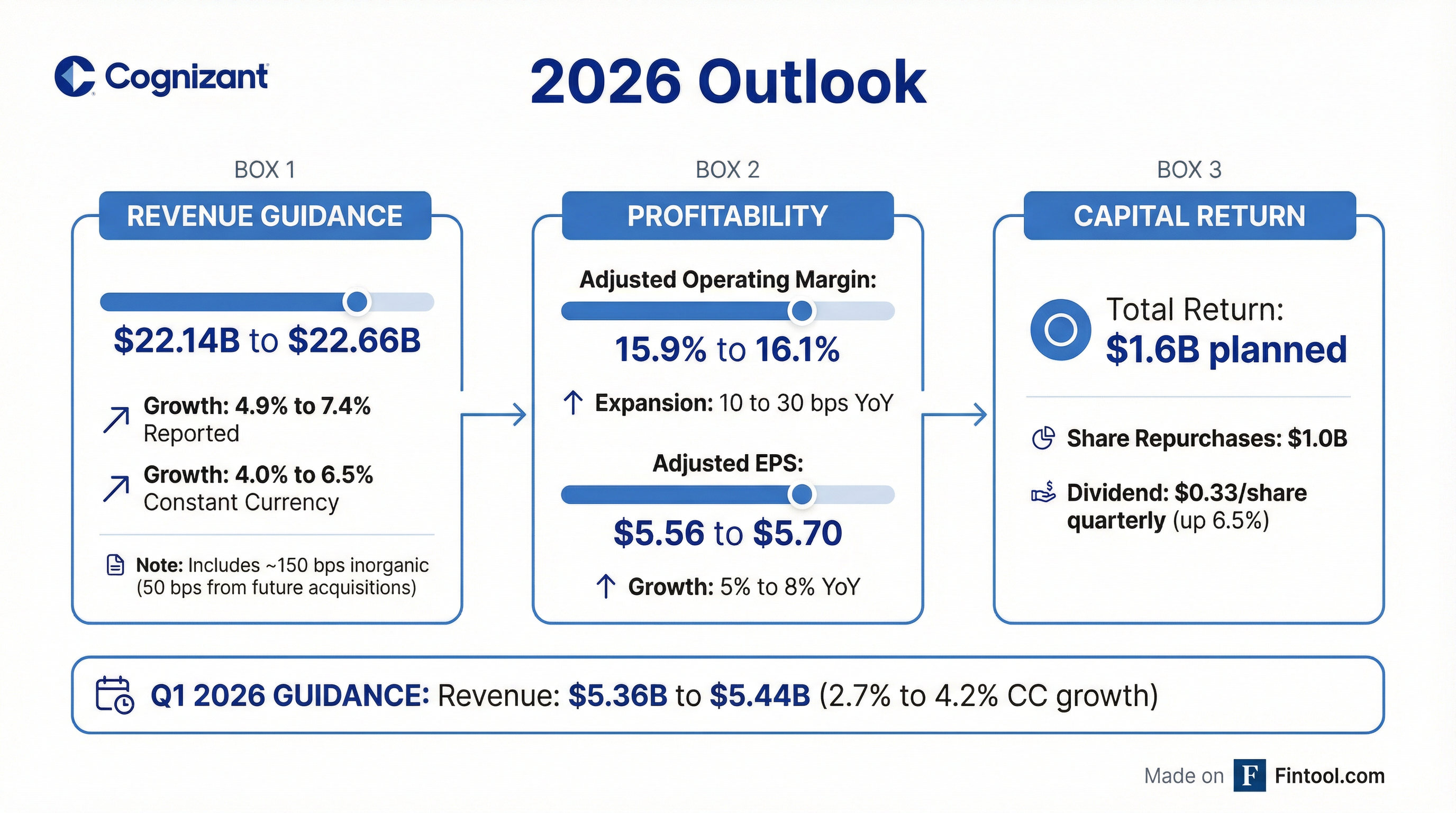
Capital return commitment: Management plans to return $1.6 billion to shareholders in 2026—$1.0 billion in share repurchases and the remainder through dividends. The quarterly dividend was raised 6.5% to $0.33/share.
What Changed From Last Quarter?
Improved:
- Bookings momentum accelerated: Q4 bookings grew 9% YoY, driving TTM bookings to $28.4B (+5% YoY, 1.3x book-to-bill)
- Large deal activity surged: 12 large deals in Q4 (including 2 mega deals >$500M), with full-year large deal TCV up 50%
- Attrition continued improving: Voluntary tech services attrition fell to 13.9% from 15.9% a year ago
- Financial Services accelerated: +10.5% YoY was the fastest quarterly growth since 2016
Deteriorated:
- Organic growth slowed sharply: +3.8% CC vs +6.5% last quarter as Belcan tailwind faded
- CMT turned negative: -0.4% YoY after +4.2% growth in Q3
- Products & Resources decelerated: +1.8% vs +12.6% in Q3 (Belcan contribution faded)
Ask Fintool AI AgentHow Did Each Segment Perform?
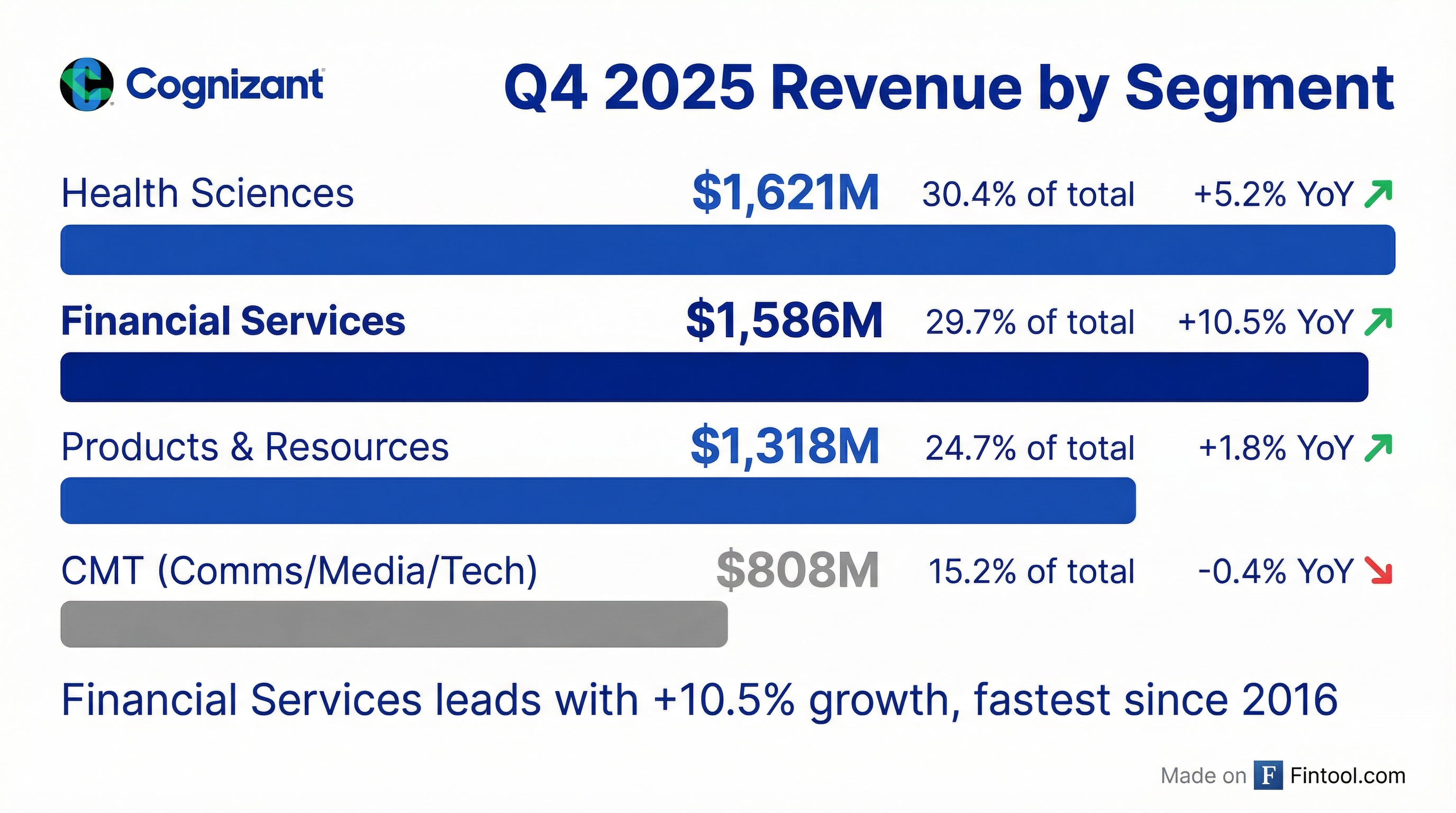
Financial Services was the star, posting its fastest annual growth since 2016. Management attributed this to banking clients resuming technology modernization and AI adoption.
Products & Resources deceleration is entirely due to the Belcan acquisition anniversary. Belcan contributed ~9.6 percentage points to segment growth in FY 2025.
Geographic mix: North America (74.7% of revenue) grew 4.2% CC, Europe (19.1%) grew 2.0% CC, and Rest of World (6.2%) grew 3.6% CC.
What Were the Key Strategic Announcements?
Acquisitions completed:
- 3Cloud acquisition closed (effective January 1, 2026): Adds more than 1,200 Azure specialists and engineers to industrialize deep expertise in Azure data and AI.
- Belcan integration milestones: Key integration completed; secured position on the Missile Defense Agency's Shield program—an indefinite delivery, indefinite quantity contract with a ceiling value of $150 billion.
AI partnerships expanded:
- NVIDIA: Offering solutions across the full life cycle, from building and fine-tuning models to deploying agentic applications as microservices
- Anthropic, Google Cloud, Microsoft Azure, and OpenAI: Using frontier models and agentic tuning to build application value
- Salesforce and ServiceNow: Embedding agentic networks directly into clients' primary enterprise workflows
- Palantir: Integrating foundry and AI platform to support TriZetto business
- Cognition, GitHub, and Windsurf: Industrializing software creation through advanced code generation
AI operational metrics:
- Over 4,000 AI engagements across all three vectors
- Over 30% of developer effort in software development cycles is AI-assisted and agentic
- 340,000+ associates completed AI skilling over the last 2.5 years
- Fixed bid and transaction-based work now represents more than 50% of revenue
What Were the Q&A Highlights?
On AI as a net positive (Jason Kupferberg, Wells Fargo):
Asked whether AI tools expediting ERP implementations would hurt Cognizant, CEO Ravi Kumar responded forcefully:
"Any tool, any technology will magically not generate value on the other side. You need a bridge, and that bridge is what companies like Cognizant do... There is $4.5 trillion of labor which can actually be amplified with higher productivity out of the $15 trillion in the United States. It's not drifted yet because all of this has to be done."
On large deal confidence (Tien-tsin Huang, JP Morgan):
"We have a strong pipeline, and we have activated both the swim lanes. We are starting to do transition of that work, and therefore we see a solid quarter two and quarter three. In fact, we see more acceleration during the year."
On fixed-price contract risks (Keith Bachman, BMO):
CFO Jatin Dalal explained Cognizant monitors bid performance monthly and "on aggregate of the portfolio, delivers very close to the expected margins." Revenue per employee up 5% and margin per employee up 8% trailing twelve months demonstrates successful execution.
On BPO durability:
"This is a total addressable spend which is 10 times or maybe 20 times more than tech spend, because you're embedding technology, data into process... Cognizant has had 9%-10% growth in BPO for three years in a row."
On India listing:
Management confirmed they "continue to evaluate a potential primary offering and secondary listing in India" with constructive discussions with regulators, but no decision has been made.
Ask Fintool AI AgentClient Examples: AI in Action
Management shared concrete examples of AI-driven transformation:
-
Sysco: Transformed complex customer interactions (product credits, order substitutions) from prolonged resolution windows to 90 seconds using orchestrated agents. Sysco is reinvesting savings into the next phase of agentification.
-
Major U.S. healthcare payer: AI intake platform reduced enrollment cycle times from 7 days to minutes. Clinical engine now adjudicates 96% of nurse note reviews autonomously, cutting human review times from 8 hours to 20 minutes.
-
Bupa Hong Kong: Largest BPO win in the region—a multi-year GenAI-led business process as a service solution modernizing claims and fraud/waste/abuse detection.
-
Kohler: Multi-year expansion bringing cloud management capabilities and Neuro IT Ops AI solutions to advance the company's digital ecosystem.
What Did CFO Jatin Dalal Say About Capital Allocation?
CFO Jatin Dalal emphasized operational rigor and consistent capital returns:
"We delivered fourth quarter revenue growth above the high end of our guidance range and exceeded the initial full year guidance we provided in February last year across all metrics: revenue, adjusted operating income, EPS, and free cash flow."
FY 2025 capital return summary:
- Share repurchases: $1.38B (17.4 million shares)
- Dividends: $610M
- Total returned: ~$2.0B
Balance sheet: Cash and short-term investments of $1.91B, total debt of $576M, net cash position of $1.34B.
What Are the Forward Catalysts?
Potential positives:
- Large deal pipeline conversion: 28 large deals signed in 2025 with 50% TCV growth, including 5 mega deals with TCV of $500 million or greater
- One $1 billion deal in Q4: Record quarterly total contract value
- 3Cloud integration: 1,200+ Azure specialists added to industrialize Azure data and AI
- Financial Services momentum: Best annual growth since 2016; pipeline remains strong
- Shield program: Belcan secured position on MDA contract with $150 billion ceiling value
Key risks to monitor:
- CMT segment recovery: Declined in Q4; comms and media softness in North America
- Inorganic reliance: ~150 bps of 2026 growth comes from acquisitions (1/3 from future M&A)
- India labor code changes: Modest increase in defined benefit costs expected
- ACV decline: Modest YoY decline due to bundling of smaller deals into consolidated contracts
- Higher tax rate in 2026: 25%-26% vs 2025's lower rate on non-repeating beneficial items
Ask Fintool AI AgentKey Takeaways
-
Beat on the quarter, but growth is slowing: Revenue and EPS exceeded estimates, but organic growth decelerated to +3.8% CC as acquisition benefits faded
-
Financial Services is the bright spot: +9% CC Q4 growth and +7% for the year was the highest annual level since 2016
-
AI investments are scaling: 4,000+ AI engagements, 30%+ AI-assisted code, 340K associates AI-skilled, 50%+ revenue now fixed-price/transaction-based
-
Large deals set up 2026: Record Q4 bookings (+9% YoY), one $1B deal, and five mega deals in 2025 provide visibility for stronger H2 growth
-
Stock reaction was severe: -10% despite beats suggests the market was pricing in stronger guidance or organic growth reacceleration
-
Management confident on AI tailwinds: CEO dismissed concerns about AI disruption, calling it "more surface area, more addressable spend" as companies need bridges to realize AI value
Sources: Cognizant Q4 2025 earnings call transcript, 8-K filing, and investor presentation (February 4, 2026). Consensus estimates from S&P Global.