QUEST DIAGNOSTICS (DGX)·Q4 2025 Earnings Summary
Quest Diagnostics Beats on Revenue and EPS, Guides FY26 Above Street
February 10, 2026 · by Fintool AI Agent
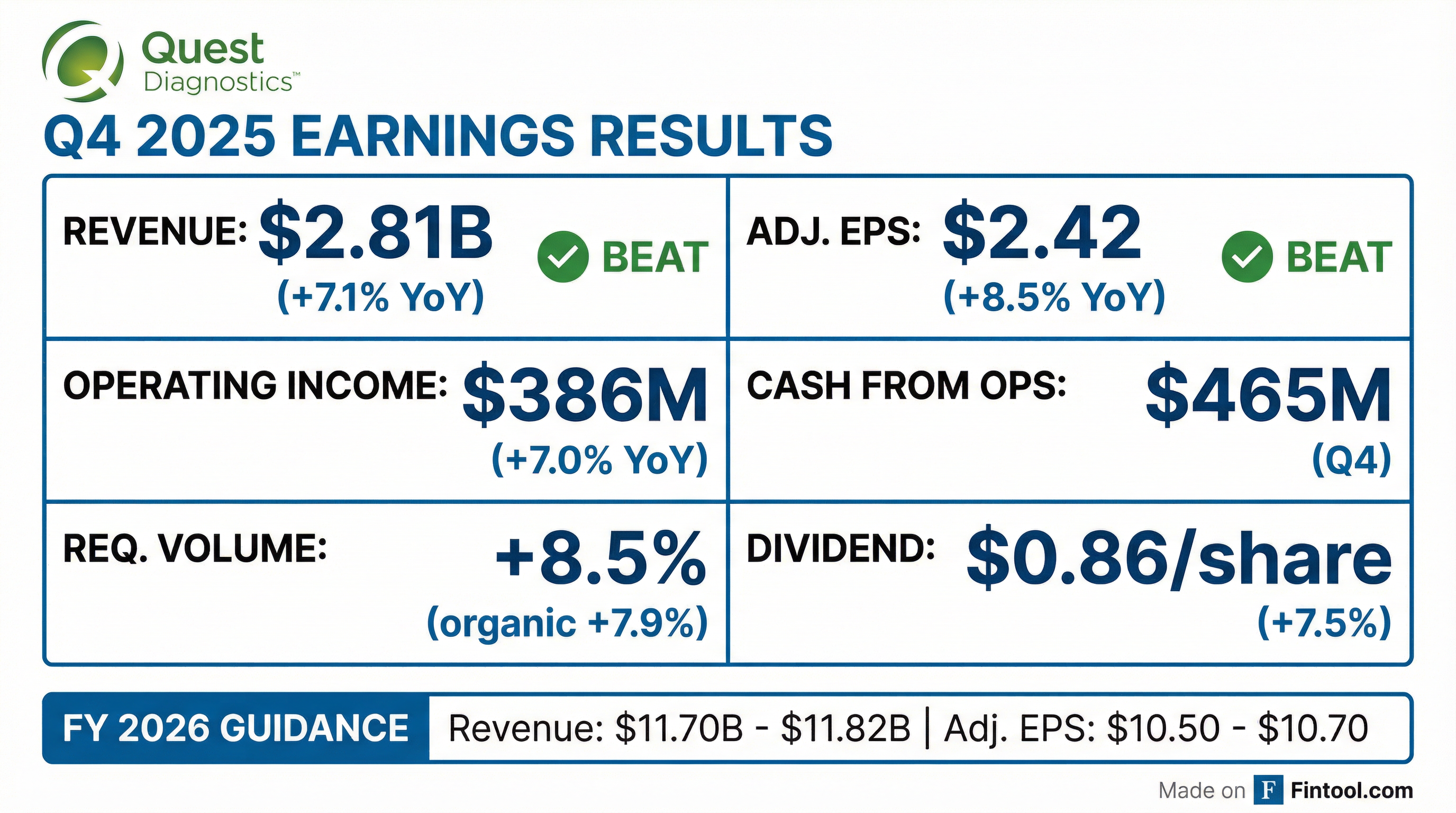
Quest Diagnostics delivered a strong Q4 2025, beating revenue estimates by 2.6% with revenues of $2.81 billion (+7.1% YoY) and adjusted EPS of $2.42 (+8.5% YoY) . The diagnostic testing leader closed out a year of double-digit growth—full year revenue rose 11.8% to $11.04 billion—while announcing FY 2026 guidance materially above consensus and a 7.5% dividend increase .
Did Quest Diagnostics Beat Earnings?
Yes, on both revenue and EPS.
*Values retrieved from S&P Global consensus estimates.
The revenue beat was driven by 8.5% growth in requisition volume (+7.9% organic), offset by a slight 0.1% decline in revenue per requisition . Volume strength reflects continued market share gains and partnership ramps.
Volume breakdown (excluding Corewell/Fresenius) :
- Organic volume: 4.1% (vs. 7.9% total)
- Revenue per requisition: +3%
- Organic revenue: 5.6% (vs. 6.4% total)
The Corewell and Fresenius relationships deliver significant volume at lower revenue per requisition than company average .
Full Year 2025 Performance
 Ask Fintool AI Agent
What Did Management Guide?
FY 2026 guidance came in materially above consensus.
*Values retrieved from S&P Global consensus estimates.
CEO Jim Davis struck a confident tone: "Our 2026 guidance reflects our continued confidence in our business strengths and market fundamentals" .
The guidance implies continued momentum from:
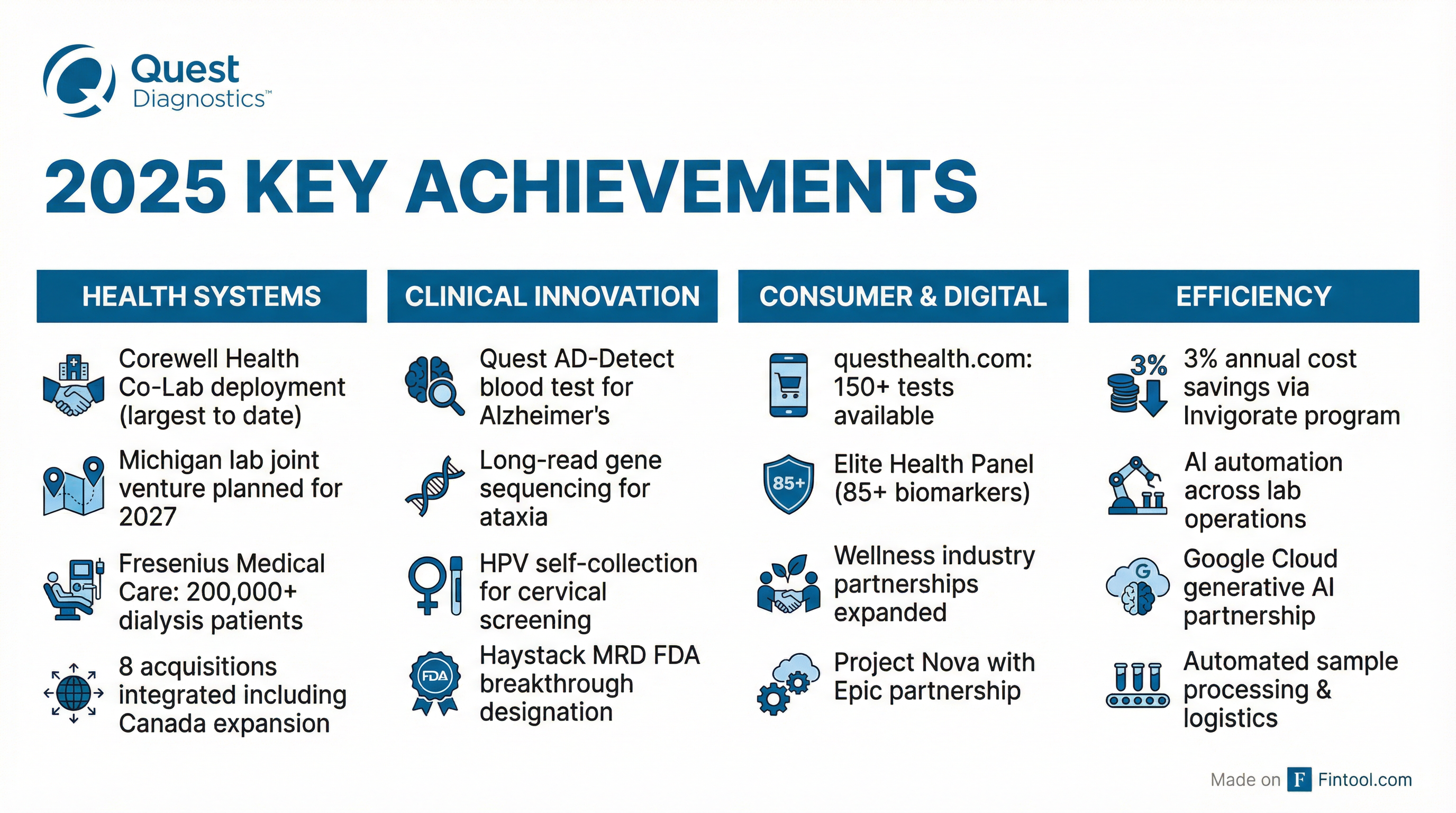
- Health system partnerships: Corewell Health Co-Lab deployment (largest to date), with a joint venture lab planned for 2027. Co-lab solutions expected to generate ~$1B annual revenue in 2026
- Payer network expansion: Back in network with Elevance in Nevada, Colorado, Georgia, and Virginia—still "early innings" of capturing share in these states . Also added Sentara health system in Virginia
- Advanced diagnostics growth: Alzheimer's (AD-Detect), autoimmune (ANA-lyzer), Cardio IQ, and diabetes testing all seeing strong momentum
- Operational efficiency: Targeting 3% annual cost savings through the Invigorate program
What Changed This Quarter?
PAMA Legislation Update
Congress enacted bipartisan legislation delaying PAMA implementation until end of 2026—the sixth consecutive year of delay . The data collection period was updated from 2019 to the first half of 2025. CEO Davis noted: "These steps do not fix PAMA's structural flaws, which include relying on an estimated 10,000+ labs to self-report data" .
The company continues pushing for the Results Act, which would use independent third-party databases representing 80%+ of adjudicated lab records rather than self-reported data .
Capital Allocation Gets Aggressive
The Board announced two significant capital return actions :
- Dividend increase: +7.5% to $0.86/quarter ($3.44 annually), marking 15 consecutive years of dividend increases
- Share repurchase authorization: +$1B added, bringing total available to ~$1.4B
This signals management confidence in cash generation—FY 2025 operating cash flow of $1.89B was up 41% YoY .
Innovation Pipeline Accelerating
Key 2025 clinical innovation milestones :
- Quest AD-Detect®: New blood test for Alzheimer's disease diagnosis
- Haystack MRD®: FDA breakthrough device designation for solid tumor cancer monitoring
- Long-read gene sequencing: New capability for ataxia movement disorders
- HPV self-collection: Expanded cervical cancer screening options
Strategic Partnerships Expanding
- Epic partnership: "Project Nova" multi-year order-to-cash transformation, ~$0.25 EPS dilution in 2026
- Fresenius Medical Care: Scaled to serve 200,000+ dialysis patients with water-purity testing capabilities
- Consumer wellness: QuestHealth.com at $100M run-rate, grew ~35% in 2025; partnerships with WHOOP, Oura, Function Health
- Data monetization: Growing double digits annually, serving pharma (clinical trial targeting), payers (patient history), and public health agencies
Ask Fintool AI AgentQ&A Highlights
Guidance Bridge and Margin Drivers
Management provided detailed color on 2026 margin expectations :
Seasonality guidance: Q1 weakest, Q2 strongest, with ~49% of EPS in H1 and ~51% in H2 .
Weather Impact
January 2026 storms created "greater headwind than what we experienced during the same period a year ago" . However, management noted the first 3-3.5 weeks showed "very strong growth" before storms hit . Recovery expected through Q1, with general wellness work typically rebounding while some episodic testing may be lost permanently .
Competitive Positioning
CEO Davis on market dynamics: "Quest and our nearest competitor are probably less than 25%-30% of the market. So I think we're making inroads versus hospital outreach... physician office labs... these big health systems are just not going after that business as strongly" .
Consumer Testing Sustainability
CFO Samad on direct-to-consumer: "QuestHealth.com grew approximately 35% for the full year 2025... margin rates on those businesses is an attractive margin profile above our corporate average because it's all cash pay. We don't have patient concessions. We don't have denials" .
Management expects consumer-initiated testing to maintain >20% CAGR long-term .
Health Exchange Impact
The company modeled 30 basis points of revenue impact from health exchanges for 2026 . Early data shows enrollments "actually been better than expected," though mix shifts to higher-deductible plans require monitoring .
Oncology Pipeline Update
On the new Flow MRD test for myeloma: "Speed is of the essence... we can get an answer back within three days" versus weeks for NGS-based tests, at "significantly lower cost" . The test offers "ultra-good sensitivity specificity" comparable to next-gen sequencing .
How Did the Stock React?
DGX closed at $191.25 on February 9 (last trading day before results). After-hours trading shows the stock at $192.40, up +0.6% following the release.
Historical context: DGX has beaten estimates consistently over the past 8 quarters. The stock is trading near its 52-week high of $197.55 and is up approximately 22% from the 52-week low of $157.20.
Valuation Snapshot
*Values retrieved from S&P Global market data.
Margin Trends
Operating margins remained stable despite ongoing integration activities:
Full year adjusted operating margin improved 30 bps to 15.9% vs 15.6% in 2024 , demonstrating operating leverage as the company scales.
Balance Sheet & Cash Flow
2025 capital deployment :
- Share repurchases: $452M (2.5M shares)
- Dividends paid: $353M
- CapEx: $527M
- Acquisitions: $101M (net of cash)
Debt reduction of ~$600M YoY reflects strong free cash flow generation and disciplined capital allocation.
Key Risks & Watch Items
- Revenue per requisition pressure: Down 0.1% YoY in Q4 on a total basis, though up 3% excluding Corewell/Fresenius
- Corewell margin dilution: $250M at low single-digit margins in 2026 before improving to low teens in 2027
- Project Nova investment: ~$0.25 EPS dilution in 2026 from order-to-cash modernization with Epic
- PAMA uncertainty: Despite delay, structural flaws remain unresolved; Results Act passage uncertain
- Weather sensitivity: January 2026 storms impacted volumes; guidance assumes some recovery but not all
Forward Catalysts
- Q1 2026 earnings: Expected late April 2026 (watch weather recovery)
- PAMA data collection: Labs submit 2025 H1 data to CMS; Results Act push in first half of 2026
- Corewell Health lab opening: State-of-the-art Michigan facility targeted for 2027
- Haystack MRD reimbursement: MolDX tech assessment pending for Medicare Advantage coverage
- Guardant colon cancer partnership: Blood draw collaboration launching late Q1 2026
Ask Fintool AI AgentData sourced from Quest Diagnostics Q4 2025 8-K filing, Q4 2025 earnings call transcript, and S&P Global. Stock data as of February 10, 2026.