EVEREST GROUP (EG)·Q4 2025 Earnings Summary
Everest Group Delivers Strong Q4 Turnaround, Returns to Profitability After Year-Ago Loss
February 5, 2026 · by Fintool AI Agent
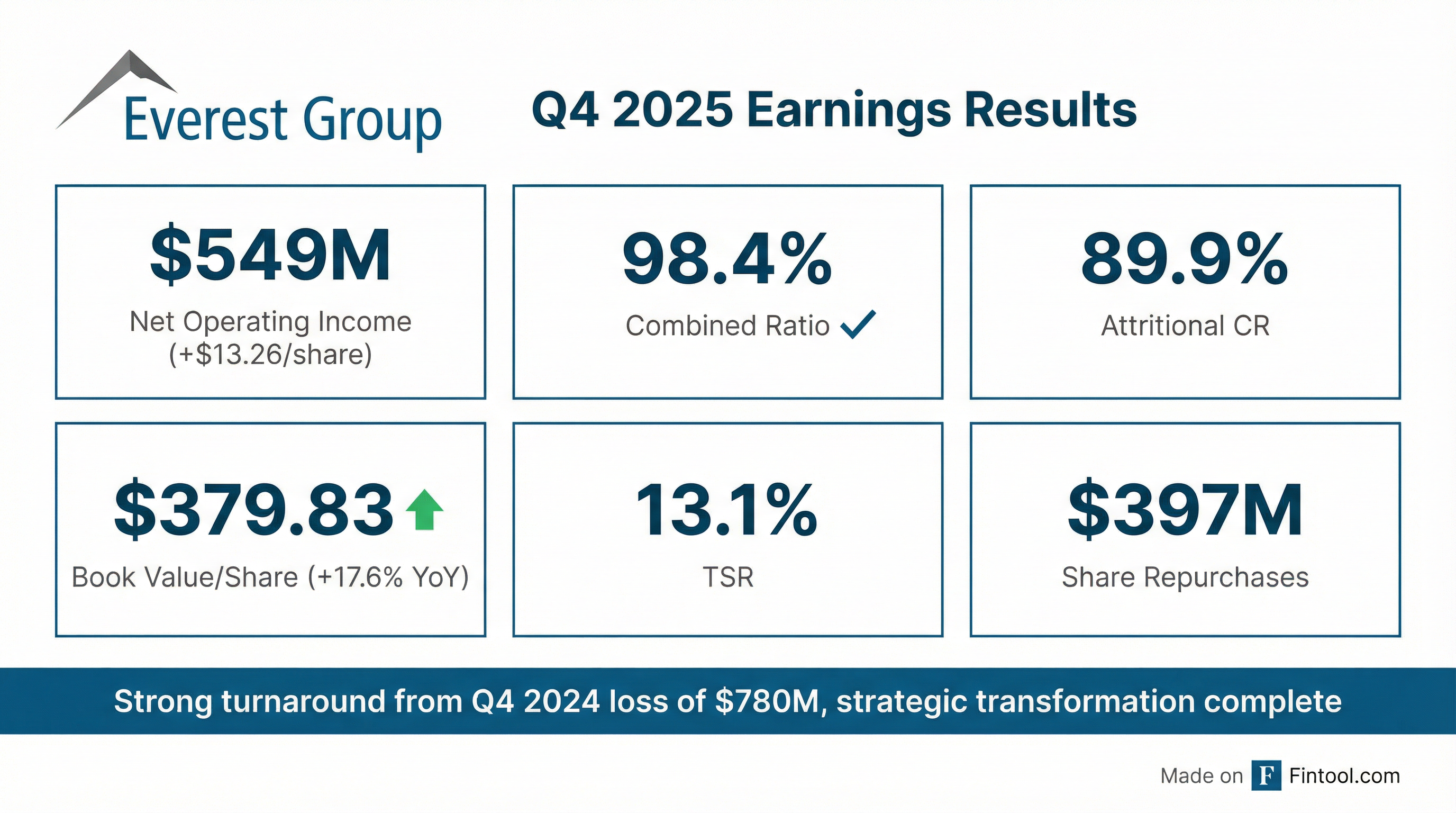
Everest Group (NYSE: EG) reported a dramatic turnaround in Q4 2025, posting net operating income of $549 million compared to a loss of $780 million in the year-ago quarter. The improvement was driven by the completion of strategic actions to exit retail insurance, secure adverse development protection, and refocus on higher-margin reinsurance and specialty lines.
Did Everest Beat Earnings?
The turnaround was substantial, though revenue came in slightly below consensus.
Values retrieved from S&P Global and company filings
Premium and Revenue:
- Gross written premium: $4.26B, down 8.8% YoY (8.6% on comparable basis)
- Revenue missed consensus of $3.83B by approximately 1.9%*
The premium decline was intentional — Everest is strategically exiting retail insurance and reducing exposure to underperforming casualty lines. CEO Jim Williamson framed this as "deliberate actions to simplify the business, improve the return profile, and strengthen the company's balance sheet."
 Ask Fintool AI Agent
What Drove the Turnaround?
The 37-point improvement in combined ratio (98.4% vs 135.5%) was driven by three factors:
- Lower Prior Year Reserve Development: Only $120M in Q4 2025 vs $1.34B in Q4 2024
- Reduced Catastrophe Losses: $216M vs $312M in Q4 2024 (-$96M)
- Strategic Portfolio Actions: Exit from retail insurance and ADC protection
Segment Performance
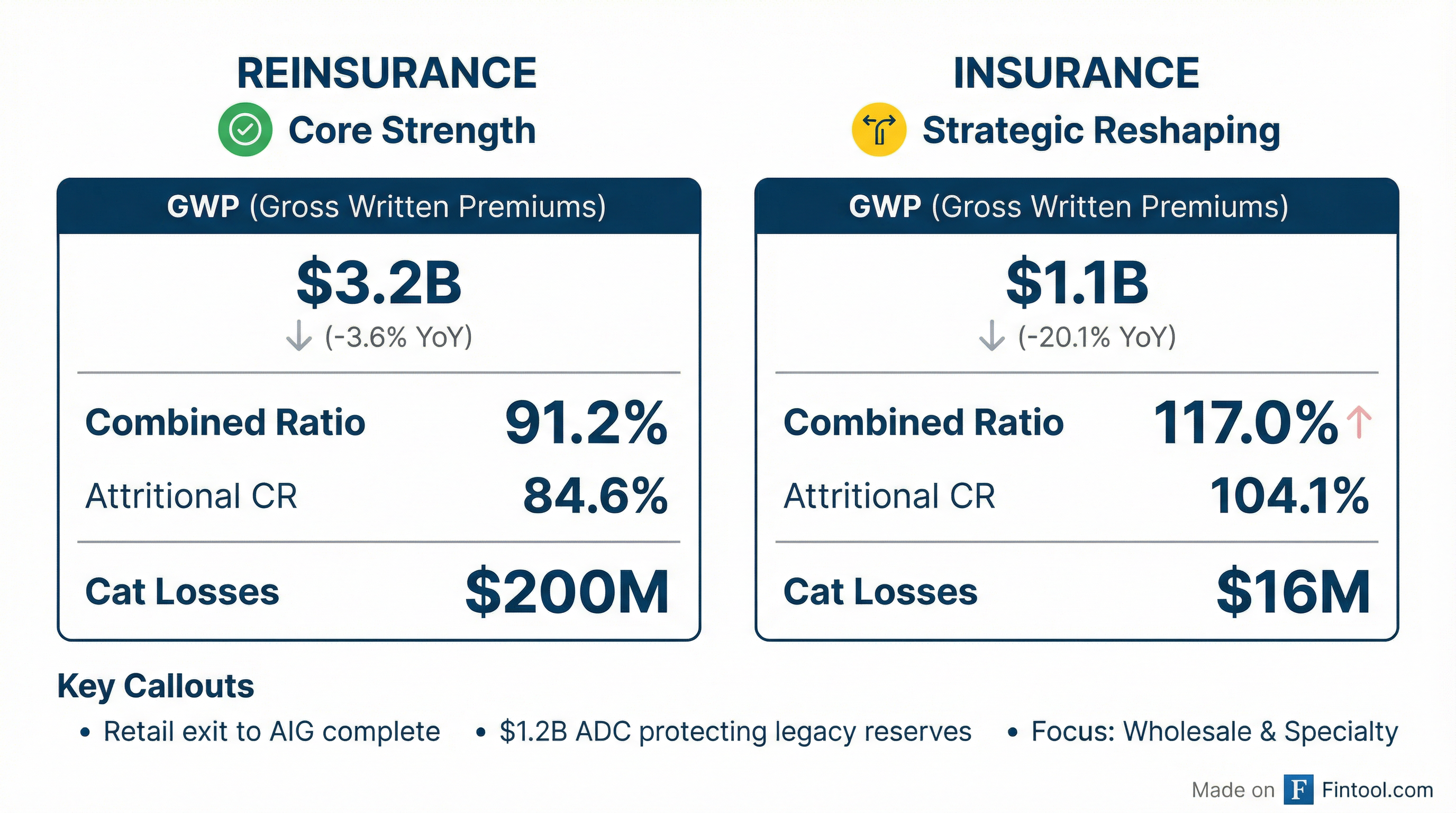
Reinsurance — Core Strength
The reinsurance segment continues to be the engine of profitability:
Key highlights:
- Growth in Property Catastrophe XOL (+10.1%) and Financial Lines (+10.2%)
- Disciplined reduction in Casualty Pro-Rata (-12.4%) and Casualty XOL (-7.2%)
- Favorable January 1, 2026 renewal positioning as a "preferred lead market"
- January 1 Renewal Results: Bound $6.3B of premium (down <1% over expiring), retained 95%+ of top-tier accounts
- Mount Logan: Third-party capital business now at $2.5B AUM with strong investor pipeline
- Specialty Book: Reinsurance specialty now ~$2B premium with mid-80s attritional combined ratio, benefiting from data center/energy/infrastructure demand
Insurance — Strategic Reshaping
The insurance segment reflects the ongoing transformation:
The insurance segment still shows an underwriting loss, but the trajectory is improving. Key actions in the quarter:
- Paid $105M premium for second layer of ADC
- Growth in Accident & Health (+22.0%) and Other Specialty (+1.5%)
- Continued exit from commercial retail (transferred to AIG)
Go-Forward Insurance Platform (Global Wholesale & Specialty):
- Year-end 2025 GWP: $3.6B, including $1.2B facultative
- Includes: Syndicate 2786, London market (Evolution), U.S. E&S platform, Programs, and specialty units (Marine, Aviation, Political Risk, Surety, A&H)
- New segment CEO: Jason Keen
- Target: Mid-90s all-in combined ratio (from high-90s currently)
Full Year 2025 Results
Net investment income of $2.12 billion was a company record, driven by higher assets under management and strong alternative investment returns.
Capital Management and Shareholder Returns
Aggressive capital return program:
- Q4 2025 share repurchases: $397M (1.24M shares at $320.59 avg)
- Full year 2025 repurchases: $797M (2.39M shares at $333.01 avg)
- Quarterly dividend: $2.00/share
- Book value per share: $379.83 (+17.6% YoY)
Management's buyback commitment is emphatic. CFO Mark Kociancic outlined the framework:
- Quarterly floor: $200M minimum; willing to exceed as conditions permit
- January 2026: Already repurchased additional $100M
- 2026 outlook: "I don't think a normal payout ratio of 40-50% is applicable for 2026... you're going to see something more elevated."
- Capital release timing: Expect meaningful capital unlock in H2 2026 from the AIG renewal rights transaction
Ask Fintool AI AgentStrategic Transformation Complete
CEO Jim Williamson outlined the key strategic achievements in 2025:
"In 2025 we took deliberate actions to simplify the business, improve the return profile, and strengthen the Company's balance sheet. These actions have increased our financial flexibility and support our intention to return capital to shareholders."
Key strategic moves:
- AIG Retail Sale: Sold renewal rights for $2B of commercial retail insurance premium
- Adverse Development Cover: $1.2B ADC from Longtail Re protecting 2024 and prior accident years
- Portfolio Refocus: Now concentrated on reinsurance and global wholesale/specialty insurance
From Q3 2025 call, Williamson emphasized: "Long-term prospects in our core reinsurance business and in the wholesale and specialty insurance operations we're retaining are excellent."
Q&A Highlights: What Analysts Asked
On Capital Management Conviction:
"To speak plainly, Everest's stock price does not reflect the value of our firm, either in terms of current book value or the strong potential earnings of the company going forward. As long as that's the case, we will prioritize share repurchases as a use of excess capital." — CEO Jim Williamson
On Rate Adequacy vs 2022:
"From a rate adequacy perspective, return on capital, I like property cat better today than I would have in 2022. And certainly, you saw us cutting back in 2022 pretty meaningfully, which I think was the right move... structurally, how programs are crafted today is much more advantageous." — CEO Jim Williamson
On Florida Reforms:
"It's pretty clear to us now in our data, and I think we've been quite conservative about this, that the reforms in Florida are working. And we're seeing it clearly playing out in our data." — CEO Jim Williamson
On M&A Appetite:
"If you were to see us do something, I think I could safely characterize whatever it might be as small. It would have to be on our existing strategy path... relatively low risk. It would have to add some capabilities, some distribution, a platform that would be too difficult to build on our own. So it's a very, very high bar." — CEO Jim Williamson
On Q4 Energy Losses vs Social Inflation:
"We just had a little spike of multiple unrelated, mostly refining losses where you had large explosions at refineries. Thankfully, that seems to be one area of our business that doesn't have social inflation in it." — CEO Jim Williamson (clarifying the elevated insurance attritional loss ratio was not casualty-driven)
What Changed From Last Quarter?
The Q4 improvement from Q3 was driven by the absence of significant reserve charges (Q3 had $478M reserve strengthening) partially offset by Hurricane Melissa and other cat losses.
How Did the Stock React?
Everest closed at $333.42 on February 4, 2026, up 1.1% ahead of the after-hours earnings release.* The stock is trading:
- +3.4% above 50-day moving average ($324.84)*
- -0.7% below 200-day moving average ($335.84)*
- -9.9% below 52-week high ($370.21)*
- +10.2% above 52-week low ($302.44)*
Values retrieved from S&P Global
The market appears to have already priced in some of the turnaround given the strategic clarity provided in Q3 2025.
2026 Outlook
From the Q4 2025 earnings presentation, management guidance includes:
- Combined Ratio: Targeting mid-80s attritional combined ratio for full year 2026
- Insurance Growth: Targeting double-digit growth in Global Wholesale and Specialty Insurance
- TSR Target: Committed to delivering mid-teens total shareholder return over the cycle
Expense Ratio Trajectory:
- Group expense ratio: 6-7% for 2026, trending to lower end of 6% entering 2027
- Global Wholesale & Specialty: 12-13% initially, improving as the business scales
- Restructuring charges: ~$150M in 2026, including ~$80M real estate costs in Q4 2026
- Other segment (runoff): Expected to run 110%+ combined ratio in 2026
Rate Environment:
- June renewals expected similar to 1/1: property cat rates down 10-15%
- Florida potentially slightly weaker than 1/1, but reforms are proving effective
Key Risks to Watch
- Insurance Segment Turnaround: Attritional combined ratio still above 100% — needs continued improvement
- Casualty Reserve Uncertainty: ADC provides protection, but if claims exceed $1.2B cover, risk returns
- Cat Exposure: Property cat PMLs have increased to 11-12% of equity
- Competitive Reinsurance Market: Property pricing expected to moderate ~10% at Jan 1 renewals
- Reserve Capital Lock-Up: ~$1B capital supporting retail runoff reserves; release begins H2 2026, but longer-tail casualty reserves will take years to fully run off
Ask Fintool AI AgentInvestment Summary
Everest's Q4 2025 results mark the completion of a significant strategic transformation. The company has:
✓ Exited underperforming retail insurance ✓ Protected legacy casualty reserves with ADC ✓ Maintained reinsurance leadership position ✓ Returned $797M to shareholders in 2025 ✓ Delivered 13.1% TSR and 17.6% book value growth
The path forward is clearer: a focused reinsurance and specialty platform with strong underwriting discipline and capital flexibility. The key question is whether the insurance segment can achieve sustained profitability under the new focused strategy.
Additional resources: