Enphase Energy (ENPH)·Q4 2025 Earnings Summary
Enphase Crushes EPS, Stock Surges 20% as Fifth-Gen Battery Looms
February 3, 2026 · by Fintool AI Agent
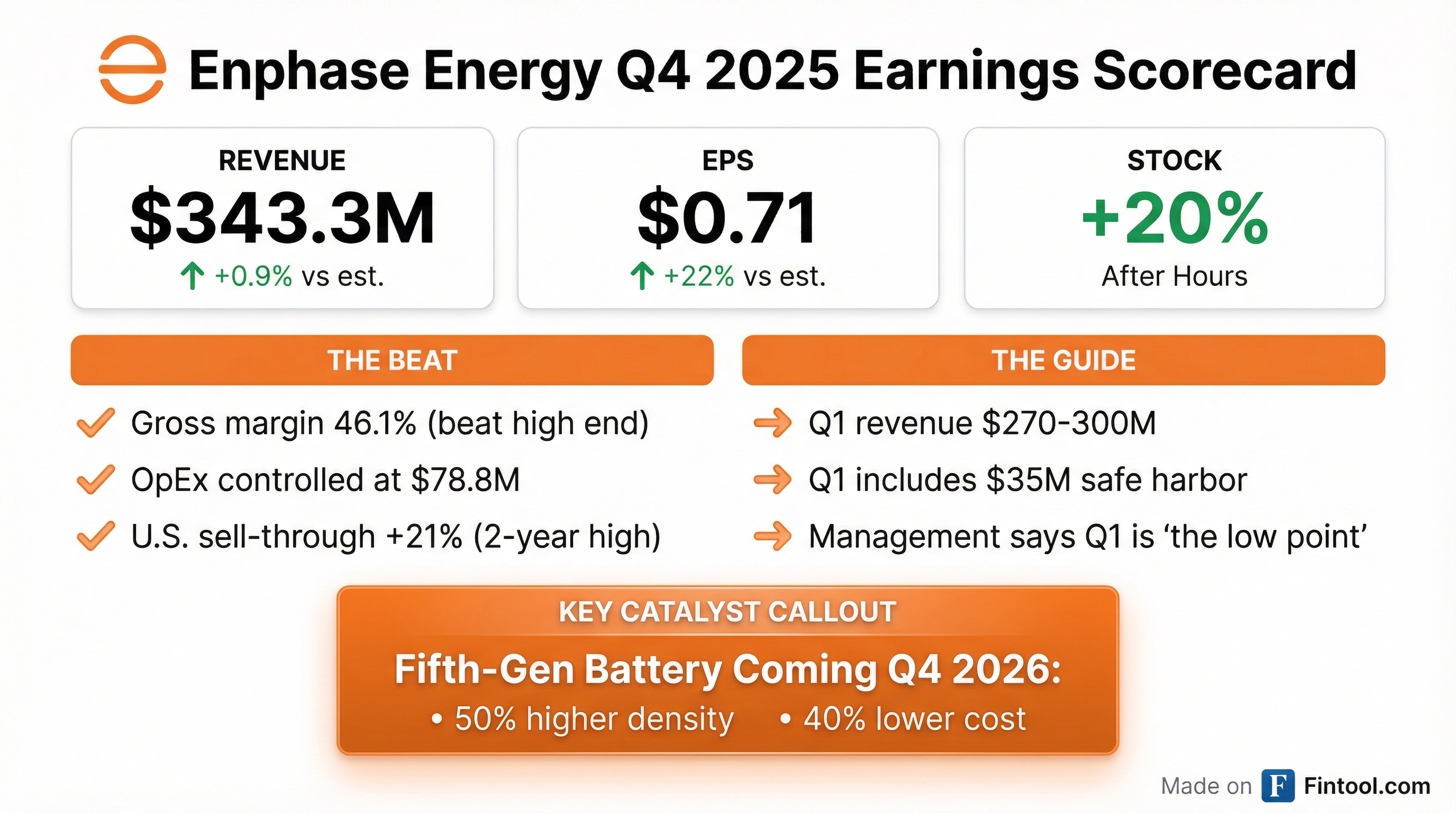
Enphase Energy delivered a blowout Q4 2025, with non-GAAP EPS of $0.71 crushing the $0.58 consensus by 22%, despite revenue declining 16% sequentially to $343.3 million. The stock exploded 19.8% in after-hours trading to $44.65 as investors cheered the EPS beat, record U.S. sell-through demand, and CEO Badri Kothandaraman's detailed roadmap for the fifth-generation battery—which he said will have "40% lower cost structure" than the current generation.
Did Enphase Beat Earnings?
Yes—on both revenue and EPS, with margin strength the highlight.
The EPS outperformance was driven by gross margin beating the high end of guidance (46.1% vs 43-46% guided), disciplined OpEx at $78.8M, and a favorable product mix despite the 5.1 percentage point tariff headwind.
 Ask Fintool AI Agent
What Changed From Last Quarter?
The sequential story is mixed—revenue down but U.S. demand surging:
Key drivers of the revenue decline:
- Safe harbor revenue drop: $20.3M in Q4 vs $70.9M in Q3—a $50M headwind
- Europe collapsed: Revenue down 29% QoQ, sell-through down 23%
- U.S. down 13%: Despite strong underlying demand, comparison suffered from lower safe harbor
The bright spot: U.S. sell-through demand surged 21% QoQ to the highest level in more than two years, driven by installations ahead of the Section 25D tax credit expiration. Battery sell-through was up 27% and microinverter sell-through up ~20%.
What Did Management Guide?
Q1 2026 guidance came in below Q4, though better than October's $250M preliminary view:
Key guidance context:
- Management said Q1 marks the "low point for underlying demand" with improvement expected through 2026
- Company is approximately 90% booked to the midpoint of revenue guidance
- Headcount reduction: 6% workforce cut, targeting $70-75M OpEx starting Q3 2026
- Q2 revenue expected to be up vs Q1, with additional safe harbor activity anticipated
Ask Fintool AI AgentHow Did the Stock React?
ENPH closed the regular session at $36.47 (up 2.2% during the day) and surged to $44.65 in after-hours trading—a 19.8% gain.
The massive rally reflects:
- EPS crushed expectations by 22% with margin discipline
- U.S. demand inflected with sell-through at 2-year highs
- Fifth-gen battery excitement with 40% lower costs enabling competitive pricing
- Credible roadmap for 2026 with multiple growth levers articulated
Year-to-date context: ENPH entered earnings having traded as low as $25.78 over the past year. Even after the after-hours surge, the stock remains well below its 52-week high of $70.78.
Key Management Quotes
"We expect Q1 marks the low point for underlying demand with improvement expected through 2026, particularly in the second half." — Badri Kothandaraman, CEO
"The cost structure [of the fifth-generation battery] will be 40% lower. This will enable us to basically reduce our end pricing for the consumer, which is necessary as battery adoption increases, and yet maintain our gross margins in line with the corporate gross margins." — Badri Kothandaraman, CEO
"Every state in the next 10 years will become solar-plus storage. Storage is going to boom. Batteries will pull solar. It's got to become the reverse." — Badri Kothandaraman, CEO
"We are evaluating multiple next-generation power conversion architectures as part of our long-term R&D... where medium voltage AC can be efficiently converted, controlled, and managed into 800-volt DC before the power reaches the AI rack." — Badri Kothandaraman, CEO, on data center opportunity
Five Growth Levers Management Outlined
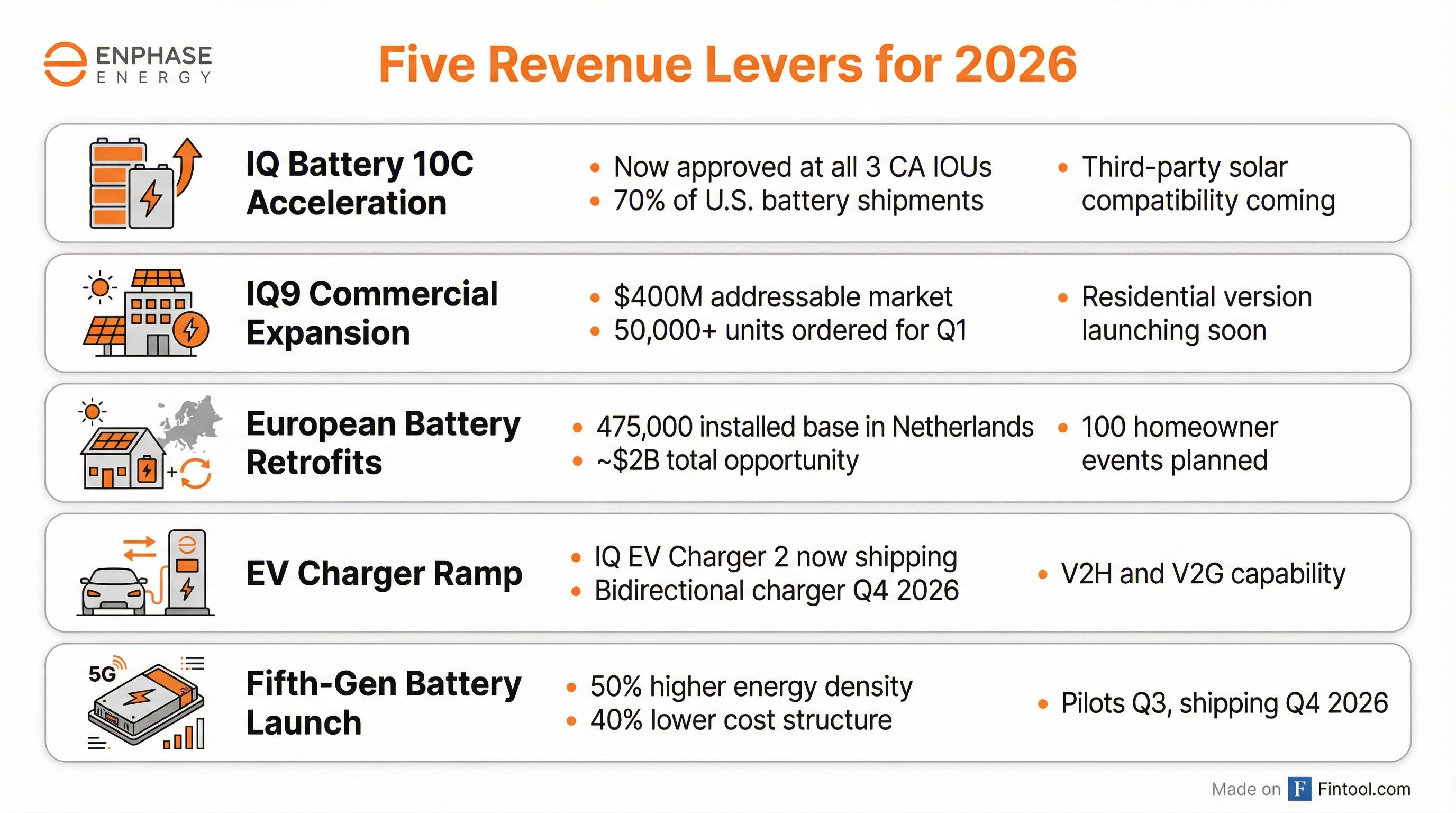
CEO Badri Kothandaraman laid out five specific revenue levers "entirely in our control":
-
Accelerating IQ Battery 10C growth - Now approved at all three California IOUs; 70% of U.S. battery shipments are the new 10C; third-party solar compatibility coming
-
Scaling IQ9 GaN microinverters - Expanding into $400M 480V commercial TAM; >50,000 units ordered for Q1; residential version launching "in a few weeks"
-
Unlocking battery retrofits in Europe - Holding 2 homeowner events per week in Netherlands (100 planned for 2026); ~475,000 installed base represents ~$2B battery retrofit opportunity
-
Ramping IQ EV Charger 2 - Shipping in U.S., Europe, Australia, Canada, New Zealand; bidirectional charger targeting Q4 2026 production
-
Launching fifth-generation battery - 50% higher energy density, 40% lower cost; pilots Q3 2026, shipping Q4 2026
Tariff Mitigation Strategy
Management was direct about the 5% gross margin tariff drag and how they plan to offset it:
Current tariff impact breakdown:
- Microinverters: ~2% (raw materials imported for U.S. manufacturing)
- Batteries: ~2% (45% tariff on China cell packs)
- Accessories: ~1%
Mitigation through innovation:
- IQ9: Higher power (10% increase) in smaller form factor → better margins + higher PTC credits ($0.11/watt)
- Fifth-gen battery: Compact prismatic cells with 50% higher energy density and 40% lower cost → enables "above corporate gross margins even with tariffs"
- Non-China battery cells: First shipments expected Q1 2026; ramping in H1 2026
"The answer is in innovation. IQ9, fifth-generation battery... We are not stopping there. We are already thinking about our sixth-generation battery." — Badri Kothandaraman, CEO
Prepaid Lease Pilot Update
Enphase provided details on its TPO-led prepaid lease pilot:
- Operational in 4 states with ~40 installers
- Getting reasonable originations but testing the full cycle before scaling
- Structure: TPO owns system initially, claims 4080 tax credit, shares value with homeowner through prepaid lease
- Goal: Replace pre-25D loan TAM with prepaid leases
- Timeline: Expect to know "everything" in next 3-6 months; confident in expanding to more states
"Installers like the extra. They like this prepaid lease as a tool that helps them counter the TAM loss due to loan." — Badri Kothandaraman, CEO
Balance Sheet & Capital Allocation
Inventory note: Balance sheet inventory up ~$100M sequentially as Enphase took ownership of contract manufacturer inventory to ensure FIOC compliance. Management "laser-focused" on bringing it down.
Q&A Highlights
On Q2 revenue trajectory:
"We expect Q2 to be up... We also expect healthy Safe Harbor in the second quarter because TPO partners are going to formulate plans for 2028, 2029, 2030."
On commercial market ambitions:
"We expect over a three-year time frame to get into similar market share [in commercial] as what we have on residential."
On battery market share recovery:
"Fourth-gen will do it a bit... Fifth generation, yes, we expect to definitely take a lot of share there too... Even with all of the tariffs in place, I will be able to make good gross margins as well as offer excellent consumer pricing."
On data center opportunity:
"We are evaluating multiple next-generation power conversion architectures... specifically how medium voltage AC (13.8 kV and 34.5 kV AC) can be efficiently converted into 800-volt DC before the power reaches the AI rack."
On channel inventory:
"In the U.S., the channel is actually much leaner [than the normal 8-10 weeks]. Forward-looking weeks on hand is in the normal range."
Ask Fintool AI AgentForward Catalysts
Near-Term (Q1-Q2 2026):
- IQ9 residential microinverter launch (next few weeks)
- Non-China battery cell ramp
- Prepaid lease pilot expansion
- Safe harbor orders for 2028-2030 (TPOs have until ~July to decide)
Second Half 2026:
- IQ9 548-watt higher-power version (Q3)
- Fifth-generation battery pilots (Q3)
- Fifth-generation battery shipping (Q4)
- Bidirectional EV Charger production (Q4)
- OpEx reduction to $70-75M/quarter (Q3 onward)
Key Risks:
- Tariff pressure: 5+ percentage points of gross margin drag expected to persist
- European demand: No recovery in sight; Netherlands/France retrofit opportunity takes time
- Interest rates: Higher rates pressure solar financing economics
- Debt maturity: $632.5M due March 1, 2026 (will be paid with cash)
The Bottom Line
Enphase delivered a blowout quarter that reframes the 2026 narrative. The 22% EPS beat demonstrates margin discipline is intact despite tariffs. The 21% surge in U.S. sell-through—the highest in two years—validates underlying market health even as safe harbor revenue normalizes.
But the real story is the product roadmap. The fifth-generation battery with 40% lower costs arrives in Q4 2026 and could be a game-changer for market share. The IQ9 opens a new $400M commercial TAM. And the bidirectional EV charger positions Enphase for the vehicle-to-grid opportunity.
The 20% after-hours rally reflects a market that was positioned for the worst and got something much better—a credible path to reacceleration with multiple levers management can control.
View ENPH Company Page | View Q3 2025 Earnings | View Transcript