Eaton Corp (ETN)·Q4 2025 Earnings Summary
Eaton Stock Tumbles 7% After Hours Despite EPS Beat as Q1 Guidance Disappoints
February 3, 2026 · by Fintool AI Agent
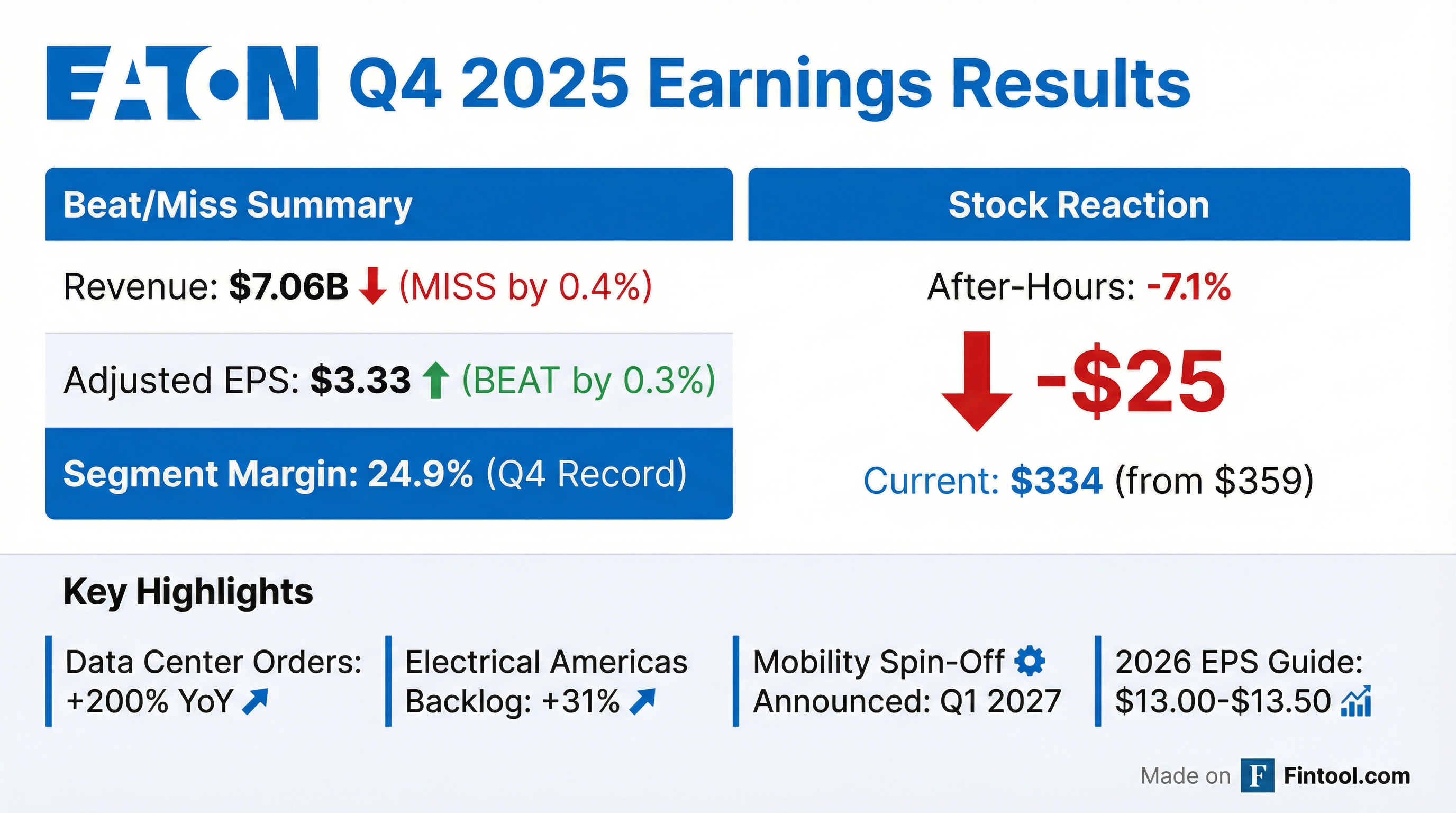
Eaton Corporation (ETN) delivered record Q4 2025 results with adjusted EPS of $3.33, up 18% year-over-year and slightly ahead of consensus expectations . Revenue of $7.06B grew 13% YoY but came in marginally below the Street's $7.08B estimate . Despite the strong quarter, shares plunged 7% in after-hours trading to $334 as Q1 2026 guidance landed roughly 8% below analyst expectations.
The company announced a major strategic pivot: a planned spin-off of its Mobility business (Vehicle and eMobility segments) expected to complete by end of Q1 2027, positioning the remaining Eaton to focus exclusively on its high-growth Electrical and Aerospace businesses .
Did Eaton Beat Earnings?
Eaton posted mixed results against consensus:
The Q4 marked Eaton's ninth consecutive quarter of EPS beats. However, the magnitude of the beat has narrowed considerably from earlier in 2025.
EPS Beat/Miss History (Last 8 Quarters):
*Values retrieved from S&P Global
 Ask Fintool AI Agent
Why Is Eaton Stock Down 7%?
The after-hours selloff stemmed from disappointing Q1 2026 guidance:
The Q1 guidance midpoint of $2.75 represents a meaningful step-down from Q4's $3.33, and significantly trails analyst expectations of $3.01. Management attributed the sequential decline to typical Q1 seasonality and additional corporate expenses noted at ~$45M higher than Q1 2025 .
What Did Management Guide for 2026?
Full-year 2026 guidance came in largely in-line with expectations:
Guidance assumes ~$1.1B in capex and a tax rate of 17.5-18.5% on adjusted earnings .
Segment Performance: Electrical Dominates
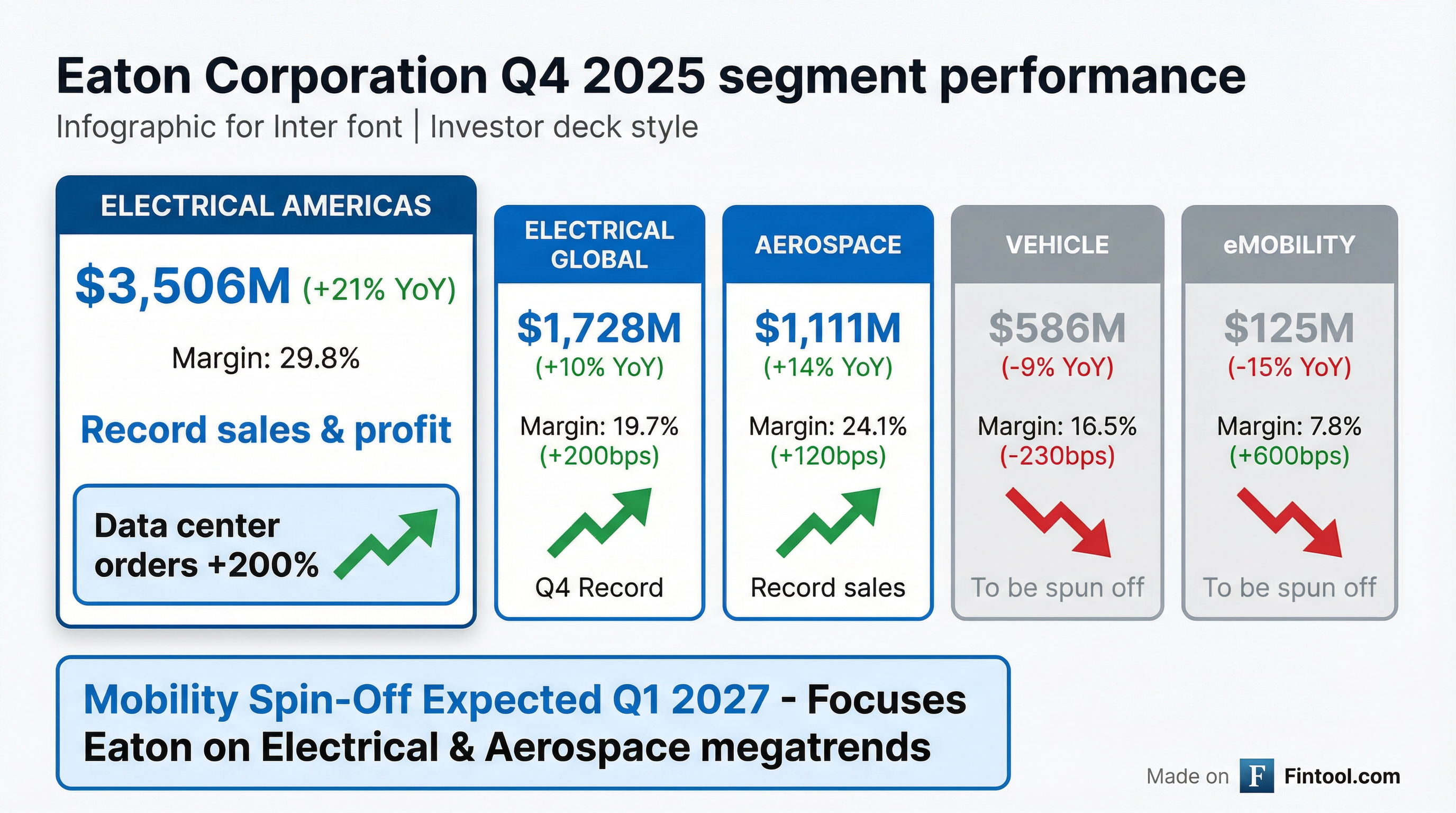
Electrical Americas delivered another blowout quarter with 21% revenue growth and record profits :
Key highlights:
- Data center orders up ~200% YoY in Q4
- Orders up 16% on rolling 12-month basis
- Book-to-bill of 1.2 on rolling 12-month basis
- Backlog up $3.1B or 31% YoY
The margin decline reflects mix shift and investments to ramp capacity (~$1.5B invested across ~24 projects) . Management provided clarity on the ramp timeline:
- Half of projects: Construction completed mid-2025, currently ramping production
- Quarter of projects: Construction completing H1 2026, ramp starting late Q2
- Remaining quarter: Construction through 2026, production ramping 2027
Other Segments:
Ask Fintool AI AgentThe Mobility Spin-Off: What It Means
Eaton announced plans to spin off its Mobility business (combining Vehicle and eMobility segments) into an independent, publicly traded company by end of Q1 2027 . The spin is expected to be tax-free to U.S. shareholders.
Rationale:
- Portfolio focus: Concentrates Eaton on Electrical and Aerospace businesses benefiting from secular megatrends (data centers, grid modernization, electrification)
- Capital allocation: Enables tailored strategies for high-growth vs cyclical businesses
- Agility: Dedicated leadership teams can adapt faster to market dynamics
Scale of Mobility business (combined):
- Q4 2025 Revenue: ~$711M (Vehicle $586M + eMobility $125M)
- ~10% of total Eaton revenue
- Lower margin profile (Vehicle 16.5%, eMobility 7.8%) vs core segments
This follows Eaton's track record of portfolio transformation, including recent deals like Fibrebond ($1.43B, data center power enclosures) , Ultra PCS ($1.55B, aerospace electronics, closed January 2026) , and Boyd Thermal ($9.5B pending, thermal systems for data centers) .
M&A Acceleration: $12B+ in Deals
Eaton has dramatically accelerated its acquisition strategy, deploying capital to strengthen its Electrical and Aerospace businesses:
The Boyd Thermal acquisition, once closed, would represent Eaton's largest deal ever and significantly expand its thermal management capabilities for data center and aerospace applications.
Backlog Tells the Story
Eaton's backlog position provides strong visibility into future growth:
Combined Electrical + Aerospace backlog has grown from $4.2B in 2019 to $19.6B in 2025 — a near 5x increase. The company noted backlog provides "extended visibility and a high level of confidence in future growth" .
2026 Segment Outlook
End market growth assumptions for 2026 total ~7%, with particular strength in data centers/distributed IT (21% of sales) and commercial aerospace (9% of sales) .
Non-Data Center Momentum (from Q&A):
- Utilities orders: Up low teens on 12-month basis in Electrical Americas
- Aerospace aftermarket: Surprise strength in 2025, potential upside in 2026
- Short-cycle markets: Management sees "green shoots" in residential, Machine OEM, and mobility — "inflecting positively" but maintaining caution
Q&A Highlights: What Analysts Asked
The earnings call Q&A revealed important details on investor concerns:
On Data Center Confidence (Andrew Obin, Bank of America): CEO Paulo Ruiz emphasized the durability of data center demand: "Announcements on the industry were up over 200% year-over-year in 2025. The backlog is also over 200% up, and it equates to 11 years of what was built in 2025... The market is very, very strong."
Key data points shared:
- Hyperscalers reconfirmed 2026 CapEx plans
- Multi-tenant and new cloud players "so active — I've never seen them so active"
- Order mix shifting to AI: 50% cloud / 50% AI by orders in 2025, vs 70% cloud / 30% AI by revenue
- Eaton's addressable market grows from $2.9M to $3.4M per megawatt after Boyd closes
On Boyd Thermal & Liquid Cooling Strategy: Ruiz provided an extensive technical explanation of Eaton's cooling strategy, distinguishing between "inner loop" (close to the white space, where Eaton plays) and "outer loop" (chillers, where Eaton partners with specialists) . On NVIDIA's announcement that next-gen chips can run hotter:
"There is no negative impact on the inner loop, the part of the cooling that we decided to play. I would say it's quite the opposite because with those systems, those new systems, we require bigger and even more sophisticated elements."
Boyd delivered a strong January and management remains confident in $1.7B revenue target for 2026 .
On 800-Volt DC Transition (Deane Dray, RBC): "We are leading the technology here with Resilient Power. We are working with authorities to create codes so we can commercialize the technology. We have a seat on the table to define those codes together with the industry leaders."
On EPS Cadence (Chris Snyder, Morgan Stanley): Management explained the 44/56 first-half/second-half EPS split (vs historical 47/53):
- Tax rate: 20-21% in H1 vs 16-17% in H2 (explains ~2 points of the gap)
- Electrical Americas ramp costs: Front-loaded investments explain the remainder
"We set realistic expectations, which we aim to beat." — CEO Paulo Ruiz
On Margin Trajectory (Nicole DeBlase, Deutsche Bank): CFO Olivier Leonetti quantified the margin impact: "The impact on ESA margin due to those ramps was about 100 basis points last year. We believe this year is going to be... about 130 basis points in the full 2026. Those higher costs will be front-end loaded."
Ruiz outlined the quarterly cadence: "Think about Q1 as being our guidance for the business. Expect progress in Q2. Expect momentum into Q3 and then a stronger pace of backlog liquidation in Q4."
On Order Mix & Multi-Year Agreements (Deane Dray): Management noted the order dynamic has normalized — customers are no longer "panic buying" to lock in capacity: "The orders we are getting now are to be delivered in between 12-18 months. That's it... No one is pre-booking or pre-ordering capacity that they see for the future."
Leadership Transition
CFO Olivier Leonetti will depart on April 1, 2026, as part of a planned transition . He has served as a board director for five years and CFO for two years. No successor has been announced publicly.
Key Risks and Concerns
- Q1 guidance miss: The -8.6% gap to consensus on Q1 EPS signals either conservatism or legitimate headwinds that could persist
- Electrical Americas margins: -180 bps compression despite revenue surge suggests capacity investments are pressuring near-term profitability — quantified at ~130 bps drag in 2026
- Mobility uncertainty: Spin-off execution risk and value realization for a subscale, lower-margin business
- Tariff exposure: While Eaton has historically managed trade disruptions well , renewed tariff pressures could impact 2026
- CFO transition: Olivier Leonetti departing April 1, 2026 creates near-term leadership transition risk
What to Watch Going Forward
- Q1 2026 results (expected early May): Will actual results beat the low guidance bar? Management explicitly noted they "set realistic expectations, which we aim to beat"
- Boyd Thermal close (expected Q2 2026): $1.7B revenue target for 2026 — strong January start
- Mobility spin details: Management expected to provide more information throughout 2026 — no investor day planned for 2026 as focus remains on execution
- CFO succession: Olivier Leonetti departing April 1, 2026 — successor not yet announced
- Data center order sustainability: Can the +200% YoY order momentum continue? Watch for AI vs cloud mix shifts
- Margin trajectory: Q4 2026 expected to show "stronger pace" as ramp costs normalize
Ask Fintool AI AgentFor more on Eaton, visit the ETN company page or read the full Q4 2025 earnings transcript.