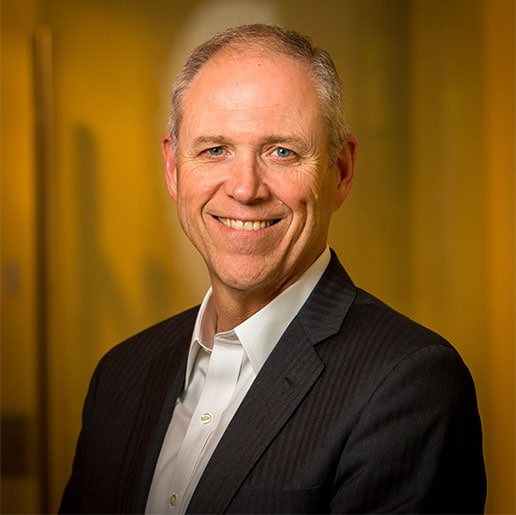
Archie Brown
 FIRST FINANCIAL BANCORP /OH/
About Archie Brown
Archie M. Brown, 64, is President and CEO of First Financial Bancorp. and First Financial Bank, and has served as a director since 2018 (CEO effective April 1, 2018) . He is a 40-year banking operator with broad experience across commercial, consumer, risk, balance sheet management, M&A integration and regulatory engagement; prior to FFBC he was CEO of MainSource Financial Group (2008–2018) and Chairman (2011–2018) . Under his leadership, FFBC’s 2024 performance delivered record adjusted revenue ($854M), loan growth ($829M), deposit growth ($968M), and a 4.05% net interest margin; the CEO’s short-term incentive paid at 136.8% of target based on relative ROA, asset quality and EPS growth, indicating above-target operating execution . Long-term performance-based equity from the 2022 grant vested at 150% (top-quartile 3-year ROA and TSR vs KBW banks), underscoring strong 3-year relative performance through 2024 year-end .
Past Roles
| Organization | Role | Years | Strategic impact |
|---|---|---|---|
| MainSource Financial Group / MainSource Bank | President & CEO | 2008–2018 | Led turnaround/growth through the GFC and integration into FFBC; broad enterprise risk, process re-engineering, and consolidation experience |
| MainSource Financial Group / MainSource Bank | Chairman | 2011–2018 | Board leadership and M&A/integration stewardship ahead of FFBC combination |
External Roles
| Organization | Role | Years | Strategic impact |
|---|---|---|---|
| CNO Financial Group (NASDAQ: CNO) | Board Member | Current | Cross-industry public board perspective (insurance/financial services) |
| Federal Reserve Bank of Cleveland – Cincinnati Branch | Board Member | Current | Macro/regulatory insights and local economic oversight |
| Cincinnati City Centre Development Corp (3CDC) | Board & Executive Committees | Current | Urban development/community engagement |
| Cincinnati Business Committee; Cincinnati USA Regional Chamber; Ohio Capital Budget Task Force | Member | Current | Regional economic and policy engagement |
Fixed Compensation
- Base salary set at $867,000 for 2024 (2% increase vs 2023 cap for execs) .
- Multi-year compensation summary (Salary, Stock Awards, Cash Incentive) below.
| Metric (USD) | FY 2022 | FY 2023 | FY 2024 |
|---|---|---|---|
| Salary (paid) | $820,432 | $845,392 | $863,931 |
| Stock Awards (grant-date fair value) | $948,780 | $1,020,028 | $1,127,102 |
| Non-Equity Incentive (STIP cash) | $912,146 | $1,268,475 | $1,064,248 |
Notes: 2024 base salary level approved at $867,000; salary paid reflects timing across the year .
Performance Compensation
2024 Short-Term Incentive Plan (STIP) – CEO
- Target opportunity: 90% of base salary; payout range 0–200% of target; metrics are relative to KBW Regional Bank Index peers; payouts interpolated across thresholds .
| Metric | Weight | Target definition | FFBC actual | Percentile vs peers | Payout as % of target |
|---|---|---|---|---|---|
| Return on Assets | 40% | Relative ROA vs KBW | 1.36% | 88.7 | 195.7% |
| Classified Assets | 30% | Relative classified assets vs KBW | 1.21% | 59.3 | 118.6% |
| EPS Growth | 30% | Relative EPS growth vs KBW | (8.63)% | 44.1 | 76.4% |
| Weighted payout | — | — | — | — | 136.8% |
- CEO 2024 STIP payout: $1,064,248 .
Long-Term Incentive Plan (LTIP)
- Structure: 50% time-based RS; 50% performance-based RS; 3-year vesting; dividends escrowed and paid only on earned/vested shares; no option repricing; double-trigger acceleration on CIC .
- 2024 grant (3/7/2024): CEO LTI target = 130% of salary; 50,862 shares total; 25,431 time-based RS (vesting 1/3 each on 3/7/2025, 3/7/2026, 3/7/2027), and 25,431 performance-based RS (target) measured on 3-year TSR and 3-year avg ROA vs KBW; max 150% at ≥75th percentile; threshold begins at 25th percentile .
| 2024 LTIP grant | Grant date | Target value | Total shares | Time-based RS | Performance RS (target) | Metrics and vesting |
|---|---|---|---|---|---|---|
| CEO | 3/7/2024 | $1,127,102 | 50,862 | 25,431 | 25,431 | 50% 3-yr TSR vs KBW; 50% 3-yr avg ROA vs KBW; payout 0–150% at 25th–75th percentile; vests after 3 years |
- 2022 performance-based RS (performance period ended 12/31/2024) paid at 150% (top quartile on both ROA and TSR) and vested 3/5/2025 .
Equity Ownership & Alignment
- Beneficial ownership (as of 3/28/2025): 303,986 shares; includes 118,478 jointly with spouse and 50,595 through the 401(k); executive retains voting and dividends on unvested performance-based restricted shares (72,405 included); <1% of outstanding .
- Outstanding unvested awards at 12/31/2024 (market value at $26.88):
| Category | Shares/Units | Market value |
|---|---|---|
| Unvested time-based RS (multiple grants) | 3,728; 10,265; 17,885 | $100,209; $275,923; $480,749 |
| Unearned performance RS (target) | 20,204; 21,889; 25,431 | $543,084; $588,376; $683,585 |
- Shares vested in 2024: 51,795 shares; value realized $1,159,015. Dividends accrued on unvested RS are paid only when shares vest (not before) .
- Ownership policy: CEO must hold ≥5x base salary; all executives currently in compliance. Anti-hedging and anti-pledging policy prohibits hedging/pledging and holding in margin accounts, reducing alignment risks .
Employment Terms
| Term | Details |
|---|---|
| Agreement | Employment & Non-Competition Agreement; initial 3-year term; auto-renews annually; if CIC, auto-renews for two years . |
| Severance (non‑CIC) | If terminated without Cause or for Good Reason: (i) salary through termination; (ii) 24 months of base salary; (iii) installments equal to lesser of 2.5x target STIP or 2x average of last three STIP; (iv) outplacement up to 5% of salary; (v) employer portion of COBRA up to 12 months . |
| CIC treatment | Company-wide policy uses double-trigger for equity acceleration; plan prohibits single-trigger acceleration; LTIP/cash design follows double-trigger practice . |
| Restrictive covenants | Non-compete for 18 months; non-solicit for two years; confidentiality/non-disparagement . |
| 280G cutback | Payments reduced to avoid excise taxes if better after-tax outcome (no gross-up) . |
| Potential CIC payout (as of 12/31/2024) | Severance benefits: $3,741,428; unvested equity acceleration: $2,804,462; total: $6,545,890 (no 280G cutback required on stated assumptions) . |
| Clawback | Dodd-Frank-compliant policy; mandatory recoupment for restatements; additional misconduct/ negligence triggers; 3-year lookback . |
Board Governance and Director Service
- Board service: Director since 2018; not independent (employee director); serves on the Diversity & Inclusion Committee .
- Board structure: Separate Chair (Claude E. Davis) and CEO; Lead Independent Director (Vincent A. Berta); 9/10 directors independent; 96% overall board/committee attendance in 2024; 7 independent-only executive sessions in 2024 .
- Dual-role implications: Brown is CEO and director but not Chair; separation of Chair/CEO and designated Lead Independent Director mitigate independence concerns; board maintains majority independence and regular executive sessions .
- Director pay: As an employee director, Brown receives no additional board fees; non-employee directors receive $130,000 annual retainer (cash + RS) .
Compensation Design and Pay-for-Performance Indicators
- Program uses peers (21 regional banks) sized ~0.5–2.0x FFBC; Committee does not pay to a fixed percentile but uses peer data as a reference; STIP targets set with intent to be within ~15% of market median .
- Performance mix: Majority at-risk; STIP metrics (ROA, asset quality, EPS) are relative vs KBW to neutralize macro rate volatility; LTIP metrics are 3-yr TSR and 3-yr avg ROA vs KBW to align with shareholder value creation .
- Best practices: Double-trigger severance/equity on CIC; no tax gross-ups; no option repricing; no share recycling; hedging/pledging prohibited; dividends on unvested RS accrue and pay only if vested .
Say‑on‑Pay and Shareholder Feedback
- Say‑on‑pay support: 97.35% (2023) and 96.69% (2024) approvals, indicating strong investor endorsement of the program .
- Annual shareholder outreach conducted; feedback reported to CGNC, Compensation Committee and Board .
Risk Indicators and Red/Yellow Flags
- Alignment positives: High relative-performance orientation (ROA/TSR) and strong 3-year results (150% vest on 2022 PSU); anti-hedging/pledging and stock ownership requirements support alignment .
- Potential concerns: CIC economics meaningful ($6.55M as of 12/31/2024); however, structure includes double-trigger and 280G cutback (no gross-up), and equity vests only on double-trigger .
- Near-term supply: Annual RS vesting each March (e.g., 2024 vested 51,795 shares for Brown) may create periodic Form 4 activity; dividends on unvested RS accrue until vest, which can modestly add realized value upon vest .
Director/Executive Ownership and Pledging
- CEO ownership: 303,986 shares; includes spouse joint ownership and 401(k); <1% of outstanding; unvested PSU counted for beneficial ownership; no pledging permitted under policy .
Compensation Committee/Peer and Consultant
- Compensation Committee independent; uses Meridian Compensation Partners as independent consultant; regular review of peer group and market competitiveness .
Investment Implications
- Pay-for-performance is credible: Above-target 2024 STIP payout (136.8%) and 150% vesting on 2022 PSUs reflect strong relative operating/TSR performance through 2024; say‑on‑pay support >96% for two years underscores investor alignment .
- Retention risk appears low-to-moderate: Auto-renewing CEO contract, competitive equity mix, and double-trigger CIC protections balance retention with governance; non-compete (18 months) and non-solicit (2 years) add stability .
- Trading signals: Scheduled March RS and PSU events can create predictable vesting-related Form 4 flows (2024 vested 51,795 shares); policy prohibits hedging/pledging, lowering adverse alignment risk; monitor March vest/settlement windows for potential liquidity events .
- CIC exposure: Total modeled CEO CIC package ~$6.5M (as of 12/31/2024) is material but structured with cutback (no gross-up) and double-trigger vesting, moderating shareholder risk in a sale scenario .