FMC (FMC)·Q4 2025 Earnings Summary
FMC Explores Sale as Stock Surges 5% Despite Earnings Miss
February 4, 2026 · by Fintool AI Agent
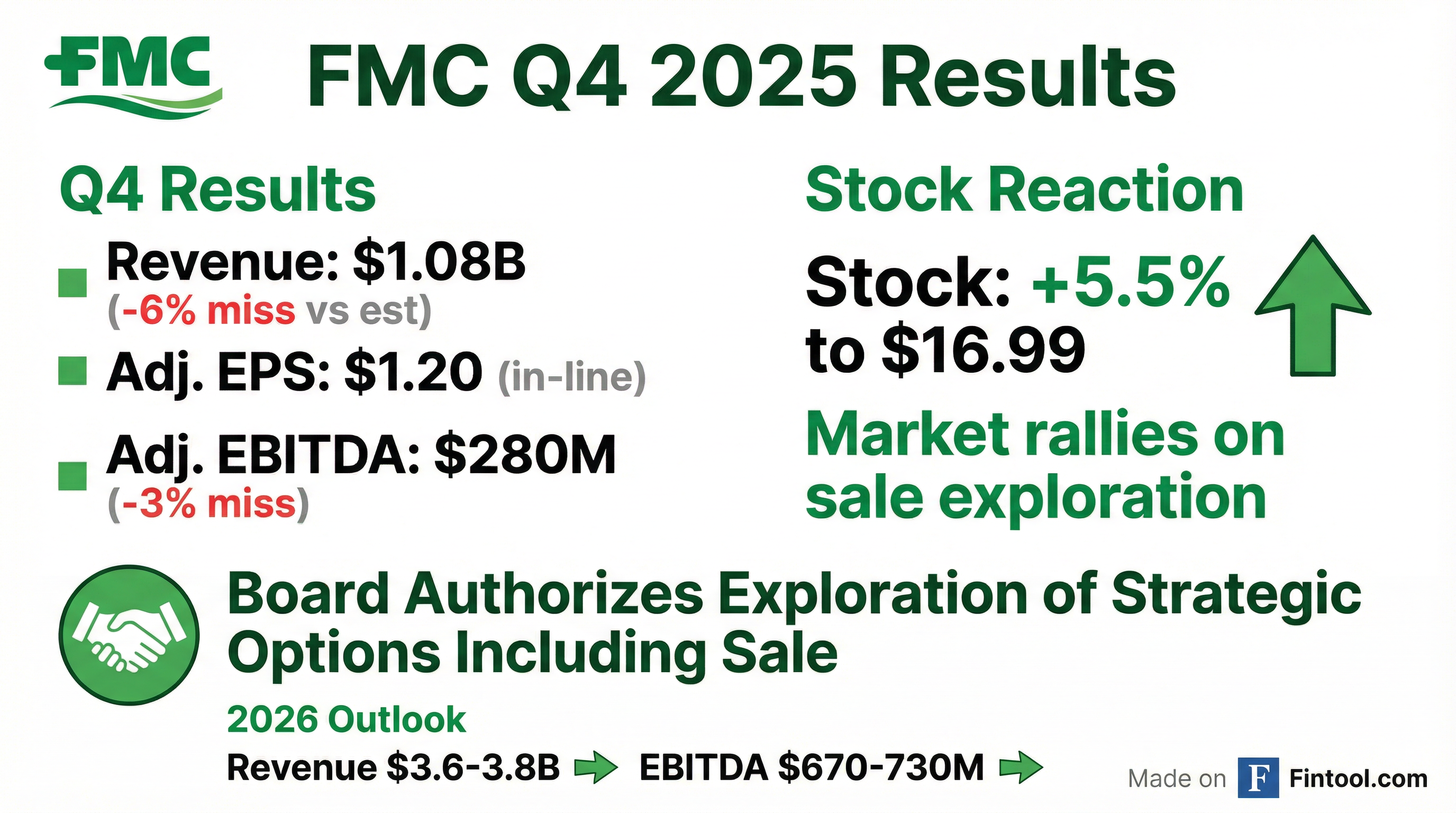
FMC Corporation reported Q4 2025 results that missed revenue expectations but met EPS consensus, while simultaneously announcing the Board has authorized a strategic review including a potential sale of the company. The stock surged 5.5% to $16.99 as investors reacted to the potential M&A catalyst, despite underwhelming operating results and a $1.36 billion goodwill impairment charge.
Did FMC Beat Earnings?
FMC posted mixed Q4 2025 results that missed on revenue but met adjusted EPS expectations:
*Values retrieved from S&P Global
The revenue miss was driven by a 6% price decline mainly in Rynaxypyr® and less volume growth than anticipated due to elevated competition for core products in Latin America. Revenue excluding India was $1.09 billion, down 11% versus prior year.
GAAP Results: The company reported a GAAP net loss of $1.72 billion, or $(13.74) per share, driven primarily by a non-cash goodwill impairment of $1.36 billion.
What Did Management Announce About Strategic Options?
The headline-grabbing news was the Board's authorization to explore strategic alternatives:
"The FMC Board of Directors has authorized the exploration of strategic options, including but not limited to, the sale of the company to unlock shareholder value and ensure its growth and core portfolios are best positioned for long-term success."
CEO Pierre Brondeau stated: "Our focus in 2026 is on executing our operational priorities, which include strengthening the balance sheet and improving the overall competitiveness of our portfolio. In parallel, the Board has authorized the exploration of strategic options to maximize shareholder value and to help ensure our valuable assets and pipeline are positioned for long-term success."
The company noted that its four new active ingredients (Isoflex®, fluindapyr, Dodhylex®, and rimisoxafen) along with its broader development pipeline are "unique and transformative," and believes there is significant opportunity to enhance shareholder value with additional investment in these technologies.
Importantly, the process targets $1 billion in debt reduction through asset sales and licensing agreements in parallel with the strategic review:
"The process of partial divestiture versus full divestiture are separate. One is taking place with a base plan. The other one is a separate process we are currently undertaking right now."
 Ask Fintool AI Agent
What Changed From Last Quarter?
Several significant developments since Q3 2025:
The goodwill impairment was triggered by the significant decline in stock price, resulting in a $1.36 billion write-off of the entire goodwill balance.
How Did the Stock React?
FMC stock rose 5.5% on the earnings release, closing at $16.99. The positive reaction was driven primarily by the strategic review announcement rather than the operating results:
The stock has collapsed 75% from its 52-week high of $44.78, reflecting the ongoing challenges in the agricultural chemicals market and Rynaxypyr® patent expiration pressures.
What Did Management Guide?
FMC provided 2026 outlook with significant year-over-year declines expected:
Q1 2026 will be particularly weak:
The abnormally low Q1 EBITDA margin is driven by nearly all of the $20 million annual tariff headwind hitting in Q1, combined with unfavorable manufacturing cost timing. Management expects EBITDA margins to return to more historical levels in subsequent quarters.
Ask Fintool AI AgentFull Year 2025 Summary
New active ingredients (fluindapyr, Isoflex®, Dodhylex®) reached approximately $200 million in sales, growing 54% but below the company's $250 million target mainly due to delayed registration for Isoflex® in Great Britain.
Regional Performance
Q4 2025 regional revenue breakdown (in millions):
North America was the only region to show growth, while Asia (ex-India) showed the steepest decline as the company winds down its India commercial business.
2026 Operational Priorities
Management outlined key priorities for 2026:
-
Strengthen the Balance Sheet: Target $1 billion in debt paydown through:
- Complete sale of India commercial business
- Active discussions for active ingredient licensing including upfront payments
- Additional asset sales in planning
-
Improve Core Portfolio Competitiveness:
- Lower manufacturing costs of non-diamide core products
- Adjust Asia cost structure to account for smaller size following India sale
-
Manage Post-Patent Rynaxypyr® Strategy:
- Offer advanced mixtures and formulations to differentiate from generic offerings
- Lower price and grow volume by capturing market share from older insecticides
- New formulations to address resistance challenges
-
Advance New Active Ingredients: Target $300M-$400M in 2026 sales through:
- Commercial licensing agreements to accelerate growth
- Increase direct-to-grower sales in Brazil
New Active Ingredient Pipeline — Long-Term Value Driver
FMC's growth thesis centers on its four new active ingredients scaling toward significant revenue:
Long-term Sales Targets:
- ~$1B base sales from new actives by 2030
- ~$2B base sales from new actives by 2035
- Two additional actives launching in the 2030s (not included in targets)
What's the 2027-2028 Outlook?
Management provided forward-looking commentary on growth expectations:
Key Takeaway: Management expects mid-teens percent EBITDA growth in both 2027 and 2028, independent of market recovery.
CEO Pierre Brondeau explained the path to 15% EBITDA growth:
"Delivering a 15% EBITDA growth in 2027 has to be done by a continuation of what we have done over the last two years on the growth platform, which we are confident we can do, and really, really get our core products competitive from a manufacturing standpoint, which we expect to do by the end of 2026, early 2027."
Q4 2025 EBITDA Bridge — What Drove the Decline?
Adjusted EBITDA declined 17% YoY to $280M, with the following drivers:
Full Year EBITDA Bridge (FY 2025 vs FY 2024):
Roughly half of the price decline was due to adjustments for certain diamide partners on "cost-plus" contracts.
2026 Modeling Assumptions
For financial modeling purposes, FMC provided the following 2026 guidance:
Balance Sheet Position
The significant equity decline reflects the goodwill impairment and India business write-downs. Net debt increased as the company drew on credit facilities while waiting for asset sale proceeds.
Q&A Highlights — Key Investor Questions Answered
The earnings call Q&A session provided additional color on several critical topics:
On the strategic review timing:
"We have a base plan which is robust and will put us in a good place in 2027. But the alternative could be highly beneficial for shareholders and would allow the company potentially to operate better and faster. That's why the two processes are being followed in parallel."
Was this prompted by inbound interest? No. CEO Pierre Brondeau confirmed this was a proactive, board-initiated process: "We worked with our board, and we presented to the board a business plan... Once we presented to the board, we also discussed, 'Is there a way to increase shareholder return?'... That discussion with the board led us to say we need to go pursue two paths."
Could the company be sold in pieces? While technically possible, management sees two highest-probability outcomes: (1) the base operating plan with asset sales and licensing, or (2) a full sale of the company.
On confidence in 2026 execution:
"The number of things we have to fix is limited. It's one thing. The rest, it's in place. The problem, this thing we have to fix, we better fix it because it's big. But it's not that complicated to know what we have to do."
Rynaxypyr mix shift is key:
"I believe for Rynaxypyr in 2026, 50% of our sales will shift to advanced formulation. So it is not at all the same portfolio in 2026 that we would have in 2025. And this 50% advanced formulation commands a higher price. So there is no price decrease for those formulations."
Why new AI sales missed $250M target: Beyond the UK registration delay, Fluindapyr underperformed due to lower-than-expected direct sales to growers in Brazil.
Debt and covenant update:
- $500M bonds maturing in October 2026; intent is to refinance in H1 2026
- Covenant limit is 6x through Q3 2026, stepping down to 5.5x at year-end
- Team is "laser-focused" on managing working capital to stay within covenants given weak Q1 EBITDA
Core portfolio manufacturing fix: Management plans to lower manufacturing costs of ~$1B of non-diamide products by at least 35% by 2027. This requires re-registration for most products and inventory buildup, limiting flexibility in 2026.
Ask Fintool AI AgentRisks and Concerns
-
Rynaxypyr® Patent Cliff: The company's flagship insecticide faces post-patent competition, driving mid-single-digit price declines
-
Cash Flow Pressure: FY 2026 free cash flow guided to essentially breakeven at best
-
Strategic Review Uncertainty: No assurance the process will result in a transaction
-
Tariff Headwinds: ~$20 million additional tariff charges expected, nearly all in Q1
-
Legacy Portfolio Decline: Core products facing competitive pressure, particularly in Latin America
Ask Fintool AI AgentForward Catalysts
Ask Fintool AI AgentFMC Corporation is a global agricultural sciences company dedicated to helping growers produce food, feed, fiber and fuel. The company's crop protection solutions include biologicals, crop nutrition, digital and precision agriculture products.