Earnings summaries and quarterly performance for FMC.
Executive leadership at FMC.

Pierre Brondeau
Chief Executive Officer
Andrew Sandifer
Executive Vice President and Chief Financial Officer
Brian Angeli
Executive Vice President and Chief Marketing Officer
Jacqueline Scanlan
Executive Vice President and Chief Human Resources Officer
Ronaldo Pereira
President
Sara Velazquez Ponessa
Executive Vice President, General Counsel and Corporate Secretary
Seva Rostovtsev
Executive Vice President and Chief Technology Officer
Thaisa Hugenneyer
Executive Vice President, Integrated Supply Chain
Board of directors at FMC.
Anthony DiSilvestro
Director
Dirk Kempthorne
Director
Eduardo Cordeiro
Director
John Davidson
Director
John Raines
Director
K'Lynne Johnson
Director
Kathy Fortmann
Director
Margareth Ovrum
Director
Patricia Verduin
Director
Robert Pallash
Director
Scott Greer
Lead Independent Director
Steven Merkt
Director
Research analysts who have asked questions during FMC earnings calls.

Vincent Andrews
Morgan Stanley
6 questions for FMC
Aleksey Yefremov
KeyBanc Capital Markets
5 questions for FMC
Frank Mitsch
Fermium Research
5 questions for FMC

Joel Jackson
BMO Capital Markets
5 questions for FMC
Christopher Parkinson
Wolfe Research
4 questions for FMC
Edlain Rodriguez
Mizuho Securities
3 questions for FMC

Kevin McCarthy
Vertical Research Partners
3 questions for FMC
Mike Harrison
Seaport Research Partners
3 questions for FMC
Alex Amarant
UBS
2 questions for FMC
Arun Viswanathan
RBC Capital Markets
2 questions for FMC
Benjamin Theurer
Barclays Corporate & Investment Bank
2 questions for FMC

Harris Fein
Wolfe Research
2 questions for FMC
Josh Spector
UBS Group
2 questions for FMC

Joshua Spector
UBS
2 questions for FMC
Laurence Alexander
Jefferies
2 questions for FMC
Matt De Yoe
Bank of America
2 questions for FMC
Matt Hutworth
Vertical Research Partners
2 questions for FMC

Patrick Cunningham
Citigroup
2 questions for FMC

Richard Garchitorena
Wells Fargo
2 questions for FMC

Steve Byrne
Bank of America
2 questions for FMC

Duffy Fischer
Goldman Sachs
1 question for FMC
Jeffrey Zekauskas
JPMorgan Chase & Co.
1 question for FMC
Laurent Favre
BNP Paribas
1 question for FMC
Michael Harrison
Seaport Research Partners
1 question for FMC
Recent press releases and 8-K filings for FMC.
- 2026 operational plan comprises four pillars: $1 billion in asset divestitures (including sale of the India business and licensing an advanced molecule with a significant upfront payment), reshaping the manufacturing footprint, executing the Rynaxypyr post-patent strategy, and scaling four new active ingredients.
- Strategic alternatives (Plan B) are being run in parallel, with Bank of America and Goldman Sachs engaged and management presentations already delivered to potential acquirers exploring a sale or merger of FMC.
- Manufacturing cost reduction aims for a 35% cut (approx. $150–170 million) by shifting active ingredient production from Europe and North America to India and China via in-house plants and toll partners to restore competitiveness.
- Financial outlook targets break-even free cash flow in 2026 (including ~$130 million of restructuring spend), with mid-teens EBITDA growth through 2028 driven by declining restructuring charges and working capital efficiency improvements.
- Balance sheet actions include $1 billion of debt paydown through disposals, managing an October $500 million notes maturity with existing liquidity, and planning a secured high-yield bond issuance in H1 2026.
- FMC’s Plan A focuses on divesting $1 billion in assets, reshaping manufacturing, executing the post-patent Rynaxypyr strategy, and launching four new active ingredients.
- The sale of the India business and upfront licensing of an advanced molecule (a meaningful portion of the $1 billion) are well advanced, with binding offers expected in the coming weeks and a licensing decision targeted for Q1/Q2 2026.
- A concurrent Plan B process for a potential sale or merger is being run by Bank of America and Goldman Sachs, with management presentations delivered to interested parties.
- FMC aims to cut active-ingredient manufacturing costs by 35% (≈ $150–170 million) by relocating production to India and China.
- The company guides to break-even free cash flow in 2026 (including ~$130 million of restructuring spend), plans to refinance an October $500 million debt maturity via a secured high-yield bond in H1 2026.
- Plan A focuses on $1 billion in asset divestitures, reshaping the manufacturing footprint, executing a Rynaxypyr post-patent strategy and scaling four new active ingredients; sale of India business and licensing of an advanced molecule expected by Q2 2026
- Plan B is being run in parallel under Bank of America and Goldman Sachs to explore a sale, merger or other strategic alternatives for the entire company
- Manufacturing of core active ingredients will shift to India and China to achieve ~35% cost savings, enabling competitive pricing across key markets, notably Latin America and Asia
- 2026 free cash flow is expected to be roughly break-even, including $130 million of restructuring spend; a $500 million bond matures in October, and FMC is evaluating a secured high-yield bond issuance while maintaining revolver liquidity
- Board-authorized strategic review to explore options including a potential sale; base plan targets $1 billion of debt reduction via the India commercial business sale and licensing agreements; process at preliminary stage with financial and legal advisors retained.
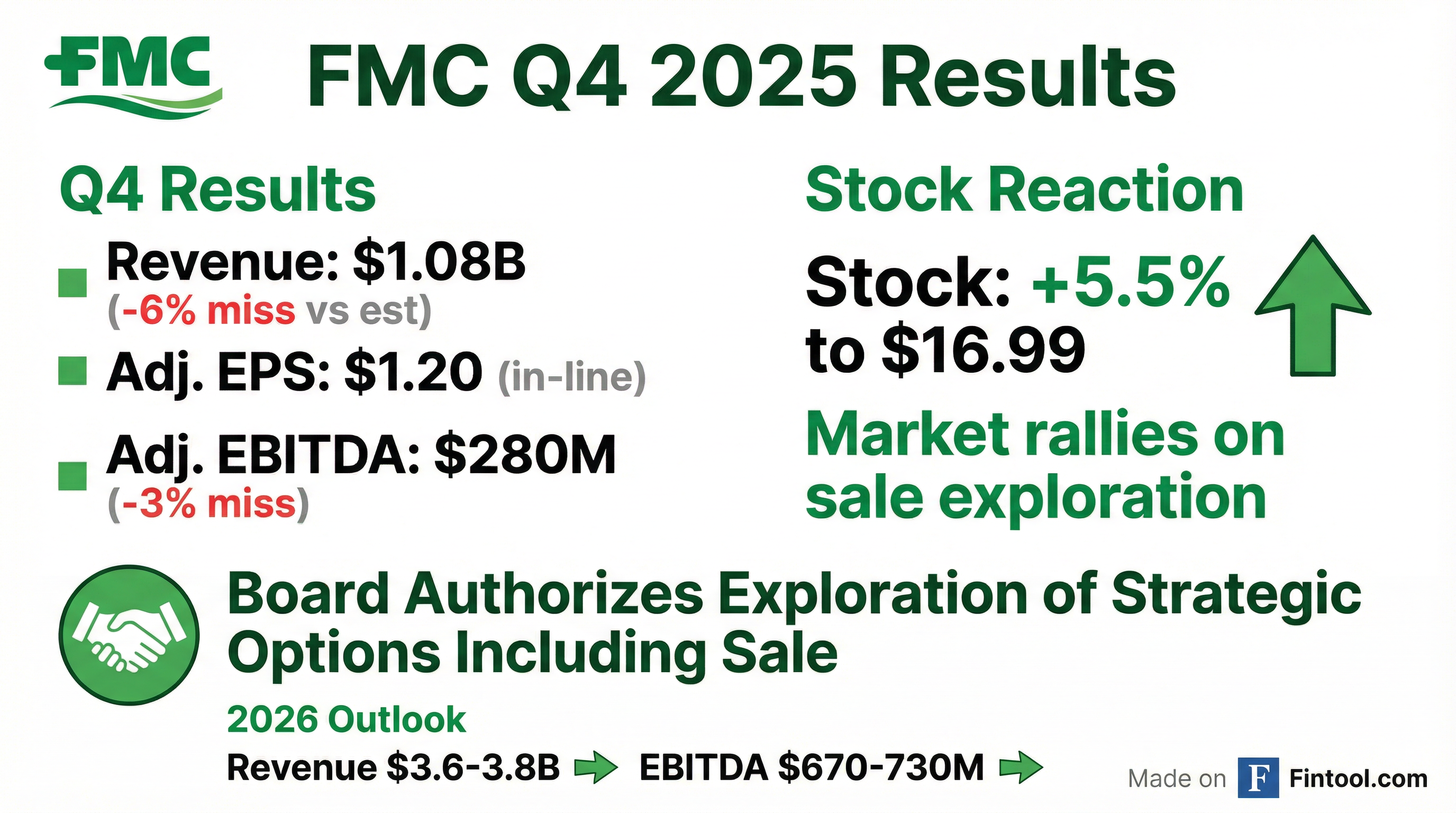
- Q4 2025 results: $1.08 billion in sales (–11% YoY; –5% ex-India), $280 million adjusted EBITDA (–17% YoY; –8% ex-India), $1.20 adjusted EPS (–33% YoY); free cash flow $623 million in the quarter; FY 2025 free cash flow –$165 million; net debt $3.5 billion, leverage 4.1× EBITDA.
- 2026 guidance: full-year sales $3.6–3.8 billion (–5% vs 2025) and adjusted EBITDA $670–730 million; Q1 sales $725–775 million, adjusted EBITDA $45–50 million; free cash flow expected to be roughly break-even (–$65 million to +$65 million) including $130 million of restructuring spend, targeting ~0.5× net leverage reduction.
- 2026 operational priorities: strengthen the balance sheet; improve legacy portfolio competitiveness by cutting non-diamide manufacturing costs 35% by 2027; manage post-patent Rynaxypyr strategy (2025 sales ~$800 million); and accelerate new active ingredients—sales up 54% to ~$200 million in 2025, with targets of $300–400 million in 2026 and $2 billion by 2035.
- Board has authorized a preliminary strategic review, including a potential sale of the entire company and separate processes to divest the India commercial business and pursue licensing deals, to maximize shareholder value.
- Q4 2025 sales were $1.08 billion, down 11% Y/Y (-5% ex-India); adjusted EBITDA was $280 million, down 17% Y/Y (-8% ex-India); adjusted EPS was $1.20, down 33% Y/Y.
- 2026 guidance: full-year sales of $3.6–$3.8 billion (-5% at midpoint), adjusted EBITDA of $670–$730 million; Q1 sales of $725–$775 million and Q1 adjusted EBITDA of $45–$50 million.
- Year-end 2025 net debt was $3.5 billion (4.1× trailing EBITDA); Q4 free cash flow was $623 million, full-year 2025 free cash flow was –$165 million. 2026 free cash flow is expected to be –$65 million to +$65 million (break-even at midpoint) supporting a $1 billion debt-reduction plan.
- FMC reported Q4 sales of $1.08 billion (−11% y/y; −5% ex-India), adjusted EBITDA of $280 million (−17% y/y; −8% ex-India), and adj. EPS of $1.20 (−33% y/y). Q4 free cash flow was $623 million, ending the period with net debt of $3.5 billion (4.1× TTM EBITDA).
- The board has authorized a preliminary review of strategic options, including a potential sale of the company, while continuing the sale of the India commercial business. FMC aims to pay down >$1 billion of debt via asset sales and licensing agreements in 2026 ; it guides 2026 sales of $3.6–3.8 billion and adj. EBITDA of $670–730 million.
- Operational priorities for 2026 include strengthening the balance sheet, improving core portfolio competitiveness (lowering manufacturing costs by ≥35% by 2027), executing a post-patent Rynaxypyr strategy (2025 sales ~$800 million, branded earnings flat in 2026), and growing four new active ingredients (2025 sales ~$200 million, +54% y/y; expected $300–400 million in 2026; >$2 billion by 2035).
- For 2026, FMC expects free cash flow of –$65 million to +$65 million (break-even at midpoint, including $130 million in restructuring spend) and projects net leverage to decline by ~0.5× by year-end.
- Q4 2025 revenue ex-India was $1,086 million, down on lower volumes, pricing and FX headwinds.
- Adjusted EBITDA declined 17% YoY to $280 million, driven by volume and price pressures partly offset by cost savings and favorable FX.
- FY 2026 guidance: $3.60–3.80 billion revenue (–5% YoY), $670–730 million adjusted EBITDA (–17%), $1.63–1.89 adjusted EPS (–41%).
- 2026 strategic priorities include strengthening the balance sheet with $1 billion debt paydown via asset sales (including India), licensing deals and core portfolio competitiveness improvements.
- The Board has authorized exploration of strategic options, including a potential sale, to unlock shareholder value and position its core portfolios for long-term success.
- Q4 2025 revenue was $1.08 billion, down 12% YoY; Adjusted EBITDA was $280 million, down 17%, and Adjusted EPS was $1.20, a 33% decline.
- Full-year 2025 revenue totaled $3.47 billion, down 18%, with Adjusted EBITDA of $843 million (-7%) and Adjusted EPS of $2.96 (-15%).
- 2026 outlook includes revenue guidance of $3.60–$3.80 billion (-5%), Adjusted EBITDA of $670–$730 million, and Adjusted EPS of $1.63–$1.89.
- The FMC Board has authorized the exploration of strategic options, including a potential sale of the company, to unlock shareholder value and position its assets and pipeline for long-term success.
- FMC’s 2026 operational priorities include strengthening the balance sheet by paying down $1 billion of debt (including the sale of its India commercial business), improving core portfolio competitiveness, managing the post-patent Rynaxypyr® transition and accelerating commercialization of new active ingredients (Isoflex®, fluindapyr, Dodhylex® and rimisoxafen).
- Full-year 2026 guidance calls for $3.60 billion to $3.80 billion of revenue (down 5% at midpoint), $670 million to $730 million of Adjusted EBITDA (down 17% at midpoint) and $1.63 to $1.89 of Adjusted EPS (down 41% at midpoint).
- Q4 2025 revenue was $1.08 billion (-12% YoY) , and full-year 2025 revenue was $3.47 billion (-18% YoY).
- FMC’s Board approved Project Foundation, including a Manufacturing Restructuring Program to optimize its cost structure and exit high-cost plants, targeting $175 million of annual run-rate savings by end of 2027.
- The company expects $560–635 million of pre-tax restructuring charges, of which $420–440 million are non-cash asset write-offs and $140–195 million are cash expenditures for severance, consulting and decommissioning.
- Following a steep stock-price decline, FMC will test goodwill and other intangible assets for impairment and anticipates a significant non-cash impairment charge that will not affect cash flows.
Fintool News
In-depth analysis and coverage of FMC.

Quarterly earnings call transcripts for FMC.

Ask Fintool AI Agent
Get instant answers from SEC filings, earnings calls & more