GREIF (GEF)·Q1 2026 Earnings Summary
Greif Delivers 24% EBITDA Growth as Cost Optimization Drives Margin Expansion
January 28, 2026 · by Fintool AI Agent
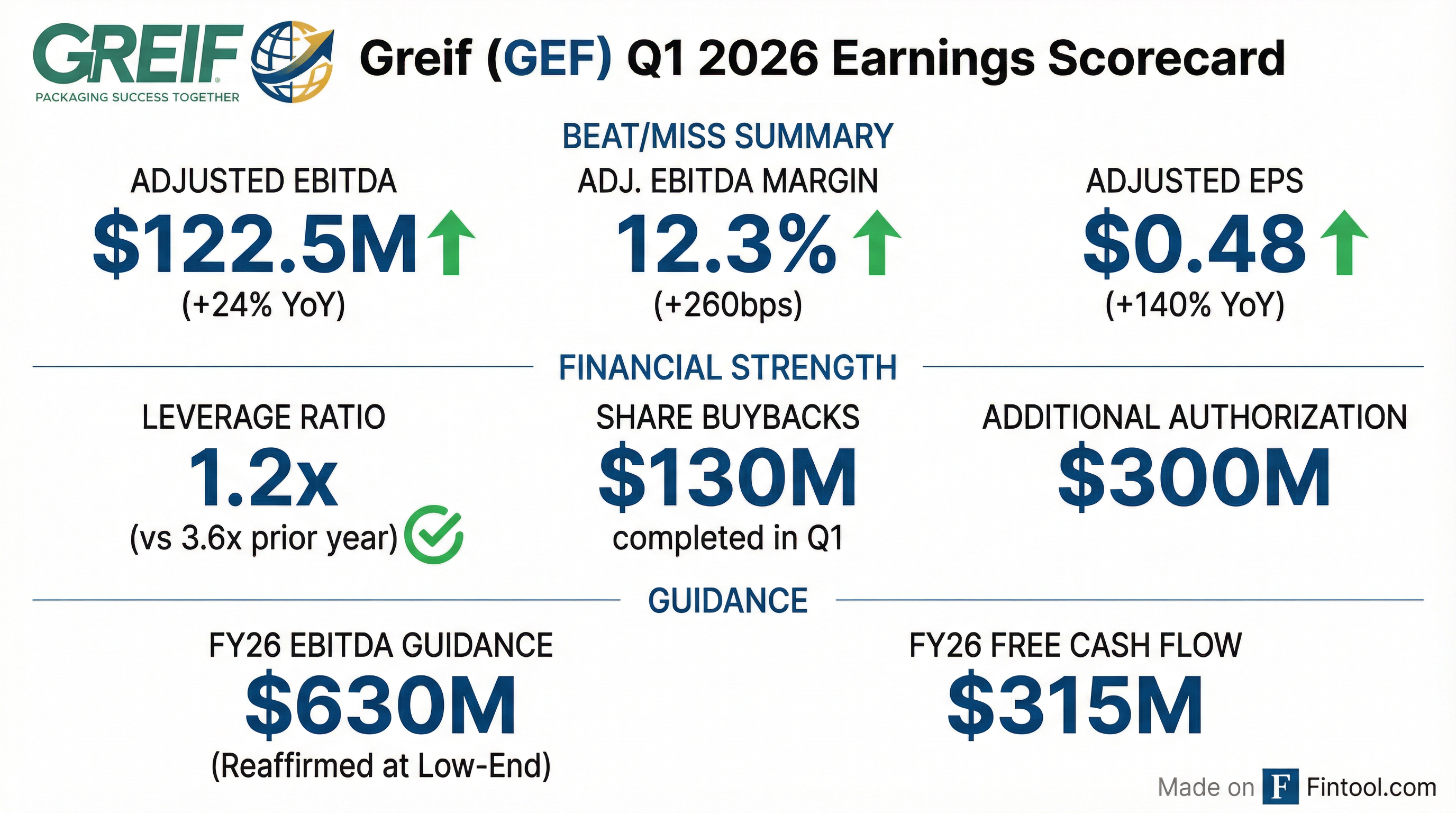
Greif (NYSE: GEF) reported Q1 2026 results that demonstrate the industrial packaging leader's ability to deliver margin expansion despite soft end-market demand. Adjusted EBITDA jumped 24% year-over-year to $122.5M, with margins expanding 260 basis points to 12.3% . The company's "Build to Last" strategy is gaining traction, with $65M in run-rate cost optimization already achieved and aggressive capital returns underway .
Did Greif Beat Earnings?
Greif delivered a strong quarter across key profitability metrics:
The earnings improvement was driven by improved price/cost dynamics and significant structural cost optimization gains . Additionally, lower year-over-year interest expense from significant debt reduction in 2025 boosted EPS, partially offset by higher taxes .
GAAP net income was $182.9M, or $3.00 per diluted Class A share, which included a large gain on disposal of properties, plants, and equipment of $215.7M .
 Ask Fintool AI Agent
What Happened to Volumes?
While profitability surged, volumes remained challenged across all four segments due to industrial economy softness:
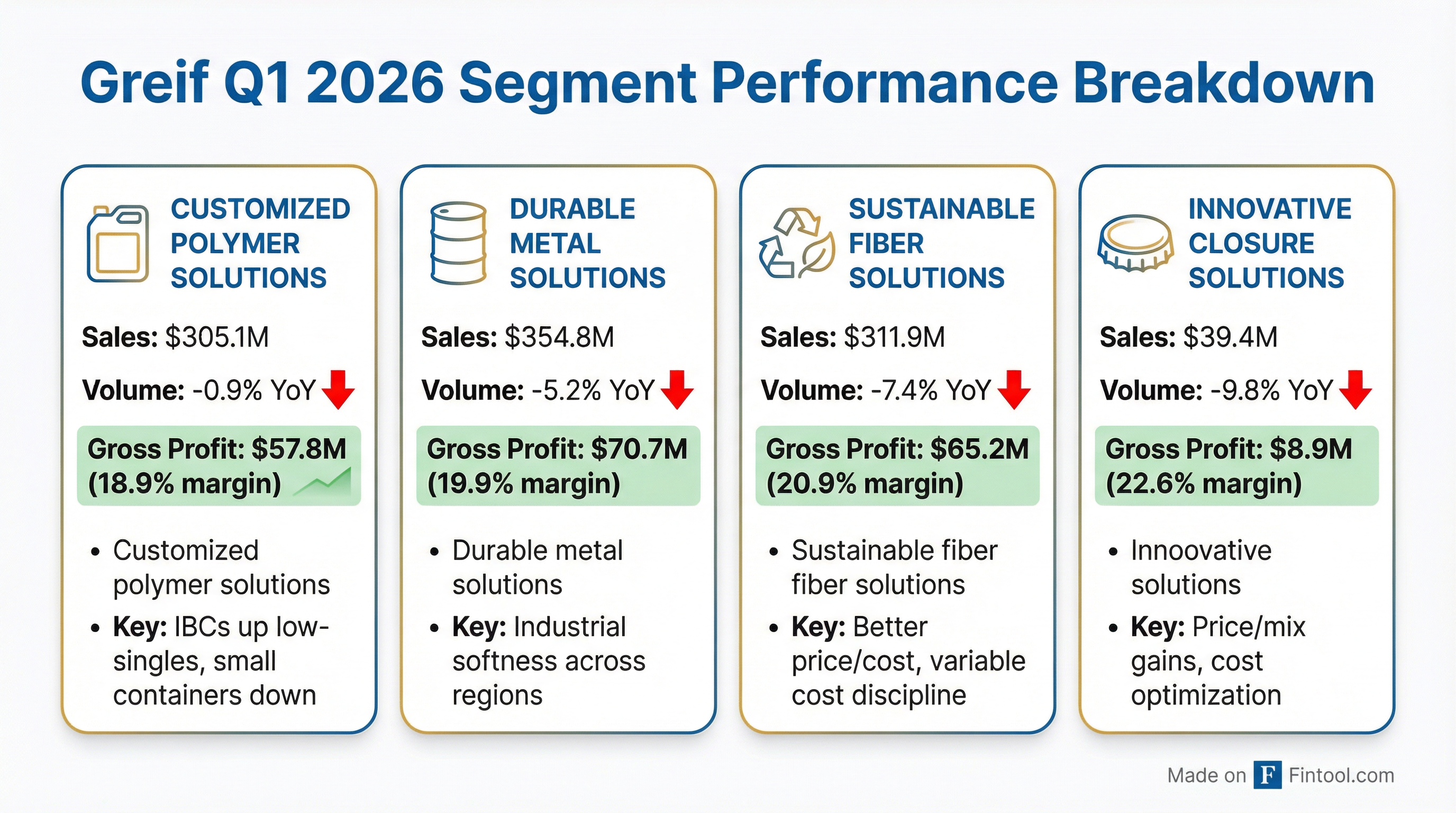
Key volume dynamics :
- Polymer Solutions: IBC containers up low-singles, but small containers down from Ag seasonality (expected to improve Q2)
- Metal Solutions: Broad softness across regions driven by industrial demand weakness
- Fiber Solutions: Mills operated at industry levels despite ~14k tons of downtime; converting volumes down mid-singles
- Closures: Third-party volumes down high-singles from metal and polymer closure demand weakness
Target end markets (agrochemicals, food & beverage, pharma & medical, flavors & fragrances) continue to demonstrate relative resilience amid broader industrial softness .
What Did Management Guide?
Greif reaffirmed its low-end FY26 guidance despite the soft volume environment :
Volume assumptions embedded in guidance :
- Customized Polymer Solutions: Up low-single digits
- Durable Metal Solutions: Flat to down low-single digits
- Sustainable Fiber Solutions: Flat to down low-single digits
- Innovative Closure Solutions: Up low-single digits
Free cash flow bridge :
- DD&A: $225M
- Adjusted capital expenditures: $155M
- Cash interest expense: $40M
- Cash tax expense: $120M
- Cash restructuring and pension: $50M
- Operating working capital source: $50M
Ask Fintool AI AgentCapital Returns: Aggressive Buyback Program
Greif is deploying its strong cash flow position toward shareholder returns :
- $130M share repurchases completed in Q1 2026 under the $150M plan announced in Q4 2025
- $300M additional share repurchase capacity authorized by the Board in December 2025
- Target: Annual share repurchases of up to 2% of outstanding equity value
The capital allocation framework prioritizes: (1) maintaining a strong foundation with disciplined leverage and liquidity management, (2) returning cash to shareholders through consistent growing dividends and opportunistic buybacks, and (3) investing for growth via high-return organic initiatives and disciplined bolt-on acquisitions .
How Did the Stock React?
GEF shares closed at $73.14 on January 27, 2026, just below the 52-week high of $73.56 and up 1.9% on the day ahead of the earnings release. The stock has significantly outperformed over the past year:
The stock has been on a strong run since Q4 2025 earnings in November, reflecting investor appreciation for the company's margin expansion and capital return story.
What Changed From Last Quarter?
Positive developments:
- EBITDA margin expanded 260bps YoY as cost optimization gains accelerate
- Leverage dropped dramatically to 1.2x from 3.6x, providing significant balance sheet flexibility
- $65M run-rate cost optimization achieved, tracking toward long-term 18%+ EBITDA margin commitment
- Professional headcount cut by 10% (220 reductions), demonstrating commitment to structural cost takeout
- Share repurchase program executing aggressively with $130M deployed
Concerns:
- Volumes declined across all four segments, ranging from -0.9% to -9.8%
- Adjusted Free Cash Flow worsened to ($41.0M) from ($23.3M) YoY, primarily due to lack of contribution from recent divestments
- Industrial end market softness persists across regions (EMEA, NA, LATAM, APAC)
Investment Thesis: Why Invest in Greif?
Management outlined three pillars of the Greif investment case :
-
Packaging Leader to Essential Industries: Highly scalable global franchise with world-renowned brand and high product quality, positioned to capture incremental market share
-
Delivering Stronger Earnings Power: Portfolio optimization enabling focus on higher growth, less cyclical end markets; cost optimization driving toward long-term 18%+ EBITDA margin commitment; Adjusted FCF generation targeting 50%+ long-term conversion
-
Proactive Capital Allocation: Consistent return of cash to shareholders including ongoing buybacks; organic growth focus with disciplined tuck-in M&A and strong synergy execution
Ask Fintool AI AgentQ&A Highlights: What Analysts Asked
Volume Trajectory & Confidence in Guidance
Gabe Hajde (Wells Fargo) asked about inventory management and volume trends heading into fiscal Q2 .
CEO Ole Rosgaard: "Demand conditions remain muted, particularly across fiber and steel, reflecting continued pressure in both industrial and chemical end markets. The last week I visited about eight customers in various parts of the world, and the message is really the same... Our commercial teams are executing with intent, and we are really transforming our commercial team to hunters from farmers."
CFO Larry Hilsheimer added: "We have seen volume trajectory in our small plastics start Q2 in a very positive way."
Housing Market: A Potential Catalyst
George Staphos (Bank of America) asked about metal end markets and housing exposure .
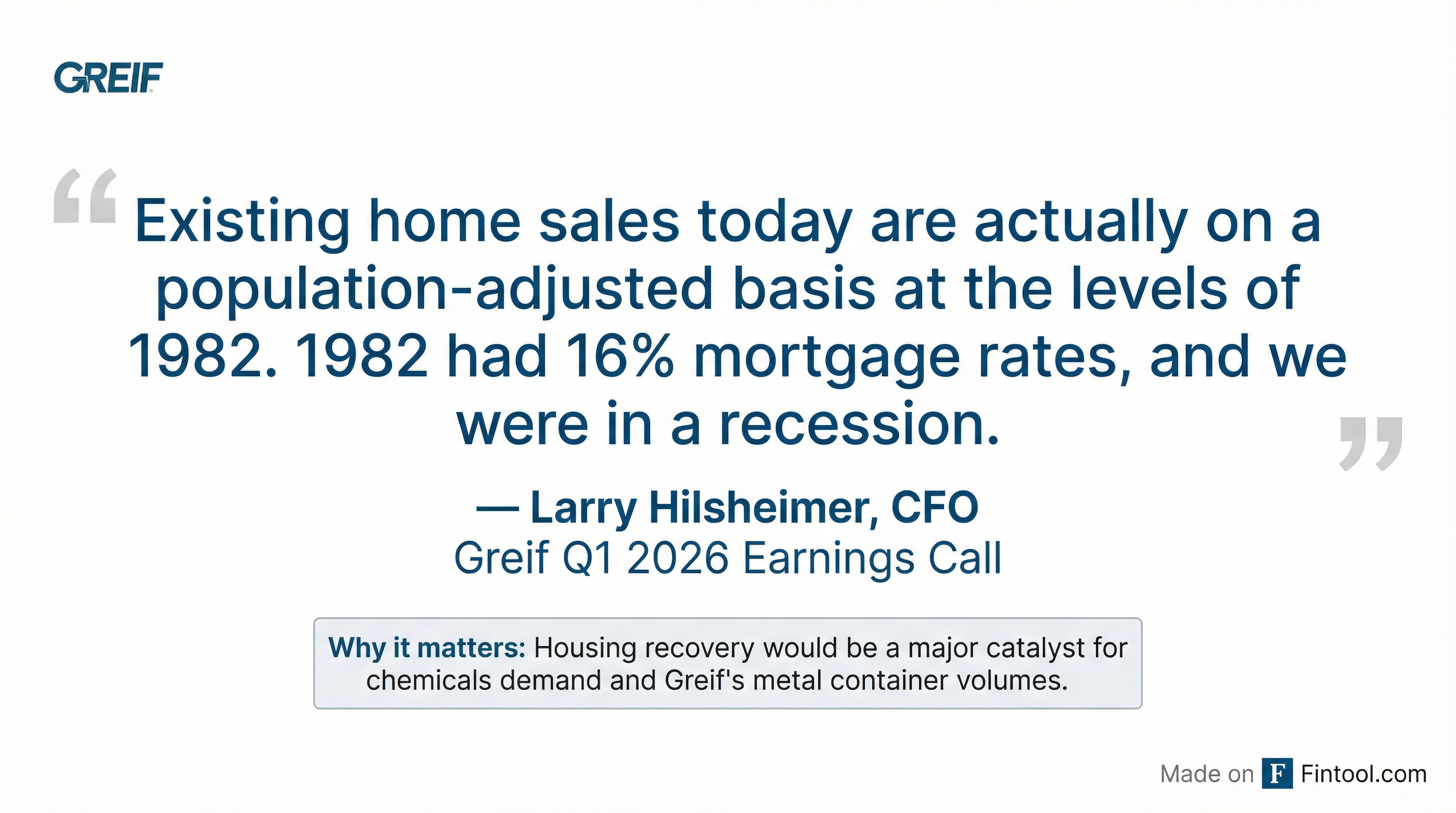
CFO Larry Hilsheimer provided striking context: "Existing home sales today are actually on a population-adjusted basis at the levels of 1982. 1982 had 16% mortgage rates, and we were in a recession... When people go to sell an existing home, they spend money to fix it up. The new person moves in, tears out what everybody else fixed up, buys new appliances, paints, buys new furniture. So it really is a big driver for the chemicals industry and us, but it is not there yet."
The administration is focused on housing, with discussions of portable mortgages and limiting corporate investment in housing .
SiOx Barrier Technology: New Product Innovation
Mike Roxland (Truist) asked about the proprietary barrier technology mentioned last quarter .
CEO Ole Rosgaard: "It's called SiOx technology. We have received orders. The first machine is fully operational in France. We have three more machines in production that will be deployed during this year, and that will be followed by further machines."
CFO Larry Hilsheimer noted: "The financial impact for this year is not significant, but we are very, very optimistic about this technology and its impact."
Growth CapEx & Regional Opportunities
Gabe Hajde asked about growth CapEx geography .
CEO Ole Rosgaard: "In Africa, where I've just been, the whole mining sector in Southern Africa is picking up significantly due to the run on precious metals. A lot of the products we manufacture in that part of the world actually goes into mines... When we add capacity in this respect, we get the ROIC on it almost immediately. We have added capacity in India, and last year we did it in Singapore as well, for specific customers where we end up with long-term contracts."
Price/Cost Timing in Fiber
George Staphos asked when fiber price/cost benefits will anniversary .
CFO Larry Hilsheimer: "The $40 a ton in URB was last May, rolled in in June and July, and the OCC was through the last part of the year. So it's that second half of our year, with more of it coming in the last quarter, just because of the way some of the contractual pass-throughs work."
Ask Fintool AI AgentKey Takeaways
-
Margin story intact: Despite volume headwinds, Greif expanded EBITDA margins 260bps through price/cost management and structural cost optimization
-
Balance sheet transformed: Leverage at 1.2x provides optionality for M&A and continued buybacks
-
Guidance reaffirmed: Low-end FY26 targets of $630M EBITDA and $315M FCF maintained
-
Capital returns accelerating: $130M buybacks completed with $300M additional authorization
-
Volume recovery key to upside: Target end markets showing resilience, but broader industrial demand remains soft
-
Commercial transformation underway: Management converting commercial team "from farmers to hunters" with new incentive structures
-
Housing as latent catalyst: Existing home sales at 1982 levels (population-adjusted) represent significant upside when rates normalize
-
SiOx technology ramping: First machine operational in France with three more deploying this year — long-term opportunity
Data sourced from Greif Q1 2026 Earnings Call Transcript and Earnings Presentation dated January 28, 2026.