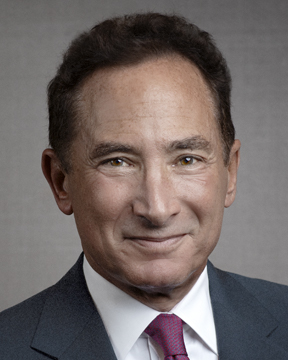
Ronald J. Kramer
 GRIFFON
About Ronald J. Kramer
Ronald J. Kramer, age 66, is Chairman and Chief Executive Officer of Griffon Corporation, serving as CEO since April 2008, a director since 1993, and Chairman since January 2018; prior roles include Vice Chairman (2003–2018), President/director at Wynn Resorts (2002–2008), and Managing Director at Dresdner Kleinwort Wasserstein/Wasserstein Perella (1999–2001) . Under his tenure, Griffon’s total shareholder return from 2021 to 2024 translated a $100 investment into $431.70, well above its peer index at $204.57; Adjusted EPS rose from $1.86 in 2021 to $5.12 in 2024, and the company reported adjusted EBITDA of $515.7 million and year-end working capital of $816.0 million in FY2024, with free cash flow compounding at 114% from 2021 to 2024 .
Past Roles
| Organization | Role | Years | Strategic Impact |
|---|---|---|---|
| Griffon Corporation | Vice Chairman of the Board | 2003–2018 | Supported strategic repositioning and capital allocation ahead of later CEO tenure . |
| Wynn Resorts, Ltd. | President and Director | 2002–2008 | Senior leadership at global resort operator; finance and transactions expertise . |
| Dresdner Kleinwort Wasserstein / Wasserstein Perella | Managing Director | 1999–2001 | Investment banking, M&A and financing experience . |
External Roles
| Organization | Role | Years |
|---|---|---|
| Entain plc (LSE: ENT) | Director | Current |
| Franklin BSP Capital Corporation | Director | Current |
| Franklin BSP Private Credit Fund | Director | Current |
Fixed Compensation
| Year | Base Salary ($) | Stock Awards ($) | Non-Equity Incentives ($) | All Other ($) | Total ($) |
|---|---|---|---|---|---|
| 2024 | 1,248,992 | 6,411,093 | 8,462,183 | 423,192 | 16,545,460 |
| 2023 | 1,212,614 | 2,432,249 | 9,066,667 | 398,016 | 13,109,546 |
| 2022 | 1,177,295 | 3,637,347 | 9,066,667 | 407,659 | 14,288,968 |
- CEO base increased to $1,255,085 effective Dec 1, 2023 and to $1,292,738 effective Dec 1, 2024, reflecting 3.0% cost-of-living raises in each year .
- Policy: No tax gross-ups in NEO compensation arrangements; limited exceptions for relocation/expatriate tax equalization .
Performance Compensation
Annual Cash Bonus (FY2024 structure and outcome)
| Metric | Weighting | Target Definition | Actual (FY2024) | Payout to Kramer ($) | Vesting/Timing |
|---|---|---|---|---|---|
| Adjusted EBITDA | 75% | Committee-set FY target | 515.7 million | 2,825,516 | Paid following FY close |
| Working Capital | 15% | Year-end working capital | 816.0 million | 566,667 | Paid following FY close |
| ESG Goals | 10% | 5 ESG areas, qualitative | Better than satisfactory | 210,000 | Paid following FY close; ESG removed for FY2025 |
- Annual bonus thresholds/targets: Threshold $920,000; Target $2,100,000; Maximum $3,666,667 (short-term cash plan) .
Long-Term Cash Incentive (FY2022–FY2024 cycle)
| Metric | Weighting | Target Levels | Outcome | Kramer Payout ($) |
|---|---|---|---|---|
| Aggregate Core EPS | 65% | Threshold/Target/Max set; adjusted for Telephonics sale | Aggregate Core EPS $13.73; CAGR 45.0% (2021 base to 2024) | 3,510,000 |
| Aggregate Free Cash Flow | 25% | Threshold/Target/Max set; adjusted | Aggregate FCF $732.1 million; CAGR 114.4% (2021–2024) | 1,350,000 |
| Hunter EBITDA | 10% | Threshold/Target/Max set | Below threshold; no payout | 0 |
Equity Awards (Performance-Based Restricted Stock)
| Grant Date | Performance Metric | Threshold (#) | Target (#) | Maximum (#) | Vesting Date | Notes |
|---|---|---|---|---|---|---|
| Mar 20, 2024 | ROIC (avg 2024–2026) | 20,380 | 40,760 | 122,280 | Jan 31, 2027 | ROIC target increased; max 300% of target; 60% of grant value |
| Mar 20, 2024 | Relative TSR vs Russell 2000 | 13,587 | 27,173 | 81,519 | Jan 31, 2027 | TSR tranche is 40% of grant value; max 300% of target; cap at target if TSR not positive |
| Mar 10, 2022 | Relative TSR vs Russell 2000 | 75,691 target; expected max vest | 75,691 | Max reflected | Jan 27, 2025 | Committee expected >75th percentile TSR |
| Mar 10, 2022 | ROIC (avg 2022–2024) | 75,691 target; expected max vest | 75,691 | Max reflected | Jan 27, 2025 | Committee expected >11.3% ROIC |
| Jan 27, 2021 | Stock price + TSR modifier | 360,000 target (price achieved; 110% expected) | 360,000 | 396,000 vesting reflected | Jan 27, 2025 | Requires $26.18 close for 30 consecutive trading days; TSR-based +/-10%/-20% |
-
Post-vesting holding: CEO/COO awards require two-year holding; FY2024 grants for CFO/GC also require two-year holding .
-
FY2024 equity split changed to 60% ROIC / 40% TSR (from 50/50 in prior years) to increase management control and align with CPP sourcing strategy; maximum increased to 300% to reward extraordinary performance .
-
Stock vested in FY2024: 182,203 shares on Dec 17, 2023 ($10,310,868) and 495,000 shares on Jan 30, 2024 ($30,190,050) for Kramer .
Equity Ownership & Alignment
| Item | Amount |
|---|---|
| Beneficial ownership (shares) | 2,877,776; includes 40,298 held by spouse (disclaimed) |
| Ownership (% of outstanding) | 6.0% |
| Restricted shares included in ownership | 1,263,503 |
| ESOP shares allocated (can direct vote) | 5,229 |
| Stock ownership guideline (CEO) | 5x salary; quarterly testing; retain net shares until compliant |
| CEO guideline compliance | Holds >1,500,000 shares directly, well above ~88,000 target; ~6% total including restricted |
| Anti-pledging/anti-hedging policy | Prohibits pledging, hedging, margin purchases; directors/officers in compliance |
Outstanding Equity Awards at FY2024 Year-End (Selected for Kramer)
| Award | Shares Unvested (#) | Market Value ($) |
|---|---|---|
| Jan 27, 2021 PBRS (expected 110%) | 396,000 | 27,720,000 (at $70) |
| Mar 10, 2022 TSR (expected max) | 151,382 | 10,596,740 (at $70) |
| Mar 10, 2022 ROIC (expected max) | 151,382 | 10,596,740 (at $70) |
| Nov 16, 2022 TSR target | 34,216 | 2,395,120 (at $70) |
| Nov 16, 2022 ROIC target | 34,216 | 2,395,120 (at $70) |
| Mar 20, 2024 TSR target | 13,587 | 951,090 (at $70) |
| Mar 20, 2024 ROIC target | 20,380 | 1,426,600 (at $70) |
Employment Terms
| Provision | Key Terms |
|---|---|
| Agreement history | CEO agreement entered March 16, 2008; amended 2011, 2013, 2022, and amended & restated May 8, 2024 |
| Term/renewal | Continues for three years from notice by either party not to renew (rolling term) |
| Severance – base salary | 2x base salary upon Good Reason resignation/without Cause pre-CIC (12 monthly installments); 3x base salary upon CIC termination (lump sum or installments per 409A) |
| Severance – bonus | 2x highest combined annual + long-term bonus pre-CIC; 3x post-CIC; disability: 1x highest combined bonus (12 monthly installments) |
| Pro-rata bonus | Disability: 150% of then-current salary (lump sum); Post-CIC: pro-rata of greater of latest actual combined bonus or target |
| Equity acceleration | Death/disability: vest at target on Jan 27, 2021, Mar 10, 2022, Nov 16, 2022, and Mar 20, 2024 awards; CIC termination: generally vest at target, except Mar 20, 2024 awards vest greater of target or performance to date |
| Health benefits | 18 months post termination pre-CIC; until Dec 31 of second year post-CIC termination |
| 280G cutback | Modified cutback to avoid excise tax if net after-tax is higher; estimated cutback −$938,529 in CIC scenario |
| No tax gross-ups | Company policy prohibits tax gross-ups in NEO arrangements |
Estimated Potential Payments (as of Sep 30, 2024)
| Scenario | Total Estimated ($) |
|---|---|
| Death | 48,397,115 |
| Disability | 60,694,984 |
| Good Reason/Without Cause (pre-CIC) | 55,524,806 |
| Good Reason/Without Cause (post-CIC) | 87,627,974 |
Board Governance
- Dual role: Kramer is Chairman and CEO; Board believes this structure serves shareholders given his background and track record; agendas shaped with Lead Independent Director input .
- Independence safeguards: Every director except CEO is independent; strong Lead Independent Director (Jerome L. Coben, since Mar 2023) with defined duties; independent directors hold regular executive sessions; all standing committees are fully independent .
- Committees: Compensation (Chair: Cheryl L. Turnbull), Nominating & Corporate Governance (Chair: Lacy M. Johnson), Audit (Chair: Louis J. Grabowsky), Finance; CEO is not a member of board committees .
- Director compensation and ownership: Independent directors receive cash fees and annual restricted stock grants ($109,998 grant-date value in FY2024; 1,525 restricted shares outstanding per director as of Sep 30, 2024); directors have 4x annual retainer stock ownership guidelines with four-year compliance window .
Compensation Committee Analysis
- Committee and consultant: Compensation Committee of independent directors sets NEO pay, using Gallagher as independent consultant; robust shareholder outreach informs program design .
- Peer group: Diversified industrials/building product peers; revised in early FY2025 to add Resideo Technologies and Zurn Elkay after Masonite’s acquisition; peer group used as one factor, not a binding target .
- Risk mitigation: Multi-metric bonus design, long-term cash and equity heavily performance-based with cliff vesting and post-vesting holding; anti-hedging/anti-pledging and clawback policies aligned to SEC’s 2023 rules .
- Say-on-pay: 87.1% approval at March 20, 2024 annual meeting; program viewed as “shareholder friendly” by most engaged investors .
Equity Ownership & Alignment Details
| Policy/Metric | Detail |
|---|---|
| Clawback | Restated in 2023; Company will recover excess incentive compensation from executive officers for three years preceding a restatement |
| Post-vesting holding | CEO/COO grants require two-year holding; FY2024 CFO/GC grants also include two-year holding |
| Insider trading policy | Comprehensive policy; filed as Exhibit 19.1(a) to FY2024 10-K; prohibits pledging/hedging/margin purchases; all directors/officers compliant |
Performance & Track Record
| Measure | Outcome |
|---|---|
| Total Shareholder Return (2021–2024) | $100 → $431.70 (company) vs $204.57 (peer group) |
| Adjusted EPS (2021 → 2024) | $1.86 → $5.12; key pay linkage measure |
| FY2024 Adjusted EBITDA | $515.7 million |
| FY2024 Working Capital | $816.0 million |
| FCF (2021 → 2024) | CAGR 114.4%; Aggregate 2022–2024 $732.1 million |
About Ronald J. Kramer’s Board Service, Roles, and Independence
- Board tenure: Director since 1993; Chairman since 2018 .
- Committee roles: As CEO/Chairman, Kramer does not serve on board committees; all committees are independent-only .
- Independence and dual-role implications: Board mitigates dual-role concerns via a strong Lead Independent Director, independent executive sessions, and fully independent committees overseeing compensation, audit, governance, and finance .
Investment Implications
- Alignment signals: High pay-at-risk structure, multi-year ROIC/TSR equity with two-year holding requirements, and strong ownership (~6% including restricted) suggest long-term alignment; pledging/hedging prohibited and policy compliance reduces alignment risk .
- Near-term vesting catalysts: Significant equity vesting on Jan 27, 2025 (2021 and 2022 grants) and Jan 31, 2027 (2024 grants) may create event-driven liquidity needs (e.g., tax withholding) but two-year holding mitigates immediate selling pressure for many awards .
- Change-of-control economics: Substantial CIC benefits (estimated ~$87.6 million) feature double-trigger equity acceleration (target or performance-to-date for Mar 20, 2024 awards) and 3x salary/bonus multiples; modified 280G cutback reduces excise exposure, indicating robust protection but fewer gross-up concerns .
- Performance delivery: Strong TSR outperformance and EPS/FCF growth underpin recent long-term cash and equity payouts, with FY2024 operational metrics met; continued ROIC execution will be pivotal given 60% weighting of FY2024 equity grants .
- Governance risk controls: Independent committees, clawback, anti-pledging/anti-hedging, and ownership guidelines, plus credible shareholder engagement, reduce governance-related risk and support pay-for-performance durability .