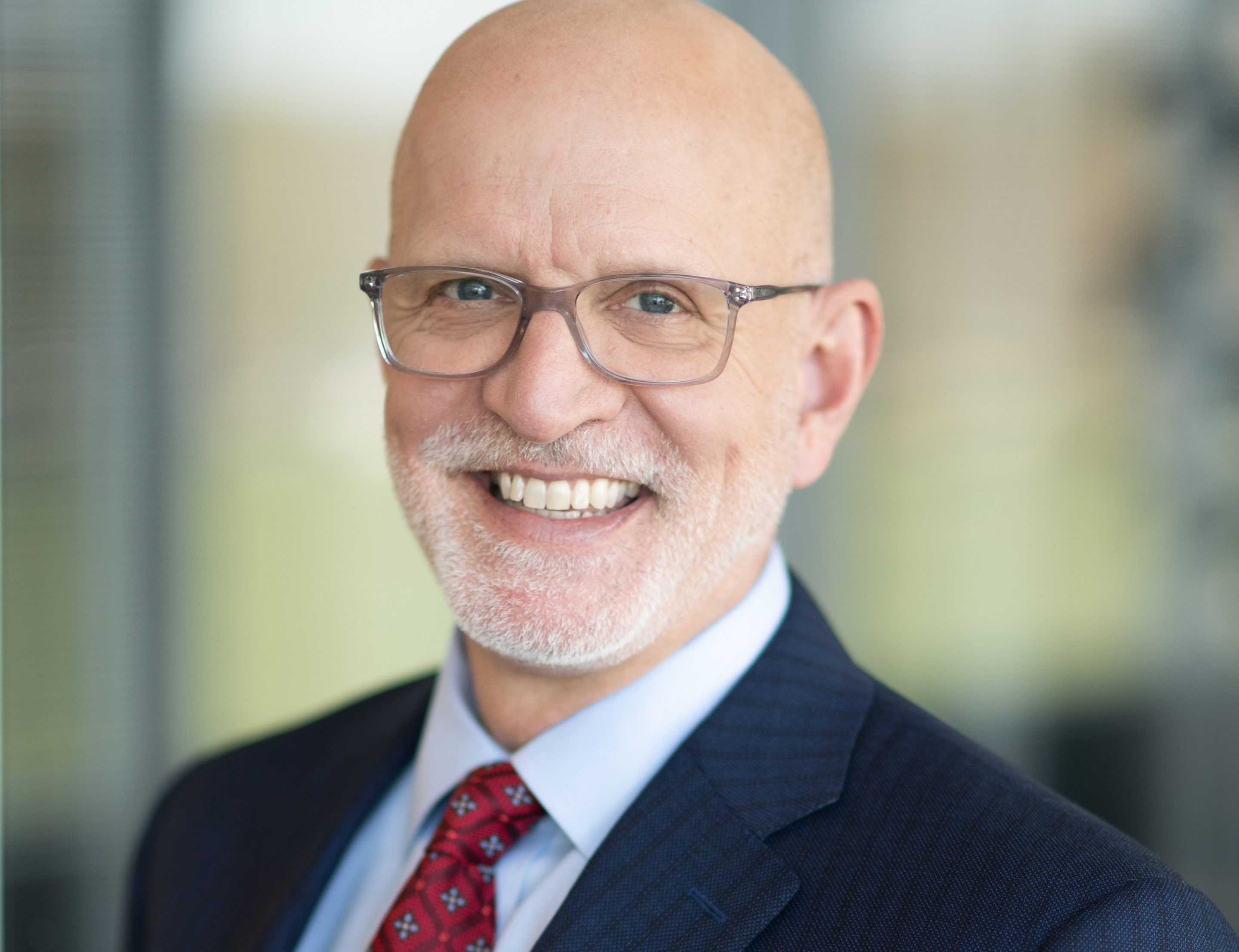
Jeffrey Harmening
 GENERAL MILLS
About Jeffrey Harmening
Jeffrey L. Harmening is Chairman and Chief Executive Officer of General Mills (GIS). He joined General Mills in 1994, became CEO in June 2017 and was named Chairman in January 2018; he is age 58 and also serves as a member of the Board of Directors . Under his tenure, GIS executed portfolio reshaping and drove strong free cash flow conversion, though fiscal 2025 results were mixed: net sales $19.5B, organic net sales down 2%, adjusted operating profit down 7% constant-currency, adjusted diluted EPS $4.21 down 7%, and free cash flow ≈$2.3B at a 97% conversion rate . Over the five years to fiscal 2024, GIS delivered 52% TSR, outperforming its compensation peer group by 36% (as of May 26, 2024) .
Past Roles
| Organization | Role | Years | Strategic impact |
|---|---|---|---|
| General Mills | Chairman | Jan 2018–present | Combined Chair/CEO leadership; board-level strategic oversight |
| General Mills | Chief Executive Officer | Jun 2017–present | Led Accelerate strategy; portfolio reshaping (e.g., yogurt divestiture; Whitebridge Pet acquisition) |
| General Mills | President & Chief Operating Officer | Jul 2016–Jun 2017 | Senior operating leadership across segments |
| General Mills | EVP & COO, U.S. Retail | 2014–Jun 2016 | Led largest segment; U.S. retail execution |
| Cereal Partners Worldwide (JV with Nestlé) | CEO | 2012–2014 | International leadership; global cereal JV |
| General Mills | SVP/VP, Big G Cereal division | 2007–2012 | Category leadership; brand building |
| Cereal Partners Worldwide | VP Marketing (Switzerland) | 2003 | International marketing leadership |
| General Mills | Various roles | 1994–2003 | Progressive leadership positions |
External Roles
| Organization | Role | Years | Notes |
|---|---|---|---|
| The Toro Company | Director | — (current) | Current public company directorship |
Fixed Compensation
| Metric (USD) | FY 2023 | FY 2024 | FY 2025 |
|---|---|---|---|
| Base Salary | $1,250,000 | $1,333,333 | $1,350,000 |
| Bonus | $0 | $0 | $0 |
| Stock Awards (RSUs/PSUs grant-date fair value) | $6,508,460 | $7,203,495 | $7,278,003 |
| Option Awards (grant-date fair value) | $2,204,316 | $2,847,138 | $2,608,294 |
| Non-Equity Incentive Plan (Annual bonus paid) | $3,622,500 | $1,204,800 | $889,380 |
| Change in Pension Value & NQDC Earnings | $2,465,417 | $3,303,184 | $274,971 |
| All Other Compensation | $334,953 | $164,164 | $92,182 |
| Total Compensation | $16,385,646 | $16,056,114 | $12,492,830 |
Notes:
- Base salary set at $1,350,000 for FY24 and kept flat for FY25; annual incentive target maintained at 180% of salary .
Performance Compensation
Annual incentive (EIP) structure and results
- Structure: 80% Company performance (Organic Net Sales Growth; Adjusted Operating Profit Growth), 20% Individual performance .
- FY2025 CEO individual performance rating: 75% .
| Fiscal Year | Metric (Weight) | Target | Actual | Award Achievement % |
|---|---|---|---|---|
| FY2025 | Organic Net Sales Growth (50%) | 2.0% | -1.8% | 24% |
| FY2025 | Adjusted Operating Profit Growth (50%) | 1.0% | -7.9% | 29% |
| FY2025 | Business Achievement % (weighted) | — | — | 27% |
| FY2024 | Organic Net Sales Growth (50%) | 5.0% | -1.1% | 0% |
| FY2024 | Adjusted Operating Profit Growth (50%) | 7.0% | 5.2% | 88% |
| FY2024 | Business Achievement % (weighted) | — | — | 44% |
Calculation: Annual bonus payout = Base Salary × Target % × [0.8×Business Achievement + 0.2×Individual Achievement]; FY25 NEO payouts ranged ~37–45% of target .
Long-term incentives (LTIs)
- Mix: 50% PSUs (3-year cliff + 1-year holding), 25% Stock Options (4-year graded vesting), 25% RSUs (4-year graded vesting); PSUs measured on 3-year Organic Net Sales CAGR and Cumulative Operating Cash Flow, with +/-25% Relative TSR modifier; options expire 10 years + 1 month from grant .
PSU performance outcomes:
| PSU Cycle | Metric | Target | Actual | Award Achievement % | TSR Modifier | Payout |
|---|---|---|---|---|---|---|
| FY2023–FY2025 | Organic Net Sales CAGR (50%) | 3.1% | 2.6% | 86% | 100% | 89% |
| Cumulative Operating Cash Flow (50%) ($mm) | $9,480 | $9,244 | 92% | |||
| FY2022–FY2024 | Organic Net Sales CAGR (50%) | 0.7% | 4.5% | 197% | 125% (86th percentile) | 200% (capped) |
| Cumulative Operating Cash Flow (50%) ($mm) | $8,890 | $9,673 | 129% |
FY2025 LTI grants (CEO):
| Grant date | Award type | Units/Options | Exercise price | Vesting | Grant-date fair value |
|---|---|---|---|---|---|
| 6/28/2024 | RSUs | 39,520 | — | 25% per year over 4 years | $2,500,035 |
| 6/28/2024 | PSUs (target) | 79,040 | — | 3-year cliff + 1-year holding | $4,777,968 |
| 6/28/2024 | Stock Options | 197,598 | $63.26 | 25% per year over 4 years; 10y+1m expiry | $2,608,294 |
Equity Ownership & Alignment
| Item | Detail |
|---|---|
| Beneficial ownership (7/31/2025) | 622,662 shares; 1,295,312 exercisable options (sole voting/investment unless noted) |
| Deferred stock units (included in ownership note) | 260,646 units deferred (no current voting/investment power) |
| Ownership guideline | CEO must hold ≥10× base salary; Harmening holds 747,988 shares and is at 27× multiple (meets guideline) |
| Hedging/pledging | Prohibited for officers/directors; Section 16 pre-clearance and blackouts apply |
| Deferred compensation (FY2025) | CEO deferred RSUs worth $1,795,762; aggregate earnings $(2,147,791); withdrawals $527,373; ending balance $20,077,939 |
| Pension/SERP present value (FY2025) | U.S. Pension Plan PV $2,998,612; Supplemental Retirement Plan PV $19,853,684; eligible for early retirement |
| Outstanding unvested equity (selected) | Unvested RSUs include multiple grants (e.g., 39,520 from 6/28/2024); unearned PSUs include 65,190 (FY2024 grant) and 79,040 (FY2025 grant) at target |
| Option moneyness context | FY2025 proxy uses $53.38 as year-end price for valuations; older 2018 options ($46.06) were in-the-money at FYE; many recent grants (e.g., $63.26 in 2024) were out-of-the-money at FYE |
Employment Terms
- No individual employment contract; covered by the Separation Pay and Benefits Program (Severance Plan) .
- Change-in-control: double-trigger vesting for equity; cash benefits paid upon qualifying termination; no excise tax gross-ups (net best applies) .
- Severance benefits: 18–24 months of base salary and target bonus; continuation of medical/life benefits for 18–24 months; outplacement; pro-rated bonus in year of termination .
- Restrictive covenants: receipt of severance requires signing a separation agreement including confidentiality, non-disparagement, non-competition, and non-solicitation provisions .
Estimated CEO payments by scenario (as of 5/25/2025):
| Scenario (as of FY2025 FYE) | Estimated total |
|---|---|
| Involuntary Not for Cause | $7,655,760 |
| Death | $18,941,276 |
| Change in Control + qualifying termination | $26,582,036 |
Board Governance and Dual-Role Implications
- Harmening is not independent under NYSE rules (as Chair/CEO); all other director nominees are independent . The board uses a combined Chair/CEO structure with a robust Independent Lead Director (Maria Henry) who approves agendas, presides over executive sessions at each meeting, and represents independent directors with shareholders .
- A shareholder proposal to separate Chair and CEO roles was presented in 2025; the board recommended against it, citing flexibility and the robust Lead Independent Director role .
- Say-on-pay support: ≈93% of votes cast supported GIS executive compensation at the 2024 Annual Meeting .
Performance & Track Record
- Fiscal 2025 highlights: net sales $19.5B; organic net sales -2%; adjusted operating profit $3.35B (constant-currency -7%); adjusted diluted EPS $4.21 (constant-currency -7%); free cash flow ≈$2.3B (97% conversion) .
- Portfolio actions under his leadership: divestiture of North America Yogurt businesses; acquisition of Whitebridge Pet Brands’ North American premium pet food business .
- Five-year TSR through FY2024: 52%, +36% vs compensation peers (as of May 26, 2024) .
- Pay-for-performance: PSU cycles show strong FY2022–2024 performance (200% payout with top-quartile TSR) followed by moderated FY2023–2025 payout at 89% reflecting tougher operating backdrop .
Compensation Program Design and Governance
- CEO pay mix heavily performance-based: significant majority at risk (annual incentive + PSUs/options/RSUs) .
- Annual incentive metrics (organic sales growth, adjusted operating profit growth) tied to GIS long-term financial model; PSU metrics emphasize growth and cash generation with relative TSR modifier .
- Clawbacks: recovery of erroneously paid incentive comp upon restatement; broader recoupment for misconduct permitted .
- Insider trading controls: pre-clearance for Section 16 officers; hedging and pledging prohibited .
- Peer group used for market calibration includes CPB, HSY, MDLZ, KO, K, PEP, CL, KMB, PG, CAG, KHC, KDP, SJM, and select non-U.S. comparators (excluded from pay comparisons) .
Performance Compensation Detail (Mechanics)
| Element | Weighting / Metric | Target design | Vesting / Holding | Notes |
|---|---|---|---|---|
| Annual incentive (EIP) | 80% Company (Organic Net Sales Growth; Adjusted Operating Profit Growth), 20% Individual | Targets set from Board-approved annual plan | Annual cash payout | FY2025 business achievement 27%; CEO individual 75% |
| PSUs | 50% of LTI; Organic Net Sales CAGR (50%); Cumulative Operating Cash Flow (50%); ±25% TSR modifier | 3-year goals set at cycle start | 3-year cliff; +1-year PSU holding for CEO and SLT | FY2023–2025 payout 89%; FY2022–2024 payout 200% (capped) |
| RSUs | 25% of LTI | Time-based | 4-year graded (25%/yr) | Dividend equivalents paid only if vested |
| Stock Options | 25% of LTI | Time-based | 4-year graded (25%/yr); 10y+1m expiry; strike = close on grant date | No repricing/backdating |
Investment Implications
- Alignment/retention: High ownership (27× salary), robust holding/deferral practices, and PSU one-year post-vest holding for top execs support alignment and reduce near-term sell pressure; hedging/pledging banned .
- Incentive signal: Shift from a maxed-out PSU cycle (FY2022–2024) to sub-target (89%) for FY2023–2025 indicates moderated multi-year operating performance; FY2025 annual bonus business factor (27%) reflects near-term headwinds in organic sales and profit growth .
- Change-in-control economics: Double-trigger vesting, 18–24 months cash/benefits, and no excise tax gross-ups (net best) are shareholder-friendly features that temper parachute risk; key-man risk remains due to dual role .
- Governance: Combined Chair/CEO structure persists despite shareholder pressure to separate; strong Lead Independent Director mitigates independence concerns, but structure can remain a governance discount for some investors .
- Execution risk: FY2025 underperformance vs growth targets, alongside portfolio reshaping, places emphasis on FY2026 execution to restore volume-led organic growth, particularly in North America Retail and Pet .
