GRI Bio (GRI)·Q4 2025 Earnings Summary
GRI Bio Reports $12M FY 2025 Loss, Cash Runway Extended Into 2027 After January Raise
February 4, 2026 · by Fintool AI Agent
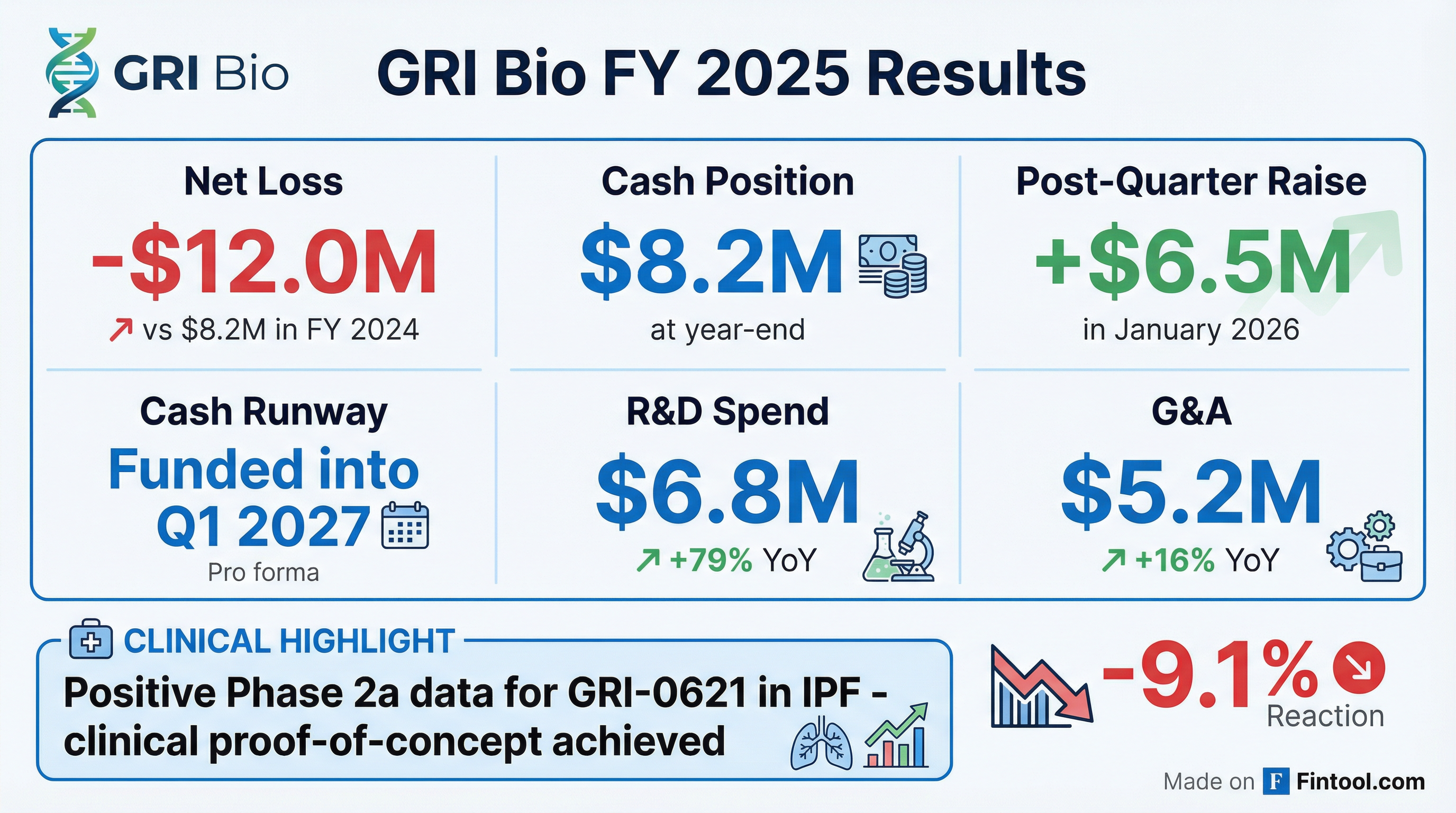
GRI Bio (NASDAQ: GRI) reiterated its FY 2025 financial results today, reporting a net loss of $12 million and $8.2 million in cash at year-end. The clinical-stage biotech, focused on inflammatory, fibrotic, and autoimmune diseases, strengthened its balance sheet with a $6.5 million At The Market offering in January 2026, extending its cash runway into Q1 2027.
Did GRI Bio Meet Expectations?
As a pre-revenue clinical-stage biotech, GRI Bio has no revenue to report. The company's key metrics center on cash management and clinical progress.
*Values retrieved from S&P Global
The higher net loss was driven primarily by a $3 million increase in R&D spending related to the Phase 2a clinical program for GRI-0621, along with $0.7 million in higher G&A costs from increased personnel expenses and stock-based compensation.
How Did the Stock React?
GRI shares fell 9.1% on the day to $2.60, continuing a steep decline from 52-week highs above $300. The stock has lost significant value as the company navigates the capital-intensive clinical development phase.
The micro-cap biotech (market cap ~$230K) trades near its 52-week low of $2.40, with the January capital raise providing critical runway extension.
 Ask Fintool AI Agent
What Did Management Say About Cash Runway?
CEO Marc Hertz emphasized capital discipline and clinical execution in the earnings announcement:
"In 2025, we prioritized disciplined clinical execution and balance sheet strength, delivering compelling clinical data from our lead IPF program which underscores the therapeutic differentiation of GRI-0621. Entering 2026 with a strong cash position, we are focused on advancing GRI-0621 in IPF, progressing GRI-0803 toward the clinic and executing our clinical strategy with capital discipline to drive long-term value creation."
Cash Position Summary:
- Year-end 2025: $8.2 million
- January 2026 raise: $6.5 million gross proceeds (ATM offering)
- Total raised Dec 2025 + Jan 2026: ~$14.5 million
- Runway: Funded into Q1 2027
Management noted that this runway estimate assumes "only initial preparatory activities for GRI-0621 as substantial additional capital or resources will be required to fund a Phase 2b clinical trial."
What Changed From Last Quarter?
Clinical Progress:
- Announced positive Phase 2a topline data from the completed study of GRI-0621 in idiopathic pulmonary fibrosis (IPF)
- Reported additional data demonstrating suppression of pro-fibrotic immune phenotypes, reinforcing clinical proof-of-concept
- Generated new RNA-sequencing gene expression data showing direct impact on the core biology of fibrosis and lung repair
Pipeline Expansion:
- Advanced plans to progress GRI-0803 into IND-enabling studies, expanding the pipeline into autoimmune disease
What Is GRI Bio's Pipeline?
GRI Bio is focused on modulating immune cells—specifically Natural Killer T (NKT) cells—to treat inflammatory, fibrotic, and autoimmune diseases.
The company has a library of over 500 proprietary compounds to fuel future pipeline development.
Ask Fintool AI AgentKey Risks Flagged by Management
The company highlighted several risk factors in its forward-looking statements:
- Capital requirements: Substantial additional funding needed for Phase 2b clinical trial of GRI-0621
- Nasdaq listing: Risk of inability to maintain listing on The Nasdaq Capital Market
- Clinical uncertainty: Later data may be inconsistent with Phase 2a observations
- Regulatory risk: Inability to obtain and maintain regulatory clearance or approval
- Competition: Other companies developing similar products and services
Forward Catalysts
2026 Focus Areas:
- Advance GRI-0621 in IPF (Phase 2b preparation)
- Progress GRI-0803 through IND-enabling studies
- Execute clinical strategy with capital discipline
- Potential additional financing as needed
Summary
GRI Bio's FY 2025 results reflect a clinical-stage biotech in active development mode: higher R&D spending to advance its lead IPF program, positive Phase 2a proof-of-concept data, and balance sheet management to extend runway. The key question for investors is whether the company can secure the capital needed for a Phase 2b trial while maintaining its Nasdaq listing.
Ask Fintool AI Agent