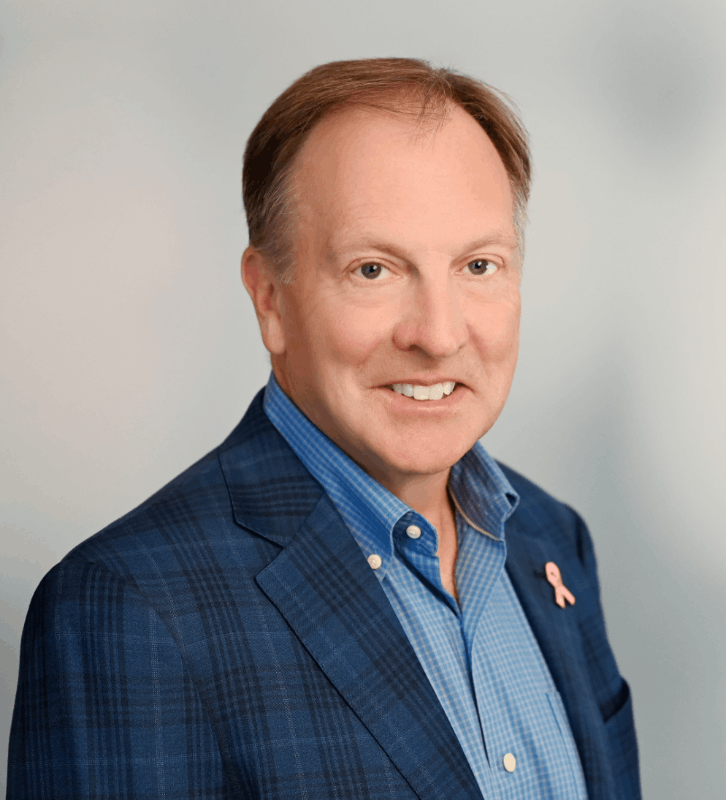
Stephen P. MacMillan
 HOLOGIC
About Stephen P. MacMillan
Stephen P. MacMillan, age 61, has served as Hologic’s President, CEO and director since December 2013 and Chairman since June 2015 . He holds a BA in economics from Davidson College and completed Harvard Business School’s Advanced Management Program . Under his leadership, Hologic’s share price more than tripled from $22.29 to $80.82 by FY2024, total shareholder return exceeded 200%, and revenue has grown at ~5% CAGR during his tenure, supported by deleveraging net debt from ~$4.0B to ~$0.4B and strong base business growth . Incentive pay emphasizes adjusted revenue, adjusted EPS, adjusted ROIC, relative TSR, and adjusted free cash flow (FCF), aligning his compensation with shareholder value creation .
Past Roles
| Organization | Role | Years | Strategic impact |
|---|---|---|---|
| sBioMed, LLC | Chief Executive Officer | 2012–2013 | Biomedical research leadership ahead of joining Hologic |
| Stryker Corporation | Chief Operating Officer; Chief Executive Officer; Chairman | COO 2003–2005; CEO 2005–2012; Chairman 2010–2012 | Led a major medtech platform; multi-year leadership and governance experience |
| Pharmacia Corporation | Senior executive overseeing five global businesses | Pre-2003 (exact years not disclosed) | Managed diverse global businesses; strategic operating oversight |
| Johnson & Johnson | Various senior roles; President of J&J consumer pharmaceuticals JV with Merck | ~11 years (dates not disclosed) | Multi-geography leadership in US/Europe; consumer pharma JV leadership |
| Procter & Gamble | Early career | Began 1985 | Foundational operating experience |
External Roles
| Organization | Role | Years | Notes |
|---|---|---|---|
| Illumina, Inc. | Director | Not disclosed | Current public board service |
| Alere, Inc. | Director | Not disclosed | Former public board |
| Boston Scientific Corporation | Director | Not disclosed | Former public board |
| Stryker Corporation | Director | Not disclosed | Former public board (and former CEO/Chairman) |
| Texas Instruments Incorporated | Director | Not disclosed | Former public board |
Fixed Compensation
| Metric | FY 2022 | FY 2023 | FY 2024 |
|---|---|---|---|
| Salary ($) | 1,130,236 | 1,175,341 | 1,212,628 |
| Bonus ($) | — | — | — |
| All Other Compensation ($) | 560,097 | 632,885 | 537,275 |
| Total Fixed (Salary + All Other) ($) | 1,690,333 | 1,808,226 | 1,749,903 |
• FY2024 “All Other Compensation” for MacMillan includes: DCP contributions $327,500; 401(k) match $13,800; leased automobile personal use $32,867; salesforce reward trip reimbursement $96,722; related tax reimbursements $8,227; personal use of private aircraft $58,159 (net of SIFL reimbursements) .
Performance Compensation
| Metric | Structure/Weighting | FY2024 Target | FY2024 Actual | Payout | Vesting |
|---|---|---|---|---|---|
| STIP (cash) | Adjusted Revenue (60%), Adjusted EPS (40%) | Target cash $1,818,942; Threshold $909,471; Max $3,637,884 | Adjusted Revenue 91% of target; Adjusted EPS 134% of target | STIP pool funded at 109% of target; MacMillan bonus $1,990,413 | Annual cash award |
| PSUs – Adjusted FCF | 50% of PSU grant value | 3‑year cumulative target $2,900M; Threshold $2,100M; Max $3,500M | Not disclosed for FY24–26 (in progress) | 0–200% shares based on goal; 200% at max | 3‑year cliff vest; settled in shares |
| PSUs – Adjusted ROIC | 25% of PSU grant value | 3‑year avg ROIC target 13%; Threshold 10%; Max 16% | Not disclosed for FY24–26 (in progress) | 0–200% shares based on goal | 3‑year cliff vest |
| PSUs – Relative TSR | 25% of PSU grant value; payout capped at 100% if absolute TSR is negative | Target at 50th percentile; Max at 95th percentile; Threshold at 25th percentile | Three-year results vesting disclosed for prior cycles: FY2021 PSUs vested at 100%; FY2022 PSUs at 160% | 0–200% shares; 200% at 95th percentile | 3‑year cliff vest |
| RSUs | 25% of LTI mix | N/A | N/A | N/A | Vest annually over 3 years |
| Stock Options | 25% of LTI mix | N/A | N/A | N/A | Vest annually over 4 years; 10-year term |
2024 Long-Term Annual Incentive Grant Mix (value-based): CEO $11,750,000 (+6.8% YoY) reflecting performance and leadership; other NEO awards shown for context .
FY2024 Award Details (Grants of Plan-Based Awards – CEO)
| Award Type | Grant Date | Units/Options | Price/Terms | GAAP Fair Value ($) |
|---|---|---|---|---|
| RSU | 11/14/2023 | 40,832 | 3-year annual vest | 2,937,454 |
| Stock Options | 11/14/2023 | 117,829 | $71.94 strike; expire 11/14/2033; 4-year vest | 2,937,477 |
| FCF PSUs (target) | 11/14/2023 | 20,416 | 3-year cliff; 0–200% payout | 2,937,454 |
| ROIC PSUs (target) | 11/14/2023 | 10,208 | 3-year cliff; 0–200% payout | 1,468,727 |
| TSR PSUs (target) | 11/14/2023 | 10,208 | 3-year cliff; 0–200% payout; 100% cap if negative TSR | 1,797,833 |
Equity Ownership & Alignment
| Ownership item | Amount/Status |
|---|---|
| Total beneficial ownership | 3,048,272 shares; 1.34% of outstanding |
| Options currently exercisable/within 60 days | 1,826,066 options |
| RSUs/PSUs vesting within 60 days | — (none listed) |
| Deferred equity (vested but settlement deferred) | 1,079,673 shares |
| Shares in MacMillan Family Trust | 1,146,829 shares |
| Stock ownership guideline | 5× base salary for CEO |
| Compliance with guideline | >140× FY2024 base salary; ~11% purchased in open market; among top 25 holders |
| Hedging/pledging | Prohibited; no holding in margin accounts or pledging as collateral |
Outstanding Equity Awards (FY2024 year-end – CEO)
| Award | Quantity | Market/Payout Value ($) | Key terms |
|---|---|---|---|
| Options – various 2015–2023 grants (exercisable/unexercisable) | See detail: e.g., 117,829 (11/14/2023, unexercisable), 59,438/59,439 (11/8/2021), etc. | N/A | 10-year term; typical strikes in $37–$74; four-year vest |
| Unvested RSUs (11/8/2021; 11/7/2022; 11/14/2023) | 11,716; 24,658; 40,832 | $946,887; $1,992,860; $3,300,042 | 3-year annual vest |
| Unearned PSUs (various cycles) | 73,974; 36,986; 36,986; 81,664; 40,832; 40,832 | $5,978,579; $2,989,209; $2,989,209; $6,600,084; $3,300,042; $3,300,042 | 3-year cliff; 0–200% payout based on FCF, ROIC, TSR |
Employment Terms
• Employment Agreement (2015; amended 2016 and Oct 2020): Committee discretion over base salary, STIP target, DCP, and annual equity grant values .
• Severance (without cause/good reason during term): Accrued compensation; cash severance equal to 2× (annual base salary + prior fiscal year cash bonus) paid over two years; pro‑rated current-year bonus; one-year severance if termination follows non‑renewal at term end; contingent on release of claims .
• Change-of-Control Agreement (double-trigger within three years of CoC): Accrued compensation; pro‑rated highest annual bonus; lump sum 2.99× (prior FY base salary + highest annual bonus) and immediate full vesting of all equity; options exercisable for remaining term or up to one year post-termination; 280G excise tax cutback applies .
Potential Payments on Termination/Change of Control (as of 9/28/2024)
| Scenario | Cash Severance ($) | Share Awards ($) | Health/Welfare ($) | Total ($) |
|---|---|---|---|---|
| Change of Control (termination within three years) | 10,449,291 | 30,924,525 | 43,049 | 41,416,865 |
| Involuntary (without cause)/Good Reason | 6,989,492 | 30,924,525 | — | 37,914,017 |
| Death/Disability | 5,776,864 | 30,924,525 | 43,049 | 36,744,438 |
Clawback: Policy updated to comply with Nasdaq Rule 10D‑1; mandatory recoupment of excess incentive-based compensation in event of material restatement; discretionary recoupment if fraud/willful misconduct . No tax gross-ups; no option repricing without shareholder approval; double-trigger equity vesting upon change of control; golden parachute policy; robust ownership guidelines .
Board Governance
• Board service: Director since 2013; Chairman since 2015 .
• Independence: MacMillan classified as non-independent (active officer); all other directors are independent; all standing committees (Audit & Finance; Compensation; Nominating & Corporate Governance) are fully independent .
• Committee meetings FY2024: Audit & Finance (10), Compensation (5), Nominating & Corporate Governance (4) .
• Leadership structure: Combined CEO/Chairman with a Lead Independent Director (Amy M. Wendell, appointed March 2024) to ensure independent oversight; executive sessions without CEO occur regularly; clear roles/responsibilities delineated in governance guidelines .
• Director compensation: CEO receives no additional director compensation; non‑employee directors receive $90,000 annual cash retainer, committee chair stipends, and annual equity grants ($240,000, 50/50 RSUs/options) .
Compensation Committee Analysis
• Composition includes independent directors; 5 meetings in FY2024; oversight of executive compensation, equity grants, risk assessments, and program design; independent compensation consultant used .
• Executive compensation framework emphasizes pay-for-performance with metrics tied to adjusted revenue, adjusted EPS, adjusted ROIC, relative TSR, and adjusted FCF; LTI mix remains 50% PSUs, 25% RSUs, 25% options .
• Policy cap: New severance/employment agreements limited to 2.99× salary+bonus unless ratified by shareholders .
Say-on-Pay & Shareholder Feedback
• Company reports shareholder engagement and support from large investors; continued evaluation and alignment of compensation design; highlights >91% of CEO TDC performance-based for FY2024 .
Equity Incentive Mechanics and Vesting Schedules
• RSUs vest in three equal annual installments (full vest at third anniversary) .
• Stock options vest over four years, 10-year term, struck at market on grant date .
• PSUs cliff-vest after three years with 0–200% payout scaling; metrics and targets: FCF ($2,900M target; $3,500M max), ROIC (13% target; 16% max), TSR (50th percentile target; 95th percentile max; 100% cap if absolute TSR negative) .
• Recent PSU outcomes: FY2021 TSR PSUs vested at 100%; FY2022 TSR PSUs vested at 160% .
Employment Terms (additional considerations)
• Retirement eligibility benefits: continued vesting of RSUs, options, PSUs if age ≥65 or age ≥55 with ≥10 years service; no PSU vesting if threshold performance not achieved .
• Death/Disability equity treatment: full acceleration of stock options and RSUs; pro‑rata target PSUs .
Investment Implications
• Strong alignment: Majority of CEO compensation is variable and performance-based; LTI uses balanced internal (FCF, ROIC) and external (TSR) metrics with rigorous maximums and negative TSR cap, linking pay to shareholder outcomes .
• High ownership reduces agency risk: CEO exceeds ownership guideline (>140× salary), has significant vested deferred equity, and is prohibited from hedging/pledging—mitigating misalignment and leverage-related risks .
• Retention and transaction dynamics: Double-trigger CoC protection (2.99× base+bonus and full equity vesting) and severance mechanics promote stability but create meaningful transaction costs in change events; policy caps and clawback mitigate excess risk-taking .
• Option and PSU overhang: Material exercisable options (1.83M) and multi-cycle PSUs outstanding could create periodic selling pressure upon vest/exercise; however, prohibitions on hedging/pledging and deferred equity practices help manage governance optics .
• Execution track record: Share price and TSR expansion, deleveraging, and base business growth under MacMillan support ongoing incentive credibility and confidence in capital discipline (FCF/ROIC focus) .
