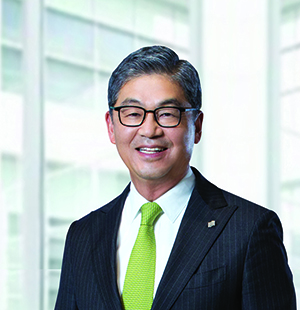
Kevin S. Kim
 HOPE BANCORP
About Kevin S. Kim
Kevin S. Kim, age 67, serves as Chairman, President & CEO of Hope Bancorp, Inc. and Bank of Hope; he became CEO in 2013 and Chairman in 2019, leading the organization from $5.8B in assets at the start of his CEO tenure to more than $17.0B as of December 31, 2024 . 2024 performance under his leadership included net income of $99.6M (EPS $0.82), PPNR ROAA of 0.85%, and strengthened capital ratios (CET1 13.06%, TCE 10.05%) while completing the Territorial Savings acquisition in April 2025; the Company’s TSR value of a $100 investment stood at $106 for 2024, versus the KBW Regional Banking peer group at $131 . Kim holds a B.A. (Hankuk Univ. of Foreign Studies), MBA (UCLA Anderson), JD (Loyola Law), completed ABA Stonier, and earned a Wharton Leadership Certificate .
Past Roles
| Organization | Role | Years | Strategic Impact |
|---|---|---|---|
| Center Financial Corporation / Center Bank | Director | 2008 onward | Spearheaded merger of equals with Nara Bancorp/Nara Bank to create BBCN Bancorp/BBCN Bank (Nov 30, 2011) |
| BBCN Bancorp / BBCN Bank | President & CEO (holding company) | Mar 2013 | Led platform as CEO |
| BBCN Bancorp / BBCN Bank | President & CEO (bank) | Apr 2014 | Expanded leadership to bank operations |
| Hope Bancorp / Bank of Hope (formed from BBCN-Wilshire merger) | Chairman; President & CEO | Chairman since May 23, 2019 | Led 2016 merger with Wilshire Bancorp to form Hope Bancorp; continued scale-up to >$17.0B assets |
| Hope Bancorp / Territorial Savings | Acquirer | Closed Apr 2, 2025 | Added ~$1.7B low-cost core deposits and Hawaii footprint; loan mix diversification |
External Roles
No current public-company board roles disclosed for Kim; education and professional credentials listed above .
Fixed Compensation
| Metric | 2022 | 2023 | 2024 |
|---|---|---|---|
| Base Salary ($) | $1,037,077 | $1,050,000 | $1,100,000 target; $1,086,538 earned |
| STIP Target (% of Salary) | — | — | 100% ($1,100,000) |
| LTIP Target (% of Salary) | — | — | 150% grant date fair value target |
Summary Compensation (CEO):
| Component ($) | 2022 | 2023 | 2024 |
|---|---|---|---|
| Salary | $1,037,077 | $1,050,000 | $1,086,538 |
| Bonus | $1,050 | $1,050 | $189,700 |
| Stock Awards | $1,428,155 | $1,234,428 | $1,604,158 |
| Non-Equity Incentive Comp (STIP corporate) | $1,030,730 | $654,980 | $351,560 |
| All Other Compensation | $57,399 | $60,712 | $76,113 |
| Total | $3,560,325 | $3,007,465 | $3,314,768 |
Performance Compensation
STIP Scorecard (Corporate Metrics – 80% of STIP):
| Metric | Weight | Target | Actual 2024 | Payout vs Target |
|---|---|---|---|---|
| EPS (ex-notables) | 25% | $1.00 | $0.85 | 63% |
| PPNR ROAA (ex-notables) | 25% | 0.98% | 0.88% | 50% |
| Criticized Loan Ratio (4Q average) | 20% | 2.33% | 3.35% | 0% |
| Total Loan Growth | 15% | 3.0% | (1.62)% | 0% |
| Avg Deposit Change (ex-brokered) | 15% | (2.0)% | (2.58)% | 78% |
| Total Corporate Achievement | 100% | — | — | 40% |
STIP Earned (CEO):
| Component | Amount ($) | % of Target |
|---|---|---|
| Corporate performance component | $351,560 | — |
| Individual performance component | $189,640 (86% of the 20% individual portion) | — |
| Total STIP cash incentive | $541,200 | 49% |
LTIP (2024 Grants and Design):
| Item | Details |
|---|---|
| Award Mix | 50% time-based RSUs; 50% PSUs (3-year performance period) |
| PSUs Metrics & Weighting | 50% ROTCE (ex-notables, absolute vs internal 3-year forecast) and 50% relative TSR vs KBW Nasdaq Regional Banking Index; payout 50%/100%/150% at Threshold/Target/Stretch |
| CEO 2024 RSUs Granted | 65,011 units (vest one-third annually over 3 years) |
| CEO 2024 PSUs (at target) | 32,506 ROTCE PSUs; 32,506 TSR PSUs |
| PSU Grant Date Fair Values | ROTCE: $412,501 (probable)/$618,752 (max); TSR: $366,668 (probable)/$618,752 (max) |
2022 LTIP – PSU Outcome (determined Q1’25):
| Metric | Weight | Result | Payout |
|---|---|---|---|
| EPS (12-month, 2022) | 40% | $1.81 (above stretch) | 150% |
| Relative ROTCE (2022–2024) | 40% | 8th percentile | 0% |
| Relative TSR (2022–2024) | 20% | 26th percentile | 52% |
| CEO Target/Earned Shares | 48,853 target; 34,393 vested Mar 7, 2025 (70% of target) |
Equity Ownership & Alignment
| Item | Value |
|---|---|
| CEO Stock Ownership Guideline | 5x base salary; target shares 447,518; held 909,703; guideline satisfied |
| Beneficial Ownership (CEO) | Shares owned: 825,840; options exercisable: 260,660; total beneficial: 1,086,500; <1% of shares |
| Options (CEO) | 30,660 @ $16.12 exp. 5/26/2026; 60,000 @ $17.18 exp. 9/1/2026 |
| In-the-money value (12/31/24) | $0 for options (stock $12.29 below strikes) |
| Outstanding 2024 RSUs & PSUs | RSUs: 65,011; PSUs: 32,506 (ROTCE) and 32,506 (TSR) |
| Hedging/Pledging Policy | Hedging and pledging prohibited; margin accounts disallowed; limited pledging exceptions require Legal approval |
Upcoming vesting cadence (potential withholding/selling pressure):
- Time-vested RSUs vest ratably over 3 years from grant dates: 2022 (first vest 3/23/2023), 2023 (first vest 3/22/2024), 2024 (first vest 7/19/2025), “substantially equal” portions each anniversary; PSUs vest contingent on performance by March 2027 for 2024 awards .
Employment Terms
| Term | Key Provisions |
|---|---|
| Agreement Term | Start 3/28/2022; End 3/31/2027; auto-renews annually from Apr 1, 2027; not beyond 3/31/2029; termination by Company for cause or without cause (30 days notice); by CEO (90 days) |
| Base Salary | $1,100,000 (subject to annual adjustments) |
| Annual Bonus Target | 100% of base salary; paid based on performance criteria |
| Annual Equity Target | Up to 150% of base salary grant date fair value; 50% service-based, 50% performance-based |
| Restrictive Covenants | Non-solicitation for one year post-termination; confidentiality obligations indefinite |
| Severance (No CoC) | 150% of base salary plus accelerated vesting of outstanding equity (performance awards vest only to extent conditions satisfied) upon termination without cause or resignation for good reason |
| Severance (Within 1 year post-CoC) | 250% of base salary plus accelerated vesting per above |
| Death/Disability | Accelerated vesting; performance awards vest at target if conditions not met |
| Equity Plan Change-in-Control | Plans allow accelerated vesting upon change in control; values calculated at $12.29 for 12/31/24 illustration |
| BOLI / Executive Survivor Plan | Eligible death benefit $3.0M while employed; convertible to split-dollar if terminated without cause/for good reason/disability; otherwise max benefit scales: $0.75M (2023), $1.5M (2024), $2.25M (2025), $3.0M (2026+) |
Board Governance
- Dual role: Kim is Chairman and CEO since May 23, 2019; Board uses a Lead Independent Director to mitigate combined role concentration (executive sessions, agenda coordination, CEO performance feedback) .
- Committees are 100% independent (Audit, Compensation, Nomination); independent directors conduct executive sessions; annual board and committee evaluations .
- Kim chairs the Executive Committee; majority of director nominees (9/11) are independent; Steven S. Koh is non-independent due to family relationship with the COO .
- Meeting attendance: all current directors attended at least 75% of Board/committee meetings in 2024; committee meetings held in 2024—Audit: 15; Compensation: 8; Nomination: 6; Board Risk: 8; Executive: 6 .
Director Compensation (Board context)
Non-employee director program—annual cash and RSU retainers; leadership and chair retainers; RSUs vest in one year; director equity guideline: 3x cash retainer (five years to comply) . Not applicable to Kim’s compensation as a management director .
Compensation Structure Analysis
- Program architecture: base salary + STIP (80% financial + 20% individual) + LTIP (50% RSUs, 50% PSUs with 3-year measurement); changes in 2024 added diversified metrics and eliminated overlapping measures; three-year PSU measurement favored by shareholders .
- Pay-for-performance signals: 2024 corporate STIP achieved 40% given EPS/PPNR pressures and asset quality metrics; CEO total STIP payout at 49% of target; 2022 PSU outcomes diluted by weak relative ROTCE yet above-stretch EPS for the 12-month component .
- Governance safeguards: clawback policy adopted Oct 2023; anti-hedging/pledging; independent compensation consultant (Pearl Meyer) and peer benchmarking; no excessive perquisites .
- Equity award mix: shift to RSUs + PSUs vs options; legacy options remain outstanding and are currently out-of-the-money (no repricing disclosed) .
Equity Ownership & Alignment Details
| Aspect | Observation |
|---|---|
| Ownership guideline compliance | CEO exceeds 5x salary ownership threshold; strong alignment |
| Pledging/Hedging | Policy prohibits; no pledging disclosed; exceptions require Legal approval |
| Vested vs unvested | Significant unvested RSUs and PSUs outstanding; scheduled annual RSU vesting creates periodic withholding/sale needs |
| Options | All CEO options carry exercise prices > market on 12/31/24; zero intrinsic value |
Performance & Track Record
| Metric | 2023 | 2024 |
|---|---|---|
| Net Interest Income ($M) | $525.9 | $427.9 |
| Net Income ($M) | $133.7 | $99.6 |
| EPS (GAAP) | $1.11 | $0.82 |
| EPS (ex-notables) | $1.20 (context) | $0.85 |
| PPNR ROAA (ex-notables) | 1.12% | 0.88% |
| Deposits ($B) | $14.8 | $14.3; brokered reduced to 7% from 10% |
| Loans ($B) | $13.9 | $13.6 |
| Capital ratios (CET1 / Total / TCE) | 12.28% / 13.92% / 8.86% | 13.06% / 14.78% / 10.05% |
| TSR ($100 investment) | $99 | $106 |
Strategic execution highlights: re-oriented organization around lines of business; inflection to loan growth in H2’24; cost control improved noninterest expense; consummated Territorial Savings acquisition, adding ~$1.7B core deposits and Hawaii presence .
Compensation Committee Analysis
- Committee composition independent; Chair: Dale S. Zuehls; eight meetings in 2024; uses Pearl Meyer for benchmarking and program design; LTIP uses KBW Regional Banking Index for relative TSR peer group .
- 2024 say-on-pay support: ~97% approval; shareholder feedback directly influenced STIP/LTIP restructuring .
Related Party Transactions and Compliance
- No material related-party transactions beyond ordinary-course banking loans on market terms; all such items subject to Audit Committee oversight; all Section 16(a) ownership filings compliant .
Equity Ownership Peer & Index Concentration
Top institutional holders include BlackRock (14.51%), Vanguard (11.34%), Fuller & Thaler (5.74%), DFA (5.59%), State Street (5.08%), as of relevant 13G filings .
Compensation Peer Group (for benchmarking)
Ameris Bancorp; Atlantic Union Bankshares; Banner; Cathay General; CVB Financial; First Financial Bancorp; First Interstate BancSystem; Fulton Financial; Glacier Bancorp; Heartland Financial USA; Independent Bank Group; Independent Bank Corp.; Pacific Premier Bancorp; Renasant; Simmons First National; United Community Banks; WesBanco; WSFS Financial .
Say-on-Pay & Shareholder Feedback
- 2024 advisory vote approval ~97%; engagement with holders representing 69% of outstanding shares in fall 2024 affirmed support for program changes .
Board Service, Committees, and Dual-Role Implications
- Board Service History: Director since 2011; Chairman since 2019; Executive Committee Chair .
- Committee Roles: Executive Committee (Chair); CEO performance overseen by independent Compensation Committee; risk oversight via Board Risk Committee .
- Independence Considerations: Combined Chair/CEO role offset by Lead Independent Director structure and fully independent principal committees; one non-independent director (Honorary Chairman Steven S. Koh) due to familial relationship with the COO .
- Attendance: All directors attended ≥75% of meetings in 2024; robust committee cadence .
- Executive Sessions: Lead Independent Director presides; annual Chairman evaluation coordinated with Nomination Committee .
Investment Implications
- Alignment: Strong ownership by CEO exceeding 5x salary guideline and balanced equity mix with performance-contingent PSUs support long-term alignment; clawback and anti-hedging/pledging mitigate agency risk .
- Retention Risk: Employment agreement provides meaningful severance (1.5x base; 2.5x within 1 year post-CoC) and accelerated vesting protections—reducing near-term departure risk; however, scheduled RSU vesting calendars can create periodic withholding/sale pressure around vest dates .
- Pay-for-Performance: 2024 STIP corporate payout at 40% reflects macro rate and credit headwinds; LTIP maintains rigorous three-year absolute ROTCE and relative TSR hurdles, with mixed outcomes for the 2022 cycle—indicative of balanced risk-taking and external sensitivity .
- Governance: Combined Chair/CEO structure warrants continued emphasis on Lead Independent Director authority and independent committee oversight; board independence remains high (9/11 nominees) .
- Execution Risk: Integration of Territorial Savings and continued deposit/loan mix optimization are key value-creation levers; capital ratios improved year-over-year provide buffer, but EPS and PPNR are sensitive to rate path and credit quality metrics embedded in incentive targets .