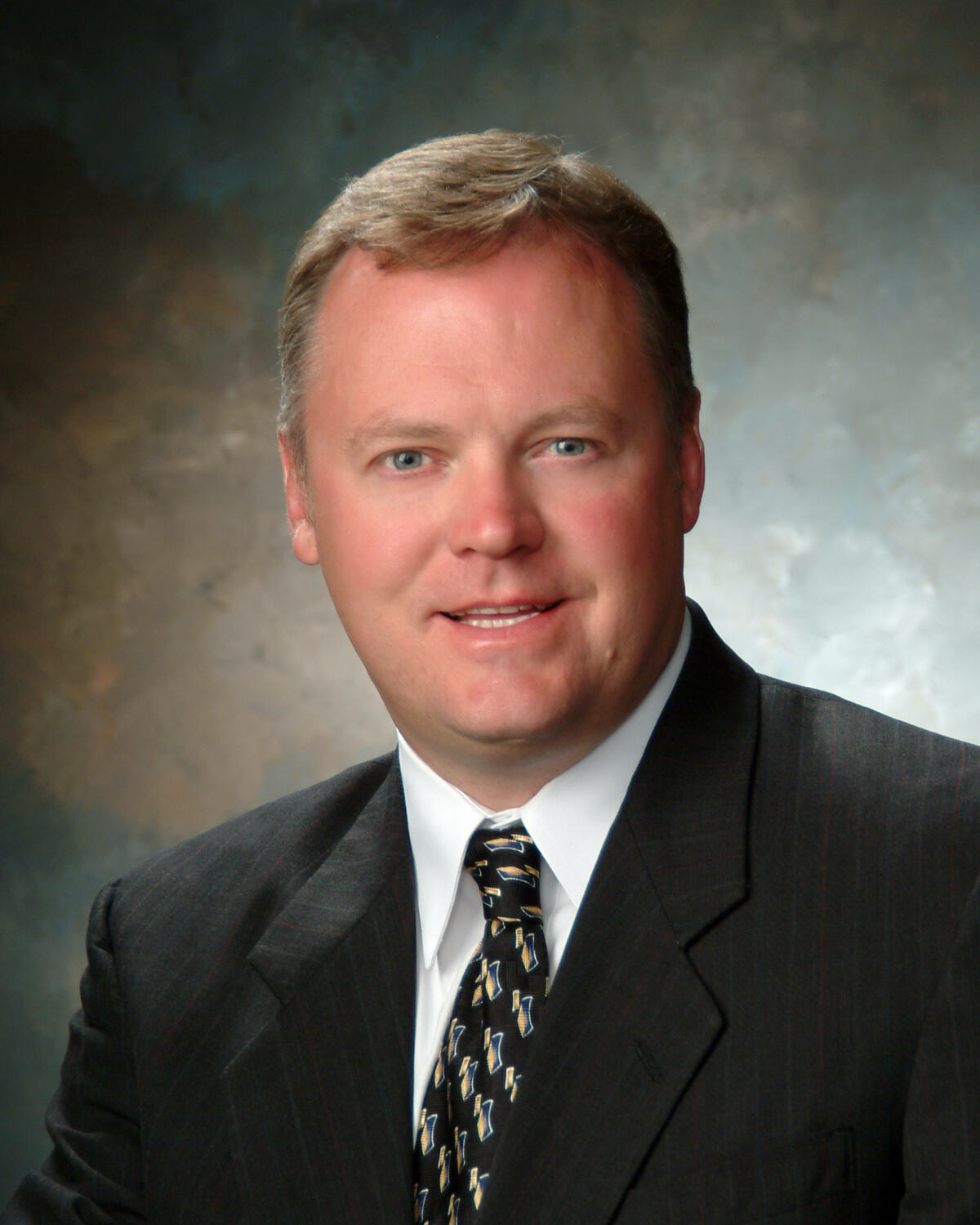
Michael J. Gerdin
 HEARTLAND EXPRESS
About Michael J. Gerdin
Michael J. Gerdin, age 55, is Chairman, Chief Executive Officer, President, and Director of Heartland Express (HTLD). He has served as CEO and Chairman since 2011, President since 2006, and has been a director since 1996, with 41 years of industry experience across operations, sales, safety, maintenance, and driver recruiting . Under his leadership, Heartland expanded from $529 million to $1.0 billion in annual revenue, aided by the 2022 acquisitions of Smith Transport and CFI; recent performance shows FY 2024 revenue of $1.05 billion and EBITDA of $154 million*, with pay-versus-performance metrics focused on TSR, Net Income, and Operating Ratio (2024 OR 101.9%) . He does not serve on board committees, reflecting the combined CEO-Chairman role that the board supports given company size and independent committee structure .
Values retrieved from S&P Global*
Past Roles
| Organization | Role | Years | Strategic Impact |
|---|---|---|---|
| Heartland Express | CEO & Chairman | 2011–Present | Grew the company from $529M to $1.0B in annual revenue; led strategic objectives and daily operations . |
| Heartland Express | President | 2006–Present | Executive leadership continuity across operations and strategy . |
| Heartland Express | VP Regional Operations | 2001–2006 | Operational leadership in regional networks . |
| A & M Express (subsidiary) | President | 1998–2001 | Subsidiary leadership and integration . |
| Heartland Express | Various posts (operations, sales, safety, maintenance, recruiting) | 1983–1998 | Grounded expertise across core trucking functions . |
External Roles
| Organization | Role | Years | Strategic Impact |
|---|---|---|---|
| West Bancorporation & West Bank | Director | 2013–2023 | Regional banking oversight; financial governance experience . |
| Iowa Motor Truck Association | Board service (prior) | Not disclosed | Industry advocacy and policy engagement . |
| Iowa State Univ. College of Business | Dean’s Advisory Council | Current | Academic-industry linkage; talent pipeline and strategy . |
Fixed Compensation
| Year | Salary ($) | Bonus ($) | Stock Awards ($) | All Other Compensation ($) | Total ($) |
|---|---|---|---|---|---|
| 2024 | 1,050,410 | — | — | 20,097 (Tuition Plan) | 1,070,507 |
| 2023 | 980,577 | — | — | 31,906 (Tuition Plan) | 1,012,483 |
| 2022 | 830,770 | — | — | 8,895 (Tuition Plan) | 839,665 |
Additional CEO pay practices and context:
- CEO compensation is salary-only (no annual bonus, RSUs, PSUs, or options), reflecting alignment via significant stock ownership; no tax gross-ups; conservative equity usage .
- CEO pay ratio was ~19x the median employee in 2024 (CEO $1,070,507 vs. median $55,271) .
Performance Compensation
- Heartland links executive pay decisions to TSR (vs. peers), Net Income, and Operating Ratio; the proxy does not disclose metric weightings, targets, or formulaic payouts for the CEO, and indicates no CEO stock awards .
- NEO stock awards in 2024 were discretionary service-vested RSUs (no performance metrics), with specific schedules for two NEOs on Jan 1, 2025 (quarterly vesting through October 2025) and single-date vesting grants for two NEOs in 2024 .
| Metric | Role in Decisions | Target | Actual | Payout | Vesting |
|---|---|---|---|---|---|
| Total Shareholder Return (Company vs. Peer Group) | Key input for salary and equity decisions | Not disclosed | Value of $100: 2024 $56.33; Peer $146.78 | Not formulaic; discretionary | Not applicable to CEO awards (none) |
| Net Income | Key input for salary and equity decisions | Not disclosed | 2024 $(29.7) million | Not formulaic; discretionary | Not applicable to CEO awards (none) |
| Operating Ratio | Key input; defined as operating expenses / operating revenues | Not disclosed | 2024 101.9% | Not formulaic; discretionary | Not applicable to CEO awards (none) |
Equity Ownership & Alignment
| Item | Detail |
|---|---|
| Total beneficial ownership | 31,805,618 shares; 40.5% of diluted shares (78,596,766) . |
| Ownership structure | Includes GRATS (trustee), children’s trusts (trustee), Gerdin Family Investments LP (co-general partner), 2007/2009 Gerdin Heartland Trusts (co-trustee), Ann S. Gerdin Revocable Trust (co-trustee), Michael J. Gerdin Revocable Trust (trustee), and Michael J. Gerdin Family Trust (spouse trustee); various beneficial ownership disclaimers apply where control is shared or no pecuniary interest exists . |
| Shares pledged as collateral | Prohibited by the company’s anti-hedging and pledging policy (no hardship exceptions) . |
| Hedging (shorts, derivatives) | Prohibited for directors and Section 16 officers . |
| Stock ownership guidelines | CEO required to own 5x base salary; 8 years from 2021 to comply . |
| Compliance status | Not explicitly disclosed for CEO; holdings are significant relative to guideline . |
| Vested vs. unvested equity | No outstanding CEO equity awards; NEOs had service-vested RSUs; none outstanding at FY-end 2024 . |
| Options | No option awards disclosed for CEO; none outstanding at FY-end 2024 for NEOs . |
| Deferred compensation | CEO DC Plan balance $226,942 at 12/31/2024 . |
Employment Terms
- Contracts and severance: No employment contracts and no severance obligations for NEOs, including CEO .
- Change-in-control (CIC): DC Plan employer contributions immediately vest upon CIC; RSUs include double-trigger (vesting only if termination without cause or for good reason within 24 months post-CIC) .
- Distribution elections: DC Plan permits changes upon CIC, enabling lump sum or installments at participant election .
- Clawback: Board must seek recovery for restatements; may seek recovery for misconduct or restrictive covenant breaches; applies to current/former Section 16 officers .
- Anti-hedging/pledging: Prohibits hedging, pledging, and margin purchases for directors and Section 16 officers .
- Insider trading policy: Applies to all personnel; policy filed as 10-K exhibit .
- Stock grant practices: No timing of grants around MNPI; no option repricing/backdating .
Board Service, Committees, and Governance Implications
- Board roles: CEO, Chairman, President, Director; does not serve on board committees .
- Independence: Majority-independent board; all committees (Audit & Risk, Compensation, Nominating & Governance) are fully independent .
- Committee leadership: Audit & Risk Chair James G. Pratt; Compensation Chair Benjamin J. Allen; Nominating & Governance Chair Brenda S. Neville .
- Attendance: Board met 4 times in FY 2024; all directors attended 100% of board and committee meetings; all attended the 2024 Annual Meeting .
- CEO + Chairman dual role: Board supports combined role for efficient functioning given company size; mitigated by independent committees and majority-independent board .
- Director compensation and ownership: Non-employee directors receive $45,000 annual cash retainer, plus meeting fees ($1,500 board; $750 committee) and chair stipends (Audit $12,500; Compensation $7,000; Nominating $7,000); director ownership guideline is 3x cash retainer within 4 years .
Performance & Track Record
| Measure | 2020 | 2021 | 2022 | 2023 | 2024 |
|---|---|---|---|---|---|
| Revenue ($) | 645.3M ] | 607.3M ] | 968.0M ] | 1,207.5M ] | 1,047.5M ] |
| EBITDA ($) | 189.0M* | 172.2M* | 224.5M* | 200.3M* | 153.8M* |
| TSR: $100 invested (Company) | 86.34 | 82.99 | 76.09 | 71.11 | 56.33 |
| TSR: $100 invested (Peer group) | 112.49 | 155.32 | 138.87 | 152.09 | 146.78 |
| Net Income ($M) | 70.8 | 79.3 | 133.6 | 14.8 | (29.7) |
| Operating Ratio (%) | 85.5 | 82.6 | 80.5 | 96.5 | 101.9 |
Values retrieved from S&P Global*
Context:
- Management cites a challenging freight environment and the impact of the Smith Transport (May 31, 2022) and CFI (Aug 31, 2022) acquisitions: revenue expanded to $1.0B (2024) and $1.2B (2023), but margins and leverage were pressured vs. historical levels .
- Pay vs performance disclosure emphasizes TSR, Net Income, and Operating Ratio as the “most important measures” linking compensation to performance .
Governance, Related Parties, and Shareholder Sentiment
- Security ownership: The “Gerdin Family” collectively owns ~44% through direct holdings and trusts; CEO beneficially owns ~31.8M shares (40.5%) .
- Related party transactions: Brian Janssen (relative) employed; total compensation $185,491 in 2024; oversight via Audit & Risk Committee procedures for related party transactions .
- Say-on-Pay (2024): 89.7% approval; annual say-on-pay adopted; frequency vote supported annual cycle .
- Compensation peer group: Covenant Logistics, Knight-Swift, Marten Transport, P.A.M Transportation, Schneider National, Werner Enterprises; used as reference, not for specific percentile targeting .
- Section 16 compliance: Late Form 3 (Helmich) and late Form 4 (Donovan); no issues noted for CEO .
Investment Implications
- Alignment and control: CEO’s ~40.5% beneficial stake and a family block (~44%) create strong alignment and long-term orientation; anti-hedging/pledging policy reduces risk of hedging or collateral-driven selling pressure .
- Pay-for-performance signal: CEO compensation is purely fixed salary with no incentive pay or equity grants, relying on large personal ownership for alignment; investors should note the lack of variable pay levers tied to explicit targets or weights .
- CIC economics and retention: No employment contracts or severance; double-trigger equity acceleration only applies to unvested RSUs (CEO has none); DC Plan vests on CIC—CEO balance is modest ($226,942), implying low CIC cash drains .
- Performance risk: TSR has lagged peers and net income turned negative in 2024 while OR deteriorated; compensation decisions consider TSR, Net Income, and OR, but CEO’s pay is not performance-variant, placing emphasis on strategic execution to restore margins and growth .
- Governance mitigants to dual role: Combined CEO-Chairman model is mitigated by majority-independent board and fully independent committees; board attendance and engagement are high, with clear committee leadership .