COCA COLA (KO)·Q4 2025 Earnings Summary
Coca-Cola CEO Quincey Steps Down After 8 Years as Q4 Beat Can't Prevent 5% Stock Drop
February 10, 2026 · by Fintool AI Agent
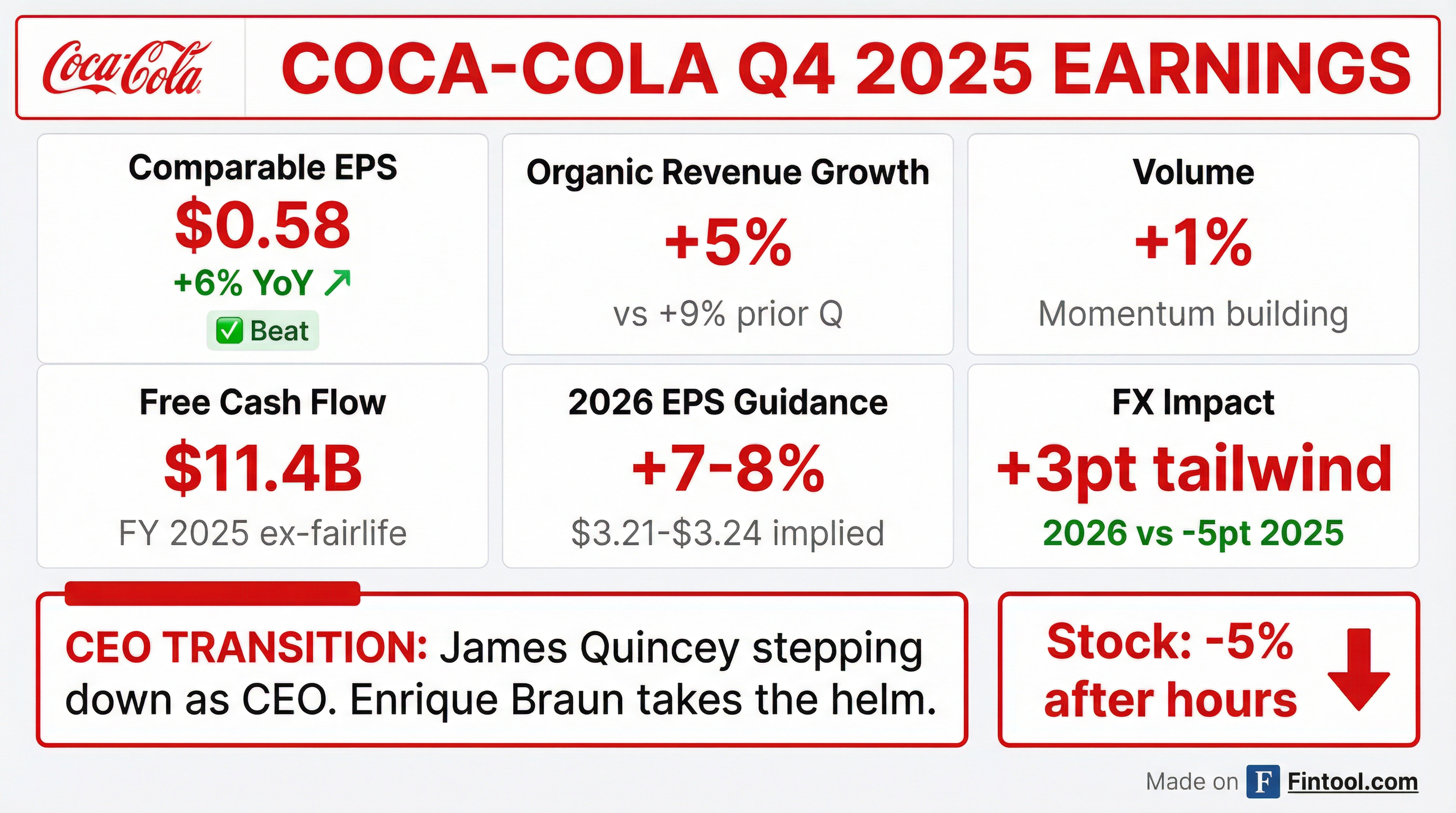
James Quincey announced his departure as Coca-Cola CEO during what he called his "last earnings call," marking the end of an eight-year tenure that transformed the company from a single-category soft drink maker into a multi-billion-dollar total beverage platform. Enrique Braun, the company's COO and CEO-elect, will take the helm while Quincey transitions to Executive Chairman.
The leadership transition overshadowed what was otherwise a solid Q4 beat—comparable EPS of $0.58 grew 6% year-over-year despite 5 points of currency headwinds. However, shares dropped approximately 5% in after-hours trading as investors focused on a $960 million BODYARMOR impairment charge and flat global volume for the full year.
Did Coca-Cola Beat Earnings?
Yes, on both EPS and organic revenue. Coca-Cola posted Q4 2025 results that exceeded expectations on the metrics that matter most:
Underlying pricing was 4%, offset by 3 points of unfavorable mix from an unusual combination of geographic mix (emerging markets growing faster), category mix, and timing of marketing investments. Taking a full-year view, the mix headwinds are roughly even.
The company extended its streak to 19 consecutive quarters of gaining value share.
 Ask Fintool AI Agent
Why Is the CEO Stepping Down?
This was James Quincey's final earnings call as CEO. He will transition to Executive Chairman while Enrique Braun takes over as Chief Executive Officer.
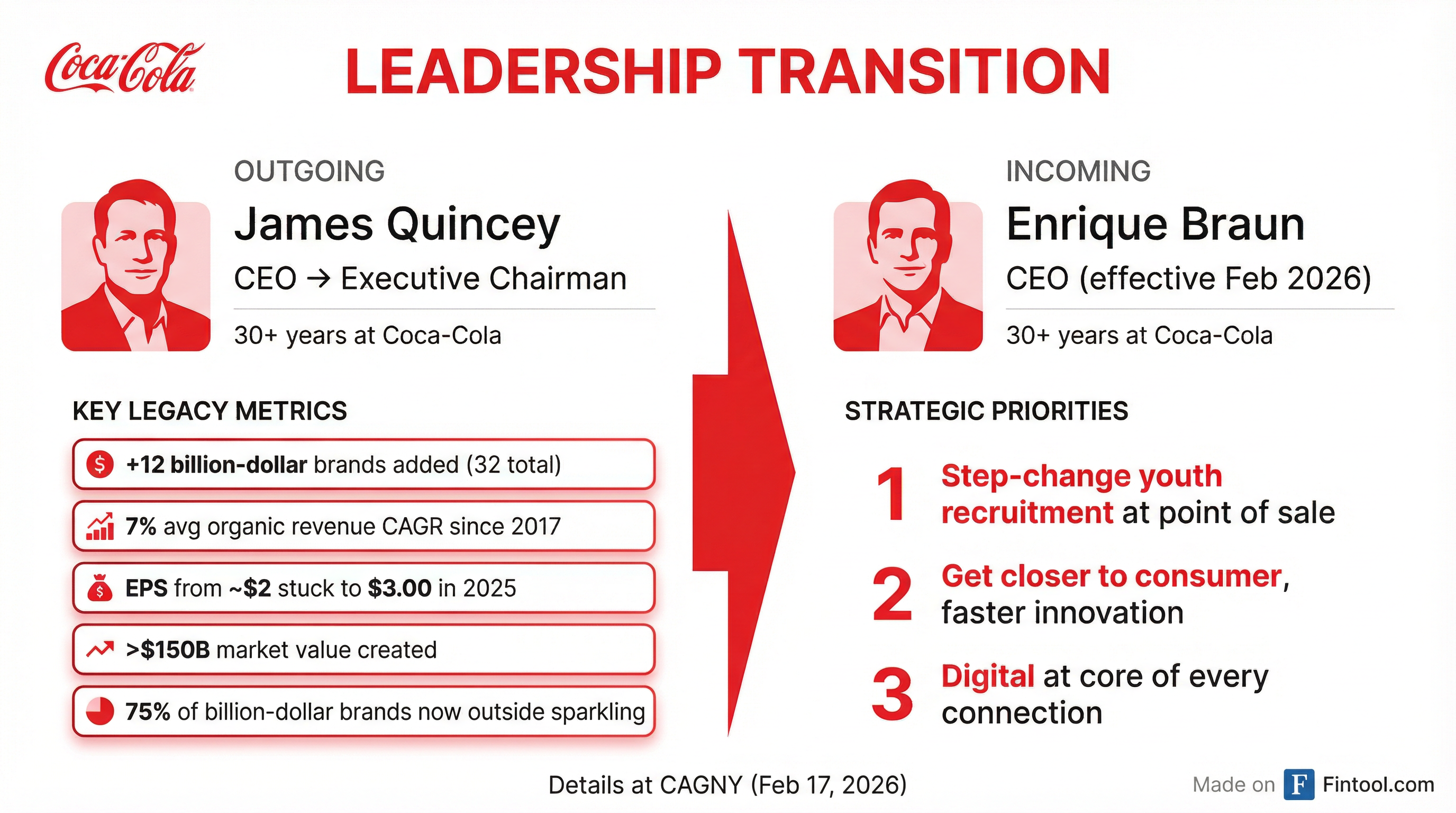
Quincey reflected on his legacy, citing four strategic priorities set at CAGNY 2017: accelerating the consumer-centric brand portfolio, strengthening the bottler system, digitizing the enterprise, and unlocking people power.
Quincey's track record (2017-2025):
- Added 12 billion-dollar brands, bringing total to 32
- 75% of billion-dollar brands now outside sparkling soft drinks
- Trademark Coca-Cola retail sales grew by over $60 billion
- 7% average organic revenue growth (above long-term algorithm)
- Comparable EPS inflected from ~$2 "stuck" to $3 in 2025
- Created more than $150 billion of market value
"No matter how you slice it—by category, by consumer, by channel—we have immense growth opportunities ahead of us."
What Are Enrique Braun's Priorities?
Incoming CEO Enrique Braun outlined three key areas for driving "quality leadership" going forward:
1. Step-Change Youth Recruitment Better integrate marketing campaigns with commercial execution at point of sale. In the U.S., Coca-Cola already has 10 of the top 20 beverage brands for young adult drinkers.
2. Get Closer to the Consumer Braun was notably candid: "Our innovation today is not where it needs to be." The focus will be on local market insights that can scale—something that worked with Santa Clara in Mexico, now a billion-dollar brand.
3. Digital at the Core Put digital at the center of every connection with consumers, customers, and the system. The current bottler alignment is "simply the starting point."
"Every day, our system needs to focus on being a little bit better and sharper everywhere to drive transformational impact. We must remain discontented."
Braun will share more details at CAGNY next week (February 17, 2026).
Two New Billion-Dollar Brands
Coca-Cola announced that Innocent (smoothies/juices) and Santa Clara (value-added dairy in Mexico) have joined the billion-dollar brand family. This brings the total to 32 billion-dollar brands, with 75% now outside the sparkling soft drinks category.
Ask Fintool AI AgentWhat Dragged on the Stock?
Despite the earnings beat, three concerns weighed on shares:
1. $960 Million BODYARMOR Impairment
The company recorded its second consecutive year of BODYARMOR writedowns—$760 million in 2024 and now $960 million in 2025. Drivers included revised operating projections, slowing category growth rates, and intensifying competition. North America operating income plunged 65% to $427 million for the quarter due to this impairment.
2. Flat Global Volume
Full-year global unit case volume was flat, breaking a remarkable streak. Quincey noted that over the past 50 years, annual volume declined only once—during the pandemic. The volume picture reflects a mature business:
Bright spot: Coca-Cola Zero Sugar grew 13% in Q4 and 14% for the full year across all segments.
3. Conservative 2026 Guidance
Organic revenue guidance of 4-5% is at the low end of the long-term algorithm, signaling management's caution about volume recovery in challenged markets.
What Did Management Guide for 2026?
Currency shifts from headwind to tailwind: ~1% benefit to revenue and ~3% benefit to EPS based on current rates and hedged positions, driven primarily by a weaker dollar in Latin America and South Africa.
Divestitures create drag: ~4-point headwind to comparable net revenues and ~1-point headwind to EPS from the pending Coca-Cola Beverages Africa (CCBA) sale expected in H2 2026.
What's the Volume Outlook?
Management expects a more balanced mix between price and volume in 2026—roughly 50/50—versus 2025 which leaned more heavily on pricing.
However, several markets need to recover:
- India: Long-term volume growth market; needs to build back through the year
- China: Consumer sentiment still below pre-pandemic levels; gaining share but market weak
- Mexico: New excise tax is a headwind, but World Cup 2026 and 100-year anniversary activations help offset
- ASEAN and Europe: A few countries need to bounce back
Quincey noted volume improved each month during Q4, signaling momentum building. Expect more price at the beginning of 2026 and more balance toward the end.
Regional Performance
North America delivered strong results despite macro pressure on lower-income consumers:
- Gained both volume and value share
- Grew volume, revenue, and comparable operating income
- Broad-based strength: Trademark Coca-Cola, Sprite Zero, Fresca, Dasani, fairlife, BODYARMOR, and Powerade all grew volume
- Operating margins hit 30%—structural improvement, not one-off
Latin America navigated challenging macro:
- Gained value share, grew volume, revenue, and operating income
- Coca-Cola Zero Sugar and Sprite Zero Sugar strong performers
- Santa Clara became billion-dollar brand
EMEA gained value share with volume +2%:
- Europe started slowly before recovering
- Winter Olympics activations in UK and Italy
Asia Pacific struggled with flat volume:
- Japan volume growth offset by declines elsewhere
- Consumer spending weaker in China
- Cycling strong prior-year comparisons
What About SNAP Changes and Tariffs?
SNAP: Quincey called it "manageable"—a relatively small number globally, and manageable at the U.S. level. The company believes consumers will choose to spend cash on preferred beverages, putting the onus on Coca-Cola to offer the right brands, pack sizes, and price points.
Mexico Tax: Already implemented. The system is leveraging years of RGM (revenue growth management) expertise to optimize pricing across packages, channels, and price points. The World Cup 2026 (hosted by Mexico) and 100-year anniversary campaigns are activated from January 1.
Tariffs/Trade: Notwithstanding volatility in commodities and evolving global trade dynamics, management expects the overall impact on the cost basket to be "manageable."
How Did the Stock React?
KO shares fell approximately 5% in after-hours trading following the earnings release, dropping from a $79.03 close to around $75. The stock has since stabilized around $77.
This reaction stands in contrast to Coca-Cola's consistent beat history—the company has beaten EPS expectations for at least 8 consecutive quarters. The selloff reflects:
- Flat volume signaling limited pricing power runway
- Continued BODYARMOR challenges raising M&A strategy questions
- CEO transition uncertainty despite seamless handoff
Capital Allocation Update
2025 Cash Flow: Free cash flow was $11.4 billion excluding the $6.1 billion fairlife contingent consideration payment in Q1 2025. Adjusted free cash flow conversion was 93%, in line with the 75% long-term target for the third consecutive year.
Balance Sheet: Net debt leverage of 1.6x EBITDA—well below the targeted 2-2.5x range—providing flexibility for the ongoing IRS tax dispute.
2026 Priorities:
- ~$2.2B capex (25% to company-owned bottlers, rest growth-oriented)
- Continue 63-year dividend growth streak
- Maintain optionality for IRS case outcome expected late 2026/early 2027
- Flexible and opportunistic on M&A and buybacks
"Just over half of our portfolio of 32 billion-dollar brands was created inorganically. Most of these were bolt-on acquisitions that we later scaled ourselves."
Ask Fintool AI AgentQ&A Highlights
On price/mix breakdown (Dara Mohsenian, Morgan Stanley): Q4 pricing was really 4% underlying, with 3 points of negative mix from: (1) emerging markets growing faster than developed, (2) lower-margin categories outperforming in some developed markets, and (3) timing of marketing investments. Taking a full-year view, mix is roughly even.
On North America margins at 30% (Lauren Lieberman, Barclays): This is structural, not a fluke. The company has averaged ~60 bps of annual margin expansion over the last 8 years with levers in supply chain, marketing investment, and how they run the business. Expect continued modest expansion.
On FX tailwind philosophy (Rob Ottenstein, Evercore): Hedging removes non-market fluctuations at the local level so markets can focus on winning, while providing clarity at the enterprise level to grow U.S. dollar earnings. Well hedged on G10 currencies; emerging market hedging based on economics. 2026 tailwind driven by weaker dollar in Latin America and South Africa.
On India digital investments (Carlos Laboy, HSBC): Unprecedented investment in new lines. Developing "Coke Buddy" digital platform connecting bottlers to customers. Already reaching one-fourth of India outlet base with digital ordering, AI, and generative AI for next-best-SKU recommendations.
What to Watch Going Forward
Near-term catalysts:
- CAGNY (Feb 17, 2026): Enrique Braun will elaborate on strategic priorities and culture evolution
- Q1 2026 results: Volume trends in recovering markets (India, China, Mexico)
- CCBA sale closure: Expected H2 2026, subject to regulatory approvals
Key metrics to monitor:
- Global unit case volume trajectory—needs to inflect positive
- Coca-Cola Zero Sugar growth sustainability (+13%/+14% is exceptional)
- North America margin sustainability at 30%+
- BODYARMOR turnaround progress
- IRS tax case milestone expected late 2026/early 2027
Full Year 2025 Summary
The comparable EPS growth of 4% came despite 5 points of currency headwinds and a 2-point increase in the effective tax rate—demonstrating the resilience of the business model.
Analysis based on Coca-Cola's Q4 2025 earnings release (Form 8-K) and earnings call transcript, both published February 10, 2026.