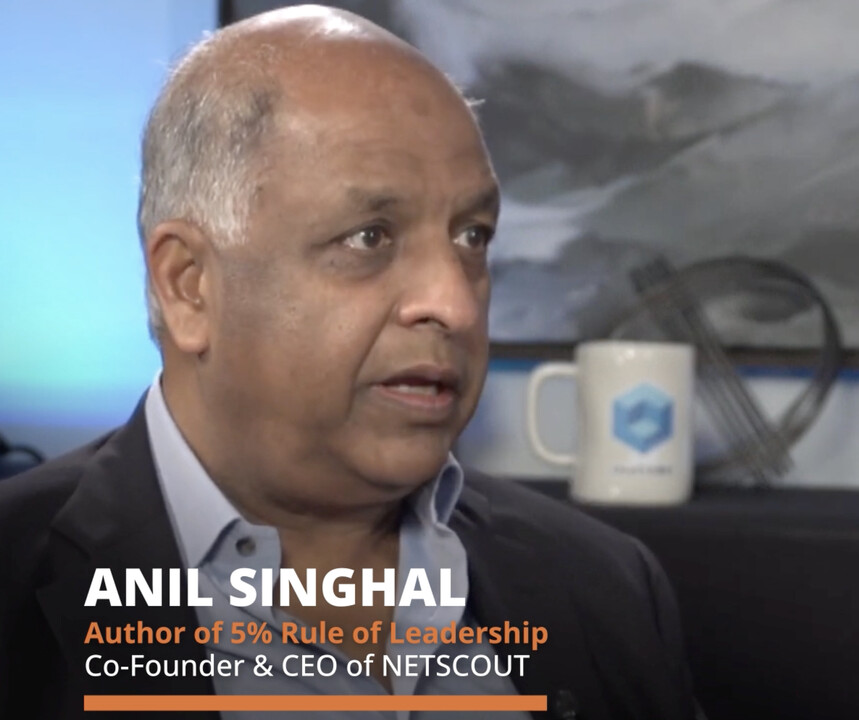
Anil K. Singhal
 NETSCOUT SYSTEMS
About Anil K. Singhal
Co‑founder of NetScout Systems, Inc., Anil K. Singhal is President, Chief Executive Officer, Chairman, and a Director (age 71). He has served on the Board since June 1984 and as Chairman since January 2007; he holds a BSEE from BITS Pilani and an MS in Computer Science from the University of Illinois at Urbana‑Champaign . Under his leadership, NetScout completed its IPO in 1999 and acquired Danaher’s Communications Business in 2015 for $2.3B, expanding scale and product breadth . For FY2025, NetScout reported total revenue of $822.7M (≈1% YoY decline) and non‑GAAP diluted EPS of $2.22; GAAP results included a $427.0M non‑cash goodwill impairment leading to a GAAP net loss of $366.9M (−$5.12 per diluted share) . On long‑term incentives, PSUs granted in FY2022 (measured to June 3, 2024) paid out at 56% of target based on relative TSR performance versus the Russell 2000 Index .
Past Roles
| Organization | Role | Years | Strategic Impact |
|---|---|---|---|
| NetScout Systems, Inc. | Co‑Founder & Chief Executive Officer | 1984–present | Led IPO (1999) and $2.3B acquisition of Danaher Communications (2015), scaling service assurance and cybersecurity portfolio . |
| NetScout Systems, Inc. | Chairman of the Board | 2007–present | Combined CEO/Chair structure with Lead Independent Director oversight; Board committees fully independent . |
| NetScout Systems, Inc. | Director | 1984–present | Founding director; long‑tenured continuity and strategic oversight . |
External Roles
- Other public company directorships: None disclosed .
Fixed Compensation
- Base salary and target bonus policy: CEO base salary and target bonus were unchanged in FY2025 vs. FY2024; CEO base salary has not increased since FY2023 .
- Say‑on‑pay: 87.4% support at the 2024 Annual Meeting .
- Perquisites: Company‑paid automobile and insurance allowances, financial/charitable planning, tax preparation, and event tickets for CEO; no tax gross‑ups .
FY2025 CEO pay components (disclosed amounts):
| Metric | FY2023 | FY2024 | FY2025 |
|---|---|---|---|
| Base Salary ($) | 594,825 | 594,825 | 594,825 |
| Target Annual Bonus ($) | — | 647,194 | 647,194 |
| Actual Annual Bonus Paid ($) | 911,464 | 323,585 | 523,580 |
| Stock Awards ($ grant‑date fair value) | 2,901,420 | 1,830,096 | 1,193,760 |
| All Other Compensation ($) | 101,889 | 104,460 | 125,314 |
Notes: FY2025 bonuses were set at 80.9% of target via negative discretion despite over‑achievement on two metrics (see Performance Compensation) .
Performance Compensation
Annual incentive (FY2025)
- Plan metrics/weights: Non‑GAAP EPS (40%), total non‑GAAP revenue (40%), YoY non‑GAAP cybersecurity revenue growth (20%). Threshold profitability (non‑GAAP EPS) gate applies .
- Targets vs. actual and payout outcome:
| Metric | Minimum | Maximum | Actual | % Attainment | Weighted Attainment |
|---|---|---|---|---|---|
| Non‑GAAP EPS (40%) | $2.10 | $2.30 | $2.22 | 160% | 64.0% |
| Total non‑GAAP revenue (40%) | $800M | $830M | $822.7M | 176% | 70.4% |
| Cybersecurity non‑GAAP revenue growth (20%) | 10% | 15% | 7% | 0% | 0% |
| Total potential payout | 134.4% | ||||
| Actual payout (after negative discretion) | 80.9% |
- CEO FY2025 bonus paid: $523,580 (80.9% of $647,194 target) .
Long‑term incentives (FY2025 grants)
- Instrument mix and objectives: ~40% PSUs (3‑yr relative TSR vs. Russell 2000, cliff vest at end of period, capped at 100% of target), and time‑based RSUs vesting in four equal annual installments .
- FY2025 CEO grant (June 6, 2024): 28,800 PSUs and 43,200 RSUs; total grant‑date fair value $1,193,760 .
- PSU measurement period: June 6, 2024–June 5, 2027; target requires TSR ≥ 5 percentage points above Russell 2000; payout schedule ranges from 2% at deep underperformance to 100% at target/maximum; capped at 100% .
- Prior PSU outcome: FY2022 PSUs (June 4, 2021–June 3, 2024) paid 56% of target based on relative TSR .
Equity Ownership & Alignment
- Beneficial ownership: 1,991,615 shares (2.75% of outstanding); includes 118,455 shares held by a charitable foundation where Mr. Singhal and his spouse are trustees; excludes 776,887 shares in a trust for his children and 400,000 shares in a trust for his benefit where he and spouse are not trustees .
- Stock ownership guidelines: CEO required to hold 5x base salary; as of March 31, 2025, all officers and non‑employee directors had met guidelines or were within the compliance period .
- Hedging/pledging: Company policy prohibits short sales, hedging, pledging, and derivative transactions in NetScout securities by directors and officers .
- Clawback: Executive Compensation Recovery Policy adopted October 2023 compliant with Nasdaq standards; applies to erroneously awarded incentive‑based compensation in restatement scenarios .
Outstanding equity awards (as of March 31, 2025)
| Award Type | Grant Date | Unvested/Unearned Units | Reference Value Basis |
|---|---|---|---|
| RSUs | 6/6/2024 | 43,200 | $907,632 value at $21.01 close on 3/31/2025 |
| PSUs (rTSR, to 6/5/2027) | 6/6/2024 | 28,800 (target) | $605,088 value at $21.01 (SEC presentation at target) |
| RSUs | 6/15/2023 | 32,400 | $680,724 value |
| PSUs (rTSR, to 6/14/2026) | 6/15/2023 | 576 (threshold presentation) | $12,102 value |
| RSUs | 10/26/2022 | 27,000 | $567,270 value |
| PSUs (rTSR, to 10/25/2025) | 10/26/2022 | 720 (threshold presentation) | $15,127 value |
| RSUs | 6/4/2021 | 13,500 | $283,635 value |
Vesting cadence
- RSUs generally vest in four equal annual installments beginning on the first anniversary of grant; PSUs are measured and vest (if earned) on a three‑year cliff, subject to certified performance .
- Upon death or disability, RSUs fully vest; PSUs are forfeited per award agreements .
Insider supply/pressure signals
- New RSU tranches vest annually per schedule; PSUs may settle at end of performance periods, potentially adding episodic supply; hedging/pledging prohibitions reduce forced‑sale risks .
Employment Terms
- Agreement: Employment agreement (in effect since 2007, as amended) with automatic one‑year renewals; terminable at will by either party .
- Severance/change‑of‑control economics (CEO): If terminated by NetScout without due cause, if he terminates at any time following a sale of NetScout, upon death or disability, or if he terminates employment for any reason prior to consummation of a sale, he (or estate) receives a lump sum equal to the net present value of $16,208 per month for seven years plus continued health/dental benefits; benefits fully vested; projected future payments for unfunded severance obligation ≈ $1,214,689 (company projection) .
- Potential payments table (as of 3/31/2025):
- Termination without cause by NetScout at any time or termination by Mr. Singhal for any reason: Salary/other cash payments $1,057,694 and health/dental $156,995 (illustrative at $21.01 share price and contemporaneous assumptions) .
- Death or disability: RSU acceleration value $2,745,288 (PSUs forfeited per award agreements) .
- Clawback/forfeiture: Agreements include clawback provisions for prohibited conduct; company‑wide executive clawback policy also applies .
Board Service & Governance
- Board roles: Chairman, President, CEO, and Director (since 1984); non‑independent; no committee memberships .
- Governance structure: Combined CEO/Chair role balanced by a Lead Independent Director with defined responsibilities; all Board committees (Audit, Compensation, Nominating & Corporate Governance, Finance) are fully independent .
- Independence profile: 8 of 10 current Directors are independent; committee chairs are independent .
- Attendance: FY2025 average Board/committee meeting attendance was 96%; each Director attended ≥75% of the meetings on which they served .
- Director pay: Employee Directors (including Mr. Singhal) receive no compensation for Board service .
Compensation Structure Details
Annual incentive design (FY2025)
- Targets (set July 2024): Non‑GAAP EPS range $2.10–$2.30; total non‑GAAP revenue $800–$830M; non‑GAAP cybersecurity revenue growth 10%–15%; weightings 40%/40%/20% .
- Achievement: EPS $2.22 and revenue $822.7M achieved; cybersecurity growth 7% fell below threshold; potential payout 134.4% of target; actual 80.9% after negative discretion .
LTI design
- PSUs: 3‑year rTSR vs. Russell 2000; target/maximum = 100% at ≥5pp outperformance; payout capped at 100%; threshold outcome as low as 2% of target for deep underperformance .
- RSUs: time‑based retention, four equal annual installments starting on first anniversary .
Peer group and positioning
- FY2025 peer group included 19 tech/communications software and hardware names (e.g., ATEN, EXTR, TENB, HLIT, CALX, BOX, IDCC, VIAV), calibrated to revenue and market cap comparability; CEO target total cash was between 25th and 50th percentiles vs. peers; other NEOs’ target total cash below 25th percentile .
Risk and policy safeguards
- No options outstanding for NEOs as of 3/31/2025; no option repricing without stockholder approval; clawback policy; ownership guidelines; prohibition on hedging/pledging; bonus cap at 200% of target; independent consultant (Pay Governance) .
Investment Implications
- Alignment: High insider ownership (2.75%) and robust ownership/holding requirements align CEO incentives with long‑term value creation; hedging/pledging prohibitions further align incentives and reduce tail risks .
- Performance sensitivity: Annual bonus tied to non‑GAAP EPS and revenue (80% weighting combined), with added emphasis on cybersecurity revenue growth (20%); negative discretion applied (actual 80.9% vs. 134.4% formulaic) signals Compensation Committee discipline in the face of mixed growth performance .
- LTI design signal: rTSR‑based PSUs over 3 years (capped at 100%) and multi‑year RSU vesting support retention but limit windfalls; the FY2022 PSU payout at 56% indicates historical TSR underperformance vs. Russell 2000 during that period, highlighting execution risk versus peers .
- Contract risk: CEO severance is unusual—fixed seven‑year stream (present‑valued) triggered in broad circumstances (including CEO resignation pre‑sale), which may be viewed as shareholder‑unfriendly and could create payout overhang in adverse scenarios .
- Execution context: FY2025 GAAP loss driven by goodwill impairment (non‑cash) amid portfolio repositioning; non‑GAAP EPS grew YoY and cybersecurity revenue rose 7% while service assurance faced carrier headwinds; leadership transitions (COO/CFO) elevate near‑term execution risk and succession focus .
- Governance mitigants: Lead Independent Director framework, fully independent committees, 96% meeting attendance, strong say‑on‑pay support (87.4%) and clawback policy reduce governance risk concerns tied to combined CEO/Chair roles .