NEWELL BRANDS (NWL)·Q4 2025 Earnings Summary
Newell Brands Beats EPS But Stock Plunges 13% on Weak 2026 Outlook
February 6, 2026 · by Fintool AI Agent
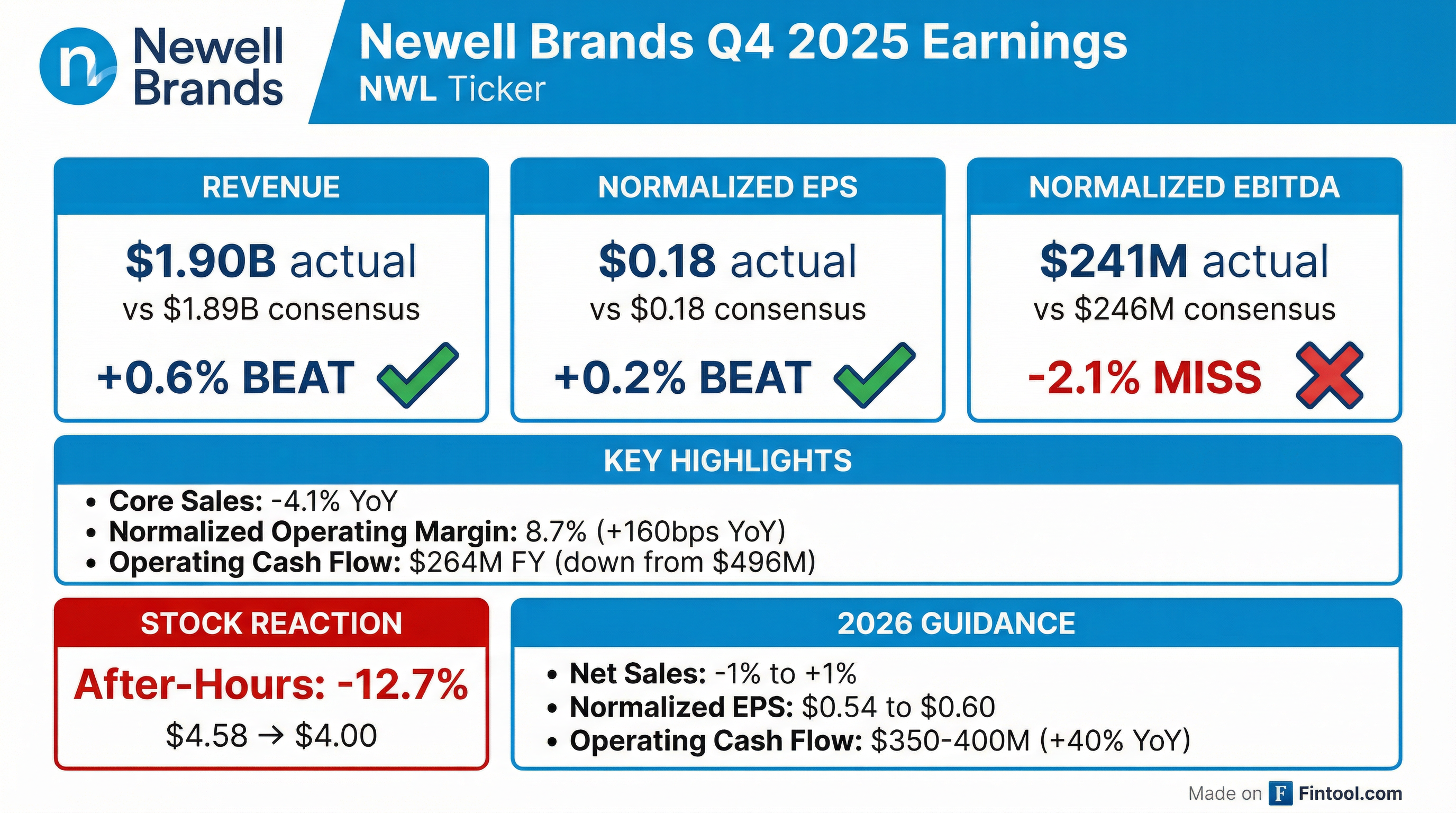
Newell Brands (NWL) reported Q4 2025 results that narrowly beat consensus on revenue and EPS, but the stock cratered 13% in after-hours trading as investors reacted to tepid 2026 guidance and continued core sales declines. The consumer products company behind Rubbermaid, Sharpie, and Yankee Candle delivered normalized EPS of $0.18 versus $0.18 expected, and revenue of $1.90 billion versus $1.89 billion expected . However, core sales declined 4.1% year-over-year, marking another quarter of persistent demand weakness .
The stock recovered intraday on February 6, opening at $3.99 (after the 13% after-hours drop) but climbing to close at $4.42 (+10.7% from the open) as investors digested the details and management's confidence in the turnaround.
Did Newell Brands Beat Earnings?
*Values retrieved from S&P Global
The beat was thin and the outlook was ugly. While Newell managed to eke out a small beat on the headline numbers, the underlying trends remained concerning. Net sales declined 2.7% year-over-year, and core sales (excluding FX and divestitures) dropped 4.1% . The only bright spot was margin improvement from restructuring actions and lower incentive compensation expense.
What Did Management Guide?
Newell initiated 2026 guidance that landed well below investor expectations, which explains the sharp after-hours selloff:
The tariff headwind is real. CFO Mark Erceg explicitly called out an additional $0.07 per share tariff impact expected in 2026 versus 2025, despite the company incurring $174 million in gross cash tariff costs during 2025 .
Q1 will be ugly. Management warned that Q1 2026 will see core sales decline 5-7%, driven by shipment timing dynamics including shelf resets and lapping prior-year tariff-related ordering .
 Ask Fintool AI Agent
How Did the Stock React?
A tale of two reactions. The initial after-hours selloff of ~13% reflected disappointment with 2026 guidance. But the stock staged a remarkable intraday recovery on February 6, opening at $3.99 and climbing throughout the day to close at $4.42 — recovering more than half the after-hours losses.
Market cap sits at ~$1.8 billion for a company generating over $7 billion in annual revenue — a reflection of elevated leverage and turnaround skepticism, though the intraday recovery suggests some investors see value in the 2026 setup.
What Changed From Last Quarter?
Improved:
- Normalized EBITDA grew 11.6% YoY to $241M despite revenue decline
- Normalized operating margin expanded 160bps to 8.7% from 7.1%
- Outdoor & Recreation segment losses narrowed significantly (normalized operating margin improved from -18.4% to -8.5%)
- Full-year normalized operating margin expanded to 8.4% from 8.2%
Deteriorated:
- Core sales remained deeply negative (-4.1% vs -3.3% in Q3)
- Home & Commercial Solutions saw core sales decline 5.3%
- Operating cash flow collapsed to $264M from $496M prior year, impacted by $174M in tariff costs
- Non-cash impairment charges of $340M on tradenames weighed on GAAP results
Segment Performance
Home & Commercial Solutions (59% of Revenue)
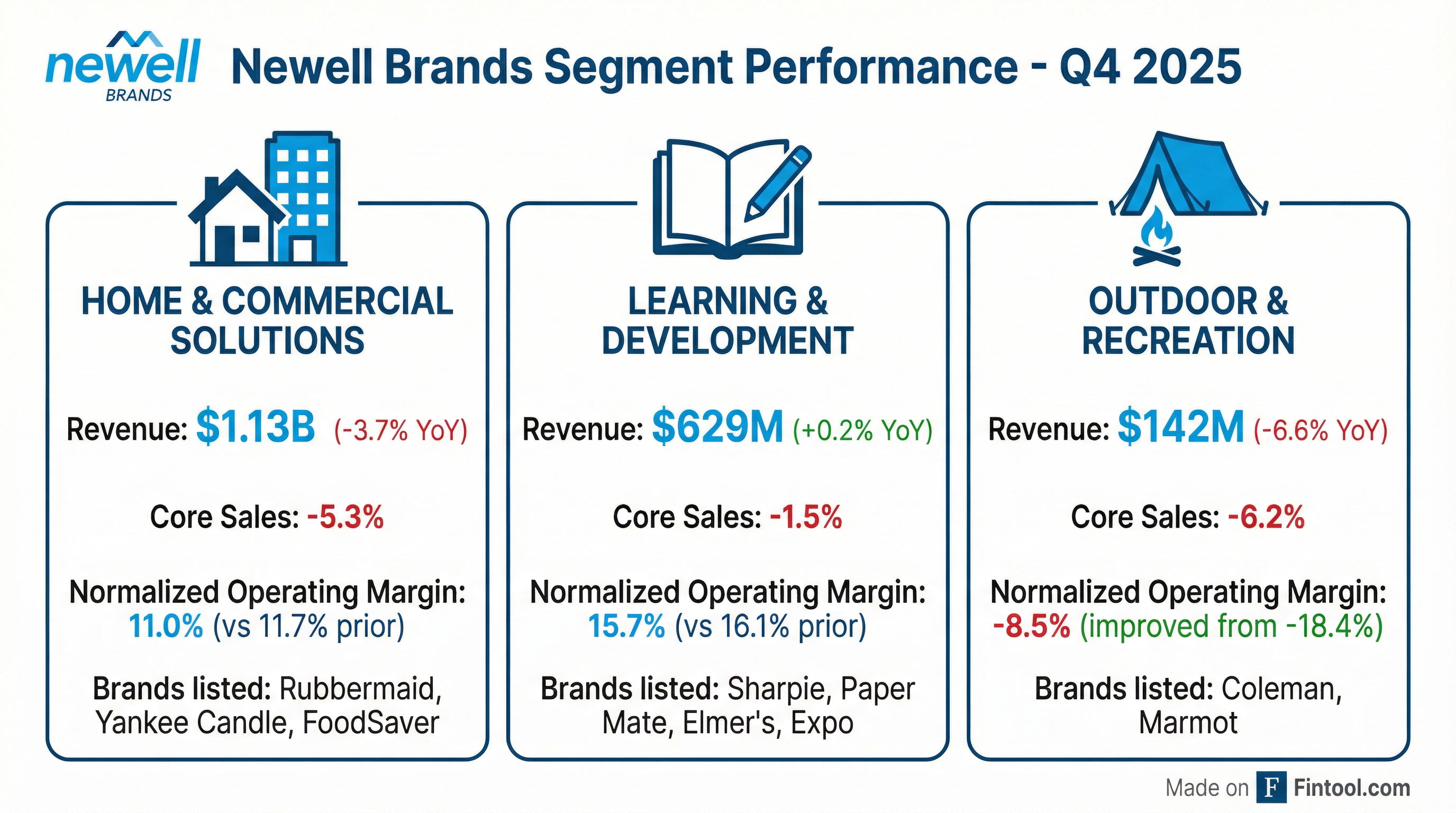
The largest segment continued to struggle. Core sales declined 5.3% with normalized operating margin compressing to 11.0% from 11.7% . This segment houses Rubbermaid, Yankee Candle, FoodSaver, and Rubbermaid Commercial Products.
Kitchen challenges: Most tariff-impacted category with soft demand, distribution losses, and elevated promotional intensity . However, Rubbermaid EasyStore lid innovation launched with strong early consumer feedback.
Home Fragrance bright spot: Yankee Candle US up 6% in Q4 core sales after full relaunch implementation . The relaunch will expand to Europe in 2026, plus Chesapeake Bay and WoodWick relaunches planned .
Learning & Development (33% of Revenue)
The most stable segment delivered nearly flat reported sales (+0.2% YoY) with a 1.5% core sales decline . This segment — home to Sharpie, Paper Mate, Elmer's, and EXPO — maintained the highest margins at 15.7% normalized operating margin .
Writing highlights: Strong brands (Sharpie, Expo), consumer-preferred innovation (Sharpie Creative Markers, Expo Wet Erase), limited tariff exposure, and "best-in-class domestic manufacturing" helped secure meaningful distribution gains .
Baby highlights: Graco market share up 350 basis points in Q4 (160bps for full year) . Turn2Me car seat was #1 selling baby item in the US .
Outdoor & Recreation (8% of Revenue)
The turnaround story is slowly playing out here. While sales declined 6.6%, normalized operating losses improved dramatically to -8.5% from -18.4% a year ago . Coleman and Campingaz are the key brands.
Ask Fintool AI AgentKey Management Quotes
CEO Chris Peterson on exiting 2025 stronger:
"While external factors may have delayed our turnaround by a few quarters, we remain confident that Newell Brands' methodical, capability-based transformation into a world-class consumer products company is still very much alive and well."
On innovation performance:
"The Graco Turn2Me rotating car seat... turned out to be the number one selling baby item as tracked by Circana in the United States. So when we get it right with good innovation and we launch it and support it, we've proven that we can resonate with consumers."
CFO Mark Erceg on 2025 performance despite tariffs:
"Having to absorb $114 million of incremental gross tariff P&L costs clearly impeded our ability to meaningfully expand normalized gross margin this past year. That is why Chris and I are very proud of how well and quickly our teams responded."
On A&P investment payoff:
"Where we were starting from was 4% of sales, which was barely giving our brands the ability to get their gloves up... one of the reasons our hit rate has gone up significantly is because the A&P levels are there for us to then drive it through the consumer purchase cycle."
Balance Sheet and Liquidity
Leverage remains elevated. With $4.7 billion in debt against a $1.9 billion market cap, the balance sheet continues to constrain financial flexibility. The company repaid its 3.9% senior notes upon maturity during Q4 .
Full Year 2025 Summary
Risks and Concerns Flagged
- Tariff Exposure: Management explicitly warned of $0.07 EPS headwind from annualized tariff impacts in 2026
- Weak Consumer Demand: The company is "not assuming an improvement in underlying category demand" for 2026
- Debt Refinancing Risk: Risks related to the company's "substantial indebtedness" and ability to refinance maturities on favorable terms
- Impairment Risk: $340M in non-cash impairment charges this quarter suggests continued tradename value destruction
Forward Catalysts
- Q1 2026 Earnings (May 2026): Will the shelf reset timing issues resolve as expected?
- Innovation Pipeline: Management betting on "stronger innovation plans" and "higher levels of advertising and promotion" to drive share gains
- Distribution Gains: First increase in points of distribution since the Jarden acquisition
- Tariff Mitigation: Productivity actions, targeted pricing, and tariff-related business wins could offset headwinds
Ask Fintool AI AgentQ&A Highlights
The analyst Q&A revealed key insights into management's confidence and the specific dynamics driving the outlook.
On Shelf Reset Timing (Raymond James)
Analyst Olivia Tong pressed on visibility into the expected sales inflection. CEO Peterson clarified this is not a first-half/second-half story but a Q1 anomaly — major shelf resets and innovation shipments are slated to hit in April and May, with Q2-Q4 expected to show "relatively even core sales growth" .
On Innovation Execution (Barclays)
Lauren Lieberman asked about wiggle room given 2025's slower-than-expected innovation flow-through. Peterson acknowledged the risk but noted: "We have a forecast that does not assume everything goes right... we know there's going to be some parts of our plan that don't go right" . He emphasized the innovation model has proven to work when executed (Graco car seat = #1 baby item; Yankee Candle US +6% in Q4).
On Tax Refund Stimulus (UBS)
Peter Grom asked about the potential $100 billion in incremental tax refunds. Peterson estimated a potential "point or two of impact" to category growth but stressed they're not baking it into guidance — instead, they've reduced production lead time by 10 days to respond in real-time if demand spikes .
On Innovation Hit Rate (Canaccord)
Brian McNamara questioned whether the expanded innovation pipeline would actually deliver. Peterson revealed that 70% of Tier 1/2 innovations are meeting or exceeding targets, with the successful 70% overperforming by more than the 30% underperforming — resulting in slightly better-than-planned aggregate revenue contribution .
Innovation Pipeline Build
Key insight: These innovations are cumulative — management expects to continue supporting multi-year launches, meaning 2026 benefits from both 2025 and 2026 innovation pipelines .
Consumer Dynamics and Category Trends
Management provided granular color on consumer behavior that informs the cautious category outlook:
Income Cohort Spending :
- Top third of households: Spending more on general merchandise
- Middle-income: Spending about the same
- Lower-income: Pulled back meaningfully (trend started April 2025)
Age Demographics :
- 25+ consumers: Slightly higher spending vs. prior year
- 18-24 consumers: "Pretty significant pullback" on general merchandise due to economic pressure on this cohort
Category Growth Outlook: Management is assuming categories decline 2% in 2026 — not counting on improvement. Long-term structural growth is 0-1%, with Newell targeting 2-3% through innovation-driven premiumization .
Ask Fintool AI AgentAI and Technology Investments
A notable theme from the call was Newell's investment in AI to accelerate innovation and marketing:
Digital Content Creation :
- Using AI to create video, photography, and copywriting content
- Faster production at lower cost
- Increasing ROI on digital marketing spend
Product Development :
- AI converts sketches to 3D CAD drawings, dramatically reducing cycle time
- Digital personas enable virtual focus group testing
- Overall ecosystem enabling faster, better innovation at scale
Global Productivity Plan :
- "Greater use of automation, digitization, and artificial intelligence to simplify processes"
- Expected to generate >$75M in year-over-year overhead savings in 2026
Pricing Actions and Competitive Position
Baby: Rolling back prices from 30% tariff assumption to 20% (effective January) after tariff rollback — notably, Graco was already gaining 350bps of share before the price reduction
Kitchen (Rubbermaid EasyStore): Taking 15% price reduction on new lid innovation — enabled by US manufacturing, automation, and resin pricing — to be "tariff-advantaged"
Competitive Gap Closing: Management noted competitors "have largely caught up with our pricing" — the price gaps that hurt in Q3/Q4 2025 are no longer a factor
The Bottom Line
Newell Brands delivered a technical beat in Q4 2025, but the guidance disappointment initially crushed the stock. The intraday recovery tells a more nuanced story: investors parsing through the Q&A heard management articulate a credible path to sales stabilization in Q2-Q4, backed by specific innovation wins (Turn2Me #1 baby item, Yankee Candle +6%), a 70% innovation hit rate, and closing competitive price gaps.
The bear case centers on: continued core sales declines, $4.7B in debt, incremental tariff headwinds, and a "prove it" dynamic after 2025's category weakness.
The bull case requires believing: the 25 Tier 1/2 innovation launches drive share gains, shelf resets and distribution wins materialize in Q2, and the consumer cohort spending weakness stabilizes.
With the stock trading at 0.25x sales and management guiding to 40%+ operating cash flow growth, the risk/reward may be improving — but execution remains everything.
For more on Newell Brands, see the company page or read the Q4 2025 transcript.