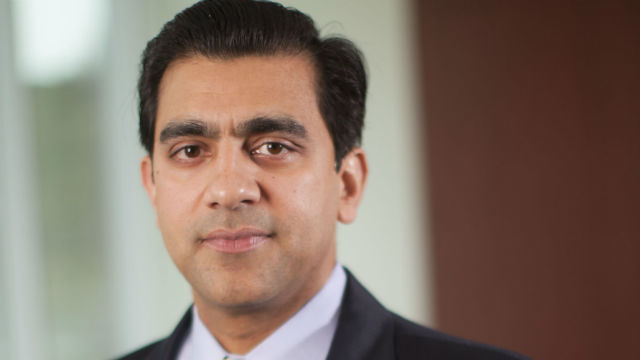
Sumit Roy
About Sumit Roy
Sumit Roy, age 55, is President and CEO of Realty Income (O), serving as CEO since October 2018 and President since November 2015; he joined the company in September 2011 after roles at UBS Investment Bank, Merrill Lynch, and Cap Gemini Ernst & Young . He holds an MBA (Chicago Booth), an MS in Computer Science (University of Georgia), and a BS in Computer Science (Georgia College & State University) . Under his leadership, 2024 delivered record AFFO per share of $4.19, 2.5% dividend-per-share growth, 98.7% occupancy, and $3.9B investments, though TSR for 2024 was -2.1% versus +8.8% for the MSCI US REIT Index . Say-on-pay support remained strong at 93.3% in 2024, reflecting investor alignment with the pay program .
Past Roles
| Organization | Role | Years | Strategic Impact |
|---|---|---|---|
| Realty Income | Chief Executive Officer | Oct 2018–Present | Led strategic growth including closing the Spirit Realty Capital acquisition in Jan 2024, scaling portfolio and maintaining strong balance sheet . |
| Realty Income | President | Nov 2015–Present | Executive leadership across strategy and operations . |
| Realty Income | EVP & COO | Oct 2014–Oct 2018 | Oversaw operations during period of portfolio expansion . |
| Realty Income | Chief Investment Officer | Oct 2013–Nov 2015 | Guided investment strategy and capital deployment . |
| Realty Income | EVP, Acquisitions; SVP, Acquisitions | Mar 2013–Oct 2013; Sep 2011–Feb 2013 | Drove acquisitions pipeline; joined the company Sept 2011 . |
| UBS Investment Bank | Executive Director, Global Real Estate, Lodging & Leisure | Pre-2011 | Real estate and capital markets expertise . |
| Merrill Lynch; Cap Gemini Ernst & Young | Various | Pre-2011 | Finance and consulting experience . |
External Roles
| Organization | Role | Years | Notes |
|---|---|---|---|
| Ventas, Inc. (NYSE: VTR) | Director | Oct 2022–Present | Public company board service . |
| Nareit Advisory Board of Governors | Member; First Vice Chair | Member since Nov 2020; First Vice Chair since Nov 2024 | Industry leadership role . |
Fixed Compensation
| Metric | 2022 | 2023 | 2024 |
|---|---|---|---|
| Base Salary ($) | $1,000,000 | $1,000,000 | $1,000,000 |
| CEO Total Target Direct Compensation ($) | — | $10,600,000 | $11,125,000 |
| Mix (2024) | — | — | 31% Cash / 69% Equity; 74% performance-based |
Performance Compensation
2024 Short-Term Incentive Program (STIP) – Company Metrics and Results
| Metric | Weight | Threshold | Target | Maximum | Actual 2024 | Payout vs Target |
|---|---|---|---|---|---|---|
| AFFO per share | 40% | $4.12 | $4.14 | $4.17 | $4.19 | 250% (capped) |
| Fixed Charge Coverage Ratio | 20% | 4.0x | 4.2x | 4.4x | 4.7x | 200% |
| Portfolio Occupancy | 10% | 98.0% | 98.3% | 98.5% | 98.7% | 200% |
| Individual Objectives | 30% | — | — | — | CEO: 185% | — |
| CEO STIP Outcome | Target ($) | Maximum ($) | % of Target Earned | % of Max Earned | Payout ($) |
|---|---|---|---|---|---|
| Sumit Roy | $2,498,000 | $5,495,600 | 216% | 98% | $5,383,190 |
2024–2026 Long-Term Incentive Program (LTIP) – Structure and CEO Awards
| Component | Weight | Performance Hurdles | Vesting | CEO Target Award |
|---|---|---|---|---|
| Relative TSR vs MSCI US REIT Index | 50% | 30th pct=50%; 55th=100%; 80th+=200% of target | 50% on certification after 2026; 50% on Jan 1, 2028 | 119,321 PSUs target; $5,720,250 value |
| Net Debt / Pro Forma Adjusted EBITDAre | 25% | 6.1x=50%; 5.75x=100%; 5.5x or less=200% | Same as above | Included in PSUs above |
| Dividend per Share Growth Rate | 25% | 3.0%=50%; 5.0%=100%; 7.0%=200% | Same as above | Included in PSUs above |
| Time-Based Restricted Shares | — | — | 25% per year starting Feb 15 following grant; retirement acceleration per policy | $1,906,750 granted 2/18/2025 (34,524 sh) |
Notes: No stock options were granted in 2024 and NEOs held no options as of 12/31/2024 .
Equity Ownership & Alignment
Beneficial Ownership and Guidelines
| Item | Value |
|---|---|
| Beneficial Ownership (3/3/2025) | 316,059 shares; <0.1% of 891,769,159 outstanding |
| Ownership Components | 78,212 unvested restricted; 237,847 directly owned |
| Executive Stock Ownership Guideline | 5x base salary; minimum 76,577 shares for CEO |
| CEO Ownership vs Guideline (12/31/2024) | 318,472 shares vs 76,577 required (meets guideline) |
| Anti-Hedging / Anti-Pledging | Hedging and pledging prohibited for directors/officers/employees |
| Clawback Policy | Mandatory SEC/NYSE-compliant clawback; discretionary recovery for miscalculated metrics or misconduct |
Unvested/Outstanding Equity Detail (12/31/2024)
| Grant/Type | Unvested Shares/Units | Notes |
|---|---|---|
| Time-based restricted (2/17/2021) | 46,428 | Unvested RS as of 12/31/2024 |
| Time-based restricted (2/14/2022) | 115,173 | Unvested RS |
| Time-based restricted (2/13/2023) | 19,831 | Unvested RS |
| Time-based restricted (2/12/2024) | 33,710 | Unvested RS |
| Unearned PSUs (2023–2025) | 164,932 (max basis) | Earnout TBD; table shows max potential |
| Unearned PSUs (2024–2026) | 238,642 (max basis) | Earnout TBD; table shows max potential |
Scheduled Vesting Calendar (Roy)
| Date | Shares Vesting |
|---|---|
| Jan 1, 2025 | 58,223 |
| Feb 15, 2025 | 8,428 |
| Feb 18, 2025 | 52,401 |
| Jan 1, 2026 | 64,196 |
| Feb 15, 2026 | 8,428 |
| Jan 1, 2027 | 6,611 |
| Feb 15, 2027 | 8,427 |
| Feb 15, 2028 | 8,427 |
Employment Terms
Plan Design and Triggers (CEO)
| Scenario | Cash Severance | Bonus Multiple | Medical | Equity Treatment |
|---|---|---|---|---|
| Qualifying Termination (without CIC) | 24 months base salary | 2x avg of last 3 years’ cash bonus | 18 months | Time-based RS vest; PSUs pro-rated to performance through termination |
| CIC + Qualifying Termination (Double Trigger) | 36 months base salary | 3x avg of last 3 years’ cash bonus | 18 months | Time-based RS vest; PSUs pro-rated to performance through CIC |
| Death/Disability | — | — | — | Time-based RS vest; PSUs vest at target if during performance period; earned PSUs vest if post-period |
| Standalone CIC (no termination) | — | — | — | Performance shares accelerate pro rata to CIC date |
| Employment Contracts | Company has no employment contracts with NEOs | — | — | — |
Estimated CEO Payments as of 12/31/2024
| Scenario | Severance ($) | Bonus ($) | Medical ($) | Equity ($) | Total ($) |
|---|---|---|---|---|---|
| Qualifying Termination | $2,000,000 | $9,622,851 | $45,000 | $23,981,308 | $35,649,159 |
| CIC + Qualifying Termination | $3,000,000 | $14,434,277 | $45,000 | $23,981,308 | $41,460,585 |
| Standalone CIC | — | — | — | $20,297,513 | $20,297,513 |
| Death | — | — | — | $18,231,168 | $18,831,168 (incl. $600k life insurance) |
| Disability | — | — | — | $18,231,168 | $18,231,168 |
Multi-Year CEO Compensation (Summary Compensation Table)
| Year | Salary ($) | Stock Awards ($) | Non-Equity Incentive ($) | All Other Comp ($) | Total ($) |
|---|---|---|---|---|---|
| 2022 | $1,000,000 | $7,437,814 | $4,996,000 | $478,001 | $14,286,815 |
| 2023 | $1,000,000 | $7,398,815 | $4,055,087 | $674,908 | $13,128,810 |
| 2024 | $1,000,000 | $7,906,212 | $5,383,190 | $956,807 | $15,246,209 |
Notes: 2024 stock awards reflect 2/12/2024 grants; 2025 time-based grants for 2024 performance disclosed separately (see LTIP) . “All Other” includes 401(k)/benefits and dividends on earned performance shares .
Performance & Track Record (Selected 2024 Operating Metrics)
| Metric | 2024 Result |
|---|---|
| AFFO per Share | $4.19 (record) |
| Dividend per Share Growth | +2.5% |
| Total Investments | $3.9B at 7.4% initial cash yield |
| Occupancy | 98.7% |
| Fixed Charge Coverage | 4.7x |
| Net Debt/Annualized Pro Forma Adjusted EBITDAre | 5.4x |
| 2024 TSR (vs MSCI US REIT) | -2.1% (vs +8.8%) |
| Spirit Realty Capital Merger | Closed Jan 23, 2024; enhanced scale/diversification |
Board Governance and Service
- Role and independence: Roy is a director since 2018 and not independent; he serves on no board committees . All other directors are independent; committees (Audit, Compensation & Talent, Nominating/Governance) are entirely independent .
- Leadership structure: Separate, independent Non-Executive Chairman (Michael D. McKee) since 2012; company maintains split CEO/Chair roles .
- Board operations: Regular executive sessions of independent directors; all directors attended at least 75% of 2024 meetings .
- Director compensation for employee-director: Roy receives no board compensation; employee directors are excluded from director pay .
- Director stock ownership guidelines: Non-employee directors must hold ≥5x annual cash retainer; vesting of director RS follows tenure-based schedule .
Committee membership highlights (independent directors):
- Compensation & Talent Committee: Chair Priya C. Huskins; members include Mary Hogan Preusse, Gerardo I. Lopez, Michael D. McKee, Gregory T. McLaughlin .
- Audit: Chair Priscilla Almodovar; financial experts designated; 2024 meetings: 7 .
- Nominating/Corporate Governance: Chair Reginald H. Gilyard .
Compensation Committee, Peer Group, and Shareholder Feedback
- Consultant: Ferguson Partners Consulting (FPC), independent; no conflicts found .
- Peer group (2024, unchanged from 2023): 15 S&P 500 REITs across sectors (e.g., PLD, EQIX, DLR, PSA, VTR, WELL); W.P. Carey as net-lease peer; O positioned near median by market cap .
- CEO target direct compensation increased from $10.6M (2023) to $11.125M (2024) to align with peers and reflect increased scale/complexity .
- Say-on-Pay: 93.3% approval in 2024; >90% every year since 2011 .
- Program design: Heavy at-risk pay; capped payouts; double-trigger time-based equity; clawback; no options in 2024; no perquisites or excise tax gross-ups .
Risk Indicators & Red Flags
- Hedging/Pledging: Prohibited (reduces alignment/credit risks from collateralized borrowing) .
- Clawback: SEC/NYSE compliant; discretionary recovery for miscalculated metrics or misconduct .
- Option repricing: Prohibited under plan without shareholder approval .
- Related parties: No related party transactions in 2024 .
- Equity acceleration: Double-trigger for time-based awards; PSU treatment tied to actual performance and timing; retirement policy provides pro-rata treatment for PSUs and full vesting for time-based awards upon qualifying retirement .
Investment Implications
- Strong pay-for-performance linkage: 74% of CEO target pay is performance-based, with STIP tied to AFFO, leverage coverage, and occupancy, and LTIP weighted to relative TSR, leverage, and dividend growth—factors central to REIT valuation and cost of capital . This aligns incentives toward sustainable cash flows and disciplined balance sheet management.
- Selling pressure/vintage timing: A visible vesting calendar through 2028 plus earned PSU dividends (cash equivalents) can create periodic liquidity events; however, anti-hedging/anti-pledging rules reduce leverage-related forced selling risk .
- Governance quality: Separate Chair/CEO, independent committees, clawback, and high say-on-pay support mitigate dual-role concerns and suggest low governance discount .
- CIC economics: CEO severance up to 3x salary and 3x bonus with equity acceleration on a double trigger balances retention and potential transaction incentives; PSU treatment remains performance-anchored, which limits windfalls .
- Optionless equity mix: Use of RS/PSUs (and no options in 2024) lowers compensation leverage to share-price spikes, emphasizing fundamental performance and dividend growth over high-beta upside .