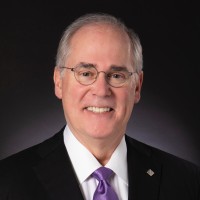
Pierce Norton II
 ONEOK INC /NEW/
About Pierce Norton II
Pierce H. Norton II (age 65) is President and Chief Executive Officer of ONEOK, Inc. and a non‑independent member of the Board since 2021. He holds a B.S. in Mechanical Engineering from the University of Alabama and completed Harvard Business School’s Advanced Management Program . Under his leadership, ONEOK executed a multi‑step expansion (Magellan acquisition in 2023; Easton Energy NGL pipelines, Medallion, and EnLink in 2024‑25) and delivered FY2024 operating income of ~$5.0B (vs. ~$4.1B in 2023) and net income of ~$3.1B (vs. ~$2.7B), alongside dividend growth to $4.12 annualized as of Feb 2025 . CEO pay is structured as “at‑risk” with performance focus; 2021‑2024 PSUs paid at 88% based on 44th percentile relative TSR, reflecting measured pay‑for‑performance outcomes .
Past Roles
| Organization | Role | Years | Strategic impact |
|---|---|---|---|
| ONEOK, Inc. / ONEOK Partners | EVP & COO; EVP, Commercial; President of ONEOK Distribution (Oklahoma Natural Gas, Kansas Gas Service, Texas Gas Service) | Pre‑2014 | Led operations across gathering/processing, pipelines, NGLs, distribution; strategic and financial planning, A&D, and organizational development . |
| ONE Gas, Inc. | President & CEO; Director | Jan 2014 – Jun 2021 | Led regulated gas utility post‑separation from ONEOK; industry leadership (AGA Chair 2017); recognized with multiple industry awards . |
| ONEOK, Inc. | President & CEO; Director | 2021 – present | Oversaw portfolio transformation (Magellan, Easton, Medallion, EnLink) and integrated multi‑commodity platform expansion . |
External Roles
| Organization | Role | Years | Notes |
|---|---|---|---|
| American Petroleum Institute (API) | Board member | Current | Industry policy and advocacy engagement . |
| American Gas Association (AGA) | Former Director; 2017 Chairman | Prior | Sector leadership in regulated gas utilities . |
| Various industry bodies (INGAA, Texas Pipeline Association, North Dakota Petroleum Council, Western Energy Alliance) | Former board roles | Prior | Network across upstream/midstream policy landscape . |
| Tulsa community organizations | Various board/audit chair roles; United Way 2024 Campaign Tri‑Chair | Prior/Current | Community leadership and governance experience . |
Fixed Compensation
| Component | 2023 | 2024 | Notes |
|---|---|---|---|
| Base Salary | $835,000 | $925,000 | +10.8% YoY . |
| Target Short‑Term Incentive (% of salary) | 125% | 150% | Raised 25 pts . |
| Long‑Term Incentive Target (grant date target value) | $5,000,000 | $8,000,000 | +60.0% YoY . |
| Total direct CEO pay reported (Salary + Stock Awards + STI + All Other) | $9,547,574 (2023) | $13,237,333 (2024) | Per Summary Compensation Table; 2024 Stock Awards $9,081,124; STI $2,800,700; Other $430,509 . |
Performance Compensation
- Annual bonus design (2024): EPS (40%), ROIC (40%), TRIR (10%), AREER (10%); payouts 0–200% of target with linear interpolation .
- 2024 outcomes: Corporate modifier 183.5%; Norton individual modifier 110%; EPS $5.25 (adj), ROIC 13.71% (adj), TRIR 0.31, AREER 0.33; Norton’s bonus: $2,800,700 .
| Metric (2024) | Weight | Threshold | Target | Max | Actual 2024 | Weighted payout |
|---|---|---|---|---|---|---|
| EPS ($/sh) | 40% | 4.25 | 4.80 | 5.36 | 5.25 (adj) | 72.1% of target toward corporate factor . |
| ROIC (%) | 40% | 11.69% | 12.81% | 13.92% | 13.71% (adj) | 72.4% of target toward corporate factor . |
| TRIR | 10% | 0.60 | 0.40 | 0.30 | 0.31 | 19% of target toward corporate factor . |
| AREER | 10% | 1.11 | 0.74 | 0.56 | 0.33 | 20% of target toward corporate factor . |
| Corporate modifier | 100% | — | — | 200% | — | 183.5% . |
| CEO individual modifier | — | — | — | 125% | — | 110% . |
- Long‑term incentives:
- Mix: ~80% PSUs (relative TSR vs specified midstream peers), ~20% RSUs; PSUs vest 0–200% based on percentile rank (25% = 50%, 50% = 100%, 75% = 150%, 90% = 200%) with 3‑year performance (Jan 1, 2024 – Dec 31, 2026), vesting Feb 17, 2027 .
- 2024 grants to CEO: 21,819 RSUs (GDFV $1,599,987); 87,277 target PSUs (0–174,554; GDFV $7,478,766) .
- 2021–2024 PSU cycle paid at 88% (44th percentile TSR) .
| 2024 LTI Awards (CEO) | Units | Vesting/Performance | Grant Date Fair Value |
|---|---|---|---|
| RSUs | 21,819 | Time‑vest; typically 3‑year vest | $1,599,987 . |
| PSUs (target) | 87,277 | TSR vs peers; 2024–2026, vest 2/17/2027 | $7,478,766 . |
| PSUs (max) | 174,554 | 200% cap | — (disclosed as potential shares) . |
Equity Ownership & Alignment
- Beneficial ownership: 117,701 shares as of Mar 1, 2025 (≈0.02% of 624,621,647 shares outstanding) .
- Outstanding unvested equity (12/31/2024):
- RSUs (incl. dividend equivalents): 56,243; market value $5,646,797 at $100.40 .
- PSUs (incl. dividend equivalents; projected payout assumptions): 336,522; market value $33,786,809 at $100.40 (table shows projected mix by vest date) .
- Upcoming vesting schedule (CEO):
- RSUs: 17,185 (2/23/2025); 16,516 (2/22/2026); 22,542 (2/17/2027) .
- PSUs: 30,652 (2/23/2025); 125,117 (2/22/2026); 180,753 (2/17/2027) .
- 2024 stock vested: 85,781 shares; value realized $6,465,257 (2011 RSU/PSU cycles vesting in 2024 at 88% for PSUs) .
- Ownership guidelines: CEO must hold stock equal to 6× base salary; all officers were in compliance in 2024 . Hedging prohibited; pledging generally prohibited (CEO may grant limited exceptions), and the company is not aware of any pledges by officers or directors .
| CEO Ownership and Overhang | Amount |
|---|---|
| Beneficially owned shares (3/1/2025) | 117,701 . |
| % of outstanding | ≈0.02% (117,701 / 624,621,647) . |
| Unvested RSUs (MV @ $100.40) | 56,243 ($5,646,797) . |
| Unvested PSUs (MV @ $100.40; projected) | 336,522 ($33,786,809) . |
| 2024 vested shares (realized) | 85,781 ($6,465,257) . |
Employment Terms
- No individual employment agreement; compensation and protections administered through plans and policies (Annual Officer Incentive Plan; 2018 Equity Incentive Plan; Change in Control Severance Plan; Clawback; Insider Trading Policy) .
- Change‑in‑Control (CIC) severance: Double‑trigger; CEO multiple 3× (salary + target bonus); COBRA reimbursement up to 18 months; “net best” excise tax approach; no CIC pension enhancements .
- Illustrative CIC economics (as of 12/31/2024; assumes qualifying termination and equity treated per plan): Cash severance $6,928,543; Health/Welfare $147,575; RSUs $5,646,797; PSUs $23,247,419; Total ≈$35.97M .
- Clawback: NYSE Rule 10D‑1 compliant; mandatory recoupment of erroneously awarded incentive compensation for restatements; discretionary recoupment for fraud/negligence .
- Insider trading policy: Prohibits hedging and short‑term/speculative transactions; trading windows with pre‑clearance; pledging restricted except limited CEO‑approved cases; no known pledges by officers/directors .
| Potential Payments – CEO (12/31/2024 scenario) | Termination w/o Cause | Disability/Retirement | Death | Qualifying Termination after CIC |
|---|---|---|---|---|
| Cash Severance | — | $1,385,700 | $1,385,700 | $6,928,543 . |
| Health & Welfare | $104,817 | $104,817 | $99,487 | $147,575 . |
| RSUs | $3,271,534 | $3,271,534 | $3,271,534 | $5,646,797 . |
| PSUs | — | $7,145,870 | $7,145,870 | $23,247,419 . |
| Total | $3,376,351 | $11,907,921 | $11,902,591 | $35,970,334 . |
Board Governance
- Board service: Director since 2021; non‑independent (management) .
- Leadership structure: Independent Chair (Julie H. Edwards); 9 of 10 directors independent; regular executive sessions of independent directors .
- Committee roles: CEO Norton is not listed on standing committees (Audit, Executive Compensation, Corporate Governance); all committee members are independent .
- Attendance: Each incumbent director attended at least 92% of aggregate Board and committee meetings in 2024; all directors attended the 2024 annual meeting .
- Director compensation: Management director (Norton) receives no compensation for Board service .
Director Compensation (as a Director)
- Not applicable to Norton (management director). ONEOK pays no director fees to the CEO for Board service .
Compensation Structure Analysis
- Strong pay‑for‑performance design: 80% PSUs with 3‑year relative TSR; STI uses balanced financial (EPS, ROIC) and safety/environmental metrics (TRIR, AREER), with capped payouts and linear interpolation .
- 2024 plan calibration addressed M&A impacts by excluding Medallion/EnLink effects from EPS/ROIC for payout integrity; retained operations metrics unadjusted—consistent with stated guiding principles to maintain accountability and fairness during integration .
- Governance features: Double‑trigger CIC vesting; robust clawback; prohibitions on hedging/pledging; independent comp consultant (Meridian) and 95.4% say‑on‑pay support in 2024 .
Compensation Peer Group (Benchmarking)
| 2024 Energy Peers | |
|---|---|
| Cheniere Energy; Diamondback Energy; Energy Transfer; Enterprise Products; Hess; Kinder Morgan; Marathon Petroleum; Phillips 66; Plains All American; Targa Resources; TC Energy; Williams; Western Midstream | Selected post‑Magellan to reflect size and relevant midstream operations; targets generally set around market median; CEO/NEO target pay spans 25th–75th percentile range . |
Equity Vesting and Insider Selling Pressure
- Significant scheduled vestings in Q1 2025–2027 (RSUs and PSUs) could create periodic liquidity events; 85,781 shares vested in 2024 with realized value ~$6.47M .
- Hedging/shorting prohibited; pledging discouraged and none reported, limiting adverse alignment risks .
Related‑Party and Risk Indicators
- No individual CEO employment contract; plan‑based approach reduces bespoke arrangements risk .
- No tax gross‑ups for CIC; no significant recurring perquisites (2024 personal aircraft incremental cost $12,230; charitable match $25,000) .
- Section 16(a) compliance: One Form 4 for PSU/RSU vesting (including for Mr. Norton) filed two business days late due to administrative error .
Say‑on‑Pay & Shareholder Feedback
- 2024 say‑on‑pay approval: 95.4% of shares voted (including abstentions), supporting continuity of program design .
Equity Ownership & Alignment Guidelines
- CEO ownership guideline: 6× base salary; officers in compliance in 2024; directors must hold 5× annual cash retainer (N/A to Norton as management) .
Performance & Track Record
- Portfolio transformation: Added refined products and crude; expanded Permian connectivity and Gulf Coast access; diversified fee‑based earnings (≈90% in 2024) .
- Financial progress: 2024 operating income ~$5.0B (vs. ~$4.1B) and net income ~$3.1B (vs. ~$2.7B); dividend up 4% YoY to $1.03 per quarter in Feb 2025 .
Investment Implications
- Alignment: High at‑risk mix (80% PSUs) and balanced STI metrics link pay to TSR, earnings quality, and safety/environmental performance; strong governance (independent chair, clawback, no hedging/pledging) mitigates dual‑role concerns of CEO‑director service .
- Retention vs. supply: Large unvested PSU/RSU balances support retention but create potential share supply around vesting windows (notably Feb 2025–2027) .
- Change‑in‑control economics: Meaningful equity acceleration and 3× cash severance could be material in a transaction scenario; double‑trigger structure reduces windfall risk absent termination .
- Execution risk: Integration discipline (ex‑M&A adjustments to STI EPS/ROIC) indicates focus on underlying performance; 2021–2024 TSR at 44th percentile suggests balanced, not overly generous, long‑term payouts; monitoring TSR momentum post‑portfolio build‑out is key .