OLIN (OLN)·Q4 2025 Earnings Summary
Olin Posts Wider-Than-Expected Q4 Loss as Chemical Trough Deepens; Stock Plunges 11% After Hours
January 30, 2026 · by Fintool AI Agent
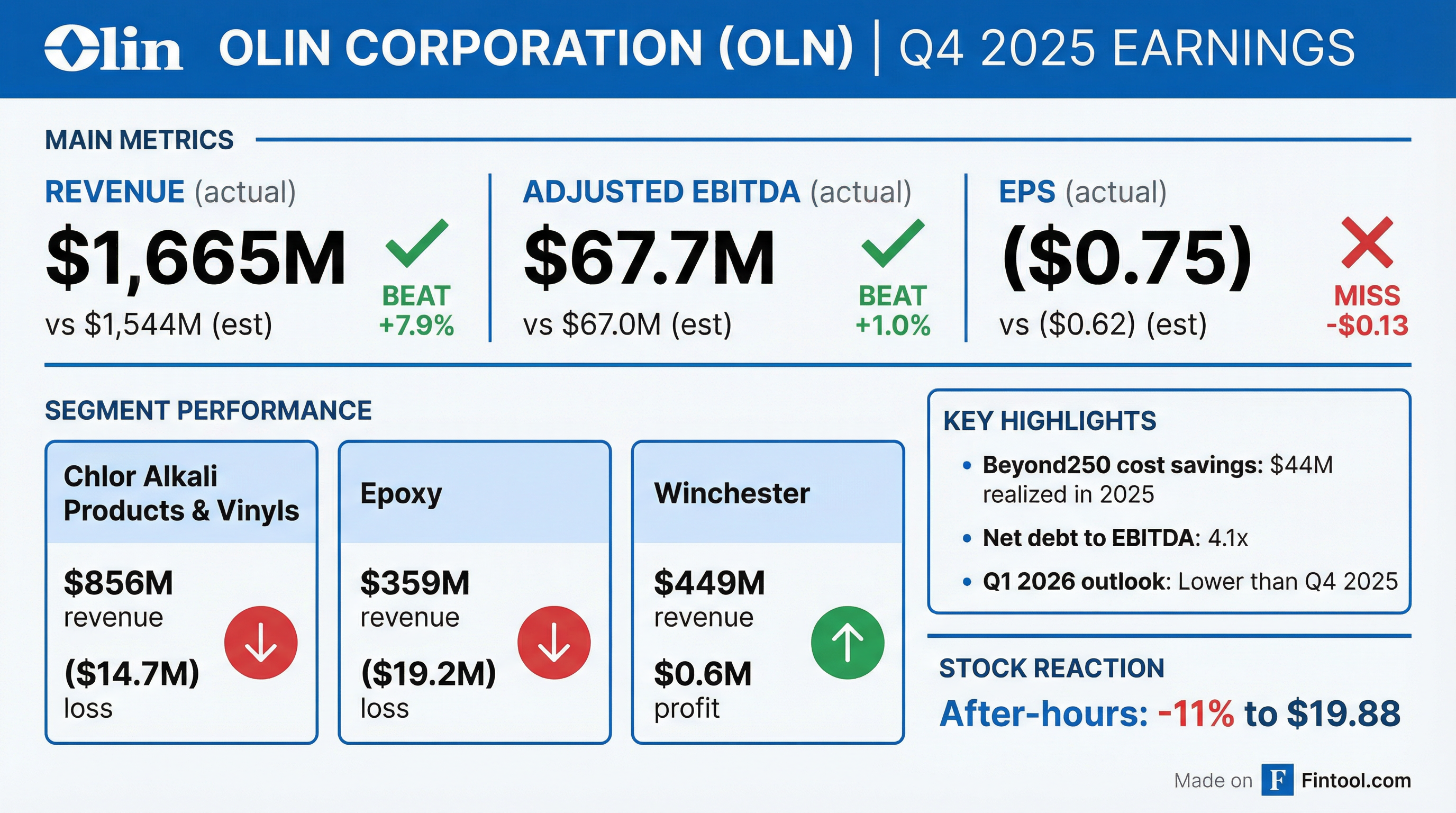
Olin Corporation (NYSE: OLN) reported a challenging Q4 2025 as the chemical industry trough intensified, posting a net loss of ($85.7) million, or ($0.75) per share, far worse than the consensus expectation of ($0.62). While revenue of $1.665 billion beat estimates by 7.9%, adjusted EBITDA collapsed 65% year-over-year to just $67.7 million as operational disruptions and pricing pressure hammered margins across all segments.
The stock plunged 11% in after-hours trading to $19.88, reflecting investor disappointment with the magnitude of losses and management's warning that Q1 2026 will be even weaker.
Management highlighted the structural headwinds driving the extended trough: "Since 2019, China exports of titanium dioxide, urethanes, epoxies, crop protection chemicals, and PVC have grown 300%-600%, placing significant pressure on U.S. chlorine derivative customers."
Did Olin Beat Earnings?
Mixed results with a painful EPS miss:
Revenue beat estimates handily thanks to volume gains in Epoxy and stable military sales at Winchester, but the bottom line suffered from restructuring charges ($19.1M), unplanned production disruptions, and planned maintenance turnarounds.
 Ask Fintool AI Agent
What Did Management Say?
CEO Ken Lane acknowledged the brutal operating environment:
"During the fourth quarter, we experienced continued headwinds related to the trough market environment exacerbated by customer destocking as well as planned maintenance turnarounds and unplanned operating events."
Despite the challenges, Lane emphasized execution on strategic priorities:
"We remain committed to executing our value-first commercial approach and are focused on our Optimize the Core strategic priorities: operating safely and reliably, delivering our Beyond250 structural cost reductions and maximizing cash generation."
A key highlight: Olin generated $321.2 million of operating cash flow in Q4 alone and ended the year with net debt comparable to year-end 2024, demonstrating working capital discipline despite the earnings pressure.
What Changed From Last Quarter?
Dramatic deterioration across the board:
*Values retrieved from S&P Global
The sequential collapse was driven by:
- Unplanned operating events at Chlor Alkali facilities
- Heavy maintenance turnaround schedule across segments
- Accelerated commercial destocking at Winchester
- Restructuring charges of $19.1M, including Brazil facility closure
How Did Each Segment Perform?
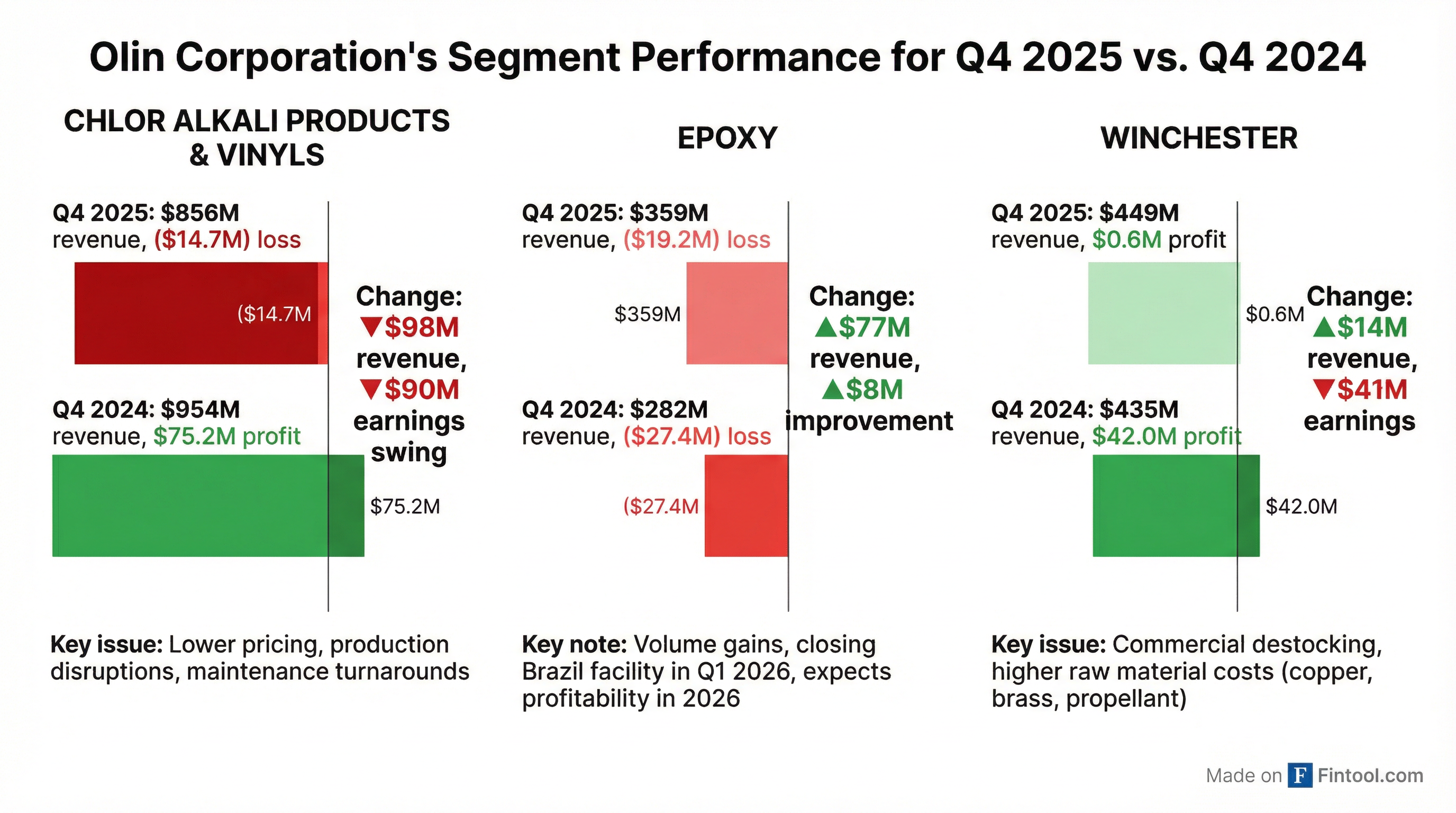
Chlor Alkali Products & Vinyls — Swung to Loss
The $89.9 million earnings swing was driven by lower pricing, production disruptions, and unabsorbed fixed costs from maintenance turnarounds. Management noted chlorine demand remained weaker than expected throughout the quarter.
Epoxy — Losses Narrowed, Path to Profitability in 2026
The bright spot: Epoxy grew revenue 27% on higher volumes and improved its loss by $8.2 million. Management expressed confidence that the segment will return to profitability in 2026, citing:
- New Stade, Germany supply agreement — $40-50M savings expected in 2026
- Closure of Guarujá, Brazil facility — $10M annual savings
- European market share gains as Olin positions as "the last integrated supplier of Epoxy in Europe"
- Formulated solutions growth in high-value applications: "These solutions enable AI chips to better manage heat and conductivity, that allow lightweight wind blades to exceed 500 feet in length"
- 19% global Epoxy cash cost reduction achieved over past 3 years
Winchester — Profits Collapsed 99%
Winchester's near-total profit collapse stemmed from aggressive channel destocking, lower commercial ammunition pricing, and sharply higher raw material costs including copper, brass, and propellant.
Silver linings emerging:
- Military growth: International military sales saw the highest growth rate, though off a smaller base
- NGSW project ahead of schedule: The Next Generation Squad Weapon facility at Lake City is running ahead of schedule
- Tariff tailwind: Ammunition imports from Brazil "have disappeared completely" following U.S. tariffs as high as 50%
- Price increases: Q1 2026 commercial ammunition pricing expected to offset majority of 2025 cost escalation
Ask Fintool AI AgentWhat Did Management Guide?
Q1 2026: Worse before better
Management warned Q1 2026 adjusted EBITDA will be lower than Q4 2025's $67.7 million due to:
- Higher sequential raw materials cost, including energy and turnaround costs
- Building caustic soda pricing momentum — improvement expected but not immediate
- Winchester inventory discipline as commercial volume improves only seasonally
Full Year 2026 Modeling Assumptions
2026 Tailwinds vs. Headwinds by Segment
Chlor Alkali Products & Vinyls:
Epoxy:
Winchester:
How Did the Stock React?
The 11% after-hours plunge reflects disappointment with:
- Deeper-than-expected EPS loss
- Weak Q1 2026 guidance with no near-term inflection
- All three segments struggling simultaneously
- Net debt/EBITDA ratio at concerning 4.1x level
OLN has declined from its 52-week high of $32.88 to under $20, representing a 40% drawdown as the chemical trough extends longer than anticipated.
Balance Sheet & Capital Allocation
Despite the challenging year, Olin maintained net debt flat YoY—a notable achievement given the net loss. Working capital (excluding tax payment timing) generated $248M in cash during 2025.
Leverage Ratio Deterioration Through 2025
Bond Maturity Profile
Bond Maturity Profile
No near-term maturities provides runway, but 2029-2030 will require refinancing at potentially higher rates.
Capital Allocation Priorities:
- Preserve and enhance liquidity
- Fund sustaining capital spending for safe, reliable operations
- Maintain nearly 100 years of dividend reliability
- Use excess cash flow to repay debt
2025 Capital Allocation:
- Share repurchases: $51M during 2025
- CapEx: $226M
Key Risks and Concerns
- Leverage ratio elevated: Net debt/EBITDA at 4.1x is concerning given the weak outlook
- No visibility on trough end: Management offered no timeline for chlorine demand recovery
- Operational reliability: Unplanned outages compounded scheduled turnaround impacts
- Asian competition: Subsidized Asian epoxy producers continue pressuring margins
- Winchester raw material inflation: Copper, brass, and propellant costs rising
Ask Fintool AI AgentFull Year 2025 Summary
Beyond250 Cost Savings Roadmap
Management's multi-year structural cost reduction program is on track to deliver $250M+ in annual savings by 2028:
Savings by Segment Target:
- CAPV: ~$150M
- Epoxy: ~$80M
- Winchester: ~$30M
Key Actions Underway:
- 300+ employee and contractor positions eliminated in H2 2025; similar level expected for 2026
- Stade, Germany supply agreement — $40-50M savings expected in 2026
- Freeport power optimization — already offset ~$20M of the $70M stranded cost from Dow closure
- Guarujá, Brazil epoxy plant closure — $10M annual benefit
- Freeport pilot program rolling out to other global sites, focusing on contractor efficiency and work processes
- Winchester staffing right-sizing aligned to pre-COVID demand levels
2026 Maintenance Turnaround Schedule
Q&A Highlights
On Chlorine Pipeline Demand Decline (Alexei Yefremov, KeyBank):
Ken Lane attributed the sharp December decline to customer destocking: "That really happened in December, late in December. As you can imagine, it's pretty easy to reduce that offtake when you're on a pipeline. So we saw that happen. We think it was primarily related to destocking." He does not expect a repeat in Q1 but cautioned demand won't meaningfully recover until Q2 with warmer weather.
On Caustic Supply Tightness:
"There's no issue with demand on caustic. What we see happening on caustic is we don't have the volume to sell. The market is tighter than what people think, and we actually are gonna see a little bit lower volumes in the first quarter on caustic. That's an availability issue. That's not a demand issue."
On Winchester Commercial Ammunition Recovery (Kevin McCarthy, Vertical Research):
Lane highlighted an emerging "green shoot": "Since the end of December, and it has been continuing, we are seeing weekly improvements in out-the-door sales at retailers. And so that is a very positive sign. I think that you are starting to see things get more balanced in that market."
On PVC Strategy (Patrick Cunningham, Citi):
Management confirmed all options remain on the table for downstream vinyls expansion, including JVs, partnerships, or continuing the current tolling relationship. Lane noted any expansion would target 2030/2031 timing: "That's an eternity right now... A lot of things are gonna change and look different by the time we get there."
On $70M Stranded Costs from Dow Closure (Frank Mitch, Fermium Research):
Lane explained the Dow Freeport propylene oxide plant closure impact: "You don't take the costs out until you shut the assets, and so those assets are being closed and wound down as we speak... That is a very clear focus for us to be able to do that as we wind those assets down."
On Epoxy Profitability (Matthew DeYoe, Bank of America):
Lane confirmed Epoxy will deliver $40-50M of the cost savings target in 2026 and expects positive EBITDA for the full year: "You're gonna see in Epoxy last year, 50-ish million EBITDA negative. We're gonna be positive this year."
On Winchester Margins (Peter Osterland, Truist):
CFO Todd Slater was blunt about copper headwinds: "Candidly, we need more pricing to offset. If copper stays at, I don't know, $6.10 this morning, there needs to be more." Lane added that price increases are just recovering costs, not improving margins.
On Full Year EBITDA Trajectory (Arun Viswanathan, RBC):
Lane noted 2026 is the peak turnaround year: "This is probably the peak year that we've ever seen. You know, we had a high year last year, we've had a higher year this year, and then we'll see some relief in 2027."
Forward Catalysts to Watch
- Q1 2026 Earnings (late April): Will guide reveal trough inflection?
- Braskem Agreement: Long-term contract upgrading export EDC values
- Caustic price increases: Implementation in progress, expected to build momentum starting Q2
- NGSW Building Project: Ahead of schedule at Lake City
- Tariff tailwind: Brazilian ammunition imports "disappeared completely" after 50% tariffs
- European Epoxy gains: Capitalizing on competitor capacity closures
- Retail ammunition recovery: Showing signs of YoY improvement
Earnings call held on Thursday, January 30, 2026.
Related: View OLN Company Profile | Read Q4 2025 Earnings Transcript | View Q3 2025 Earnings