Offerpad Solutions (OPAD)·Q4 2025 Earnings Summary
Offerpad Q4 2025: Revenue Misses, But Signed Contracts Double as iBuyer Pivots to Multi-Solution Platform
February 23, 2026 · by Fintool AI Agent
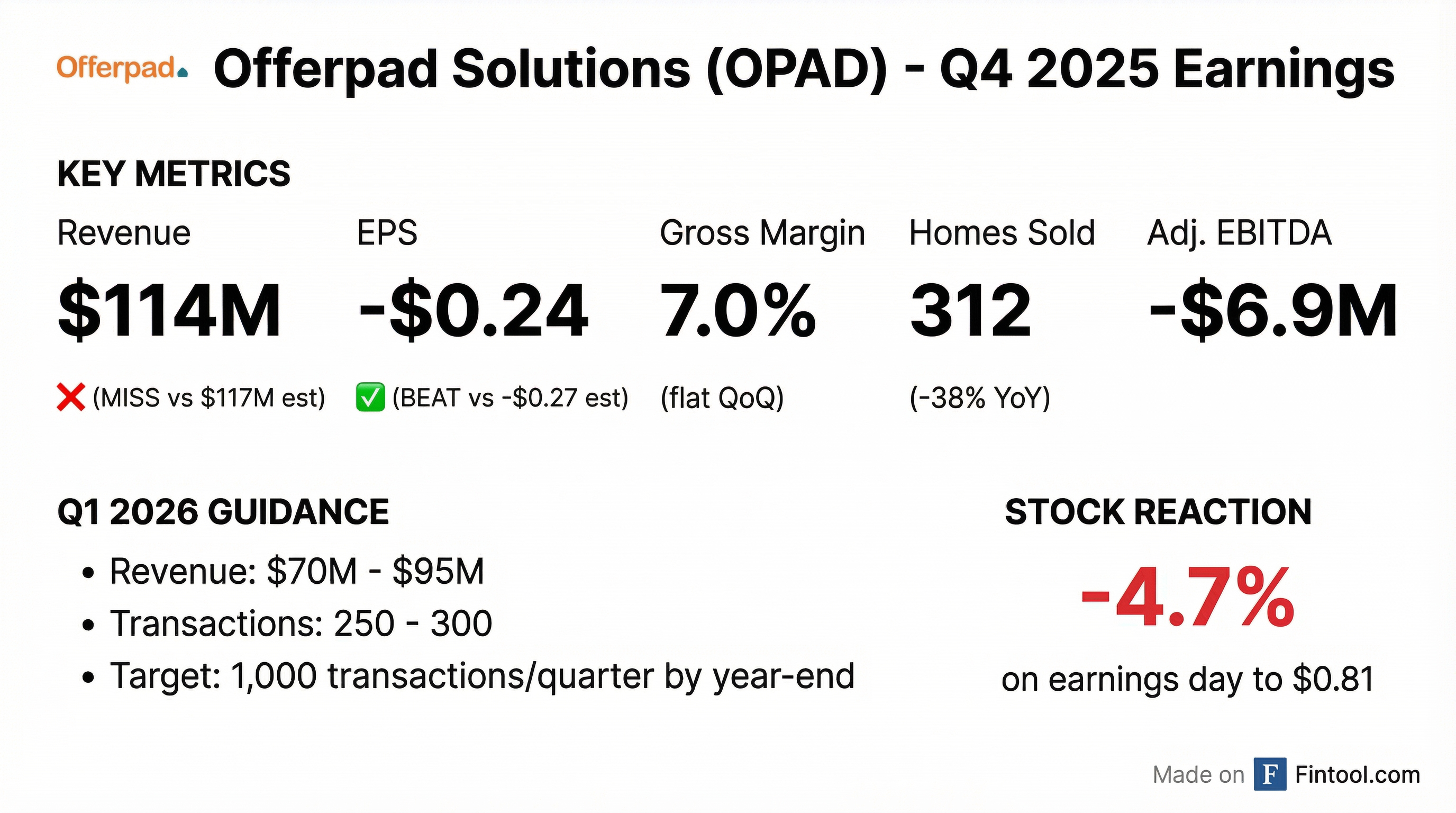
Offerpad delivered Q4 2025 results that reflect deliberate contraction amid a challenging housing market, but management painted an optimistic picture for 2026. Revenue of $114 million missed consensus by 2%, while EPS beat expectations with a smaller loss of $0.24 per share. The real story: signed contracts doubled from November through January, and management believes the company has hit a trough.
Did Offerpad Beat Earnings?
Mixed. The headline numbers:
*Estimates from S&P Global
The EPS beat came from cost discipline—operating expenses fell 37% YoY to $15 million, with $140 million in annualized expenses removed since 2022.
 Ask Fintool AI Agent
What Did Management Guide?
Q1 2026 guidance reflects a measured start to the year:
Full-year 2026 targets:
- 1,000 transactions per quarter as the company exits 2026
- Positive Adjusted EBITDA within the year
- No additional capital required under current framework
CFO Peter Knag: "Current transaction volume represents a trough for the business... we expect a fairly linear growth trend as we move from approximately 100 transactions per month up to just above 300 transactions per month."
What Changed From Last Quarter?
The Q4 numbers show continued contraction, but leading indicators are improving:
But here's what's different:
- Signed contracts doubled (+102%) from November through January
- December signed volumes up 71% month-over-month
- 305 contracts signed through mid-February—nearly matching all of Q4 (314) with half the quarter remaining
- Aged inventory reduced to fewer than 60 homes not under contract
- All cohorts except 2 homes expected to be profitable
How Did the Stock React?
Offerpad shares fell 4.7% on earnings day to $0.81, with aftermarket trading down to $0.75. The stock has collapsed from its August peak:
The Four-Solution Platform
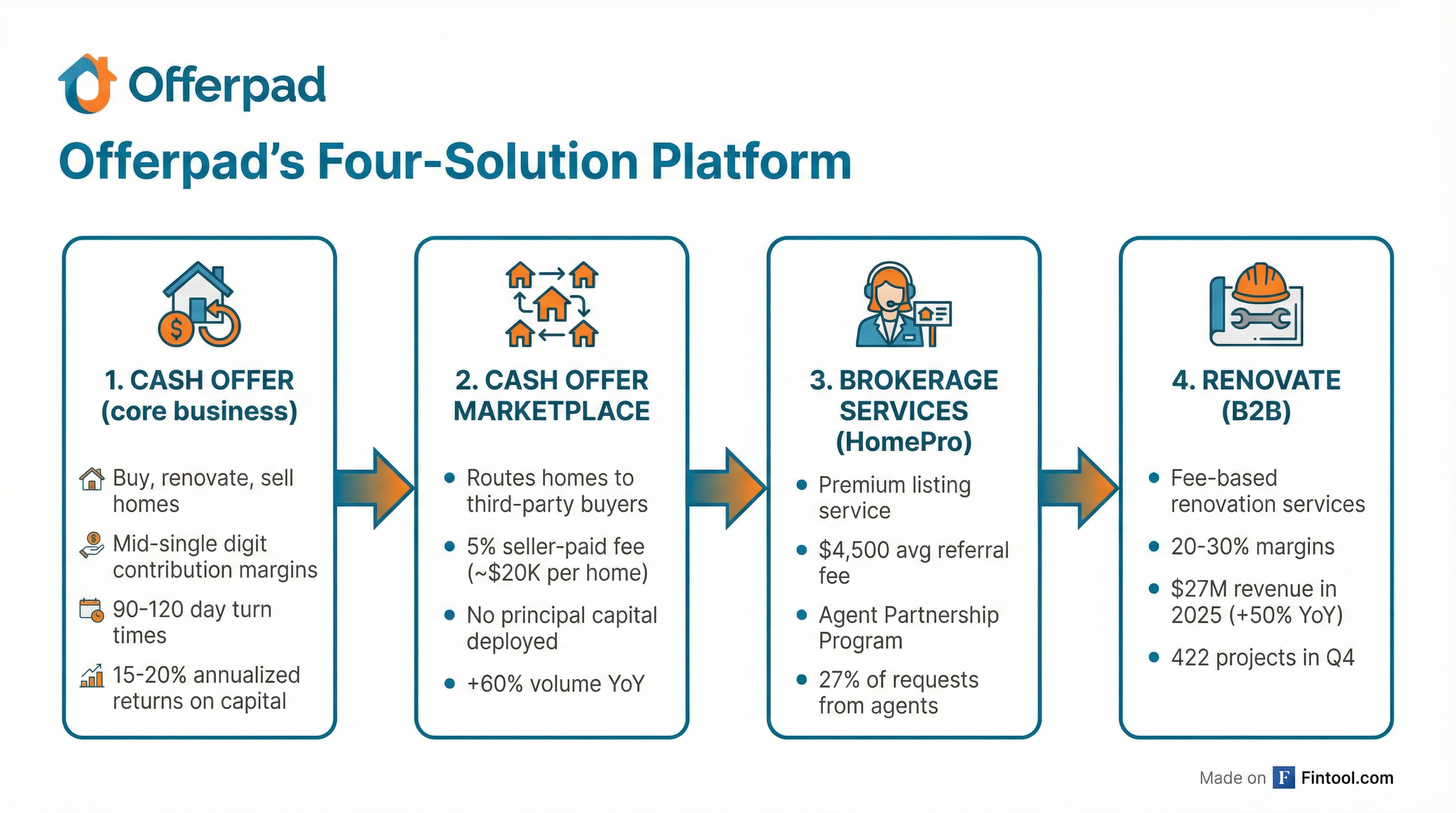
The most significant strategic shift: Offerpad is no longer a single-product iBuyer. Management unveiled a four-solution platform designed to monetize every seller interaction:
1. Cash Offer (Core Business)
The traditional iBuying model with refined economics:
- Median purchase price: ~$370,000
- Average renovation investment: $25,000 per home
- Target turn times: 90-120 days
- Property-level contribution margins: Mid-single digits
- Annualized return on deployed capital: 15-20%
CEO Brian Bair: "We're not optimizing for margin per home; we're optimizing for return on deployed capital... When you turn capital that fast at those property-level margins, we're generating annualized returns in the 15%-20% range."
2. Cash Offer Marketplace
Routes homes to third-party professional buyers without deploying balance sheet capital:
- Average seller-paid fee: 5% (~$20,000 on a $400,000 home)
- 2025 volume growth: +60% YoY
- Buyer network: "Direct Plus" partners including fix-and-flip operators, regional investors, and structured capital buyers
3. Brokerage Services (HomePro)
A premium listing service for sellers who prefer traditional market exposure:
- Average referral fee: ~$4,500 per transaction
- Agent Partnership Program: ~1/3 of Cash Offer requests now come through agents
4. Renovate (B2B Services)
Fee-based renovation services for third-party property owners:
- 2025 revenue: $27 million (+50% YoY)
- Margins: 20-30%
- Q4 projects completed: 422
- Markets served: 21
Ask Fintool AI AgentExpected Product Mix Evolution
Management expects the mix to shift as the multi-solution strategy matures:
CFO: "As we focus really equally across three products, we expect that mix to move up towards eventually the 50/50 range."
AI Strategy: What's Changing
Management emphasized AI integration across the business:
Near-term AI applications:
- AI voice scheduling: Automating inspection scheduling and call center Q&A
- Pricing precision: Leveraging 10+ years of transaction data with generative AI and machine learning
- Portfolio management: Integrated system optimizing acquisition, hold strategy, and disposition decisions
CEO Bair: "We're leveraging years of operating data and experience, transaction history, and market intelligence to increase pricing precision and reduce risk."
The company also added Tela Gallagher Mathias to the board—25+ years of enterprise tech and generative AI leadership—to support AI scaling.
Capital Position and Liquidity
The balance sheet has stabilized after the $18 million Q1 2026 capital raise:
CFO: "Our 2026 operating framework currently does not require incremental capital to execute."
Q&A Highlights
On Government Risk to Institutional Investors
Q: Could restrictions on institutional investors buying single-family homes impact your business?
A: CEO Bair: "From an Offerpad perspective, we buy, renovate, and sell homes and put a better home on the market within a very short period of time... On the short-term side, you'll see everything from fix and flips to partners with different cash buyer structures... we've focused on adding a different array of cash buyers. If one segment slows down, we're going to have another segment that can pick up that volume."
On P&L Impact of AI
Q: Where should we expect to see AI impact first in the P&L?
A: CEO Bair: "The real estate operations and pricing sensitivity—we have 10 years of data that we can pull from... But we're also seeing immediately some really good impact in AI voice scheduling inspections... with the ability of AI voice, we can now schedule inspections, have our call center Q&A... I think it makes [employees] 60%, 70% more efficient."
On Expense Optimization
Q: How much more cost cutting is left?
A: CFO Knag: "If you look at Q4 2025 versus Q4 2024, operating expenses came down from $24 million to $15 million, so $9 million there... There's some third-party spend that we continue to look at, one that's a fairly large item that we're hoping to execute across. There will be more there."
Full-Year 2025 Summary
New Leadership Team
Management added key operating roles to support the platform pivot:
- Rich Ford — Chief Strategy Officer & President, Cash Offer Marketplace (20+ years building residential real estate marketplaces)
- Chris Carpenter — Chief Operating Officer (cross-functional coordination, scalable systems)
- Dr. Jay Singh — Chief Pricing and Analytics Officer (AI/ML portfolio management system)
- Tela Gallagher Mathias — Board member (25+ years enterprise tech and generative AI)
Ask Fintool AI AgentThe Bull Case
- Momentum turning: Signed contracts doubling suggests demand recovery
- Multi-solution optionality: Four revenue streams reduce capital intensity and increase conversion
- Unit economics proven: 15-20% annualized returns on deployed capital with 7% gross margins
- Operating leverage: Cost base can support 3x+ current transaction volume without proportional overhead growth
- Valuation: Trading at ~0.6x book value with real estate assets
The Bear Case
- Execution risk: Getting from ~100 to 333 transactions/month is a 3x+ ramp
- Housing market dependency: No iBuyer can thrive if transaction volumes stay at 30-year lows
- Cash runway: Even with $70M+ liquidity, quarterly losses of ~$7-10M leave limited margin for error
- NYSE delisting risk: Company flagged potential non-compliance with listing rules
- Stock liquidity: $23M market cap makes institutional ownership difficult
The Bottom Line
Offerpad's Q4 results confirm the company hit a trough—but the early 2026 momentum is real. Signed contracts doubling from November through January, coupled with a multi-solution platform that can monetize every seller interaction, gives management a credible path to 1,000 transactions per quarter.
The question is execution. Scaling from ~100 to 333+ transactions per month in under 12 months, while maintaining unit economics and operating discipline, is a significant lift. The housing market remains constrained, and any macro deterioration could derail the ramp.
At $23 million market cap, the stock prices in substantial risk. For believers in the housing recovery and management's execution capabilities, the asymmetry is attractive. For skeptics, the delisting risk and cash runway concerns are legitimate.
Key metrics to watch:
- Monthly signed contracts (leading indicator)
- Transaction volumes by solution type
- Contribution profit per home
- Cash position and liquidity
- NYSE listing compliance
Data sourced from Offerpad Q4 2025 earnings call transcript and earnings presentation. Estimates from S&P Global.