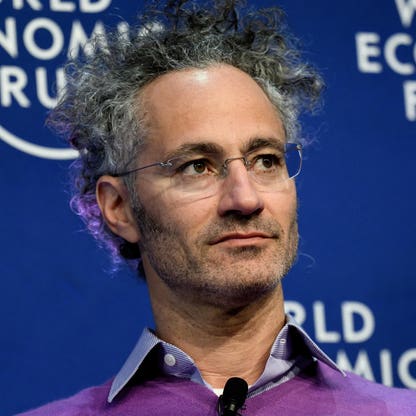
Alexander Karp
 Palantir Technologies
About Alexander Karp
Alexander Karp (age 57) is Palantir’s co‑founder, CEO since 2005, and a director since 2003; he holds a B.A. (Haverford), J.D. (Stanford), and Ph.D. (Goethe University) . In 2024, Palantir delivered 29% year-over-year revenue growth and achieved positive GAAP net income and operating income in each quarter . Pay-versus-performance disclosures show a strong 2024 stock performance: a $100 initial investment in PLTR grew to $796.11 in 2024 (peer group: $232.90), with 2024 GAAP net income of $462,190 thousand . Palantir’s executive pay program emphasizes long-term equity alignment and retention, with limited use of formulaic annual metrics and a prohibition on hedging; a clawback policy was adopted in October 2023 .
Past Roles
| Organization | Role | Years | Strategic impact |
|---|---|---|---|
| Palantir Technologies Inc. | Co‑Founder; Chief Executive Officer; Director | Director since 2003; CEO since 2005 | Led the company through a direct listing in 2020; 2020 equity plan performance condition tied to the listing was satisfied . |
External Roles
- No other public company directorships for Karp are disclosed in Palantir’s director nominee and executive officer sections .
Fixed Compensation
| Metric | FY 2022 | FY 2023 | FY 2024 |
|---|---|---|---|
| Base Salary ($) | 1,101,637 | 1,101,637 | 1,101,637 |
| Annual Bonus Paid ($) | — | 0 (no bonuses to NEOs for 2023 service) | 0 (no bonuses to NEOs for 2024 service) |
| Stock Awards ($) | — | — | — |
| All Other Compensation ($) | 4,390,966 | 2,396,560 | 3,528,533 |
| Total Compensation ($) | 5,492,603 | 3,498,197 | 4,630,170 |
- Notes: Approximately 72.6% of Karp’s base is paid as a quarterly travel stipend ($800,000 within the $1,101,637 salary) . 2024 perquisites include: tax services $363,000; umbrella liability insurance $96,176; medical/health coverage $160,000; security services $1,057,186; aircraft (charter and personally owned under security program) $1,852,171; no tax gross‑ups paid .
Performance Compensation
- No formulaic annual bonus (no 2023 or 2024 cash bonuses to NEOs); equity is the primary at‑risk component .
- Long-term equity awards (granted in 2020) and vesting constructs:
| Award | Shares | Price/Expiration | Vesting | Performance link | Change-of-control (CoC) |
|---|---|---|---|---|---|
| Executive Option (Class B) | 141,000,000 | $11.38; exp. 8/20/2032 | 2.5% quarterly from 8/20/2021 (40 equal quarters) | N/A (option pricing out-of-the-money at grant) | Greater of 20% of total award or 50% of unvested accelerates immediately prior to CoC (if serving through CoC), per Jan 2021 amendment |
| Executive RSU (2010 Plan) | 35,100,000 | — | 2.5% quarterly from 8/20/2021 (40 equal quarters) | Performance condition satisfied by direct listing (Sept 2020) | Same acceleration as above |
| Executive RSU (Executive Equity Plan) | 3,900,000 | — | 2.5% quarterly from 8/20/2021 (40 equal quarters) | Performance condition satisfied by direct listing | Same acceleration as above |
2024 realized equity activity (potential selling pressure signal):
- Options exercised: 36,000,000 shares; value realized $1,389,950,151 .
- RSUs vested: 3,900,000 shares; value realized $138,138,000 .
Equity Ownership & Alignment
Beneficial ownership (as of April 11, 2024):
- Class A: 6,432,258 shares; Class B: 91,725,319 shares; Class F: 335,000; voting percentage: 11.9% (record-date votes) .
Vested vs unvested (as of 12/31/2024):
- Options exercisable: 13,350,000; unexercisable: 91,650,000 (Class B, $11.38 strike, exp. 8/20/2032) .
- Unvested RSUs: 22,815,000 (2010 Plan; market value $1,725,498,450 at $75.63) and 2,535,000 (Executive Equity Plan; market value $191,722,050) .
- Insider trading, hedging, pledging: Hedging prohibited. Pledging is prohibited for NEOs, with limited exceptions available to the Board and CEO per policy; clawback adopted Oct 2023 in compliance with SEC/Nasdaq rules .
Employment Terms
| Provision | Key terms |
|---|---|
| Post-termination security continuation | Security Continuation Agreement (6/5/2019): If terminated and upon release, Palantir provides continuation of Karp’s security program and tax‑neutralizing payments. Estimated values: Involuntary termination—up to 30 months, $10,800,000; Voluntary termination—up to 15 months, $5,400,000; Other termination—1 month, $360,000 . |
| Traditional cash severance | None disclosed for Karp beyond security continuation; company may consider future arrangements as needed . |
| CoC equity acceleration | For Karp, greater of 20% of total award or 50% of unvested portion vests immediately prior to CoC if serving through CoC (amended Jan 2021) . |
| Potential CoC value (illustrative) | Using $75.63 (12/31/2024): RSUs $958,610,250; Executive Equity Plan Option $2,944,256,250; Total $3,902,866,500 (assumes specified acceleration and award assumption) . |
| Clawback | Non-discretionary recovery of excess incentive-based compensation upon accounting restatement, adopted Oct 2023 . |
Board Governance
- Board service history and role: Director since 2003; CEO since 2005; not identified as independent (only Moore, Woersching, Schiff, Stat are independent) .
- Committee roles: Audit Committee (Moore, Woersching, Stat) and Compensation, Nominating & Governance Committee (Moore, Schiff); Karp is not listed on either committee .
- Leadership structure: Chairman is Peter Thiel; roles of chair and CEO are separated; a lead independent may be appointed if chair is not independent .
- Attendance and executive sessions: Each incumbent director attended ≥75% of meetings in 2024; non-employee directors meet in executive session at least twice per year .
- Voting control: Founder Voting Trust (Class F) plus Founder Voting Agreement gives the Founders up to 49.999999% voting power when the ownership threshold is met; for director elections (Proposal 1), Class F had ~1.2567 billion votes (28.1%) in 2025 .
- Implication: Dual role (CEO + director) alongside founder control concentrates governance power; separation of Chair role partially mitigates this .
Director Compensation (context)
- Outside director policy excludes founders (e.g., Thiel receives no director compensation under the policy). Employee-directors like Karp are compensated as executives; outside directors receive cash fees and RSUs per policy .
Compensation Peer Group (for program design context)
- 2025 peer group (18 companies): Palo Alto Networks; Autodesk; Cloudflare; CrowdStrike; Datadog; DocuSign; Fortinet; HubSpot; MongoDB; Okta; Paycom; Snowflake; The Trade Desk; Twilio; UiPath; Unity; Workday; Zscaler (Coupa, VMware, and Splunk removed due to acquisitions) .
Say‑on‑Pay & Shareholder Feedback
- First say‑on‑pay (June 2023) approved: For 1,470,070,205; Against 65,382,345; Abstain 21,084,300; Broker non‑votes 477,894,790. Frequency: every three years; next vote in 2026 .
Risk Indicators & Red Flags
- Large potential CoC acceleration value for CEO ($3.90B at 12/31/2024 price assumption) can be a transaction‑related overhang in M&A scenarios .
- Significant perquisites (security, aircraft) justified by security assessments; no tax gross‑ups reported for 2024 .
- Founder control via Class F/Voting Agreement may reduce the probability of a change in control and concentrates decision rights .
- Hedging prohibited; pledging prohibited for NEOs but limited exceptions exist for the CEO and Board under policy; clawback policy in place .
Ownership, Vesting, and Insider Selling Pressure Signals
| Item | Detail |
|---|---|
| Beneficial ownership (4/11/2024) | Class A: 6,432,258; Class B: 91,725,319; Class F: 335,000; 11.9% voting power (record date) . |
| 2024 vest/realize | 36,000,000 options exercised ($1.39B value); 3,900,000 RSUs vested ($138.1M value) . |
| Ongoing vest cadence | CEO option and RSU awards vest in equal quarterly installments from 8/20/2021 over 40 quarters (through 2031), implying periodic settlement and potential selling to cover taxes . |
Investment Implications
- Alignment and incentives: Minimal cash pay, no annual bonus, and substantial, long-dated equity with quarterly vesting anchor Karp’s incentives to long-term stock performance; 2024 TSR markedly outperformed the peer index and net income scaled materially, reinforcing pay-for-performance alignment disclosures .
- Governance overhangs: Founder voting control (up to ~50% voting power) and very large CoC acceleration could dampen takeover optionality and influence governance dynamics; separation of Chair/CEO partially mitigates but Karp is non‑independent .
- Trading signals: Quarterly vesting through 2031 and substantial 2024 exercises indicate recurring supply events; monitor Form 4 filings and 10b5‑1 activity for timing and magnitude of sales to cover taxes/liquidity .
- Cost and optics: Elevated security and aircraft perquisites persist (bona‑fide security rationale) and a post‑termination, tax‑neutral security continuation package represents a non‑standard CEO benefit; however, no bonus payouts and a clawback policy reduce some governance risk .
