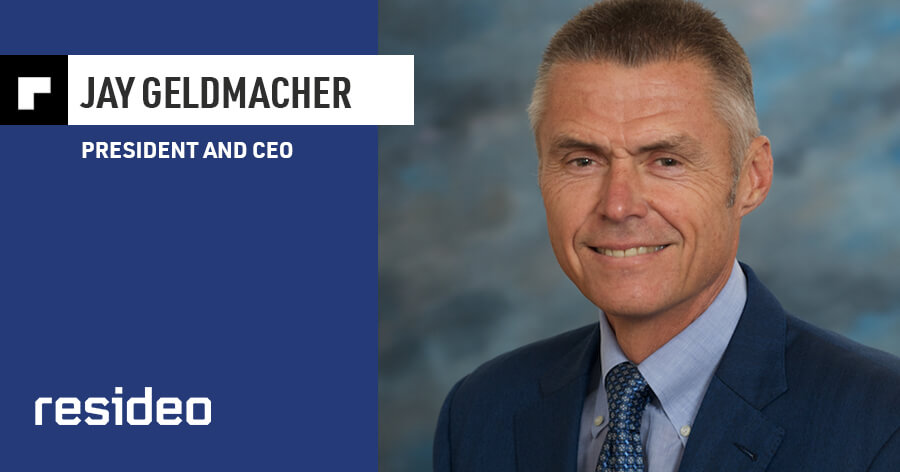
Jay Geldmacher
 RESIDEO TECHNOLOGIES
About Jay Geldmacher
Jay Geldmacher (age 69) is President, Chief Executive Officer, and Director of Resideo Technologies (since May 2020). He holds a B.S. in Marketing from the University of Arizona and an Executive MBA from the University of Chicago . Under his tenure, the company reported 2024 net revenue of $6.8B (+8% YoY), gross margin expansion to 28.1% (+90 bps), and record cash from operations of $444M; 2024 also included the strategic Snap One acquisition and a CD&R preferred investment that added two CD&R designees to the Board . For investor-aligned metrics, Resideo’s TSR grew to $193 on a $100 baseline (12/31/2019–12/31/2024), outperforming the S&P 600 at $138 over the same period .
Past Roles
| Organization | Role | Years | Strategic Impact |
|---|---|---|---|
| Electro Rent | President & CEO | 2019–2020 | Led test & measurement leader through operating cycle |
| Artesyn Embedded Technologies | President & CEO | 2013–2019 | Ran embedded computing & power spin-out; operating leadership in competitive tech markets |
| Emerson Electric – Embedded Computing & Power | EVP; President, Embedded Computing & Power Group | 2007–2013 | Capital allocation and global operating leadership |
| Astec Power Solutions (Emerson subsidiary) | President | 1998–2006 | Grew power solutions business; operations-focused strategy |
External Roles
| Organization | Role | Years | Notes |
|---|---|---|---|
| Seagate Technology Holdings plc | Director | 2012–present | Current public company directorship |
| Verra Mobility Corporation | Director | 2018–2020 | Former directorship |
| Owens-Illinois, Inc. | Director | 2008–2015 | Former directorship |
| Vertiv Holdings (Advisory) | Advisor | n/a | Advisory board role |
| University of Arizona Eller Business School (Advisory) | Advisor | n/a | Advisory board role |
Fixed Compensation
| Year | Base Salary ($) | Target Bonus (%) | Actual Annual Incentive ($) |
|---|---|---|---|
| 2024 | 1,066,000 | 150% | 2,065,908 |
Additional 2024 “All Other Compensation” for Geldmacher totaled $22,132 .
Notable perquisites/policies:
- Executive physical up to $5,000 and right to use private jet for business/commuting with full tax gross-up approved at hire; no commuting expenses in 2024 .
- Robust clawback policy tied to accounting restatements (3-year lookback) .
- Hedging and pledging of company stock prohibited .
- Executive stock ownership guideline: CEO 6x base salary; all executive officers in compliance as of 12/31/2024 .
Performance Compensation
Annual Incentive Plan (AIP) – 2024 Structure and Payouts
- Metrics and weights: 50% Net Revenue (constant currency), 50% Operating Income Margin .
- Company-level performance and payout used for CEO’s plan .
| Metric | Weight | Threshold | Target | Maximum | Actual | Perf. vs Target | Payout % | Weighted Payout % |
|---|---|---|---|---|---|---|---|---|
| Net Revenue (CC) | 50% | $5,886M | $6,540M | $7,194M | $6,596M | 100.9% | 109% | 54% |
| Operating Income Margin | 50% | 7.5% | 8.8% | 10.1% | 9.5% | 107.5% | 150% | 75% |
| Total Company Payout | — | — | — | — | — | — | — | 129.2% |
AIP governance notes:
- AIP payout range: 50% (threshold) to 200% (maximum) per metric; no payout if both below threshold .
- 2024 bonus plan excluded unanticipated items (e.g., certain legal, restructuring) consistent with plan design; actuals reported at constant currency .
Long-Term Incentives (LTI)
- Mix: 60% PSUs (CEO), 40% RSUs (CEO) in 2024 .
- CEO 2024 LTI target value: $8,000,000 (PSU target $4.8M; RSU target $3.2M) .
- Accounting grant-date fair values disclosed:
| Component | 2024 Grant Detail | Value |
|---|---|---|
| RSUs | 2/15/2024 grant (159,124 shares; vests 1/3 annually over 3 years) | $3,430,713 |
| PSUs (Target) | 2/15/2024 rTSR PSUs (target 238,687) | $8,416,104 |
| PSUs (Max) | If 200% payout | $16,832,208 |
| 2024 Monte Carlo Inputs | See table (e.g., 2/15/24: $35.26 FV, 47.58% vol, 4.28% Rf) |
PSU design and vesting:
- 2024 PSUs earned on 3‑year rTSR vs S&P 600; Threshold 25th pct → 50%; Target 55th pct → 100%; Max 75th pct → 200%; linear interpolation .
- 2022 PSUs paid out at 59.62% of target based on 3‑year TSR percentile rank (Jan 1, 2022–Dec 31, 2024) .
Forward-looking design changes:
- 2025 PSU program: 50% 3‑year average ROIC + 50% 3‑year rTSR (independent measures), 200% cap; added cap so if absolute TSR is negative, rTSR portion cannot exceed 100% .
Equity Ownership & Alignment
Beneficial Ownership (as of 4/8/2025)
| Holder | Shares Owned | Rights to Acquire (Options/near-term RSUs) | Total | % of Class |
|---|---|---|---|---|
| Jay Geldmacher | 405,056 | 237,035 | 642,091 | <1% |
- CEO stock ownership guideline: 6x base salary; all executive officers met minimum ownership as of 12/31/2024 .
- Hedging and pledging prohibited; margin accounts/pledging banned .
Outstanding Equity and Vesting Profile (as of 12/31/2024)
| Award Type | Grant Date | Quantity Outstanding | Vesting Terms / Expiration |
|---|---|---|---|
| Stock Options | 5/28/2020 | 237,035 | Strike $6.63; expire 5/27/2027; fully vested |
| RSUs | 2/9/2022 | 43,787 | Vested in full on 2/9/2025 |
| RSUs | 2/14/2023 | 112,103 | Remaining vests in equal installments on 2/14/2025 and 2/14/2026 |
| PSUs (Target) | 2/14/2023 | 252,233 | 3‑yr rTSR vs S&P 600 through 12/31/2025; pays in 2026 if earned |
| RSUs | 2/15/2024 | 159,124 | 1/3 annually on 2/15/2025, 2026, 2027 |
| PSUs (Target) | 2/15/2024 | 238,687 | 3‑yr rTSR vs S&P 600 through 12/31/2026; pays in 2027 if earned |
Implication: Material vesting events typically occur mid‑February each year (RSU tranches), which can create predictable Form 4 supply windows if net shares are sold for tax or liquidity. Company policy prohibits hedging/pledging, mitigating alignment concerns .
Employment Terms
- CEO transition: On November 7, 2024, Resideo announced Geldmacher’s intention to retire following a CEO transition. He will serve as SVP, Executive Advisor for 6 months after the new CEO starts (or through September 30, 2025, whichever is later), receive current base salary, and be eligible for a pro‑rated 2025 AIP payout at target if the transition ends during fiscal 2025 .
- Equity treatment at transition: Pro‑rated payout of unvested RSUs/PSUs; RSU vesting accelerated at separation, PSU pro‑ration based on service through separation .
- Severance: He is no longer covered under the Severance Plan during the transition period .
- Change‑in‑Control protection: Per his original offer letter, all equity vests in full if not assumed in a CIC, or upon termination without cause/good reason within 24 months post‑CIC (double‑trigger if awards are assumed) .
- Company‑wide severance governance (context): Severance Plan requires non‑competition and non‑solicitation covenants; double‑trigger CIC severance (24 months’ base plus 2x annual incentive for participants), and advisory policy not to exceed 2.99x cash severance without a shareholder advisory ratification .
- Perquisites: Executive annual physical; private jet commuting right with full tax gross‑up at hire (no commuting expenses in 2024) .
- Clawback: Applies upon accounting restatement; recover excess incentive‑based compensation for 3 prior fiscal years .
- Deferred compensation: Nonqualified plan exists, but no deferred compensation entries were disclosed for Geldmacher in 2024 .
Board Governance
- Role: President, CEO, and Director; Director since 2020; not independent; no committee assignments .
- Board structure: Independent Chairman (Andrew Teich); roles of Chair and CEO are separated .
- Committee independence: All Board committees comprised solely of independent directors .
- Attendance: The Board met 8 times in 2024; each director attended ≥75% of Board and Committee meetings .
- Employees receive no compensation for Board service (applies to Geldmacher as an employee director) .
- Hedging/pledging prohibitions and robust governance practices affirmed .
Say‑on‑Pay & Shareholder Feedback
- 2024 say‑on‑pay: 80.5% support .
- 2025 design response: Maintain at least 50% of LTI as PSUs; add 3‑year average ROIC alongside rTSR, with a cap if absolute TSR is negative; continue limited special awards with transparent rationale .
Compensation Peer Group (used for 2024 decisions)
- AOS, AYI, ADT, ALRM, ALLE, COMM, FBIN, GNRC, ITRI, JELD, JNPR, LII, VYX (NCR), OC, PNR, WSO .
Performance Snapshot (context under Geldmacher’s tenure)
- 2024 net revenue $6.8B (+8% YoY); gross margin 28.1% (+90 bps); record cash from operations $444M; Snap One acquisition and CD&R investment (two Board designees) .
- TSR since 12/31/2019 baseline: Resideo $193 vs S&P 600 $138 as of year‑end 2024 .
Investment Implications
- Pay‑for‑performance alignment: High at‑risk mix (AIP tied 50/50 to revenue and margin; majority of LTI in PSUs), with upcoming 2025 addition of ROIC to PSUs and an rTSR cap under negative TSR—supportive of long‑term value creation and risk moderation .
- Vesting/supply calendar: Concentrated RSU vesting in mid‑February plus PSU settlements on 3‑year cycles may create periodic Form 4–related supply; options are deeply in‑the‑money (strike $6.63) with 2027 expiry, but retirement/transition and retirement‑eligible provisions can influence exercise/settlement timing .
- Alignment and governance: CEO meets 6x salary ownership guideline; pledging/hedging prohibited; robust clawback; separate Chair/CEO and fully independent committees reduce dual‑role governance risk despite CEO also serving as a director .
- Retention/transition risk: Announced CEO transition with a defined advisory period and pro‑rated equity treatment reduces abrupt leadership risk; however, leadership change introduces near‑term execution risk around Snap One integration and operational initiatives .
- Shareholder sentiment: 80.5% say‑on‑pay support and disclosed engagement led to PSU design improvements (ROIC) and negative‑TSR cap—constructive signal on compensation governance responsiveness .