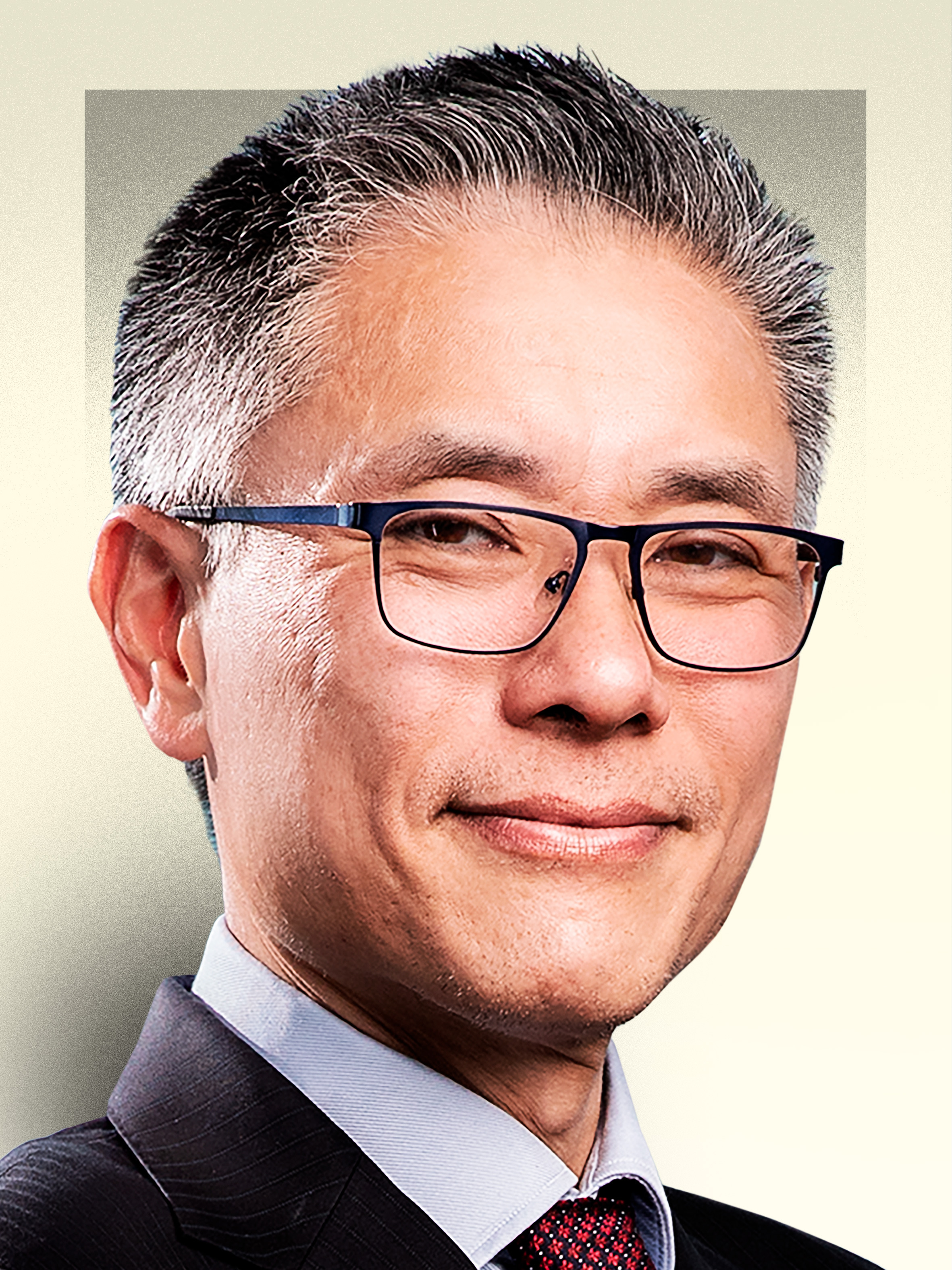
Tony Cheng
 REINSURANCE GROUP OF AMERICA
About Tony Cheng
Tony Cheng is President and Chief Executive Officer of Reinsurance Group of America (RGA), serving as CEO since January 1, 2024 and as President since January 2023; he is age 51 and a director since 2023 (not independent) . He holds a B.Ec. from Macquarie University and an MBA from Washington University in St. Louis (Olin), is a Fellow of the Institute of Actuaries of Australia (FIAA), and is a past President of the Actuarial Society of Hong Kong . RGA’s pay philosophy emphasizes pay-for-performance with key financial metrics including adjusted operating income per share, new business embedded value (NBEV), adjusted operating ROE, and book value per share (ex-AOCI); in 2024, the Annual Bonus Plan (ABP) enterprise funding was 175% and Cheng’s ABP payout was 190% of target, underscoring strong operational execution against incentive goals . “Compensation Actually Paid” to the PEO (CEO) for 2024 under SEC rules was $15,789,113, with drivers linked to equity value changes and performance .
Past Roles
| Organization | Role | Years | Strategic impact |
|---|---|---|---|
| RGA / Malaysian Life Reinsurance Group Berhad | Chief Actuary | 1997 | Joined RGA; actuarial leadership in Malaysia market |
| RGA | CEO, Hong Kong | 2004 | Led Hong Kong and Southeast Asia business development and operations |
| RGA | SVP, Asia | 2011 | Oversaw Asia region strategy and growth |
| RGA Reinsurance Company | EVP, Head of EMEA, Asia, Australia | Prior to 2023 | Executive oversight of EMEA, Asia, Australia operations |
| RGA | President; Chief Executive Officer | President 2023; CEO 2024–present | Enterprise leadership; Board director (not independent) |
External Roles
| Organization | Role | Years | Notes |
|---|---|---|---|
| Institute of Actuaries of Australia | Fellow (FIAA) | n/a | Professional credential |
| Actuarial Society of Hong Kong | Past President; Council Member; Past Chair, Experience and Life Committees | n/a | Professional leadership and governance |
Board Governance and Service
- Board service at RGA: Director since 2023; status: not independent (as CEO) .
- Committee roles: None; given their roles as Chair and President/CEO, Stephen O’Hearn (Chair) and Tony Cheng do not serve on any Board committees .
- Board structure: Independent Chair; all committees fully independent; robust risk oversight across Audit, Cybersecurity & Technology, Human Capital & Compensation, Investment, Nominating & Governance, and Risk Committees .
- Employee directors (including Cheng) do not receive director compensation; non-employee director pay reviewed with independent consultant Meridian; CEO not paid as a director .
- Say-on-Pay support: 99% approval at 2024 Annual Meeting; 10‑year average support 93.8%, signaling strong shareholder endorsement of pay design .
Fixed Compensation
| Year | Base salary ($) | Notes |
|---|---|---|
| 2024 | 950,000 | Increase reflects promotion to CEO |
| 2025 | 1,000,000 | 5.3% increase approved Oct 2024 |
Performance Compensation
Annual Bonus Plan (ABP) – 2024
| Metric | Weight | Minimum | Target | Maximum | Actual result | Payout for metric |
|---|---|---|---|---|---|---|
| Adjusted Operating Income per Share (ex notable items) | 60% | $15.98 | $19.98 | $23.98 | $22.57 | 98.9% of component (translates to 80–120% scale) |
| New Business Embedded Value (NBEV, $mm) | 30% | $531 | $950 | $1,370 | $1,730 | 55.9% of component (translates to 80–120% scale) |
| Adjusted Consolidated Revenue ($mm) | 10% | $17,839 | $22,298 | $26,758 | $22,107 | 9.8% of component (translates to 80–120% scale) |
| Financial Metric Payout | — | — | — | — | — | 168.6% (rounded) |
| Strategic Scorecard & Other Modifier | — | — | — | — | — | +6.4% |
| Enterprise Funding Factor | — | — | — | — | — | 175.0% |
| Executive | 2024 ABP Target (% salary) | Target ABP ($) | Actual ABP (% of target) | Actual ABP ($) |
|---|---|---|---|---|
| Tony Cheng | 175% | 1,662,500 | 190.0% | 3,158,750 |
2025 ABP design changes: Adjusted Revenue removed; weights reallocated to 65% Adjusted Operating Income per Share (ex notable items) and 35% NBEV; CEO ABP opportunity for 2025: 100% min / 200% target / 400% max of salary .
Long-Term Incentives: Performance Contingent Shares (PCS)
| Cycle | Performance measures (weights) | Min | Target | Max | Awarded PCS (Tony Cheng) |
|---|---|---|---|---|---|
| 2024–2026 | Book Value/Share growth ex AOCI & FWED (50%); Avg Operating ROE ex AOCI & FWED (50%); +/-20% TSR modifier | 7.1% / 12.0% | 9.5% / 13.5% | 11.9% / 15.0% | 24,996 |
| 2025–2027 | Avg ROE (65%); BVPS ex AOCI growth (35%); +/-20% TSR modifier | Set to intermediate-term goals | Set | Set | 29,145 |
Notes: The 2024 PCS performance period runs 1/1/2024–12/31/2026; 2025 PCS runs 1/1/2025–12/31/2027 .
Stock Appreciation Rights (SARs) and RSUs
- Vesting schedules: SARs granted in 2024 and later vest ratably over three years (one-third each Dec 31); RSUs vest ratably over three years (one-third each Dec 31). SARs expire 10 years from grant date .
- 2024 SAR grant: 22,719 SARs at $185.28 strike (3/15/2024), 10-year term .
- 2025 grants: Cheng to receive 26,532 SARs; no 2025 RSUs for Cheng (his mix: 25% SARs; others receive SARs and RSUs) .
- Exercises/vesting in 2024: Cheng exercised SARs delivering 1,052 shares with $379,303 value; 8,948 shares vested from stock awards with $1,732,850 value .
| Grant year | Instrument | Shares/Units | Strike | Expiration | Vesting |
|---|---|---|---|---|---|
| 2024 | SARs | 22,719 | $185.28 | 3/15/2034 | 1/3 each Dec 31, 2024–2026 |
| 2025 | SARs | 26,532 | — | — | 1/3 each year (standard schedule) |
| 2025 | RSUs | — | — | — | Not awarded to Cheng in 2025 |
Equity Ownership & Alignment
Beneficial Ownership and Guidelines
| Holder | Shares beneficially owned | % of class | Notes |
|---|---|---|---|
| Tony Cheng | 69,019 | <1% | Includes 45,888 RSUs/SARs exercisable/vestable within 60 days; none of the reported shares are pledged . Executive stock ownership guideline for CEO is 8x base salary; as of 12/31/2024, Cheng did not yet meet the requirement (increased in 2023); executives must retain net shares until compliant . Company policy prohibits hedging and pledging of Company securities by directors and officers . |
Outstanding Equity Awards at 12/31/2024 (Selected detail – Tony Cheng)
| Grant date | Exercisable SARs/Options | Unexercisable | Exercise price | Expiration | Unearned PCS (units) |
|---|---|---|---|---|---|
| 3/4/2016 | 4,152 | — | $93.53 | 3/4/2026 | — |
| 3/3/2017 | 3,280 | — | $129.72 | 3/3/2027 | — |
| 3/2/2018 | 3,384 | — | $150.87 | 3/2/2028 | — |
| 3/1/2019 | 3,882 | — | $145.25 | 3/1/2029 | — |
| 3/6/2020 | 8,127 | — | $117.85 | 3/6/2030 | — |
| 3/11/2021 | 3,491 | — | $129.01 | 3/11/2031 | — |
| 3/22/2022 | 4,729 | 1,577 | $106.53 | 3/22/2032 | — |
| 3/9/2023 | 5,462 | 5,462 | $138.34 | 3/9/2033 | 22,364 (payout-value table shows market value $4,777,621) |
| 3/15/2024 | 7,573 | 15,146 | $185.28 | 3/15/2034 | 24,996 (payout-value table shows market value $5,339,895) |
Insider activity signal: In 2024, Cheng realized $379,303 from SAR exercises (1,052 shares delivered) and $1,732,850 from vesting of stock awards (primarily 2022–2024 PCS at a 197.4% performance factor and 2022 RSUs), indicating potential periodic selling pressure around vesting/exercise windows .
Employment Terms
- Employment/severance agreements: RGA has no employment, severance or change-of-control agreements with named executive officers; limited benefits on termination and no golden parachutes or gross‑ups .
- Change-of-control mechanics: Committee has discretionary tools (accelerate, buyout, adjust, or cause assumption of awards); SARs agreements allow automatic acceleration, subject to committee discretion; PCS/RSUs deliver target shares following the end of the applicable period after a change of control .
- Estimated value of equity upon certain events (as of 12/31/2024):
- Change of Control: Options/SARs $1,009,520; PCS/RSUs at target $7,728,706 .
- Disability/Death: Options/SARs $1,009,520; PCS/RSUs pro rata $3,362,669 .
- Clawback: NYSE‑mandated recoupment policy (restatements) plus an additional executive incentive recoupment policy (misconduct/material inaccuracy/injury to company/Code of Conduct violations) with up to four‑year lookback; both policies incorporated into plan documents .
- Perquisites: No personal-benefit perquisites (aircraft, cars, apartments, club dues), except where needed for local competitiveness outside North America .
- Hedging/pledging: Prohibited for directors, officers, and employees .
Pension and Deferred Compensation (2024)
| Plan | Years of service credited | Present value/Balance |
|---|---|---|
| Performance Pension Plan (qualified) | 5 | $41,442 (PV of accumulated benefit) |
| Augmented Benefit Plan (non-qualified pension element) | 5 | $138,264 (PV of accumulated benefit) |
| Executive Deferred Savings Plan – executive contributions (2024) | — | $144,021 |
| Executive Deferred Savings Plan – registrant contributions credited (2023 credited in 2024) | — | $1,111 |
| Executive Deferred Savings Plan – aggregate earnings (2024) | — | $20,022 |
| Executive Deferred Savings Plan – aggregate balance at FYE | — | $182,320 |
Compensation Structure Analysis (signals)
- Mix shifts and risk: Cheng’s LTI emphasizes PCS and SARs; no RSUs granted to Cheng in 2024/2025, keeping more at-risk, performance- and price-linked versus time-based equity (RSUs), which is generally shareholder-aligned .
- Metric calibration: For 2024, ABP weights focused on Adjusted Operating EPS (60%), NBEV (30%), and Adjusted Revenue (10%); in 2025, Adjusted Revenue is removed and weighting shifts toward Adjusted Operating EPS (65%) vs. NBEV (35%), and PCS shifts to 65% ROE / 35% BVPS—tightening alignment with shareholder-value drivers while reducing noise from non-operating items .
- Repricing safeguards: The Flexible Stock Plan prohibits option/SAR repricing or cash buyouts without shareholder approval; awards carry minimum one‑year vesting (limited exceptions) .
- Shareholder sentiment: Very high Say‑on‑Pay support (99% in 2024; 10‑yr avg 93.8%) reduces headline governance risk on compensation .
Equity Ownership & Alignment Risk Indicators
- Ownership guideline: CEO required holding = 8x base salary; Cheng is not yet in compliance (requirement increased in 2023), and must retain net shares until compliant—mitigates forced selling and supports alignment .
- Pledging/hedging: Banned; none of Cheng’s reported shares are pledged—removes collateral-driven sell pressure risk .
- Overhang/vesting cadence: Material unearned PCS units (22,364 for 2023 grant; 24,996 for 2024 grant) plus sizable unexercised SARs across vintages through 2034 suggests recurring supply around vesting/exercise windows—relevant for trading liquidity and technicals .
Director Compensation (employee director)
- Employee directors (including Cheng) receive no director retainers, fees, or director equity; director pay program applies only to non‑employee directors and is reviewed biennially with Meridian Compensation Partners .
Investment Implications
- Alignment: Cheng’s pay mix skews toward performance-contingent equity (PCS) and price-linked SARs with strict clawbacks and anti‑hedging/pledging rules, supporting shareholder alignment and reducing governance red flags .
- Execution and incentive quality: 2024 ABP paid at 190% of target for Cheng on a 175% enterprise factor, driven by strong adjusted operating EPS and NBEV; 2025 metrics tilt further toward ROE and operating EPS, reinforcing returns discipline—positive for capital efficiency and value creation focus .
- Retention and supply technicals: Large unvested PCS and SARs through 2027, plus 3‑year ratable vesting, indicate ongoing retention hooks but also periodic vest‑related supply; recent SAR exercise and significant vesting in 2024 ($379k exercise value; $1.73m vest value) illustrate near‑term selling pressure potential around windows .
- Downside protection/CoC economics: No employment/severance agreements or golden parachutes; change‑of‑control benefits are largely equity‑based (est. $8.74m combined for options/SARs and PCS/RSUs at target as of year‑end 2024), which limits cash parachute risk but could accelerate equity dilution/timing if triggered .
- Governance quality: Independent Chair, fully independent committees, high Say‑on‑Pay support, and independent consultant usage all point to lower governance risk around compensation oversight .
Data sources: RGA 2025 DEF 14A (filed April 10, 2025) and RGA Form 8‑K (Feb 28, 2025). All figures and statements are cited inline.