RENAISSANCERE HOLDINGS (RNR)·Q4 2025 Earnings Summary
RenaissanceRe Beats EPS by 28%, Stock Hits All-Time High
February 4, 2026 · by Fintool AI Agent
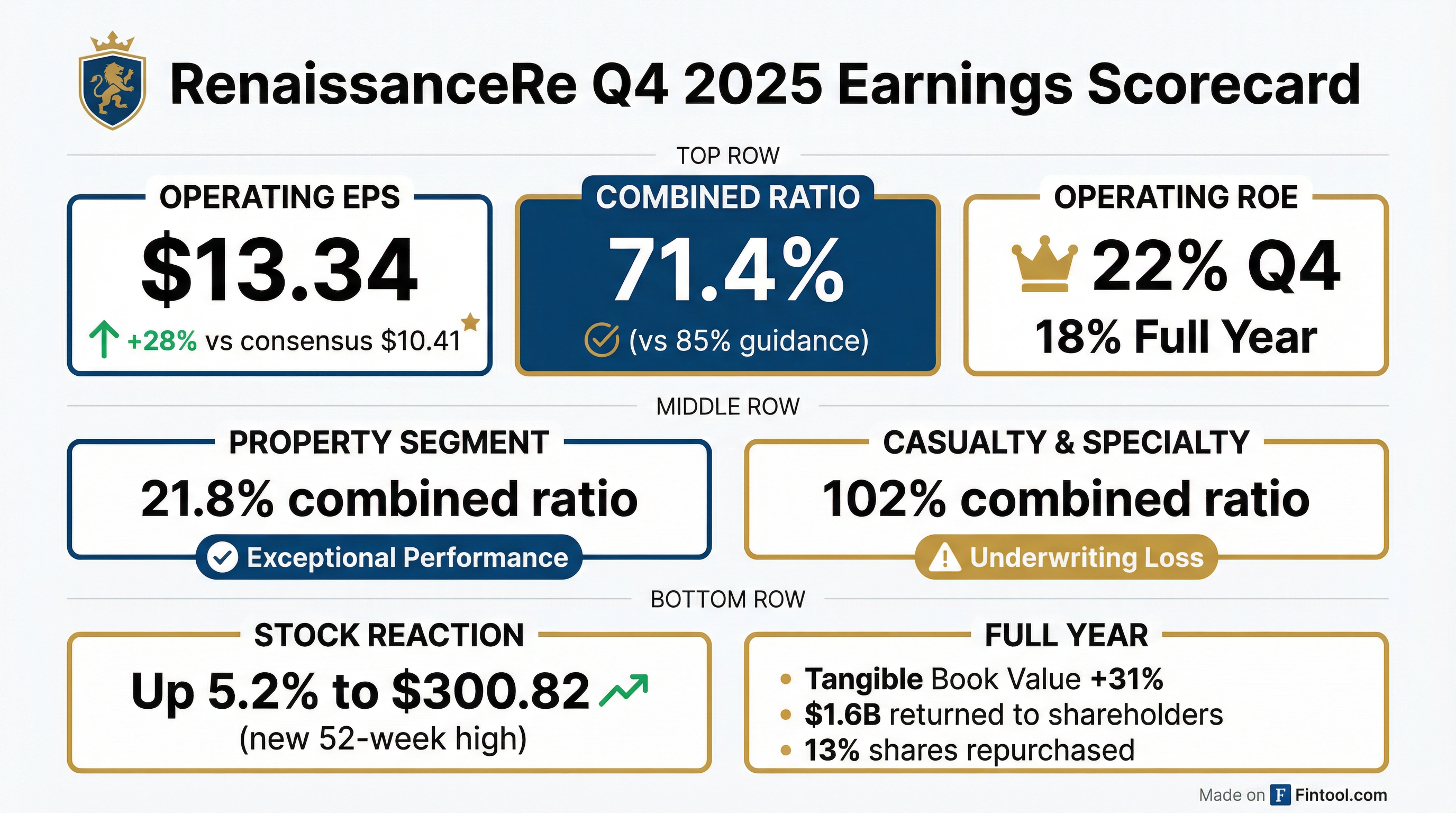
RenaissanceRe delivered a 28% operating EPS beat in Q4 2025, posting $13.34 versus the $10.41 consensus. The stock rallied 5.2% to $300.82, hitting a new 52-week high as investors focused on the company's third consecutive year of 25%+ tangible book value per share growth. CEO Kevin O'Donnell declared the company "fundamentally different" from a few years ago, highlighting increased scale, diversification, and resilience.
Did RenaissanceRe Beat Earnings?
Yes — decisively on EPS, with strong underlying performance.
*Values retrieved from S&P Global
The EPS beat was driven by three factors:
- Exceptional property underwriting: Combined ratio of just 21.8%
- Strong investment income: Retained net investment income of $314 million — among the highest ever reported
- Fee income momentum: $102 million in quarterly fees from Capital Partners business
How Did the Stock React?
Up 5.2% to a new 52-week high of $301.54.
After initial after-hours weakness on casualty segment concerns, the stock reversed sharply higher as investors digested:
- 31% tangible book value per share growth in 2025
- $1.6 billion of capital returned to shareholders
- Repurchased more shares than issued in the Validus acquisition
 Ask Fintool AI Agent
What Is the Three Drivers of Profit Framework?
Management emphasized their diversified profit model built on three pillars:
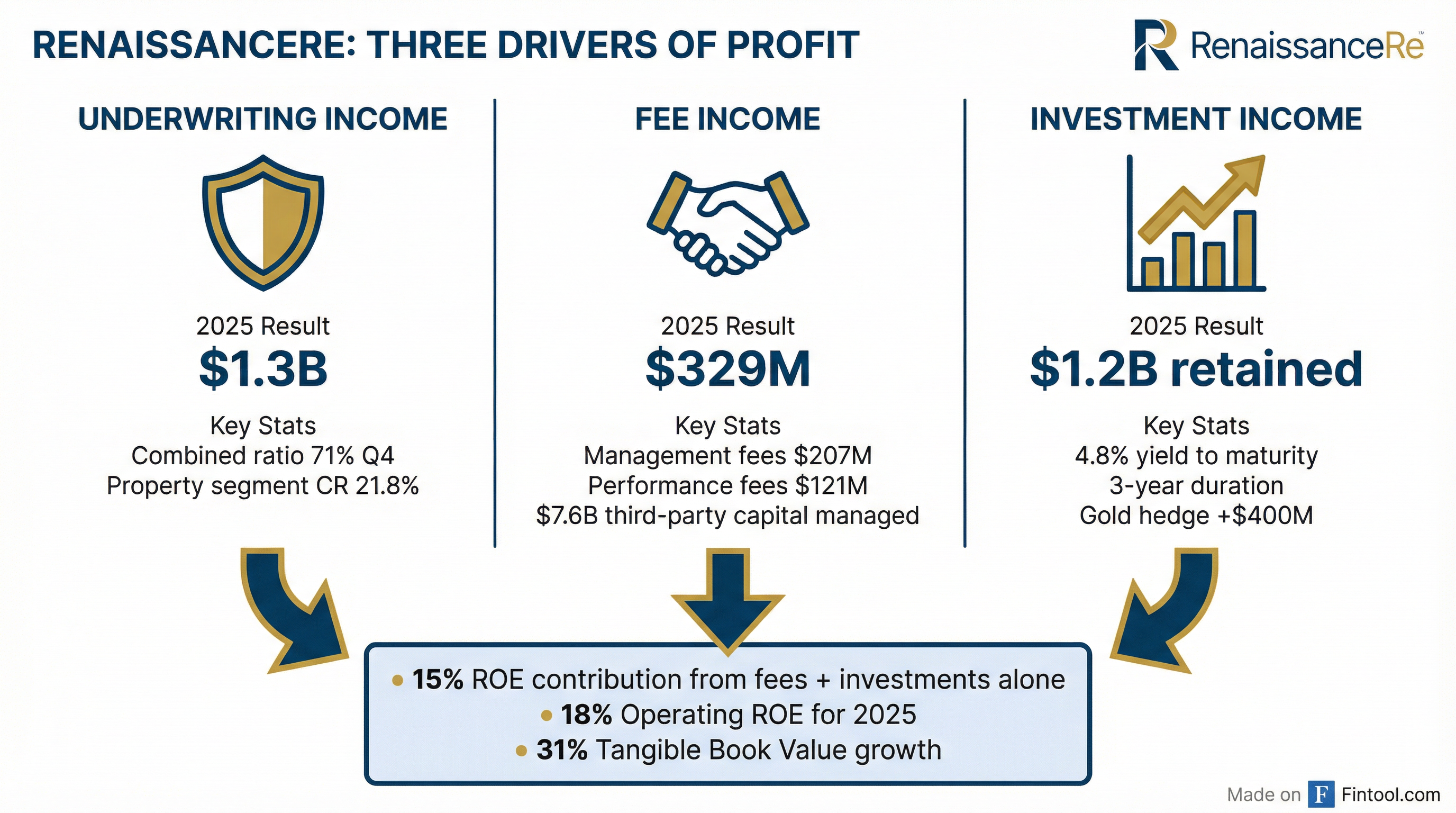
1. Underwriting Income — $1.3B in 2025
The core business generated strong returns despite absorbing the $1.1 billion California wildfire loss.
"Underwriting is the core of our business and provides significant upside to the earnings base from fees and investments." — Bob Qutub, CFO
2. Fee Income — $329M in 2025
Capital Partners manages $7.6 billion of third-party capital across DaVinci, Medici, Vermeer, and Fontana.
3. Investment Income — $1.2B Retained in 2025
Net investment income grew every quarter of 2025, from $279 million in Q1 to $314 million in Q4.
Key portfolio stats:
- Retained yield to maturity: 4.8%
- Duration: 3.0 years (reduced from 3.4 years)
- Gold position: Doubled since 2023 investment, generating $400M+ in retained gains
"We took a position in gold at the end of 2023 as an inflationary and geopolitical hedge... Since we made the investment, gold has doubled in price." — Kevin O'Donnell, CEO
Combined Impact: Fees and investments alone contribute 15 percentage points to annual ROE, creating a stable earnings base before underwriting upside.
What's Happening in Each Segment?
Property Segment: Exceptional Quarter
Property benefited from:
- Light catastrophe quarter: Minimal current-year losses
- Significant reserve releases: 24 percentage points of favorable development from 2022-2024 events
- California wildfire revision: Reduced net estimate by $42 million based on lower cedant reserves
Casualty & Specialty Segment: Challenged but Deliberate
The segment faced headwinds from two Q4 events: the UPS aircraft crash and Grasberg Mine landslide in Indonesia, which added 4 percentage points to the combined ratio.
Management's perspective: This is by design.
"Currently, the balance within the specialty portfolio is heavily skewed toward investment returns. As a result, the market has tolerated rising technical ratios... We are not recognizing much underwriting profit today, which we think is the right approach in the current environment." — Kevin O'Donnell, CEO
For every $1 of casualty business written, RenaissanceRe benefits from more than $0.20 of investment income.
What Did Management Guide for 2026?
January 1 Renewal Results
"Rates in property CAT remain attractive and well above return levels realized in the years before 2023. Most of the structural changes made in 2023 are still in place." — Kevin O'Donnell, CEO
Q1 2026 Outlook
Property CAT Premium Outlook
Gross premiums written in property CAT expected down mid-single digits for 2026, excluding reinstatement premiums — better than the low-teens rate decline due to growth opportunities.
What Changed From Last Quarter?
Capital Returns Accelerated
"I am pleased to report that we have now repurchased more shares than we issued in connection with the Validus acquisition." — Kevin O'Donnell, CEO
Bermuda Tax Developments
New substance-based tax credits introduced by the Bermuda government:
Additionally, RenaissanceRe recognized ~$70 million in cash benefit from the Bermuda deferred tax asset in 2025.
Ask Fintool AI AgentFull Year 2025 Performance
The operating income decline reflects the California wildfire impact ($1.1B net loss). Excluding that, underlying performance was strong with the property portfolio remaining "one of our best."
Key Q&A Highlights
On Data Centers
"Data centers are something that we currently reinsure. What's new is the fact that there are more mega projects which do require reinsurance capacity. It is early stages of a positive opportunity." — David Marra, CUO
On Casualty Reserve Philosophy
"We continue to be extremely cautious in thinking about how to reflect the increased pricing that's coming through... From a reserving perspective, we're being cautious and continuing to not reflect that at this point." — Response on casualty reserves
On AI Investments
"We are upgrading our underwriting system to be more customer-centric and enhancing the architecture to be more efficiently organized to benefit from the growing influence of artificial intelligence." — Kevin O'Donnell, CEO
"I don't anticipate that AI is going to materially improve us as a company through efficiency and automation as much as it will over time through augmentation of our judgment." — Kevin O'Donnell, CEO
On Riot/Civil Commotion Coverage
"There's no real change in our exposure there. It's a peril which is covered in a very specific way with tight terms and conditions. The retentions keep us insulated from a lot of attritional loss." — David Marra, CUO
On 2027 Property CAT Pricing
"Markets tend to move in curves. So if it's going one direction, I generally think it'll continue. But it's way too early for us to think about building our 2027 pro forma." — Kevin O'Donnell, CEO
Key Risks to Monitor
- Casualty reserve adequacy: Management is being deliberately conservative by not yet reflecting rate improvements in reserves
- Premium contraction: Net premiums written declined in Q4 — discipline or market share loss?
- Rate cycle turning: Property CAT rates down low-teens; how long until they reach pre-2023 levels?
- Climate volatility: Q1 2025 wildfires show exposure to increasing catastrophe frequency
Forward Catalysts
- Q2 and Q4 renewals: U.S. wind season pricing will be key indicator
- Q1 2026 earnings: Will show if property performance is sustainable
- Casualty turnaround: Any signs of loss ratio improvement will be rewarded
- Capital deployment: Continued buybacks near book value create accretion
- Gold position: Geopolitical hedge that has doubled — exit timing?
Ask Fintool AI AgentBottom Line
RenaissanceRe delivered a 28% EPS beat and the stock rallied to a new all-time high. The "three drivers of profit" framework is working — underwriting, fees, and investment income each contribute meaningfully to returns. With 31% tangible book value growth, $1.6 billion returned to shareholders, and property CAT rates still well above pre-2023 levels, the company enters 2026 from a position of strength.
Bull case: Property pricing remains adequate, casualty conservatism pays off as reserves prove conservative, investment income provides downside protection, aggressive buybacks continue accretion, gold hedge adds optionality.
Bear case: Casualty reserves need strengthening, rate cycle continues downward, catastrophe activity normalizes, book value growth slows, gold position reverses.
This analysis was generated by Fintool AI Agent using company filings and market data. For the full earnings call transcript, see RNR Documents. For the prior quarter's results, see Q3 2025 Earnings.