SAP (SAP)·Q4 2025 Earnings Summary
SAP Beats on EPS, Announces €10B Buyback as Cloud Transformation Reaches 'Inflection Point'
January 29, 2026 · by Fintool AI Agent
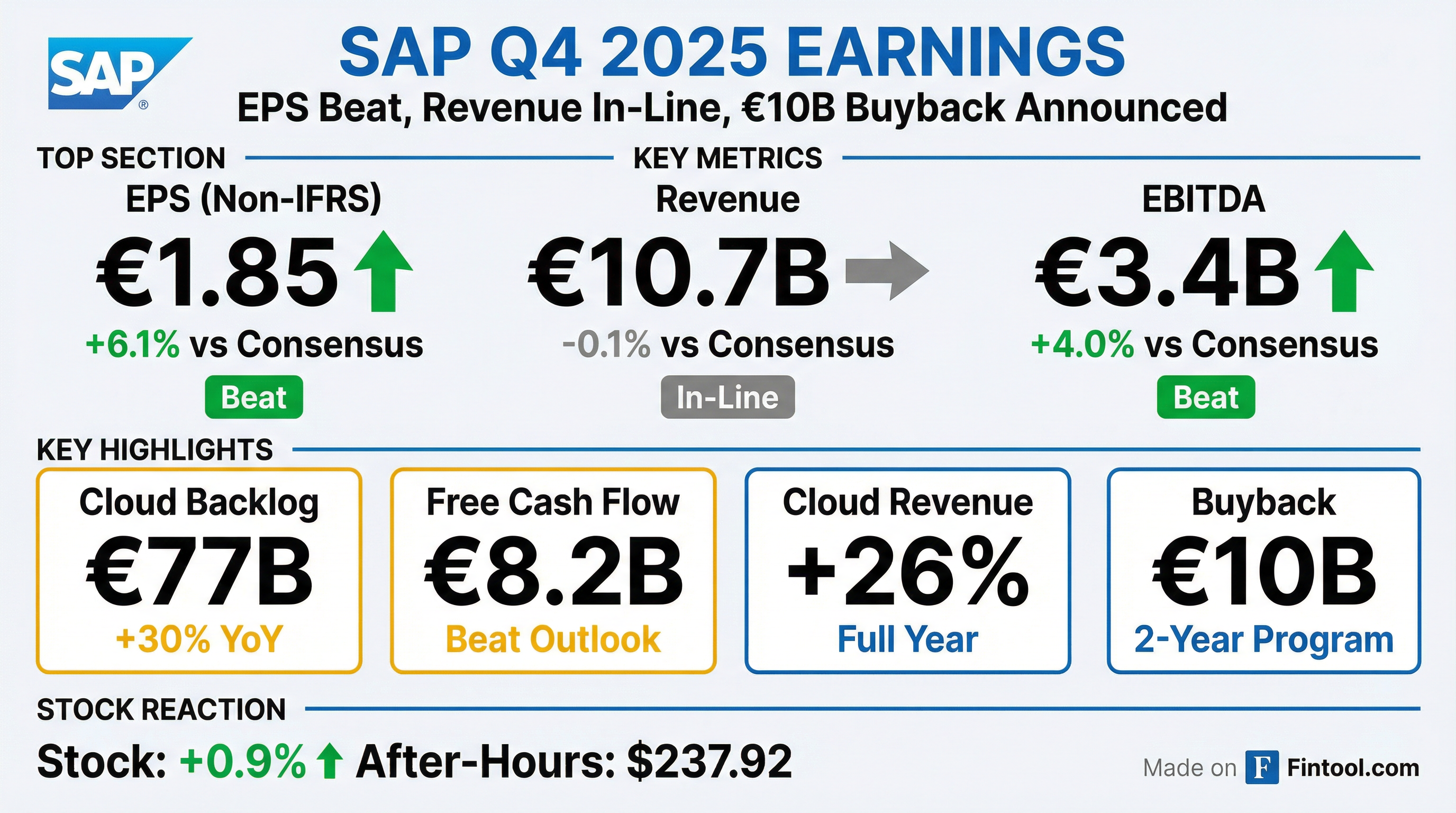
SAP delivered a mixed Q4 2025, beating on profitability while revenue came in essentially flat to expectations. The real story: Europe's largest software company declared its multi-year cloud transformation complete and announced an aggressive €10B share buyback, signaling confidence that the "groundwork is done" and "2026 will be the year AI delivers enterprise-scale return on investment."
The stock rose 0.9% to $236.11 on the news, with after-hours trading pushing shares to $237.92.
Did SAP Beat Earnings?
SAP delivered an EPS beat with profitability metrics exceeding expectations, while revenue was essentially in-line:
For the full year, SAP delivered strong execution against its transformation targets:
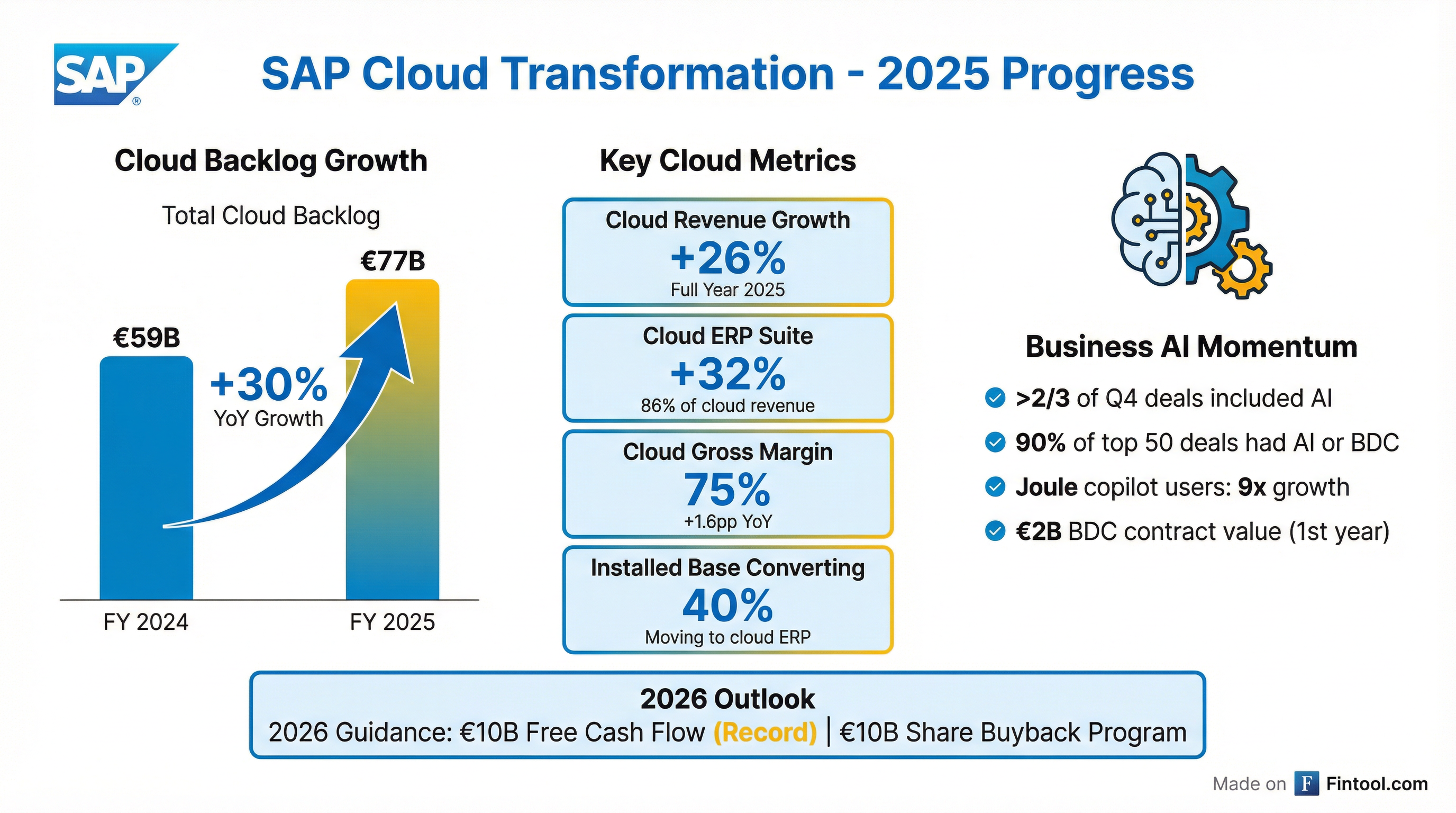
The cloud gross margin expanded 1.6 percentage points to 75%, driving cloud gross profit up 29% YoY.
 Ask Fintool AI Agent
What Happened With Current Cloud Backlog?
The headline concern: Current Cloud Backlog (CCB) grew 25% vs. the 26% guidance provided in October. This was the primary topic of the Q&A session.
CFO Dominik Asam provided a detailed three-factor explanation for the delta:
-
Larger deal mix with back-end-loaded ramps: "The biggest impact... is that we had a lot of very large deals. 71% of deals being €5 million or higher. And in these large deals, it just takes longer to ramp because the customers start with smaller instances in the company and then tackle the really challenging, big, elephant, so to speak, in the room later."
-
Government deals with termination clauses: "Christian mentioned the very strong traction we had on the defense side... there are sometimes procurement laws in certain jurisdictions where we have very mighty procurement departments that can impose a termination for convenience on the vendor, and then we cannot put it in the cloud Current Cloud Backlog because that backlog needs to be contractually committed. Now, in reality, that option is, of course, sometimes theoretical because these are deeply embedded systems which are extremely sticky."
-
Sovereign cloud deployment delays: "There is more and more customers who say: Can I really afford to have a off-the-shelf, standard, plain vanilla, U.S. hyperscaler infrastructure as a service? They also sometimes need to be built, so also from the signing of the contract till the deployment at the customer, it takes time."
Management emphasized this was a timing issue, not demand: CEO Klein noted Q4 was "our best bookings result of the year" with "lower churn than expected" and "pretty stable" discounts.
The Total Cloud Backlog (TCB) — which includes all contracted future revenue — hit €77B, up 30% YoY, outpacing CCB growth by 5 percentage points. This creates "a strong foundation for total revenue acceleration through 2027."
What Did Management Guide?
SAP provided 2026 guidance reflecting continued transformation momentum:
Importantly, management clarified 2026 CCB deceleration expectations: "Definitely not a 4% decline. That is not what we are seeking for. It will be not such a decline like what you have seen in 2025."
The company also announced a €10B share buyback program over two years, starting in February. CFO Dominik Asam stated: "This decision reflects our confidence in the sustainable strengths of the business and our continued commitment to returning capital to shareholders."
How Did the Stock React?
The stock had a volatile session — dropping 10% at the open before recovering throughout the day. CEO Christian Klein directly addressed the selloff, acknowledging SAP is "in the penalty box" with capital markets amid broader software sector concerns about AI disruption.
"When you look back into all of the technological innovations over the last 10-20 years, it always starts with chips, with the hardware. But I'm 100% sure, in order to create value on the business side, you need to move up the stack... and we are uniquely positioned to win the race on business AI."
CFO Asam provided context on the broader SaaS valuation debate: "It's almost like a philosophical war around where the value is created. Is it on the infrastructure layer, which is currently the flavor of the month? We had a similar bifurcation in the last big tech bubble in 2000, where telecoms and fiber optics were going through the roof... I wonder how much dark fiber today is still in the ground which has never been lit since then."
What Changed From Last Quarter?
Several notable shifts from Q3 2025:
AI Adoption Accelerated Materially:
- More than two-thirds of Q4 cloud order entry included Business AI, up 20+ percentage points from Q3
- 90% of the 50 largest Q4 deals included AI or SAP Business Data Cloud
- Joule copilot users grew ninefold over the course of the year
Deal Size Increased:
- Large cloud transactions (>€5M) contributed a record 71% of total cloud order entry in Q4
- Almost two-thirds of deals >€1M involved four or more lines of business, up 25 percentage points
Sovereignty Became a Bigger Factor:
- "Geopolitical tensions have led to many customers putting even more emphasis on exploring sovereign SaaS options"
- As the largest non-US software company, SAP is uniquely positioned but deal cycles are longer
Ask Fintool AI AgentWhat Are the Key Growth Drivers?
Management outlined five pillars for continued growth:
1. Installed Base Conversion (2-3x Multiplier)
- €10.5B support revenue base represents "multi-billion euro cloud revenue opportunity"
- 40% of support revenue base has initiated cloud ERP move via RISE/GROW
2. Cross-Sell Expansion
- Customers "now clearly see the value of best of suite over best of breed, especially in the age of AI"
- SAP outperformed the cloud market by 10 percentage points in 2025
3. Mid-Market Growth via Partner First
- Partner channel growing 1.5x faster than direct business
- Won 3,000+ net new customers in 2025
- Public cloud order entry growing 5x faster than private cloud
4. Business AI & Data Cloud
- SAP Business Data Cloud secured ~€2B in total contract value in first year
- AI agents embedded directly in business processes with "context-rich business data not available to LLM providers"
5. AI-Powered ERP Migration
- "Customers spend 10x more on ERP migration than software... we are shrinking this ratio"
What Did Management Say About AI Competitive Risks?
This was directly addressed in the Q&A. CEO Klein pushed back strongly on fears that LLMs could disrupt enterprise software:
"I know there is a general concern out there in the market about how will software sustain in the world of AI? Cannot everyone code software? I would say clearly, no... The LLMs are super good in the unstructured data, but you need the business data. And which company has petabytes of data which we are using to fine-tune our AI foundation? This is SAP."
He cited specific examples with extensive deal detail:
-
H&M: "They came to us and said: 'Our business will change a lot as a retailer.' We custom-coded for them a prototype on how shopping experience will change... Can an AI agent help to find the right store to deliver next day or even in the same evening? It was not only the cloud move, it was really the AI embedded in the different parts of our apps which made this happen."
-
Fresenius: "Together with Fresenius and Avelios, we are now coding on our platform a new patient management solution... it will revolutionize how much more efficient we can make the doctors and the nurses to spend more time with the people in the hospital. AI agents taking a lot of manual work over what the nurses and the doctors had to do in the past."
-
Cash flow agent example: "Customers see, oh, an LLM can read a support ticket. But what about the P&L data? What about sales negotiations, deals in the pipeline? What about certain payment information? So it always goes together. The LLMs are super good in the unstructured data, but you need the business data."
CFO Asam added competitive context: "On SaaS, PaaS in 2025, we had 30% growth in US dollar terms... You have seen results of some competitors, like Dynamics and ServiceNow. If you adjust to an apples-to-apples dollar comparison, we are actually far ahead of the pack. There are some hovering around 20%, there are some hovering around 10%, some in the mid-teens, but nobody is anywhere close."
Key Customer Wins
Q4 saw significant enterprise wins across industries:
Internal AI Transformation
SAP announced it's using AI internally to drive €2B in "real cost efficiencies by the end of 2028" — representing 15%-20% efficiency gains on addressable costs.
Key internal AI applications:
- R&D: 35% of code now automated; developer role "shifting from traditional code writing toward designing, guiding, and validating AI-generated solutions"
- Sales: AI for better quoting, pricing, and opportunity identification
- HR: AI for workforce planning and transformation
Management emphasized this is about efficiency, not headcount reduction: "Today, there is no restructuring plan. Obviously, can you hold this out forever? No. But today, I can tell you, we're gonna achieve that by just scaling our business way more than in the past with AI."
What Are the Risks?
1. CCB Deceleration Trajectory While management says "meaningfully less" deceleration than 2025's 4 points, any continued slowdown will concern investors.
2. Sovereign Cloud Complexity "These discussions take just longer than they have been a year ago... this is not a reflection of a demand issue." But longer cycles mean less predictable bookings.
3. Large Deal Concentration Record 71% of order entry from >€5M deals creates lumpiness and timing risk quarter-to-quarter.
4. FX Headwinds 13% EUR appreciation vs USD impacted reported growth significantly. Management emphasized constant currency metrics throughout.
5. Tariff Uncertainty Asked directly about tariff impacts, CEO Klein confirmed: "There are no tariffs on software or software services, which is good. So there is no direct impact... On the indirect impact, we saw in H1 2025 that was not great on the public sector. A lot of new requirements came up, we needed new certifications, but we overcame that, and Q4 was actually really good in the U.S. public sector."
Ask Fintool AI AgentQ&A Highlights
On Stock Price Drop (from journalists): Klein: "I'm doing this job now since six years. I have seen a lot of ups and downs... Our head of IR tells me we are in the penalty box because there are questions around, okay, what is the future of software in times where everyone maybe can generate and code apps? I'm 100% sure, in order to create value on the business side, you need to move up the stack. We are uniquely positioned to win the race on business AI, and we're gonna prove that."
On CCB Shortfall: Asam: "The biggest impact we've seen is that we had a lot of very large deals. 71% being €5 million or higher... it just takes longer to ramp. Second point is government deals with termination for convenience clauses we cannot put in CCB. The last point is sovereign cloud deployments taking longer."
On SaaS Valuation Debate: Asam: "If I look at the SaaS and the PaaS layer, we are doing actually great. On SaaS, PaaS in 2025, we had 30% growth in US dollar terms... There are some competitors hovering around 20%, some around 10%, some in the mid-teens, but nobody is anywhere close there. That kind of SaaS, PaaS layer is not super appreciated by capital markets, but the jury is still out."
On Geopolitical Tensions Impact: Asam: "2025 was not necessarily an easy year in terms of trade issues, geopolitical tensions. And I find it quite remarkable that on cloud revenues, despite all these adversities, we have been really within spitting distance to the midpoint of our guidance. For 2026, we have basically assumed the 2025 environment to be the new normal."
On European Regulation vs U.S.: Klein: "When we are closing deals in Q4, in the U.S., you have clear regulation. We are not even talking with customers about regulation. They are clear. And here in Europe, you have the state level, federal level, then you come to the European layer... And now, that is not good for SAP, but think about all of our startups."
On M&A vs Buyback Decision: Klein: "We didn't do larger M&A over the last years. We didn't need to. The accelerated total revenue will come organically. Going forward, would I now rule out M&A? No. We will at some point do M&A, but then more for technological reasons, especially in the data and AI space."
The Bottom Line
SAP delivered a solid close to its multi-year cloud transformation, with profitability beating expectations and management confident enough to announce a €10B buyback. The CCB "miss" of 1 percentage point was a deal-mix timing issue, not demand deterioration — bookings actually exceeded plan.
The strategic narrative has shifted from "cloud transformation in progress" to "AI delivers enterprise-scale ROI." With two-thirds of Q4 deals including AI, 9x growth in Joule users, and €2B in Business Data Cloud contract value in year one, SAP is positioning itself as the business AI platform of choice for enterprises who need more than "commodity LLMs."
For investors, the key debate is whether the TCB-to-CCB timing gap resolves as expected in 2026-2027, and whether SAP's business data moat is as defensible against AI disruption as management claims.
Related Links: