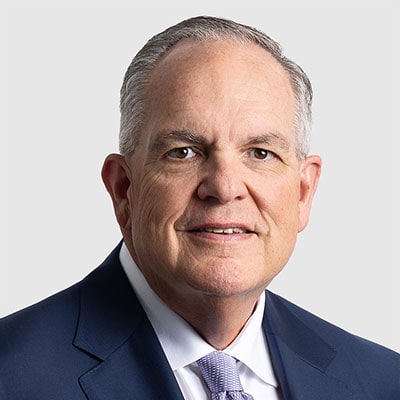
Ronald O’Hanley
 STATE STREET
About Ronald O’Hanley
Ronald P. O’Hanley (age 68) is Chairman, President and Chief Executive Officer of State Street; he has served as CEO since 2019, Chairman since 2020, and reassumed the President title effective January 1, 2024 . He holds a B.S. from Syracuse University and an M.B.A. from Harvard University . Under his leadership, 2024 delivered revenue of $13.0B (+6.2% YoY), EPS of $8.67 (+13.2% YoY), and pre-tax margin of 27.6% (+120 bps YoY); TSR was 30.2% over 1-year and 16.3%/45.0% over 3-/5-years, with outperformance versus the KBW Bank Index on 3- and 5-year horizons .
Past Roles
| Organization | Role | Years | Strategic impact |
|---|---|---|---|
| State Street Corporation | Chairman & CEO; Chairman, President & CEO; President & CEO; President & COO; Vice Chairman | 2017–present | Led transformation, technology modernization, operating model simplification; record company EPS; positive fee/operating leverage; margin expansion; multi-year TSR outperformance vs KBW on 3/5 years |
| State Street Global Advisors | CEO & President | 2015–2017 | Grew ETF franchise; set foundation for later record ETF net inflows and AUM at year-end 2024 |
| Fidelity Investments | President, Asset Management & Corporate Services | 2010–2014 | Senior leadership in global asset management and corporate operations |
| BNY Mellon Asset Management | CEO & President; other senior roles | 1997–2010 | Global AM leadership; multi-year executive management experience in regulated financial services |
External Roles
| Organization | Role | Years | Notes |
|---|---|---|---|
| Unum Group (NYSE: UNM) | Director | 2015–present | Current public company directorship |
| The Ireland Funds | Director | n/a | Non-profit board service |
| Beth Israel Lahey Health | Trustee | n/a | Non-profit board service |
| The Boston Foundation | Former Director | n/a | Non-profit board service |
Fixed Compensation
Multi-year reported compensation (SEC Summary Compensation Table):
| Metric | 2022 | 2023 | 2024 |
|---|---|---|---|
| Salary ($) | 1,000,000 | 1,146,154 | 1,200,000 |
| Bonus ($) | — | — | — |
| All Other Compensation ($) | 121,176 | 136,786 | 160,053 |
| Total ($) | 18,004,619 | 13,449,164 | 16,715,967 |
2025 target adjustments: HRC increased O’Hanley’s 2025 target incentive from $14.8M to $16.3M; target total compensation set at $17.5M .
Performance Compensation
Design highlights and 2024 outcomes:
- HRC applies a single “total incentive compensation” decision, primarily based on corporate performance, modified for individual performance; 2024 corporate performance factor set at 115% (“Above Expectations”) .
- CEO’s 2024 incentive was awarded at 115% of target, reflecting above-expectations leadership and strategic/financial execution; total incentive $17.02M; total compensation $18.22M (HRC view table) .
2024 award composition (HRC view):
| Component | Amount ($) |
|---|---|
| Immediate Cash | 4,255,000 |
| Deferred Stock Awards (DSAs) | 4,255,000 |
| Performance-Based RSUs | 8,510,000 |
| Total Incentive | 17,020,000 |
| Target Incentive | 14,800,000 |
| Total Compensation (Fixed + Incentive) | 18,220,000 |
Grants reported with 2024 performance year (granted 2/23/2024):
- CRSU: 39,665 units; grant date fair value $2,774,963
- Performance RSUs: 85,913 target (max 128,870); grant date fair value $5,549,980
- DSA: 41,988 units; grant date fair value $2,774,987
Performance framework and metrics:
- Corporate assessment considers financial (revenue, EPS, pre-tax margin, ROE; fee/operating leverage), business (sales, client retention, product/capability build, technology modernization), and risk management (resilience, regulatory posture) .
- 2024 results included revenue +6.2%, EPS +13.2%, pre-tax margin +120 bps, ROE +290 bps; record NII; TSR outperformed KBW on 3-/5-year basis .
Vesting mechanics and risk alignment:
- PBRSUs: 3-year performance period (e.g., 2024–2026) with vesting after certification; depending on grant, vesting occurs in one installment, or in 3 or 5 annual installments post-performance (plan footnotes) .
- CRSUs (cash-settled RSUs): typically vest quarterly over ~3 years (illustrative schedules in plan footnotes) .
- DSAs: vest in annual installments over 4–5 years (plan footnotes) .
- Robust ex-ante adjustment, forfeiture, and clawback regimes; NYSE 303A.14-compliant compensation recovery policy for restatements .
Equity Ownership & Alignment
| Item | Detail |
|---|---|
| Beneficial ownership (3/3/2025) | 309,543 shares; includes 152,656 held in trust (disclaims beneficial ownership except to pecuniary interest) |
| % of outstanding | Each director/NEO individually <1%; shares outstanding 288,590,984 (3/3/2025) |
| Executive stock ownership guideline | 7x base salary for CEO – O’Hanley exceeds full ownership guideline |
| Holding/retention policy | 50% net shares during 5-year phase-in if below pro rata; 100% thereafter until met |
| Hedging/pledging | Prohibited for directors and executive officers; short selling/options/hedging/pledging/speculative trading banned; Rule 10b5‑1 plans permitted |
| Options | Company does not grant or reprice options |
Insider selling pressure and scheduled supply:
- Upcoming vesting cadence concentrates around quarterly CRSUs and annual DSAs (commonly February 15 dates cited in plan footnotes), and post-performance PBRSU installments, creating potential periodic liquidity events; sales may occur under 10b5‑1 plans consistent with policy .
Employment Terms
| Provision | Key terms |
|---|---|
| Change-in-control (COC) | “Double-trigger” required for DSAs/CRSUs acceleration and cash; PBRSUs service-based restrictions lapse and vesting accelerates for U.S. NEOs upon qualified COC termination |
| COC cash severance | Lump sum = 2× (base salary + prior-year cash incentive incl. DVAs), capped at $10M |
| Involuntary termination without cause (non-COC) | Illustratively, O’Hanley total value $41.55M including continued vesting; cash severance $623,077; current-year incentive $2,775,000; health/outplacement as disclosed (as of 12/31/2024 scenario) |
| COC termination (illustrative) | Total value $38.10M including $2.4M cash severance, accelerated equity per policy, other benefits (as of 12/31/2024 scenario) |
| Retirement eligibility | Service-based restrictions lapse at age ≥55 and ≥5 years’ service; awards continue vesting on original terms; O’Hanley satisfied this retirement provision as of 12/31/2024 |
| Restrictive covenants | For U.S. NEOs: non-compete 12 months, non-solicit 18 months, confidentiality and non-disparagement |
| Clawback/forfeiture | Misconduct, risk failings, restatements, or breach of non-compete can trigger forfeiture/clawback (3–4 year look-back windows by award type) |
| Perquisites | Executive security package including car/driver; annual physicals, liability coverage; no tax gross-up on perqs (limited exceptions not applicable to CEO) |
Board Governance and Roles (dual-role implications)
- Board service: Director since 2019; Chairman of the Board since 2020; also chairs the Executive Committee and serves on the Risk Committee .
- Lead Independent Director framework: Independent Lead Director appointed annually; extensive responsibilities include agenda-setting, presiding over executive sessions, evaluation of CEO, and stakeholder engagement; Sara Mathew appointed to serve following the 2025 AGM (subject to re-election) .
- Governance considerations: A shareholder proposal in 2025 urged separation of Chair/CEO roles, citing potential conflicts and time demands; proposal references O’Hanley’s external commitments and prevailing investor preferences for independent chairs .
- Meetings/attendance: Board held seven meetings in 2024; each director attended at least 75% of Board/committee meetings; committee workloads included 10 Audit, 9 Risk, 8 HRC meetings; Executive Committee had no meetings in 2024 .
- Director pay policy: Employee directors (including O’Hanley) receive no additional compensation for Board service .
Performance & Track Record Snapshot
| Metric | 2023 | 2024 | YoY/Notes |
|---|---|---|---|
| Total Revenue ($B) | 12.2 | 13.0 | +6.2% |
| Fee Revenue ($B) | 9.5 | 10.1 | +6.3% |
| Net Interest Income ($B) | 2.8 | 2.9 | +5.9%; record NII second year |
| EPS ($) | 7.66 | 8.67 | +13.2% |
| Pre-tax Margin (%) | 26.4% | 27.6% | +1.2 pts |
| ROE (GAAP) (%) | 8.2% | 11.1% | +2.9 pts |
| 1Y TSR | — | 30.2% | 2024 |
| 3Y/5Y TSR | — | 16.3% / 45.0% | Exceeded KBW on 3-/5-year |
Compensation Committee & Governance Controls
- HRC composition (independent): Chair Sara Mathew; 8 meetings in 2024; oversees CEO goals, pay, risk alignment, and use of an independent compensation consultant .
- Independent consultant and peer benchmarking drive market-based pay targeting; 2025 CEO target incentive increased following peer review and performance considerations .
- Risk alignment: integrated ex-ante/ex-post risk adjustments; Board-level control function compensation review; policies prohibit single-trigger COC, excise tax gross-ups, options repricing; strong clawback/forfeiture tools .
Say-on-Pay & Shareholder Feedback
- Company conducts annual advisory vote on executive compensation; Board recommends “FOR” and considers vote results in decisions (2025 proxy) .
Investment Implications
- Pay-for-performance alignment looks intact: 2024 corporate factor at 115% maps to strong EPS growth, margin expansion, and multi-year TSR credibility; equity-heavy mix with 3-year PBRSU metrics (ROE, pre-tax margin, fee revenue growth, relative TSR) ties realizable pay to durable value creation .
- Retention and selling pressure: CEO exceeds 7× ownership guideline and is retirement-eligible, with vesting continuing per original schedules; quarterly/annual vesting cycles may create periodic supply, but hedging/pledging are prohibited and 10b5‑1 use is policy-governed—net alignment is strong .
- Downside protection and governance risk: Robust clawback/forfeiture reduces tail-risk of overpay; however, dual Chair/CEO role remains a governance debate point (shareholder proposal), partially mitigated by a powerful Lead Independent Director structure and active executive sessions .
- Change-in-control economics: Double-trigger standard and capped COC cash formula reduce “golden parachute” optics; illustrative tables show majority of value is tied to equity that is performance- and time-conditioned, supporting shareholder alignment in strategic scenarios .
