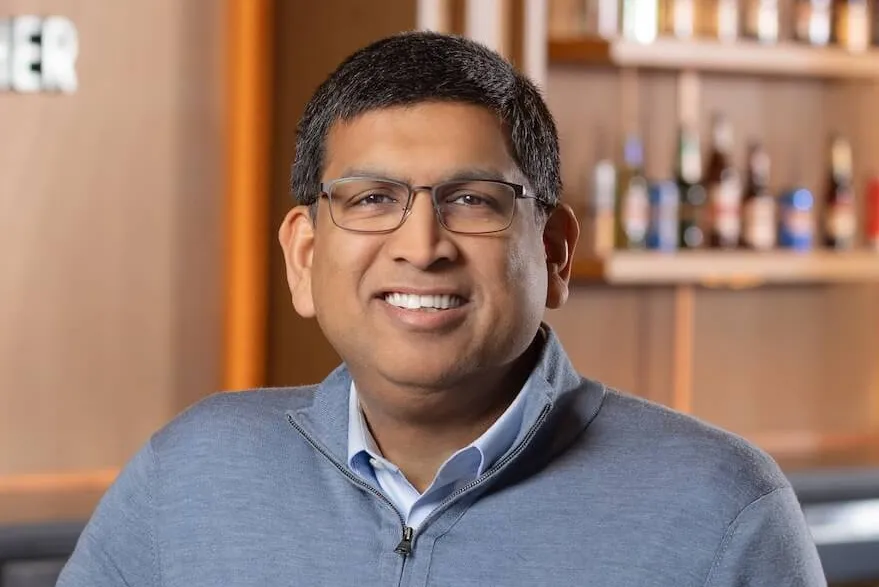
Rahul Goyal
 MOLSON COORS BEVERAGE
About Rahul Goyal
Rahul Goyal, 49, was appointed President and Chief Executive Officer and joined the Board of Molson Coors Beverage Company effective October 1, 2025 after a 24-year career across strategy, IT, finance and commercial roles . In Q3 2025, Molson Coors reported net sales down 2.3% (reported), a GAAP net loss attributable to Molson Coors of $2,927.6 million (driven by non-cash goodwill and intangible impairments), and underlying diluted EPS of $1.67 down 7.2%, with Goyal outlining restructuring actions to create a leaner, more agile Americas organization . He certified the Q3 2025 10-Q as Principal Executive Officer and executed the SOX 906 certification with the CFO .
Past Roles
| Organization | Role | Years | Strategic Impact |
|---|---|---|---|
| Molson Coors (Coors Brewing Company) | Project Manager and IT roles | 2001–2006 | Built foundational IT capabilities |
| Molson Coors | VP, IT Transformation Program | 2006–2008 | Led major transformation program |
| Molson Coors UK | Chief Information Officer | 2009–2011 | Oversaw UK technology operations |
| Molson Coors India | Chief Financial Officer | 2011–2015 | Directed finance and capital allocation in India |
| Molson Coors (Corporate) | Chief Corporate Strategy, M&A and Venturing Officer | 2015–2019 | Advanced portfolio via M&A/partnerships |
| Molson Coors | Chief Strategy Officer | 2019–2025 | Drove beyond beer ambition; partnerships with Coca-Cola and Fever‑Tree; led ZOA majority stake and Naked Life acquisition; managed Coors Distributing operations; key role in Yuengling JV management |
| Molson Coors | President and CEO; Director | 2025–present | Initiated Americas restructuring; capital allocation focus |
External Roles
No public company directorships disclosed beyond Molson Coors; prior roles emphasized operating leadership and corporate development inside Molson Coors .
Fixed Compensation
| Component | 2025 (effective 10/1) | 2026 (target) |
|---|---|---|
| Base Salary ($) | $1,100,000 | $1,100,000 (current base) |
| Annual Bonus Target (MCIP, % of salary) | 150% (prorated for roles held during 2025) | 150% (plan subject to annual review) |
| One-time RSU Grant ($) | $2,000,000; vests three years from grant or accelerates upon qualifying Severance Pay Plan termination | — |
| LTIP Target Grant Date Fair Value ($) | — | $7,000,000 (normal course annual grant eligibility in 2026) |
Performance Compensation
Program design and company-level outcomes anchoring pay-for-performance:
-
Annual MCIP metrics and weights (2024 program, enterprise): | Metric | Weighting | Threshold | Target | Max | Actual | Payout (%) | |---|---:|---:|---:|---:|---:|---:| | Underlying Income Before Income Taxes ($mm) | 45% | 1,433 | 1,592 | 1,831 | 1,621 | 112% | | Underlying Free Cash Flow ($mm) | 18% | 1,023 | 1,203 | 1,564 | 1,248 | 112% | | Underlying Net Sales Revenue ($mm) | 27% | 11,459 | 11,936 | 12,414 | 11,693 | 62% | | People & Planet Scorecard | 10% | — | — | — | — | 95% | | Total Payout | — | — | — | — | — | 97% |
-
LTIP metrics (2024–2026 PSU design): 100% Cumulative Underlying EPS with a 80–120% Relative TSR modifier vs S&P 500; PSUs settle on 3rd anniversary; RSUs and options vest on 3rd anniversary; options 10-year term .
-
Compensation mix and at-risk emphasis: CEO target total direct compensation is predominantly variable (88%) under 2024 framework; other NEOs ~76% .
Equity Ownership & Alignment
- Stock ownership guidelines: CEO 6x base salary; other NEOs 3x; five years to meet; counts owned shares, deferred units, and projected value of unvested RSUs/PSUs; excludes options .
- Hedging/pledging policies: Hedging prohibited; pledging prohibited absent approvals (CFO, Chief Legal Officer and Audit Committee for insiders); short sales prohibited; Audit Committee oversees pledging risks and mitigation plans .
Employment Terms
| Term | Provision |
|---|---|
| At-will employment | Company/employee may terminate at any time; only modifiable in writing by Board Chair |
| Severance (U.S. Severance Pay Plan) | 104 weeks of severance pay if qualifying termination occurs before April 1, 2029 |
| Change-in-Control Program | Double-trigger benefits if terminated without cause or for good reason within 2 years post-CIC (or up to 6 months pre-CIC at third-party request); no excise tax gross-ups; requires release; includes non-compete and non-solicit covenants |
| Non-compete & confidentiality | Required; injunctive relief carved out from arbitration |
| Clawbacks | Subject to Molson Coors incentive compensation clawback policies |
| Governing law & arbitration | Illinois law; AAA employment rules; arbitration in Chicago; prevailing-party cost discretion |
Board Governance
- Board service: Appointed to the Board effective Oct 1, 2025 .
- Committee roles: Not disclosed to date; CEO-director precedent in 2025 proxy shows no committee assignments for the CEO (then Gavin Hattersley) .
- Independence: Molson Coors defines independence in its charter; majority independent Board; CEO is management and typically non-independent .
- Attendance: Directors attended at least 94% of Board and committee meetings in aggregate in 2024; executive sessions led by an Independent Governance Committee Member .
Director Compensation
- CEO does not receive additional compensation for Board service .
- General director pay (reference): Annual cash retainer $105,000; annual RSU $165,000; incremental retainers for Chair/Vice Chair and committee chairs per 2024/2025 proxies .
Compensation Peer Group (2024 framework)
Brown‑Forman; Campbell Soup; Carlsberg; Clorox; Coca‑Cola Europacific Partners; Colgate‑Palmolive; Conagra; Constellation Brands; Diageo; General Mills; Heineken; Hershey; Hormel; J.M. Smucker; Kellanova; Keurig Dr Pepper; Kraft Heinz; McCormick; Monster Beverage .
Say‑on‑Pay & Shareholder Feedback
- 2023 say‑on‑pay support ~95.9% of votes cast; committee continues similar approach and integrates feedback through regular engagement and governance enhancements .
Performance & Track Record
- Early CEO tenure context: Q3 2025 results included a $3,645.7 million non‑cash partial goodwill impairment and $273.9 million intangible impairment; underlying income before income taxes $426.0 million (down 11.9% constant currency); underlying diluted EPS $1.67 (down 7.2%) .
- Strategic actions: Announced Americas restructuring (approx. 400 salaried positions; expected charges $35–$50 million, primarily cash severance/post-employment benefits in Q4 2025) to enhance agility and reinvestment capacity .
- CEO commentary emphasized balance sheet strength, free cash flow, and brand portfolio to navigate near-term headwinds while investing for growth .
Risk Indicators & Red Flags
- Anti‑hedging/anti‑pledging and short sale prohibitions reduce alignment risks; pledging exceptions require multi‑level approvals and Audit Committee oversight .
- Large Q3 2025 impairments signal near-term earnings volatility and potential “reset” dynamics during leadership transition .
- Restructuring charges and workforce reductions present execution risk but are aimed at longer‑term efficiency and reinvestment .
Compensation Structure Analysis
- High at-risk pay mix aligns incentives with performance (CEO ~88% variable under 2024 framework) .
- 2024 LTIP design shifts to cumulative EPS with TSR modifier, emphasizing earnings quality and market-relative returns .
- One-time RSU ($2.0 million) is a retention-oriented award with clear vesting (3-year) and acceleration clause tied to qualifying severance, balancing retention vs. flexibility .
- Double-trigger CIC and clawback policies mitigate windfall risks and enhance accountability .
Investment Implications
- Alignment: Goyal’s pay is predominantly performance-based with an EPS+TSR LTIP and a sizable 2026 LTIP target ($7.0 million), which should link leadership outcomes to shareholder value creation .
- Retention vs. selling pressure: The 3-year RSU vesting and ownership guidelines, combined with anti-hedging/pledging rules, reduce near-term selling pressure and support equity alignment .
- Transition execution: Q3 2025 impairments and the Americas restructuring point to a transition “reset”; monitor MCIP outcomes, restructuring delivery, and capital returns against guidance as leading indicators of execution quality .
- Governance quality: Majority independent Board, strong committee infrastructure, independent comp consultants, and robust clawback and insider trading policies support governance under a controlled-company structure .
All facts, figures, and statements above are sourced from SEC filings and company documents as cited.
