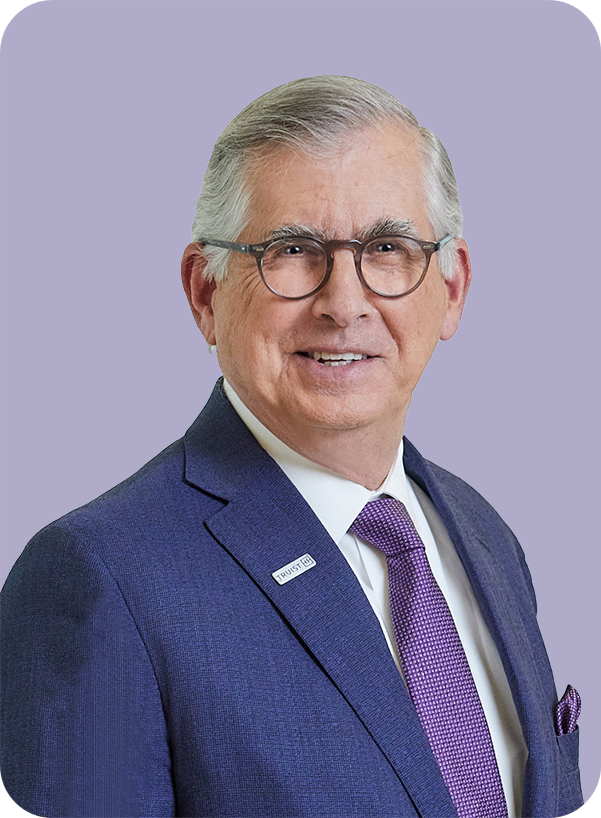
William H. Rogers, Jr.
 TRUIST FINANCIAL
About William H. Rogers, Jr.
Chairman and Chief Executive Officer of Truist Financial Corporation since March 2022 (CEO since September 2021; previously President and COO from December 7, 2019) . Age 67 and a director since 2011; not independent due to his executive role . 2024 performance highlights that underpin pay-for-performance: EPS 3.81, PPNR $8,811 million, NIE down 0.4% vs 2023, CET1 ratio 11.5%, TBVPS + Dividend Growth 47.0%, and one-year TSR 23.7% . Board leadership combines CEO and Chairman with a strong independent Lead Director framework to counterbalance the dual role .
Past Roles
| Organization | Role | Years | Strategic impact |
|---|---|---|---|
| SunTrust Banks, Inc. | Chief Executive Officer | 2011 | Led the institution prior to the merger-of-equals that formed Truist; elected to board and named CEO in 2011 . |
| SunTrust Banks, Inc. | Chairman | 2012 | Elevated to Chairman, guiding strategic and governance direction . |
| Truist Financial Corporation | President & Chief Operating Officer | Dec 7, 2019 – Sept 2021 | Managed enterprise integration and operations post-merger . |
| Federal Advisory Council (FRB) | Sixth District representative | 2017–2019 | Provided policy input to FRB on banking issues . |
External Roles
| Organization | Role | Years | Strategic impact |
|---|---|---|---|
| Federal Advisory Council (FRB) | Fifth District representative | Current | Contributes to national banking policy deliberations . |
| Boys & Girls Clubs of America | Chair of the Board | Current | Community leadership and youth initiatives . |
| Charlotte Center City Partners | Chair of the Board | Current | Regional economic development . |
| Emory University | Board of Trustees member | Current | Higher education governance and outreach . |
| Operation HOPE, Inc. | Global Board of Advisors | Current | Financial inclusion and literacy advocacy . |
| Charlotte Executive Leadership Council | Member | Current | Regional business leadership collaboration . |
Fixed Compensation
Multi-year CEO compensation summary:
| Metric | 2022 | 2023 | 2024 |
|---|---|---|---|
| Salary ($) | 1,200,000 | 1,200,000 | 1,200,000 |
| Stock Awards ($) | 6,395,548 | 6,843,578 | 6,488,339 |
| Non-Equity Incentive Plan ($) | 5,195,725 | 2,650,167 | 5,867,640 |
| Change in Pension Value ($) | — | 1,107,866 | — |
| All Other Compensation ($) | 446,569 | 599,979 | 395,564 |
| Total ($) | 13,237,842 | 12,401,590 | 13,951,543 |
Perquisites (2024 detail):
| Perquisite | Amount ($) |
|---|---|
| Residential security services | Included in total perqs |
| Limited personal use of company aircraft | 138,189 |
| Driver for personal travel | Included in total perqs |
| Total perquisites (subset of All Other Compensation) | 165,462 |
Performance Compensation
Annual Incentive Performance (AIP) – 2024:
| Item | Value |
|---|---|
| Base Salary ($) | 1,200,000 |
| Target AIP (% of base) | 300% |
| Final AIP Funding (% of target) | 95.00% (risk management adjustment) |
| AIP Award ($) | 3,420,000 |
Corporate scorecard measures and 2024 outcomes (Company-level performance used to fund AIP):
| Measure | 2024 Result | Assessment |
|---|---|---|
| EPS ($, non-GAAP for comp) | 3.81 | Exceeded |
| PPNR ($ mm) | 8,811 | At |
| TBVPS + Dividend Growth (%) | 47.0% | At |
| NIE ($ mm) | 11,330 (down 0.4% vs 2023) | Exceeded |
| CET1 Capital Ratio (%) | 11.5% | Exceeded |
| One-Year TSR (%) | 23.7% | Below (vs peers) |
Long-term incentives (2024 awards and design):
- Mix and vesting: PSUs (40%), LTIP (25%) – 3-year cliff; RSUs (35%) – vest one-third on March 15 in years 2, 3, 4; all subject to risk/operating loss forfeiture .
- 2024–2026 PSU/LTIP metrics: Absolute EPS (75%), Relative EPS growth (25%); TSR modifier ±20%; CET1 capital must be above minimums for payout .
- 2025–2027 changes: EPS (50%), average ROATCE (25%), 3-year relative TSR (25%); CET1 capital condition retained .
2024 grants to Rogers:
| Award | Grant Date | Shares/Units | Fair Value ($) |
|---|---|---|---|
| PSUs (target/max) | Feb 26, 2024 | 118,505 / 177,757 | 3,521,969 |
| RSUs | Feb 26, 2024 | 103,214 | 2,966,370 |
| LTIP (cash at target) | Feb 26, 2024 | — | 2,544,000 |
2022–2024 PSU/LTIP payout (settled early 2025):
- PSU/LTIP paid at 104.6% of target after the Committee assumed target for Q2–Q4 2024 due to TIH sale capital-structure effects .
Equity Ownership & Alignment
Beneficial ownership (as of Jan 31, 2025):
| Item | Amount |
|---|---|
| Common shares beneficially owned | 1,139,334 (includes trust holdings) |
| Shares subject to right to acquire within 60 days | 118,747 |
| Total beneficial + near-term rights | 1,258,081 |
| % of shares outstanding | ~0.096% (1,258,081 / 1,305,390,708) |
Unvested equity at FY 2024 year-end:
| Type | Count | Market/Payout Value ($) |
|---|---|---|
| Unvested RSUs | 63,385 | 2,749,641 |
| Unearned PSUs | 449,653 (includes 2023–2025 and 2024–2026 cycles) | 19,505,947 |
Upcoming RSU vest schedule (subject to risk/outcome conditions; March 15 vest dates):
- 2026: 34,405 RSUs
- 2027: 34,405 RSUs
- 2028: 34,404 RSUs
Alignment policies:
- Stock ownership guidelines: CEO must hold ≥6x base salary; all executive officers met requirement or are within grace period as of Dec 31, 2024 .
- Hedging and pledging prohibited; none of the directors or executive officers hold pledged or hedged shares .
- No stock options are granted; no option repricing .
Stock vested in 2024 (liquidity events):
| Item | Shares | Value ($) |
|---|---|---|
| Shares vested (RSU/PSU) | 70,268 | 2,449,542 |
Employment Terms
- No employment agreement; compensation is under Board/Committee plans .
- Severance and change-of-control economics (Amended and Restated Management Change of Control, Severance and Noncompetition Plan):
- Cash severance: 2x (base salary + target annual cash bonus) for qualifying termination without Cause or for Good Reason; same formula applies if within 24 months after a Change of Control (double-trigger) .
- COBRA benefit lump-sum: 24 months of employer cost differential for medical/dental/vision .
- AIP pro-rata for retirement/death/disability/qualifying termination; equity (PSUs/LTIP/RSUs) vest/payout per plan terms with performance post-termination (COC scenarios pro-rated/assumed target for incomplete periods) .
- Non-compete: 12 months (continental U.S.; banking/financial products/services) for Section 16 officers .
- Non-solicit: 12 months for clients and teammates .
- Garden leave: 3 months advance notice required for resignations; compensation during garden leave offsets severance .
- Section 280G cutback to avoid excise tax if beneficial to executive .
- Clawbacks:
- Executive Compensation Recoupment Policy (2023): mandatory recovery of erroneously awarded incentive compensation after financial restatement for covered executives (3-year lookback) .
- 2022 Incentive Plan and award agreements authorize clawback/adjustment for misconduct and materially inaccurate metrics; 2024 policy enhancement broadened triggers (e.g., sales practices violations; failure to escalate material risks) .
Deferred compensation and pension (alignment and retention):
- Non-Qualified Deferred Compensation (aggregate balance): $11,247,307 (executive contributions $211,296; company match $211,310; 2024 earnings $2,159,612) .
- Pension/SERP present values (as of Dec 31, 2024):
- Qualified Plan: $1,358,401
- Non-Qualified DB Plan: $3,784,601
- SunTrust ERISA Excess: $928,545
- SunTrust Tier 2 SERP: $4,076,411
Board Governance
- Board service: Director since 2011; Chairman and CEO; Chair of the Executive Committee (2 meetings in 2024) .
- Independence: Not independent due to executive role .
- Committee memberships: Executive (Chair); permitted committee participation only on Executive, Risk, Technology per governance guidelines (not serving on Audit/Comp/NomGov) .
- Board refreshment and attendance: Board held 13 meetings in 2024; each member attended >75% of meetings and all directors attended 2024 annual meeting .
- Lead Independent Director: Robust authority and responsibilities to counterbalance combined Chair/CEO role; current LID term extended to March 12, 2026 .
- Director compensation: Rogers receives no incremental compensation for director service (employee director) .
Director Compensation (Board program context)
- Non-employee director cash retainers: Base $100,000; additional retainers for Lead Director ($50,000), Committee Chairs ($30,000–$45,000), Audit/Risk members ($15,000) .
- Director equity: RSUs with $180,000 grant value, vest 100% at year-end; accelerated on death/disability; vest on change of control .
- Director ownership guideline: ≥5x annual cash retainer; all current directors meet or are within the time frame .
Compensation Peer Group (Benchmarking)
Peer group used for pay/performance comparisons spans large U.S. banks to balance sample size; Truist sits ~50th percentile by assets and market cap:
| Company | Assets ($ bn) | Market Cap ($ bn) |
|---|---|---|
| JPMorgan Chase | 4,003 | 675 |
| Bank of America | 3,262 | 337 |
| Wells Fargo | 1,930 | 234 |
| U.S. Bancorp | 678 | 75 |
| PNC Financial | 560 | 77 |
| Truist Financial | 531 | 58 |
| Citizens Financial | 218 | 19 |
| Fifth Third | 213 | 28 |
| M&T Bank | 208 | 31 |
| KeyCorp | 187 | 19 |
| Regions Financial | 157 | 21 |
Committee does not target a specific percentile; uses judgment considering role/performance/market data .
Say-on-Pay & Shareholder Feedback
- 2024 say-on-pay approval: ~89% of votes cast supported NEO compensation .
- Fall 2024 investor engagement (12 shareholders met): covered governance, compensation changes, one-time leadership awards; resulted in enhanced disclosures in proxy .
Risk Indicators & Red Flags
- Hedging/pledging: Prohibited; none held by directors or executive officers .
- Tax gross-ups: No excise tax gross-ups; Section 280G cutback provision applies .
- Options: None granted; no repricing .
- Related-party transactions: None requiring approval/reporting since Jan 1, 2024, other than ordinary-course dealings with large institutional holders (on market terms) .
- Dual-role governance risk: Mitigated by a strong Lead Independent Director and executive sessions without management .
Equity Award Vesting Schedules and Potential Selling Pressure
- RSUs: Begin vesting after year 2 from grant; one-third on March 15 in years 2–4 (e.g., 2026–2028 tranches outstanding), creating periodic supply as units convert to shares .
- PSUs/LTIP: Three-year performance cycles (2024–2026) with cliff vesting post-performance determination; payouts subject to EPS metrics, TSR modifier, and CET1 capital condition .
- 2024 stock vested: 70,268 shares; value $2,449,542, indicating realized equity flow in 2024 .
Compensation Structure Analysis
- High at-risk mix: ~92% of CEO target annual compensation is performance-based; 65% of LTI is subject to performance; all LTI subject to forfeiture for operating loss/negative risk outcomes .
- Shift to RSUs/PSUs (no options): Reduces path-dependent risk and aligns to sustained EPS/ROATCE/TSR performance .
- Risk adjustments: AIP funding for Rogers reduced to 95% of target due to risk management effectiveness considerations (culture of accountability) .
- Clawbacks and risk outcomes assessment expanded in 2024, strengthening alignment and accountability .
Employment & Contracts (Retention risk and terms)
- Non-compete and non-solicit (12 months) and garden leave (3 months) add retention friction; severance 2x salary+target bonus for qualifying terminations, with double-trigger protection (within 24 months of COC) supports leadership continuity but caps windfall via 280G cutback .
Investment Implications
- Strong pay-for-performance alignment: CEO pay structure emphasizes multi-year EPS/ROATCE with TSR oversight and CET1 capital constraints, reducing incentive to pursue short-term earnings at the expense of balance sheet strength .
- Governance mitigants to dual role: An empowered Lead Independent Director, independent committees, and executive sessions temper Chairman/CEO concentration risk; engagement feedback and high say-on-pay support indicate acceptable investor trust levels .
- Near-term equity supply from scheduled RSU vesting and PSU settlements is predictable; absence of options and pledging reduces forced-sale or hedging risks; insider realized vesting in 2024 was modest relative to total ownership .
- Retention risk appears contained: No employment contract; however, severance/change-of-control protections, pension/SERP balances, and deferred comp suggest meaningful “golden handcuffs” that align tenure with shareholder outcomes .