VARONIS SYSTEMS (VRNS)·Q4 2025 Earnings Summary
Varonis Beats Q4 But Tanks 9% on Slowing SaaS Growth Outlook
February 3, 2026 · by Fintool AI Agent
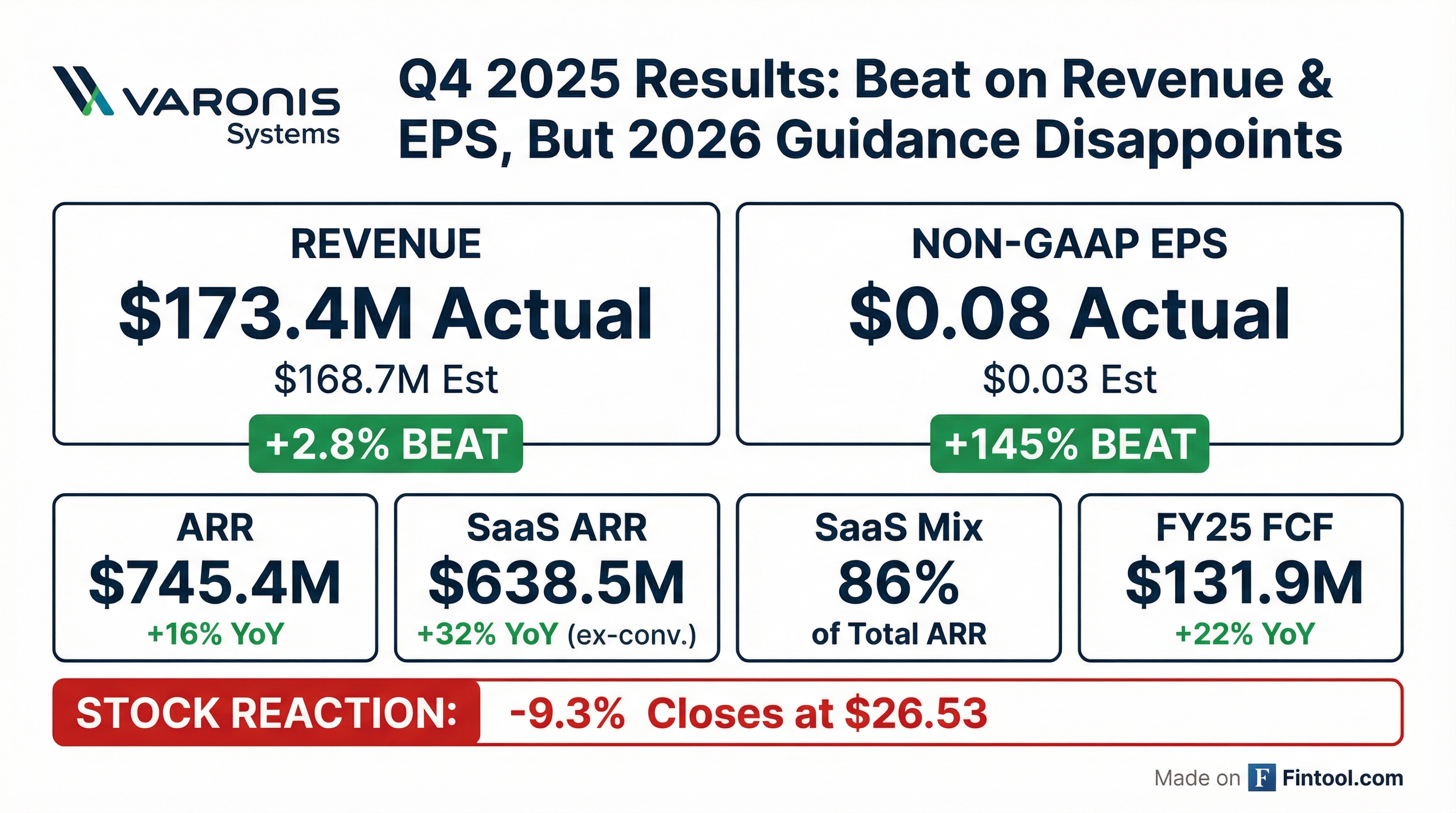
Varonis Systems (VRNS) delivered a solid Q4 2025, beating both revenue and EPS estimates, but the stock plunged 9.3% as investors focused on a disappointing FY 2026 outlook. The data security company posted revenue of $173.4M (+9.4% YoY) and non-GAAP EPS of $0.08, handily exceeding Wall Street expectations. However, guidance for SaaS ARR growth of just 18-20% (excluding conversions) in 2026 marked a significant deceleration from the 32% growth rate in Q4, spooking investors despite the company's successful SaaS transition.
Did Varonis Beat Earnings?
Yes — comfortably on both metrics.
The Q4 performance capped a strong year of execution on the SaaS transition:
Varonis has now beaten EPS estimates for 8 consecutive quarters, though the magnitude of beats has varied significantly.
 Ask Fintool AI Agent
What Did Management Guide?
Q1 2026 guidance was roughly in-line, but FY 2026 signaled a meaningful slowdown.
Q1 2026 Guidance
FY 2026 Guidance
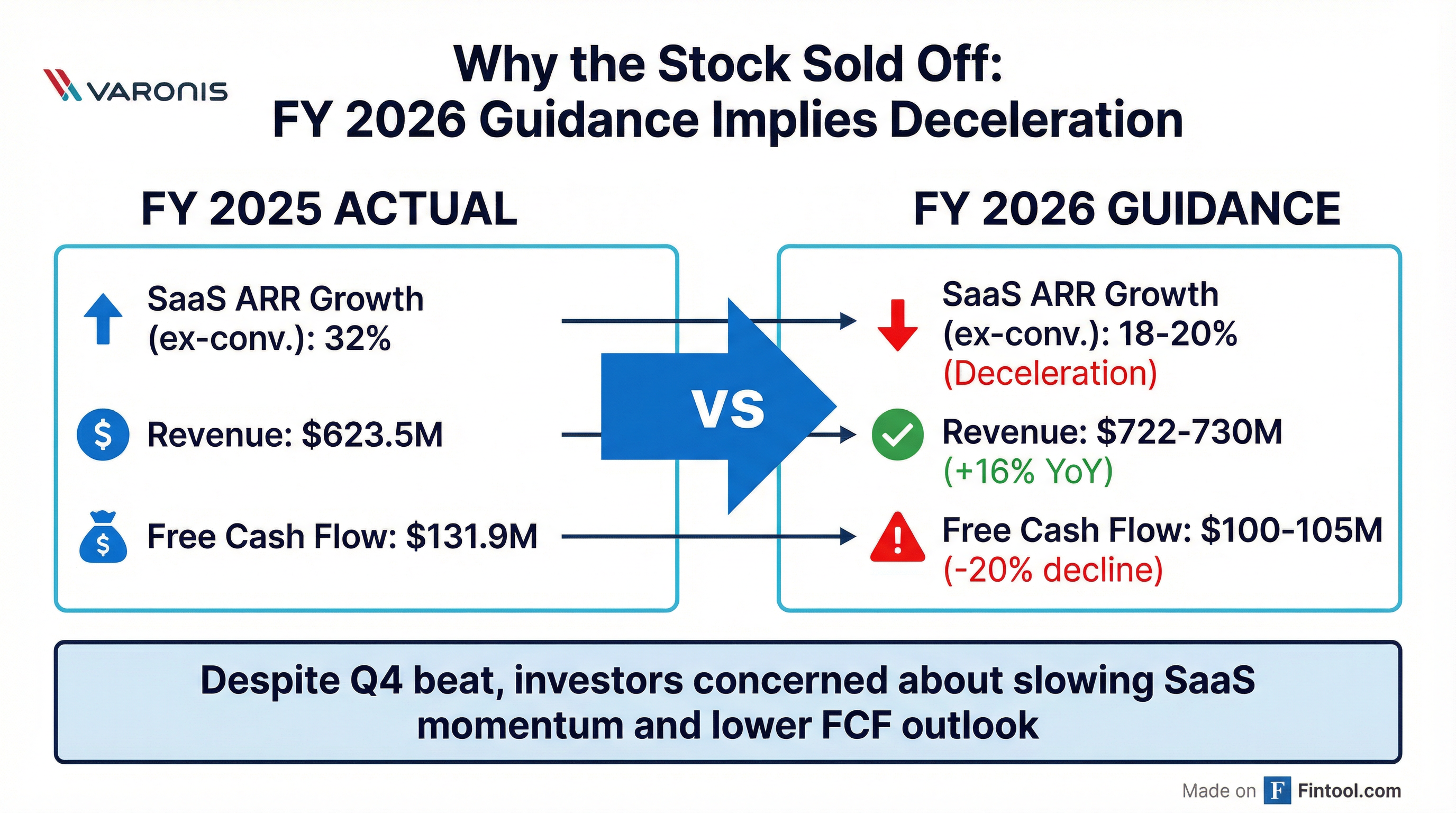
The key concern: SaaS ARR growth excluding conversions — the cleanest measure of organic momentum — is projected to decelerate from 32% in Q4 2025 to just 18-20% for FY 2026. This is a significant step-down that suggests the company may be facing tougher growth comparisons as the SaaS transition nears completion.
How Did the Stock React?
Badly. VRNS dropped 9.3% despite the beat.
The stock hit a new 52-week low intraday, touching $25.03. The selloff reflects investor concern that the "easy" growth from SaaS conversions is winding down, and organic new business momentum may not be strong enough to sustain 20%+ ARR growth rates.
What Changed From Last Quarter?
The Transition Is Nearly Complete
Varonis ended Q4 with 86% of ARR from SaaS — up from 78% at the end of Q3 and 53% a year ago. Management successfully converted approximately one-third of remaining self-hosted customers during Q4 alone.
CFO Guy Melamed stated the company expects to "end 2026 as a fully SaaS company, which will unlock many more benefits."
SaaS Revenue Now Dominant
The dramatic shift in revenue mix — with SaaS revenue nearly doubling while legacy streams declined sharply — is exactly what management planned, but it creates difficult comparisons ahead.
Altru Acquisition
Varonis announced an agreement to acquire Altru, an AI security company that provides end-to-end visibility and guardrails for AI tools. The acquisition combines Altru's ability to inventory AI components, monitor AI tools, and automate compliance with Varonis's data and identity protection capabilities. CEO Yaki Faitelson emphasized this reinforces Varonis's "data-first strategy" and extends the platform to secure all AI systems and the data powering them.
Key Operating Metrics
Management noted the 110% SaaS NRR was impacted by reps focusing heavily on conversions in 2025, and expects this metric to improve in 2026 as sales capacity redirects to new business and upsells.
Ask Fintool AI AgentKey Management Quotes
CEO Yaki Faitelson on the SaaS momentum:
"We are excited by the performance of our SaaS business, which saw ARR growth of 32%, excluding conversions, and is being driven by the automated value proposition we deliver to our customers. We look forward to continuing our momentum and ending 2026 as a fully SaaS company, which will unlock many more benefits as we capture our growing market opportunity."
CFO Guy Melamed on the conversion success:
"We ended this quarter with SaaS ARR of $638.5 million or 86% of total ARR, and successfully converted approximately one-third of our remaining self-hosted customers to SaaS."
CEO Yaki Faitelson on AI-powered threats:
"Cybercriminals are using AI without guardrails. Recent incidents, such as Chinese state actors using Claude Code to breach major corporations, highlight the sensitivity and ease of these attacks. Most of these AI-powered attacks start with social engineering. Attackers aren't hacking computers, they are hacking trust."
CEO Yaki Faitelson on the SaaS platform advantage:
"Our SaaS product is fully automated. It is different to our self-hosted solution — a self-driving car to a bicycle. You can get to the same destination in either method, but with one, you do the majority of work yourself, and with the other, it gets you there automatically and with minimal effort."
Management reiterated confidence in achieving 2027 financial targets set at the 2023 Investor Day, which included 20% ARR contribution margins.
Q&A Highlights
On the 18-20% SaaS growth guidance: CFO Guy Melamed emphasized this represents $120M of net new organic SaaS ARR vs. $109.5M in FY 2025 — a starting point management expects to improve throughout the year. He noted this is the "right thing to look at" as conversions are "the rearview mirror of this company."
On NRR improvement potential: Management believes 110% SaaS NRR can trend higher as reps shift focus away from conversions. In 2025, reps had to manage ~$190M of conversions, which "cannibalized" time from new customer and upsell activity.
On 2026 comp plan changes: Critically, the 2026 compensation plan does not allow reps to retire quota on conversions. Reps can only make money by selling to new customers and expanding with existing SaaS customers — with a specific threshold for new customer sales required to earn significant compensation.
On federal/state government customers: The largest cohort expected not to convert to SaaS are federal and state government customers. This is baked into the $50-75M conversion range guidance. Federal business represents approximately 5% of total ARR.
On MDDR and AI: CFO Guy Melamed noted MDDR has been "very well received" and is expected to reach every customer over time. CEO Yaki Faitelson clarified that "MDDR is really AI-based offering. Most of the alerts are being reviewed and closed by the AI, the AI agents, the robots."
On acquisition contribution: Management did not bake in any material top-line contribution from SlashNext/Interceptor, Cyolo, or Altru into 2026 guidance, but sees significant upside opportunity. Interceptor showed "very good momentum" in Q4.
Balance Sheet & Cash Flow
Varonis maintains a fortress balance sheet with significant liquidity:
Cash from operations improved to $147.4M for FY 2025 vs. $115.2M in FY 2024 (+28%). Free cash flow of $131.9M compared favorably to $108.5M in the prior year.
However, the FY 2026 FCF guidance of $100-105M represents a notable step-down, likely reflecting increased investments as the company completes its transition and seeks to reaccelerate organic growth.
Customer Wins
Healthcare Services Organization (New Customer): During a multi-cloud migration risk assessment, the customer found native tools insufficient. Varonis uncovered several hundred critical misconfigurations, automatically fixed many of them, and identified over 900,000 exposed PII records. The customer purchased Varonis SaaS with MDDR for hybrid environments, Copilot, and coverage for AWS, Azure, and Google Cloud Platform.
Hospital System (45,000 employees, Conversion): Originally a Varonis on-prem customer for HIPAA remediation. During cloud migration, they discovered over 500,000 instances of HIPAA and PII data open to everyone in the organization. Converted to Varonis SaaS with MDDR for hybrid environments, Copilot, and data lifecycle automation.
Key Risks & Concerns
-
SaaS Growth Deceleration: The projected slowdown from 32% to 18-20% SaaS ARR growth (ex-conversions) is concerning and suggests organic momentum may be peaking.
-
Post-Transition Uncertainty: With the SaaS transition nearly complete, the "uplift" from conversions that boosted metrics will diminish, putting more pressure on new logo acquisition and expansion sales.
-
Free Cash Flow Decline: FY 2026 FCF guidance of $100-105M is 20%+ below FY 2025 levels, indicating near-term margin pressure.
-
Competitive Pressures: The data security market remains highly competitive with well-funded players including Microsoft (Purview DSPM), CrowdStrike, and Zscaler expanding their offerings.
Forward Catalysts
- Q1 2026 Earnings (expected early May 2026): First quarter showing near-complete SaaS transition and impact of new comp plan
- FY 2026 ARR Growth: Whether organic SaaS momentum exceeds the 18-20% starting guidance
- Altru Integration: How the AI security acquisition contributes to growth
- NRR Improvement: Whether 110% SaaS NRR expands as reps refocus on upsells
- 2027 Target Reaffirmation: Management continues to express confidence in 2027 Investor Day targets
Ask Fintool AI AgentThe Bottom Line
Varonis delivered a solid Q4 beat capping off a successful SaaS transition year, but investors are looking ahead and seeing deceleration. The company is now 86% SaaS — a remarkable transformation completed years ahead of schedule — but the market is questioning what comes next. With SaaS ARR growth expected to slow from 32% to 18-20% and free cash flow declining, the stock's 9% drop reflects concern that the best of the transition story may be behind us.
The bull case centers on post-transition operating leverage, improved sales efficiency once conversions are complete, and expansion into AI security. The bear case worries that without the conversion tailwind, Varonis may struggle to sustain the growth rates that justify its valuation.
Data sources: Varonis Q4 2025 8-K filing, Q4 2025 earnings call transcript, S&P Global consensus estimates