WESTERN ALLIANCE BANCORPORATION (WAL)·Q4 2025 Earnings Summary
Western Alliance Posts Record Quarter: EPS Beats by 9%, Guides to Strong 2026
January 27, 2026 · by Fintool AI Agent
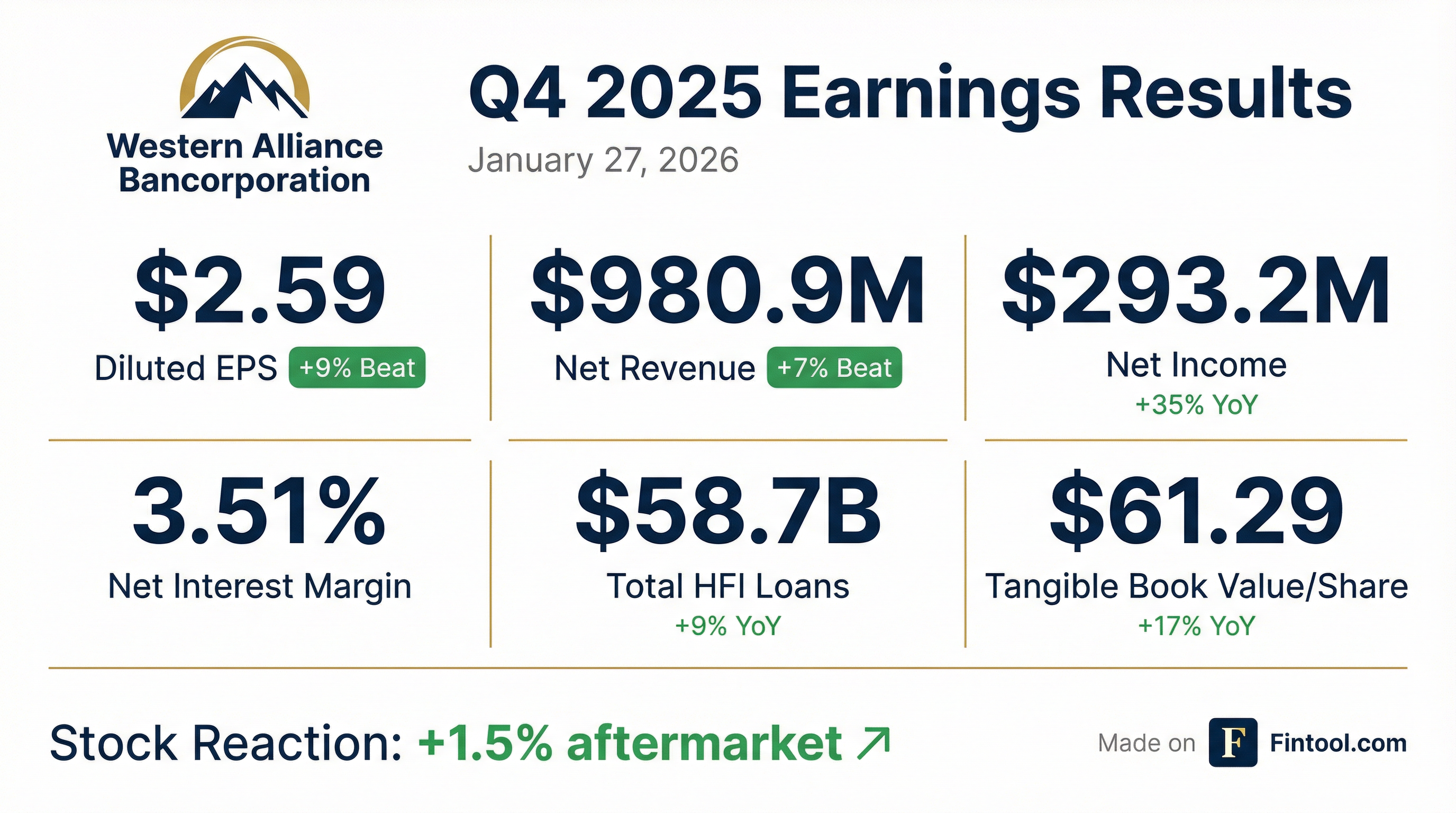
Western Alliance Bancorporation delivered exceptional Q4 2025 results, posting record net interest income, revenues, and pre-provision net revenue. Diluted EPS of $2.59 beat consensus by 9.3%, driven by $2.0 billion in quarterly loan growth and sustained profitability improvements.
CEO Kenneth Vecchione called out "outstanding loan and deposit growth, gathering strength in commercial banking non-interest income, improved efficiency, and a steady net interest margin" as key factors behind the quarter.
Did Western Alliance Beat Earnings?
Yes — decisively. Both EPS and revenue exceeded expectations:
Western Alliance has now beaten EPS estimates for 8 consecutive quarters. The magnitude of the Q4 beat—the largest in two years—reflects accelerating earnings momentum.
 Ask Fintool AI Agent
What Drove the Beat?
Three factors powered the outperformance:
1. Record Net Interest Income
Net interest income reached $766.2 million, up 15% year-over-year and 2.1% sequentially. The increase was driven by:
- Higher average interest-earning asset balances (+$2.5B QoQ)
- Lower rates on interest-bearing liabilities
- Net interest margin held steady at 3.51%, down just 2 bps sequentially
2. Exceptional Loan Growth
HFI loans grew $2.0 billion in the quarter (+3.6%) to $58.7 billion, the strongest quarterly growth of 2025.
C&I loans drove the growth, with strength across Regional Banking and National Business Lines.
3. Operating Leverage
Pre-provision net revenue (PPNR) reached a record $428.7 million, up 34.2% year-over-year. The efficiency ratio improved to 55.7% from 61.2% a year ago, and the deposit-cost-adjusted efficiency ratio hit 46.5%.
What Did Management Guide for 2026?
Management provided constructive 2026 guidance that implies continued earnings growth:
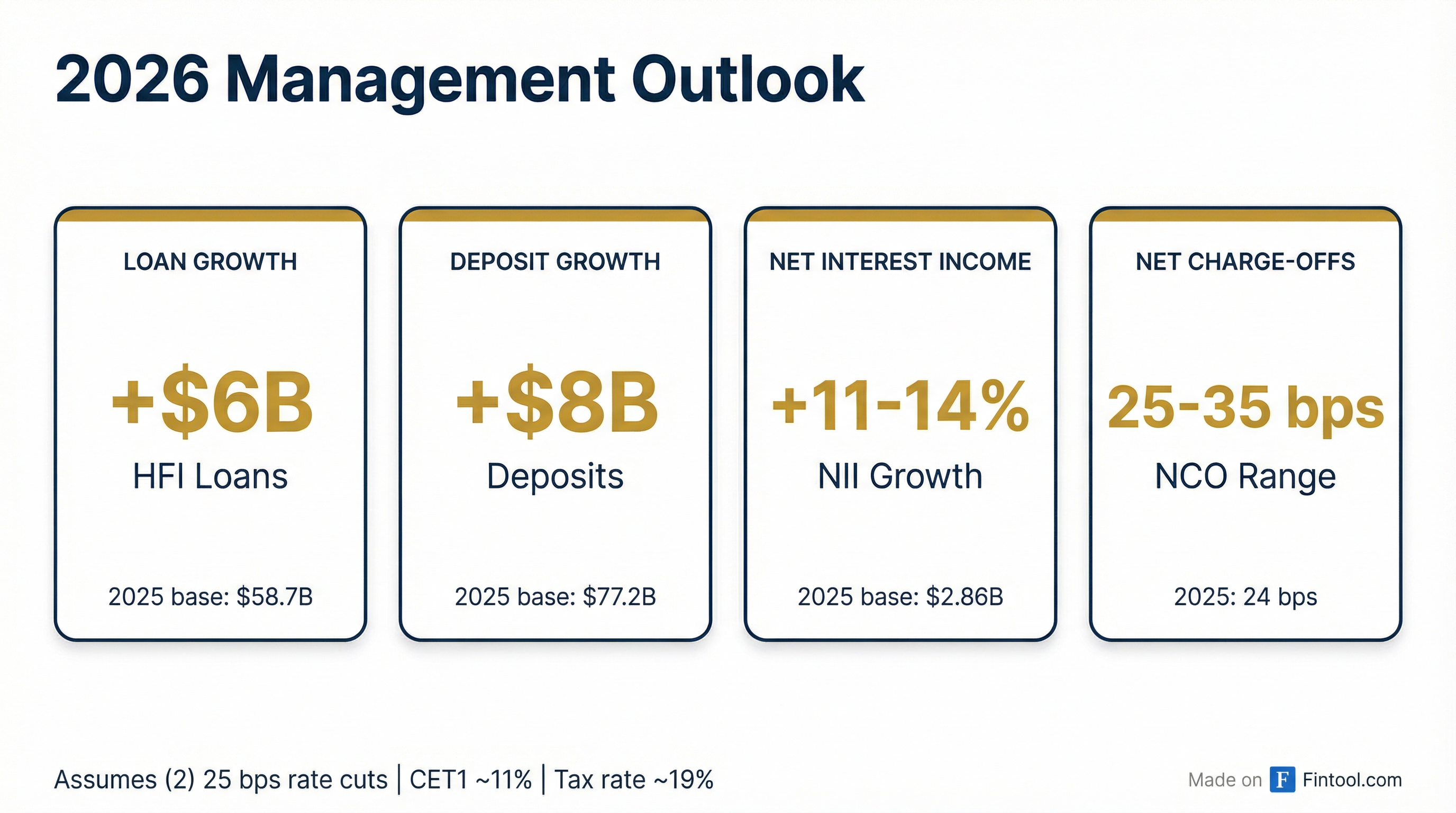
Key assumptions: Two 25 bps Fed rate cuts, continued deposit cost relief, and "strong, diversified loan growth momentum."
The NII guidance of +11-14% is notably aggressive. Even at the low end, it implies $3.18B in 2026 NII, which would represent the third consecutive year of double-digit growth.
On NIM trajectory, Vecchione clarified:
"It's not going to jump up dramatically, but it's going to slowly cascade up throughout the year... For planning purposes, I would always assume NIM is flat, but it does have a slight gentle stream upward to the right."
Key NIM drivers: continued deposit cost relief from CD runoff, growth in lower-cost specialty deposits (HOA, digital assets, trust), and remix toward higher-yielding C&I loans.
Ask Fintool AI AgentWhat Changed From Last Quarter?
Several metrics showed notable improvement:
Asset quality improved, with nonaccrual loans declining $22 million and criticized loans down $15 million. The allowance for credit losses increased to 0.87% of funded loans from 0.85%, reflecting loan growth rather than deterioration.
How Did the Stock React?
WAL shares rose 1.5% in aftermarket trading to $88.89, building on a strong run. The stock is up 61% over the past 12 months and has outperformed the regional banking sector by a wide margin.
The muted aftermarket move may reflect the strong run into earnings—WAL was already up 5% in the week before the report.
Capital and Shareholder Returns
Capital ratios remained robust:
The bank repurchased 0.7 million shares for $57.5 million at an average price of $79.55 during Q4. Since inception, the $300 million buyback program has retired 0.8 million shares at $80.82 average.
Tangible book value per share grew to $61.29, up 17.3% year-over-year—a key metric that has compounded at 19.3% annually since 2015.
Asset Quality: Office CRE Update
Investors have scrutinized WAL's commercial real estate exposure, particularly office loans. Management provided updated details:
Office CRE: $2.1 billion, representing 21% of total CRE investor and just 4% of total loans.
Key mitigants:
- Average LTV < 55%; Average LTC < 65%
- 90% suburban exposure, 10% midtown, negligible CBD
- Class A: 61%, Class B: 34%, Class C: 5%
- Dispersed maturities: 53% in 2026, 25% in 2027, 22% in 2028+
Net charge-offs increased to 0.31% annualized from 0.22% in Q3, but remained manageable. The provision for credit losses was $73 million, down from $80 million in Q3.
Classified office loans are down a third from mid-year 2025, reflecting deliberate asset-level resolution strategies.
Credit quality compares favorably to peers: classified loans to Tier 1 capital plus ACL stands at 11.7% versus the $50B-$250B peer group median of 14.7%—a 300 basis point advantage.
Q&A Highlights: What Analysts Asked
Why Not Higher Growth Guidance?
Analysts questioned whether $6B loan / $8B deposit growth was conservative given the momentum. Vecchione's response:
"Our loan growth and deposit growth, as projected, leads the peer group... What you see here is all organic growth, which is very important. We are de-emphasizing certain areas of our loan portfolio—mostly we're doing less in residential loan growth. As that runs off, it puts more pressure on the other areas to accommodate the runoff."
"$6 billion and $8 billion will produce something along the order of consensus EPS of $10.38, which is about 19% EPS growth—leading the peer group for any bank for organic growth."
Charge-Off Timing
Management signaled front-loaded charge-offs in 2026:
"Think about the range as the midpoint coming into the year for modeling purposes at 30 bps. You could see it a little bit higher than that in the first half of the year as we look to get rid of a number of non-accrual loans... We have a confident level that by the end of Q2, the non-accrual loans will be down."
Mortgage Banking Tailwinds
Vecchione was notably bullish on AmeriHome:
"We are constructive on the mortgage business as we begin 2026... We are assuming a 10% year-over-year increase in total mortgage fee-related revenues. However, if several administration's housing affordability programs take hold, combined with favorable regulatory changes and a lower interest rate environment, we think AmeriHome could outperform."
On early Q1 performance:
"As a data point—and it's an early data point, so I caution everyone on this—entering the year here, we expect Q1 total mortgage revenues to be nearly equal Q4 results. But I'll tell you that January's volumes and margins, as of close of business last night, were presently trending above our planning assumptions."
On potential MSR regulatory relief:
"It's our understanding coming out of Q1 that the FRB may give us additional guidance on MSRs... Will the FRB re-examine the MSR 25% cap to CET1 capital? If they do that, it will allow us to hold on to more MSR receivables—those have a double-digit yield to them."
Dale Gibbons on Deposit Initiatives
Dale Gibbons (Chief Banking Officer for Deposit Initiatives and Innovation, described as "back by popular demand") outlined the growth engines:
"I really do think these have awesome opportunities in front of them... In total, we think these are going to grow about three times as fast as the bank overall, north of 30% growth. And most of these have notably lower costs than what we're incurring in our other deposit channels."
ECR Deposit Costs
CFO Vishal Idnani provided deposit cost detail:
"The spot rate on interest-bearing deposits is 281 bps. That's down from the average rate for the quarter of 296 bps."
ECR deposits represent ~37% of total deposits on an average basis, with betas varying by business: Mortgage Warehouse ~100%, HOA 35-40%.
On ECR cost sensitivity if rate cuts don't materialize:
"We'll still be able to drive it down... but obviously we'll not go down as much if we don't see those rate cuts. You can see that being a little bit more sticky if we don't see a drop in rates from here."
Specific Credit Updates
First Brands (Point Bonita):
"That loan continues to pay down at an accelerated pace... Down to $124 million from $168 million. It went from a 19% advance rate to about 14-15%... That is a pass loan. Payments are coming in a little bit faster than what we modeled."
Cantor:
"We have gotten a receiver into the business with the support of the two ultra-high net worth individuals. That receiver has ordered all the appraisals for all the properties. We are expecting those appraisals to come in early March. The outstanding loan is $98 million."
On M&A vs. Organic Growth
Vecchione on acquisition philosophy:
"One of the things we consider when we look at alternative inorganic opportunities is return on management's time. Would it take away from all the organic growth that we have? We think we're unique with this organic growth... it comes with less execution and operational risk."
"Our criteria is bigger and better. I look at a lot of deals done for people wanting to get bigger. If there was a bigger and better that helped get us into deposit lines that could reduce deposit costs, we'd be very excited. But bigger for big's sake would take away from the organic momentum."
Expense Flexibility on LFI Threshold
On potential expense flexibility if the Large Financial Institution (LFI) threshold is raised from $100B:
"Embedded in our expectations is that there is no change to LFI guidance. So we've got the full boat of expenses embedded... Now, if the LFI guidance is moved up from 100 to some larger number—some say 150, some say 250—then the dollars that we spend there will not be eliminated, but will clearly be reduced."
IBT Network and Stablecoins
Dale Gibbons on competing with stablecoins:
"I don't think it competes. I think it complements. At the end of the day, people still want fiat currency or be able to figure out how they can get back to fiat in quick order... My analogy is—you're never going to drive through McDonald's and see the price of a Big Mac in Satoshis. But you'll be able to pay with USDC. And in the background, we're there facilitating that."
Ask Fintool AI AgentThe Bottom Line
Western Alliance delivered a clean beat on a strong quarter. The combination of:
- Record profitability (PPNR +34% YoY)
- Accelerating loan growth ($2B in Q4)
- Stable asset quality (NPLs down)
- Constructive guidance (NII +11-14% in 2026)
- Specialty deposit initiatives growing 3x faster than overall bank
...reinforces WAL's position as one of the best-performing regional banks. Management's 19% EPS growth target for 2026 leads the peer group for organic growth.
Key questions heading into 2026:
- Can C&I loan growth sustain this pace as residential runs off?
- Will charge-offs stay within the 25-35 bps range after the front-loaded Q1-Q2 cleanup?
- How much upside from MSR regulatory relief and mortgage market recovery?
- Will specialty deposit initiatives (HOA, Juris, digital assets) continue to outperform?
- Will the LFI threshold be raised from $100B, providing expense relief?
Related Links: