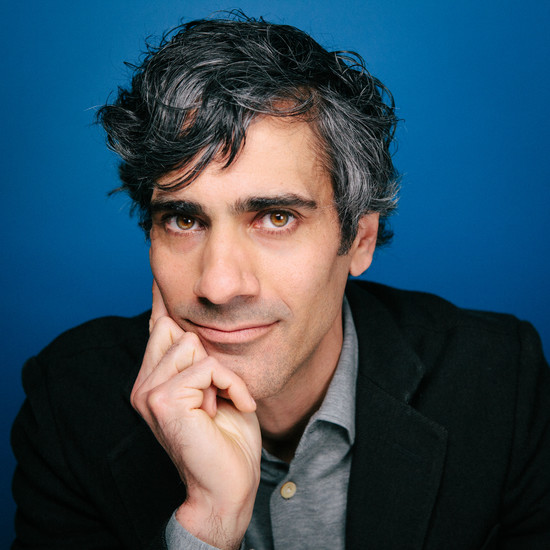
Jeremy Stoppelman
 YELP
YELPAbout Jeremy Stoppelman
Jeremy Stoppelman is Yelp’s co‑founder and Chief Executive Officer (CEO), serving in the role since the company’s inception in 2004; he has been a director since September 2005 and is 47 years old as of April 15, 2025 . He holds a B.S. in Computer Engineering from the University of Illinois Urbana‑Champaign and previously held engineering leadership roles at PayPal (most recently VP of Engineering) and software engineering at Excite@Home . Under his leadership, Yelp delivered record 2024 results: net revenue $1.41B, net income $133M, adjusted EBITDA $358M, and diluted EPS $1.88; Services categories reached 65% of advertising revenue and EPS rose 40% YoY . Long‑term performance indicators used in pay suggest relative TSR achievement at the 60th percentile for the 2022–2024 cycle (125.572% payout), while 2024 incentive performance achieved 90.8% of target across net revenue and adjusted EBITDA .
Past Roles
| Organization | Role | Years | Strategic impact |
|---|---|---|---|
| Yelp Inc. | Co‑Founder & Chief Executive Officer | 2004–present | Founder‑CEO guiding product/AI investments; delivered record 2024 revenue and profitability |
| PayPal, Inc. | Various engineering roles; VP of Engineering (most recent) | Feb 2000–Jun 2003 | Scaled engineering leadership at a major online payments platform |
| Excite@Home | Software Engineer | Aug 1999–Jan 2000 | Early internet engineering experience |
External Roles
| Organization | Role | Years | Notes |
|---|---|---|---|
| — | — | — | No other public company directorships disclosed for Mr. Stoppelman in the 2025 proxy . |
Board Governance at Yelp (service, committees, independence)
- Board service: Director since September 2005; currently CEO and director; not independent by virtue of employment .
- Leadership structure: Independent Chair (Diane Irvine) since 2015; committees 100% independent; separate Chair/CEO mitigates dual‑role concerns .
- Committees: Audit, Compensation, and Nominating committees exist; Mr. Stoppelman is not listed as a committee member; 2024 meetings: Board (8), Audit (9), Compensation (5), Nominating (5); all current directors attended ≥75% of meetings; independent directors held executive sessions at each regular Board meeting .
- Director compensation: As an employee, Mr. Stoppelman receives no additional pay for Board service .
Fixed Compensation
| Year | Base salary ($) | Target bonus (% of base) | Target bonus ($) | Actual bonus ($) |
|---|---|---|---|---|
| 2024 | 600,000 | 50% | 300,000 | 272,547 |
| 2025 | 620,000 | 80% | 496,000 | — |
- CEO target total equity value: $7,650,045 (2024, reduced 10% YoY as part of SBC initiative) .
- 2025 target total equity value: $7,650,000 (approx. flat YoY) .
Performance Compensation
Annual cash incentive (Performance Bonus Plan) – 2024 results
| Metric | Weight | Threshold (25%) | Target (100%) | Stretch | Actual | Payout |
|---|---|---|---|---|---|---|
| Net revenue | 50% | $1.405B | $1.48B | $1.554B | $1.41B | 54.7% |
| Adjusted EBITDA | 50% | $290M | $340M | $390M | $358M | 127.0% |
| Overall payout | — | — | — | — | — | 90.8% |
- CEO payout under plan: $272,547 (90.8% of $300,000 target) .
Long‑term equity design and vesting
| Award type | Metric / performance period | Payout curve / gates | 2024 CEO target shares | 2024 achievement | Vesting mechanics |
|---|---|---|---|---|---|
| Financial Performance RSUs | 2024 net revenue and adjusted EBITDA (one‑year performance) | 0–200%; interpolation; uses same thresholds/targets as cash plan | 43,735 | 90.8% of target became Eligible Shares (39,733) | Standard four‑year service vesting; 31.25% of Eligible Shares vested 3/15/2025; remainder vests quarterly through Q4’27 |
| TSR RSUs | 3‑year relative TSR vs Russell 2000 (2024–2026) | 25th/55th/75th percentiles = 50%/100%/200%; absolute TSR < 0 caps at 100% | 43,735 | In‑flight (not yet determined) | Cliff vest on determination date in Q1’27, subject to service |
| 2022 TSR RSUs (completed) | 2022–2024 relative TSR | Achieved 60th percentile; 125.572% payout | 60,164 target | 75,550 Earned Shares | 100% vested 2/20/2025 |
- 2024 CEO service‑vesting RSUs (time‑based): 87,470 shares granted; vest quarterly over four years .
- CEO 2024 grant overall: RSUs 87,470; Financial Performance RSUs target 43,735; TSR RSUs target 43,735 .
Equity Ownership & Alignment
Beneficial ownership (as of March 3, 2025)
| Holder | Shares beneficially owned | % outstanding | Notes |
|---|---|---|---|
| Jeremy Stoppelman | 4,216,909 | 6.3% | Includes 2,068,310 in the Jeremy Stoppelman Revocable Trust, 495,681 direct, 12,418 Performance Awards expected to vest within 60 days, and 1,640,500 options exercisable within 60 days . |
- 2024 stock vested (supply overhang indicator): 217,316 shares vested for Mr. Stoppelman; no option exercises by NEOs in 2024 .
- Outstanding CEO options (examples): multiple series exercisable; e.g., 426,200 at $20.47 expiring 3/9/2026; 347,650 at $34.66 expiring 3/1/2027; 288,000 at $43.58 expiring 1/16/2028; 272,700 at $36.25 expiring 2/7/2029 .
- Ownership guidelines: Updated March 2025—CEO must hold shares valued at 6x base salary; unexercised options excluded from calculation; NEOs currently exceed prior guidelines .
- Hedging/pledging: Company policy prohibits hedging, pledging, margin, short sales, derivatives, and other speculative transactions by directors/officers (mitigates misalignment and forced selling risk) .
Upcoming vesting/catalysts
- 2024 Financial Performance RSUs: 39,733 Eligible Shares for CEO—31.25% vested on 3/15/2025; remaining vests quarterly through Q4’27 (potential incremental supply as tranches settle) .
- 2024 TSR RSUs: In‑flight for 2024–2026; payout 0–200% in Q1’27; cap at target if absolute TSR is negative .
- 2022 TSR PRSUs: 75,550 shares vested on 2/20/2025 (recent supply event) .
Employment Terms
- Employment status: At‑will employment across U.S. executive officers (no fixed‑term contract) .
- Clawback: Incentive‑based cash and equity compensation subject to clawback policy .
- Non‑compete/Non‑solicit/Garden leave: Not specifically disclosed in proxy; Severance Plan governs termination economics .
- Pensions/Deferred comp/Tax gross‑ups: No pension, defined benefit, or non‑qualified deferred compensation plans; no excise tax gross‑ups; no guaranteed raises or single‑trigger CIC payouts .
- Insider trading controls: Robust policy with blackout processes; prohibitions on hedging/pledging/margin/derivatives .
Severance & Change‑in‑Control (CIC) economics (Severance Plan)
| Scenario (as of 12/31/2024) | Cash severance (base) | Cash (bonus) | Health benefits (12 mo) | Equity acceleration | Total |
|---|---|---|---|---|---|
| Qualifying termination (no CIC) | $600,000 | $272,547 | $9,021 | — | $881,568 |
| Qualifying termination during CIC period | $600,000 | $300,000 | $9,021 | $18,565,706 | $19,474,727 |
- Structure: Double‑trigger equity acceleration around CIC; 12 months of employer‑paid medical premiums (COBRA or U.K. equivalent) .
- Market practice: Change‑in‑control cash severance does not exceed annual cash compensation at termination (base + cash incentive) .
Performance & Track Record
- 2024 operating results: Net revenue up 6% YoY to $1.41B; net income $133M (9% margin); adjusted EBITDA $358M (25% margin); EPS up 40% to $1.88; Services revenue mix reached 65% of ad revenue .
- Execution highlights: 80+ product updates, AI‑powered Review Insights and Yelp Assistant; RepairPal acquisition (~$80M cash); $251M buybacks (cumulative >$1.6B through 12/31/2024); ad clicks +6% YoY with flat CPC .
- Incentive alignment signals: CEO target pay 93% at‑risk; annual goals used net revenue and adjusted EBITDA; 2024 payout 90.8%; 3‑year TSR cycle paid at 125.572% on 60th percentile relative TSR .
- Say‑on‑pay support: 2024 approval ~94% (also 94% in 2022 and 96% in 2023), indicating broad shareholder support for the pay program and its evolution (e.g., SBC reduction initiative) .
Compensation Structure Observations
- Cash vs equity mix shift: Company‑wide initiative to reduce SBC led to a 10% decrease in target equity value for executives in 2024; 2025 shifts more toward cash (higher base and target bonus) while holding equity approximately flat .
- Performance metrics: Annual incentives and half of performance equity tied to net revenue and adjusted EBITDA; long‑term PRSUs keyed to relative TSR with negative TSR cap (peer‑relative orientation and downside governance guardrail) .
- Governance guardrails: Independent Compensation Committee, independent consultant (Compensia), clawback, stronger ownership guidelines (CEO 6x salary), prohibitions on hedging/pledging, and no single‑trigger CIC or option repricing without shareholder approval .
Director Compensation (as a director)
- Mr. Stoppelman receives no additional compensation for Board service as he is an employee of Yelp .
Risk Indicators & Red Flags
- Hedging/pledging prohibited (reduces leverage‑driven forced selling risk) .
- No single‑trigger CIC cash or guaranteed equity acceleration; no excise tax gross‑ups; no pension/DB/deferral plans .
- Option exchange/repricing prohibited without shareholder approval .
- Board independence/structure: Independent Chair; 100% independent committees; regular executive sessions .
- Related‑party transactions: Section included in proxy; no specific related‑party transactions disclosed for Mr. Stoppelman in the cited sections .
Equity Overhang and Insider Selling Pressure Considerations
- Recent vesting: 75,550 TSR PRSUs vested on 2/20/2025; 31.25% of 2024 Financial Performance RSU Eligible Shares vested on 3/15/2025; remaining Eligible Shares vest quarterly through Q4’27 .
- 2024 vesting volume: 217,316 shares vested for CEO in 2024; no option exercises in 2024 by NEOs .
- Options exercisable within 60 days: 1,640,500 for Mr. Stoppelman; multiple tranches with expirations 2026–2029 and various strikes (potential exercise‑driven supply depending on market level and trading windows) .
- Ownership guidelines: Stricter 2025 guideline (6x salary) supports sustained ownership levels, potentially tempering net selling over time .
Compensation Peer Group & Benchmarking
- Process: Compensation Committee engages Compensia; avoids strict benchmarking; program emphasizes at‑risk pay and performance metrics aligned to strategy; retains flexibility while targeting responsible cost structure .
- Target setting: 2024 performance levels set with “significant rigor” relative to plan and outlook; net revenue under‑achieved target while adjusted EBITDA exceeded target (balanced growth/profitability) .
Say‑on‑Pay & Shareholder Feedback
- Results: ~94% approval in 2024; feedback supported compensation structure and SBC reduction initiative; in response, 2025 kept structure but increased cash components and strengthened stock ownership guidelines .
Investment Implications
- Pay‑for‑performance alignment appears robust: 93% of CEO target pay at‑risk; balanced use of revenue and adjusted EBITDA for annual and long‑term awards; relative TSR with downside cap embeds market‑relative accountability .
- Supply dynamics to watch: The February 2025 vesting of 75,550 TSR PRSUs and ongoing quarterly vesting of 2024 Financial Performance RSUs through 2027 create periodic potential supply; CEO has 1.64M options exercisable within 60 days, and multiple long‑dated option tranches could become relevant depending on price and windows .
- Retention risk appears controlled: Elevated ownership (6.3% of shares outstanding) plus stronger ownership guidelines (6x salary), clawback, and market‑standard severance (double‑trigger CIC equity) support alignment and retention, while the shift toward cash reduces reliance on SBC over time .
- Governance lowers dual‑role concerns: Independent Chair and fully independent committees provide oversight checks despite CEO/director dual role; strong say‑on‑pay history indicates investor support for program design .