AMD Borrows Nvidia's AI Playbook With $300M Crusoe Loan Guarantee
February 20, 2026 · by Fintool Agent



Amd is taking a page from Nvidia's playbook. The company has agreed to guarantee a $300 million loan for cloud startup Crusoe, effectively promising to buy back its own AI chips if the startup can't find customers—a financing structure that mirrors Nvidia's controversial "circular deals" that have fueled concerns about the sustainability of the AI boom.
The loan, arranged by Goldman Sachs and secured by the AMD chips themselves, will fund Crusoe's purchase of AMD Instinct AI accelerators for an Ohio data center being built by Canadian developer 5C, backed by Brookfield.
AMD's guarantee allowed Crusoe to lock in an interest rate of around 6%—far below what the startup would have secured otherwise.
The Nvidia Model
This is the first known instance of AMD using its chips as loan collateral, a practice Nvidia pioneered. The AI chip leader has invested roughly $53 billion across 170 deals spanning the entire AI ecosystem—from model builders like OpenAI and Anthropic to infrastructure providers like Coreweave.
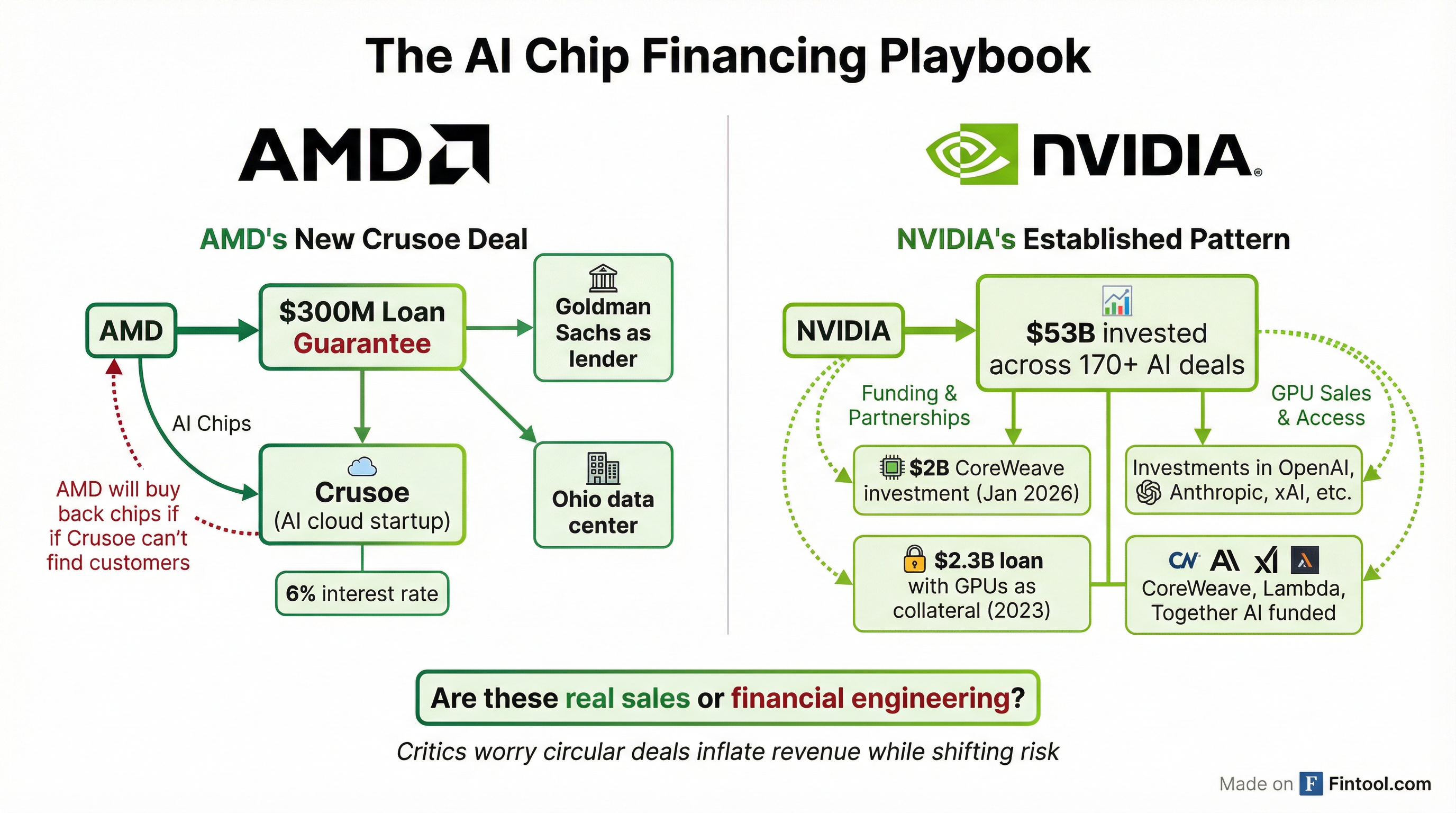
Just last month, Nvidia invested $2 billion in CoreWeave at $87.20 per share to help accelerate the buildout of more than 5 gigawatts of AI factories by 2030. This follows Nvidia's 2023 move to put up H100 GPUs as collateral for CoreWeave's $2.3 billion debt facility from Magnetar Capital and Blackstone.
 Ask Fintool AI Agent
Why AMD Needs Creative Financing
The math explains why AMD is willing to take on this risk. Nvidia commands a market capitalization of $4.6 trillion—roughly 14 times AMD's $332 billion. Despite AMD's strong execution, the gap in resources is vast.
| Metric | AMD | Nvidia |
|---|---|---|
| Market Cap | $332B | $4.6T |
| Q4 2025 Revenue | $10.3B* | $57.0B |
| Data Center Revenue (FY25) | $16.6B* | $160B+ |
| AI Infrastructure Investments | $300M (new) | $53B+ |
*Values retrieved from S&P Global
AMD's Data Center segment generated $16.6 billion in revenue in FY2025, up 32% year-over-year. CEO Lisa Su has outlined ambitious targets: growing data center revenue by more than 60% annually over the next three to five years, scaling the AI business to "tens of billions in annual revenue in 2027."
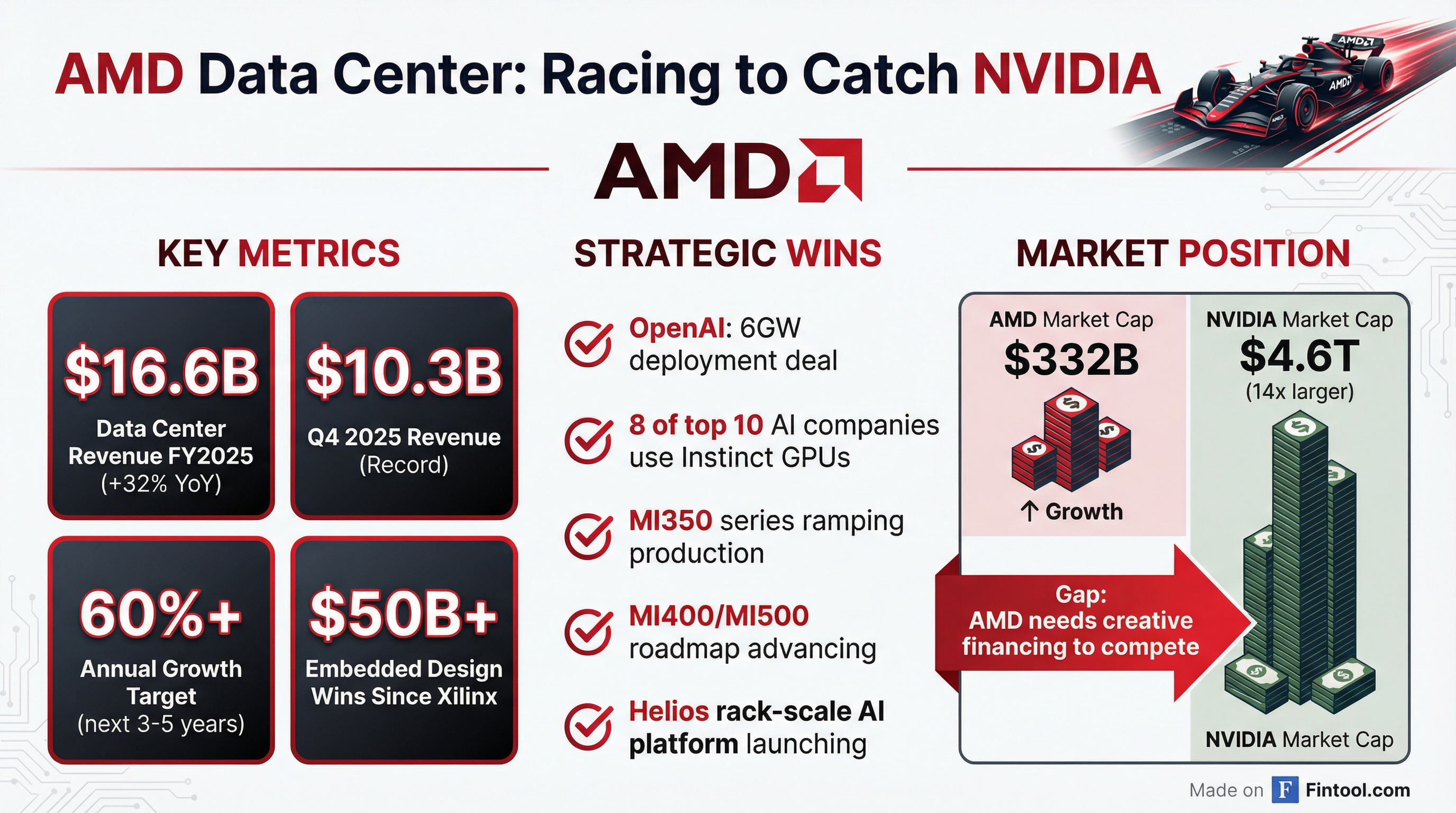
The company secured a landmark deal with OpenAI to deploy 6 gigawatts of AMD GPUs, with the first gigawatt powered by Instinct MI450 series products. Eight of the top 10 AI companies now use AMD Instinct GPUs for production workloads.
Crusoe: From Crypto to AI
Crusoe represents the new breed of "neoclouds"—specialized cloud providers built specifically for AI workloads. Founded in 2018 as a cryptocurrency company, Crusoe has pivoted to building AI infrastructure, following a path similar to CoreWeave's successful transformation.
The startup claims to build data centers with cleaner energy than competitors and is valued at around $10 billion. Reports suggest Crusoe may pursue an IPO as early as this year and expects to spend as much as $4 billion annually over the next decade on infrastructure.
The Circular Deal Debate
Critics worry that circular deals inflate revenue while shifting risk. When a chip company guarantees to buy back its own products, is that a real sale or financial engineering? CoreWeave's CEO Michael Intrator has defended the practice, arguing that companies have to "work together" to address a "violent change in supply and demand."
For AMD, the calculus is straightforward: with $5.5 billion in cash and $4 billion in debt on the balance sheet, a $300 million guarantee is manageable. If Crusoe succeeds in finding customers, AMD books genuine sales and expands its ecosystem. If Crusoe fails, AMD gets its chips back—expensive but not catastrophic.
AMD shares closed at $203.37 on Thursday, up 1.6% on the day. The stock has gained 18.4% since August 2025, outpacing Nvidia's 8.2% gain over the same period, though AMD remains 24% below its 52-week high of $267.
Ask Fintool AI AgentWhat to Watch
The AI infrastructure buildout continues at breakneck pace, with hyperscalers, governments, and enterprises racing to secure compute capacity. AMD's willingness to follow Nvidia's financing playbook signals the intensity of competition—and the lengths companies will go to capture market share.
Key catalysts ahead:
- Crusoe IPO timeline — A successful public offering would validate AMD's bet
- MI400/MI500 adoption — AMD's next-gen chips need to prove competitive with Nvidia's Blackwell
- OpenAI deployment progress — The 6GW deal represents AMD's largest customer commitment
- Neocloud funding environment — If credit tightens, chip-backed loans become riskier
The AI chip war is no longer just about technology. It's about who can finance the buildout of the infrastructure to run it.
Ask Fintool AI AgentRelated Companies: Amd · Nvidia · Coreweave · Goldman Sachs
Photo: Server Rack/Data Center