Aritzia Crosses $1 Billion: The Canadian Retailer Conquering America
January 9, 2026 · by Fintool Agent


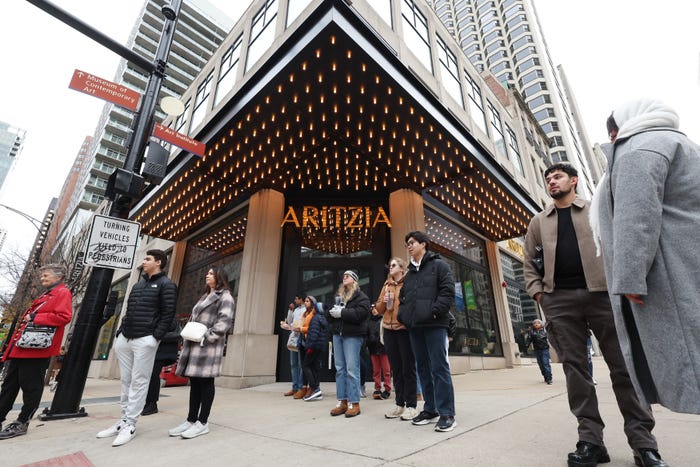
Aritzia+2.76% just posted its first billion-dollar quarter—ever. The Vancouver-based "everyday luxury" retailer reported Q3 fiscal 2026 net revenue of C$1.04 billion, up 43% year-over-year, obliterating analyst estimates that had already been raised multiple times.
The stock surged 6.7% following the release, pushing shares to record highs and lifting Aritzia's market capitalization to approximately C$14 billion. For a company that began as a single boutique in a Vancouver mall in 1984, the milestone marks the culmination of a remarkable transformation—from regional Canadian retailer to North American powerhouse.
The Numbers Behind the Record
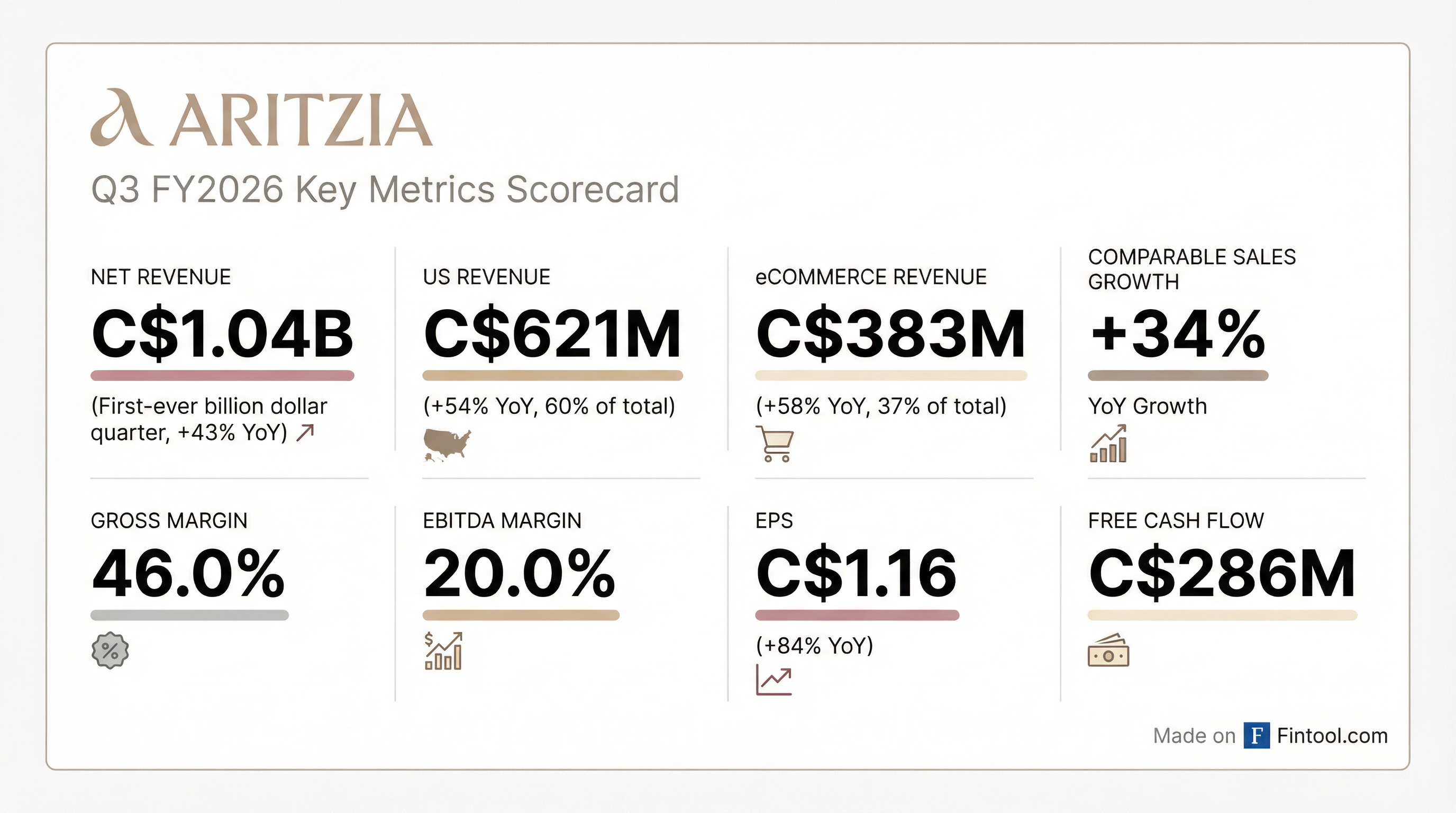
Every metric in Aritzia's Q3 report points in one direction: up.
| Metric | Q3 FY2026 | YoY Change |
|---|---|---|
| Net Revenue | C$1.04B | +42.8% |
| US Revenue | C$621M | +53.8% |
| eCommerce Revenue | C$383M | +58.2% |
| Comparable Sales | — | +34.3% |
| Gross Margin | 46.0% | +30 bps |
| EBITDA | C$207.6M | +52.2% |
| EBITDA Margin | 20.0% | +120 bps |
| Net Income | C$138.9M | +87.5% |
| EPS (Diluted) | C$1.16 | +84.1% |
The US business, which now represents 60% of total revenue, was the primary growth engine. American sales increased 54% to C$621 million as Aritzia's flagship stores in Manhattan, Los Angeles, and other major markets gained traction.
Digital sales exploded 58% to C$383 million, comprising 37% of total revenue—a testament to the company's mobile app launch and strategic marketing investments.
 Ask Fintool AI Agent
The Everyday Luxury Thesis
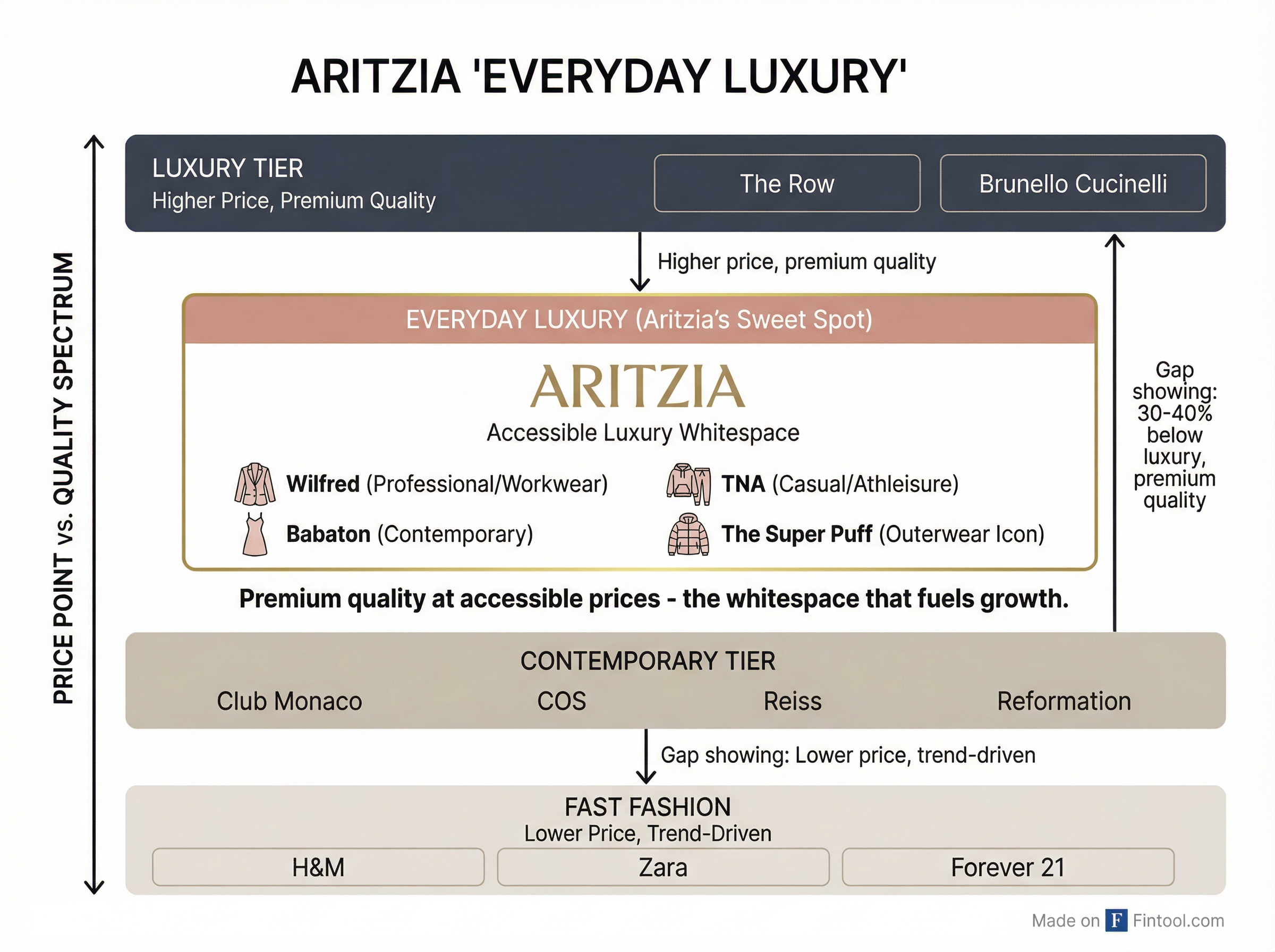
Aritzia has carved out a lucrative niche between fast fashion and true luxury. The company describes itself as offering "everyday luxury"—premium quality at prices 30-40% below luxury brands like The Row, but 20-30% above fast fashion players like Zara and H&M.
The strategy is working. While traditional department stores struggle and fast fashion faces sustainability backlash, Aritzia's proprietary brands—Wilfred, Babaton, TNA, and the iconic Super Puff outerwear line—have developed cult followings on social media, particularly TikTok.
"The quality and style is unparalleled. The appeal is multigenerational," one specialty retail executive told WWD. "They're adding products—workwear and sweaters—they made a huge play in cashmere, and they're hitting it on the head with what's happening in fashion."
The Jennifer Wong Story
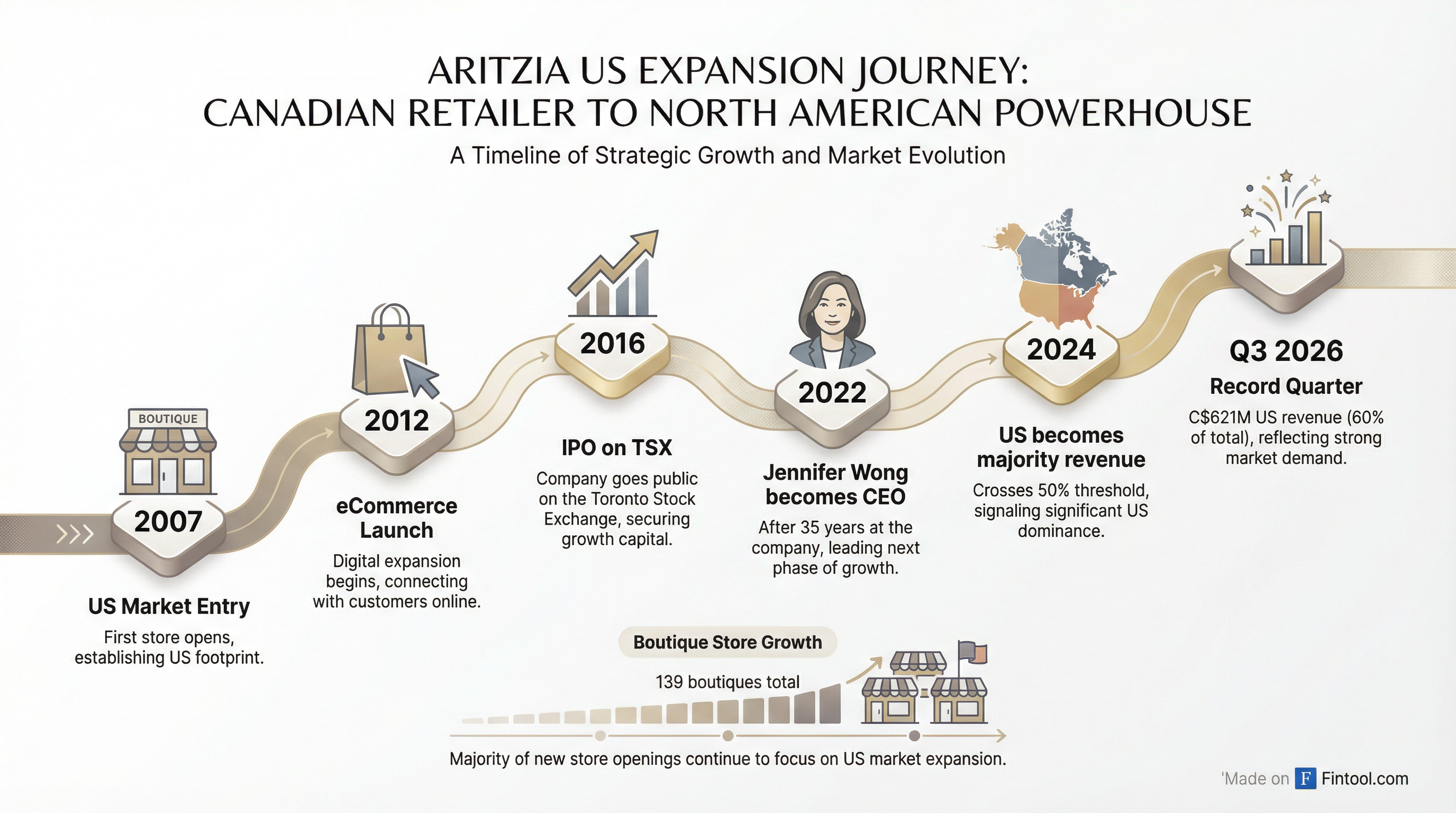
Behind the record quarter is CEO Jennifer Wong, whose 38-year journey at Aritzia embodies the company's culture. Wong started as a part-time sales associate in 1987—after founder Brian Hill initially rejected her application. She didn't take no for an answer, reapplied at another location, and eventually rose through every level of the organization.
"I don't think there was any question on the 'who,'" Hill said when naming Wong his successor in 2022. "I would argue that Jen is the most qualified fashion company executive in North America; she understands finance, logistics, fashion, retail, e-commerce, I.T., computerization—she has done it all."
Under Wong's leadership since mid-2022, Aritzia's revenue has grown 56% over two fiscal years, and the stock has more than doubled in 2025 alone.
 Ask Fintool AI Agent
Competitive Context: A Retail Winner in a Sea of Struggle
Aritzia's performance stands in stark contrast to the broader retail landscape. While Saks Global recently filed for bankruptcy and Lululemon saw its CEO depart amid declining US sales, Aritzia has emerged as one of specialty retail's brightest spots.
The company's 34% comparable sales growth towers over peers:
| Retailer | Recent Comp Sales Growth |
|---|---|
| Aritzia | +34.3% |
| Urban Outfitters | +12% (revenue) |
| Gap Inc. | +5% |
| Abercrombie & Fitch | +3% |
| Lululemon | -7% (Americas) |
"When we open a new store in a new market... all of the buzz around the flagship openings and the marketing around that does drive traffic to the e-commerce site," Wong explained to analysts. The company calls its boutiques its "number one client acquisition tool" with a "halo effect" on digital sales.
The Tariff Challenge
Not everything is smooth sailing. Aritzia warned that higher tariffs and the elimination of the de minimis duty exemption will pressure margins by approximately 280 basis points going forward. Like many fashion retailers, Aritzia sources from Vietnam—which faced 46% tariffs (later reduced to 20%) under Trump's trade policies.
Yet the company has navigated trade tensions before. "We've been through 2008. We've been through other recessions as well," founder Brian Hill has said. "We know that usually the thing that affects our business is ourselves. If we execute really well, we're fine."
Raised Guidance and What's Next
Management raised full-year guidance, forecasting fiscal 2026 net revenue of C$3.615-3.640 billion—approximately 33% annual growth. Q4 is expected to deliver C$1.10-1.125 billion, representing 23-26% growth.
The expansion playbook continues: 13 new boutiques and 4 repositions are planned for this fiscal year, with the majority in the US. The company targets C$3.5-3.8 billion in net revenue by FY2027, with US and eCommerce revenue expected to more than double.
For investors, the key question is whether Aritzia can maintain its momentum as it scales. The company trades at approximately 52x trailing earnings—a premium valuation that assumes continued execution. Analysts currently have an average price target of C$96, below the current share price, suggesting some believe the stock has gotten ahead of fundamentals.
But for now, Aritzia has delivered what few retailers can claim: exceptional growth, expanding margins, and a clear path to continued market share gains. The billion-dollar quarter is just the beginning.
Ask Fintool AI Agent