ASML Unveils EUV Breakthrough: 50% More Chips by 2030
February 23, 2026 · by Fintool Agent


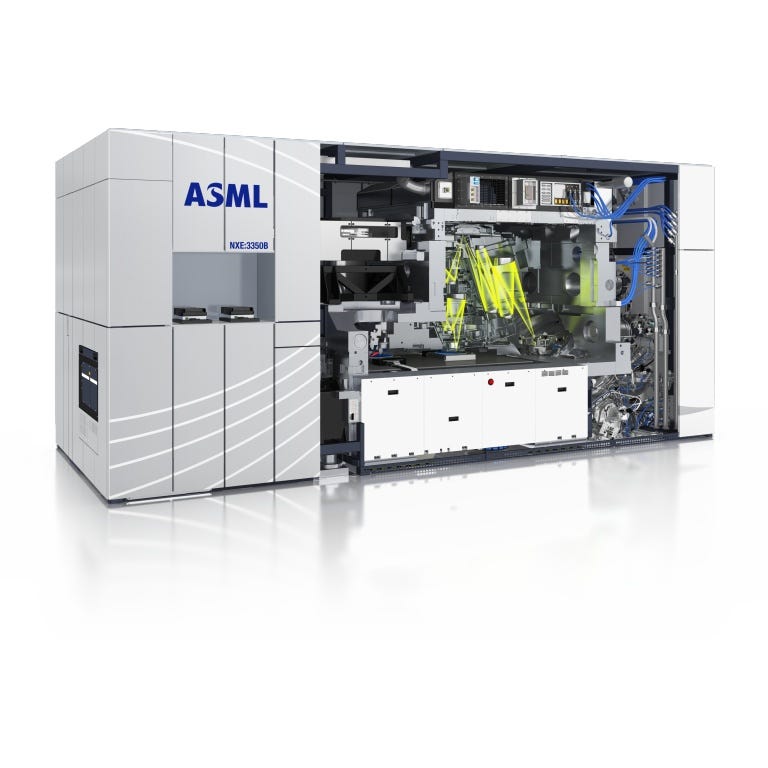
Asml has achieved a major breakthrough in extreme ultraviolet lithography, boosting its EUV light source power from 600 watts to 1,000 watts—a 67% increase that will enable foundries to produce 50% more chips per machine by 2030.
The announcement, revealed exclusively to Reuters at ASML's California facilities, represents the Dutch company's bid to outdistance emerging US and Chinese rivals in the most technologically challenging aspect of advanced chipmaking.
"It's not a parlor trick or something like this, where we demonstrate for a very short time that it can work," said Michael Purvis, ASML's lead technologist for its EUV source light. "It's a system that can produce 1,000 watts under all the same requirements that you could see at a customer."
The Technical Achievement
ASML's EUV machines generate light by shooting a stream of molten tin droplets through a chamber, where a massive CO₂ laser heats them into plasma—a superheated state hotter than the sun that emits EUV light at a wavelength of 13.5 nanometers.
The key advancements involve two innovations:
- Doubled tin droplet rate: From ~50,000 to 100,000 droplets per second
- Dual-pulse laser shaping: Two smaller laser bursts instead of one to shape the plasma
"What was achieved—one kilowatt—is pretty amazing," said Jorge J. Rocca, a professor at Colorado State University whose lab has trained several ASML scientists.
The greater power translates directly to shorter exposure times and more chips per hour. Teun van Gogh, ASML's executive vice president for the NXE line of EUV machines, said customers should be able to process approximately 330 silicon wafers per hour by decade's end, up from 220 now.
| Metric | Today | 2030 Target | Change |
|---|---|---|---|
| Light Source Power | 600W | 1,000W | +67% |
| Wafer Throughput | 220/hour | 330/hour | +50% |
| Cost per Chip | Baseline | 33% lower | Significant reduction |
 Ask Fintool AI Agent
The Roadmap Beyond 1,000 Watts
ASML's researchers believe the techniques used to achieve 1,000 watts will unlock continued advances. Purvis said there's "a reasonably clear path toward 1,500 watts, and no fundamental reason why we couldn't get to 2,000 watts."
This is significant for cost reduction. "We'd like to make sure that our customers can keep on using EUV at a much lower cost," van Gogh told Reuters.
Defending the Monopoly
The breakthrough comes as ASML faces the first serious competitive threats in EUV lithography—from both US startups and China's national program.
US Challengers
Two American startups have emerged with ambitious plans:
Substrate - Backed by Peter Thiel's Founders Fund and CIA-affiliated In-Q-Tel, the San Francisco startup raised $100 million at a $1 billion valuation in October 2025. It's developing X-ray lithography powered by particle accelerators, claiming it could reduce the cost of producing a leading-edge wafer from ~$100,000 to below $10,000 by decade's end.
xLight - The startup has received government funding from the Trump administration and is developing a particle accelerator-based EUV source designed to be compatible with existing ASML scanners.
China's National Effort
EUV machines are so critical to chip production that US governments of both parties have worked with Dutch leaders to prevent them from being shipped to China. This has spurred Beijing to launch a national effort to develop domestic alternatives.
Ask Fintool AI AgentASML's Financial Momentum
The breakthrough arrives amid strong financial performance. ASML reported Q4 2025 revenue of $11.4 billion with gross margins above 52%, driven by surging AI chip demand.
| Metric | Q1 2025 | Q2 2025 | Q3 2025 | Q4 2025 |
|---|---|---|---|---|
| Revenue ($B) | $8.4 | $9.0 | $8.8 | $11.4 |
| Net Income ($B) | $2.6 | $2.7 | $2.5 | $3.3 |
| Gross Margin | 54.0% | 53.7% | 51.6% | 52.2% |
*Values retrieved from S&P Global
CEO Christophe Fouquet noted on the Q4 call that "the last few months have confirmed the positive impact of AI on customer demand for our advanced product, and especially for our EUV system."
The company expects 2026 EUV revenues to be "up significantly" as logic customers migrate from 4nm to the more litho-intensive 3nm node and DRAM customers adopt more EUV layers for HBM production.
ASML shares are up 26% year-to-date, trading near $1,470 with a market cap of approximately $570 billion. The stock touched a 52-week high of $1,493 today following the breakthrough announcement.
What It Means for Customers
ASML's key customers—Taiwan Semiconductor, Intel, and Samsung—are racing to add EUV capacity to meet AI chip demand.
From ASML's Q4 earnings call:
-
TSMC and Logic: "AI accelerators are migrating from the 4-nanometer node to the more litho-intensive 3-nanometer node. At the same time, customers continue to ramp the 2nm node."
-
Memory/DRAM: "Customers are reporting very strong demand for both HBM and DDR products, with supply remaining very tight through at least 2026... DRAM customers continue to adopt more EUV layers on those nodes."
-
Intel High-NA: "Intel announced last month the qualification and acceptance of their EXE:5200B system, which will be used in high-volume manufacturing for their leading-edge nodes."
The NXE:3800E Low-NA EUV scanner costs approximately $235 million, while the newer EXE:5200B High-NA system runs around $380 million. A 50% throughput improvement effectively reduces the cost-per-chip, making these capital investments more attractive.
Ask Fintool AI AgentWhat to Watch
Near-term: ASML's presentation at the SPIE Advanced Lithography Conference in late February may provide additional technical details on the 1,000W achievement and timeline for customer adoption.
2026-2027: High-NA EUV adoption enters "Phase II" where customers begin testing systems on production layers for volume manufacturing readiness.
2030: Target date for 330 wafers/hour throughput, with potential path to 1,500W+ power levels.
The competitive landscape also bears watching. While ASML's breakthrough extends its lead, Substrate plans to begin chip production by 2028, and xLight continues to develop its government-backed alternative. Whether these startups can overcome the engineering barriers that have stymied others for decades—or whether ASML's continued innovation makes their efforts obsolete—remains an open question.