AWS CEO Matt Garman: Teams Achieving 10x–100x Coding Speedup With AI, 'Write No Line of Code'
February 3, 2026 · by Fintool Agent



Amazon-1.79% Web Services CEO Matt Garman delivered a wide-ranging interview at the Cisco+3.06% AI Summit on February 3, revealing that some AWS teams have mandates to "write no line of code"—only prompts—and are achieving 10x to sometimes 100x productivity improvements with AI-driven development.
Speaking with Cisco executives in San Francisco, Garman also threw cold water on space data center ambitions, said AWS has never retired an A100 server (they're completely sold out), and explained why Trainium margins will likely be passed to customers rather than boosting Amazon's bottom line.
The interview came just two weeks after AWS launched its €7.8 billion European Sovereign Cloud to address escalating concerns from European enterprises about U.S. government access to their data—a topic Garman said dominated nearly every conversation he had at Davos.
Amazon shares closed at $238.62, down 1.8% on a broadly negative day for tech stocks.
 Ask Fintool AI Agent
The AI Coding Revolution: 10x–100x Gains
Garman offered the most detailed public account yet of how AWS is using AI to transform its own software development, describing results that exceed what most industry observers have reported.
"The thing that we see that is giving massive acceleration, and I would say, you know, 10x improvement or more, sometimes 100x improvement, is when the teams start from the beginning thinking about AI-driven coding. In fact, we have teams now where they have almost a mandate that they write no line of code. All they do is they prompt the models or they prompt the systems."
This approach creates a flywheel effect: because the AI systems "build a ton of context around what they're building," they can then test all the code since they know the documentation and requirements.
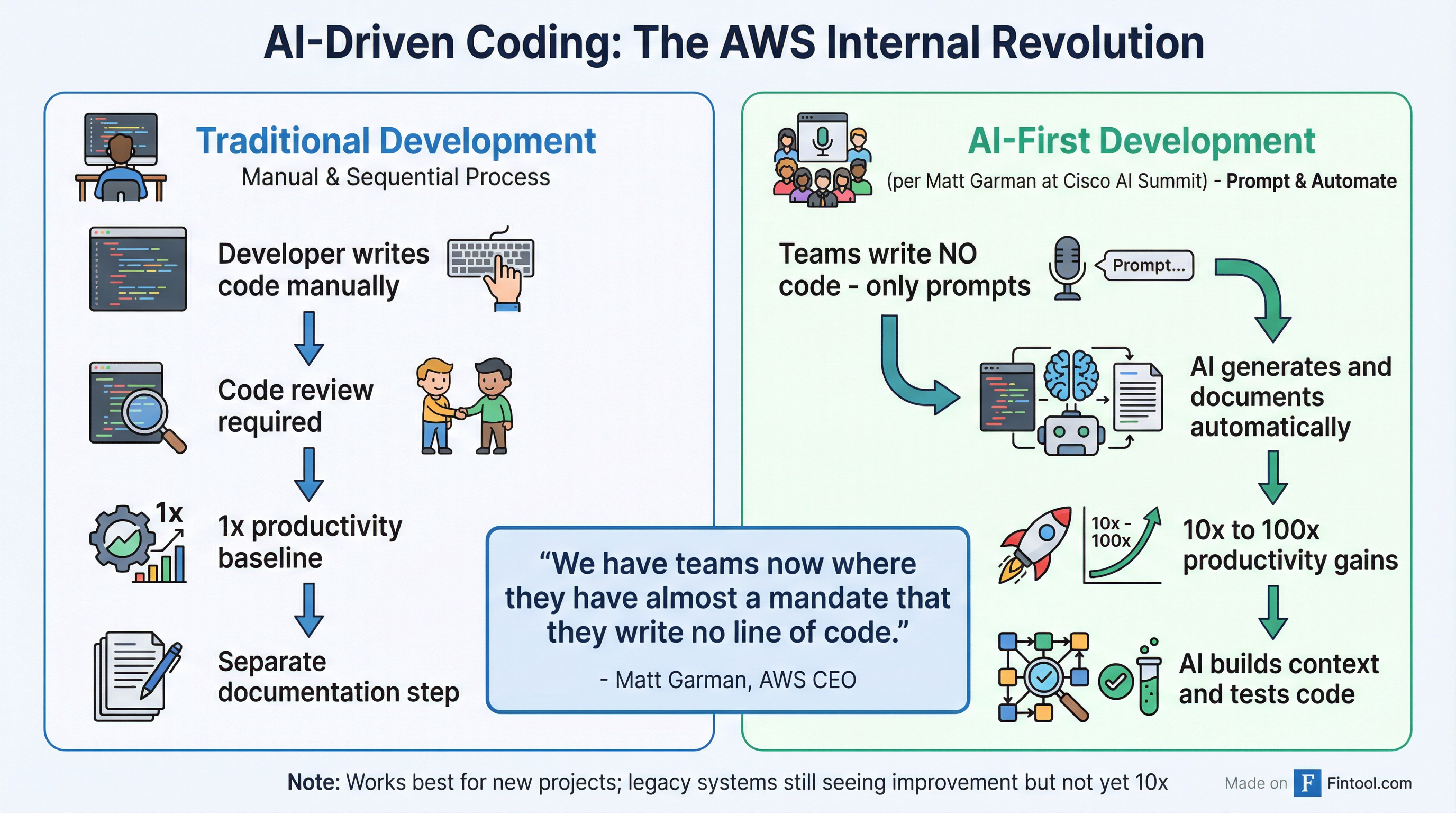
But Garman was candid about limitations. The massive speedups apply primarily to new, greenfield projects. For "really complicated integrated legacy systems"—even ones that aren't mainframes but simply "large distributed systems with a large code base" like Amazon S3—the acceleration is more modest.
"We still see some speed up, but not quite the, like, 10-50x speed up," he said, adding that AWS is "building and thinking about some novel ways in which we can get coding systems to understand legacy code."
The timeline is aggressive: Garman predicted AWS will solve the legacy code challenge "within the next 6-9 months."
Ask Fintool AI AgentWhy Trainium Margins Will Flow to Customers
With Nvidia-2.84% commanding 70-80% gross margins on its AI chips, investors have wondered whether AWS's Trainium could be a significant margin driver. Garman suggested the savings will instead flow to customers—consistent with AWS's historical approach.
Asked whether Trainium would improve margins, Garman was direct: "I have no idea. That's a good question. That's for the bankers to guess on." But he quickly clarified the likely outcome:
"I think it improves our margins versus only using NVIDIA GPUs. And they're always gonna be a big part of that, but not necessarily a big part of that margin... When you have 70%, 80% gross margins, there's room in there for somebody to take less margin, have a higher performing part, and offer choice to customers."
The bottom line: "I'd probably bet on" Trainium leading to lower prices for customers rather than margin expansion. "That's just how AWS operates... every time we lower prices, generally, we pass them on to customers and it gives customers more budget to go build new workloads. And for us, that generally leads to a good flywheel."
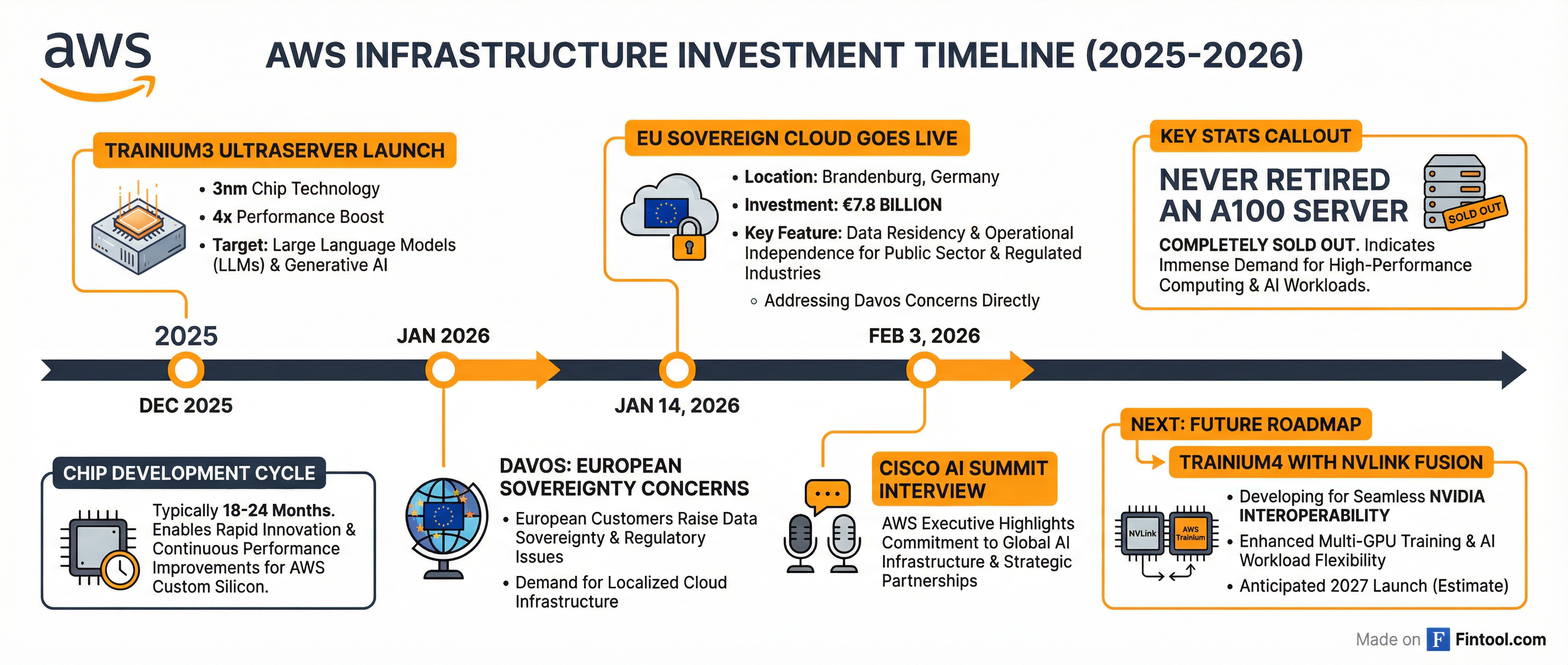
AWS launched Trainium3 UltraServer in December 2025, built on a 3-nanometer process with 4x performance and 40% better energy efficiency than the previous generation. Trainium4 is already in development with NVIDIA NVLink Fusion support, allowing interoperability with NVIDIA GPUs.
4 GW Added, Never Retired an A100
Garman revealed striking details about AWS's infrastructure buildout and GPU utilization:
Never retired an A100: "I mean, besides it going back, fail or something like that. But outside of that, no... 'Cause there's still demand for it."
Garman explained that there are structural reasons for continued A100 demand: newer chips reduce floating point accuracy for AI gains, but some customers running HPC-style calculations require higher precision. "Actually, I really can't move to Blackwells. I have to use [older chips] because I'm doing kind of HPC-style calculations, and the precision is not enough for me."
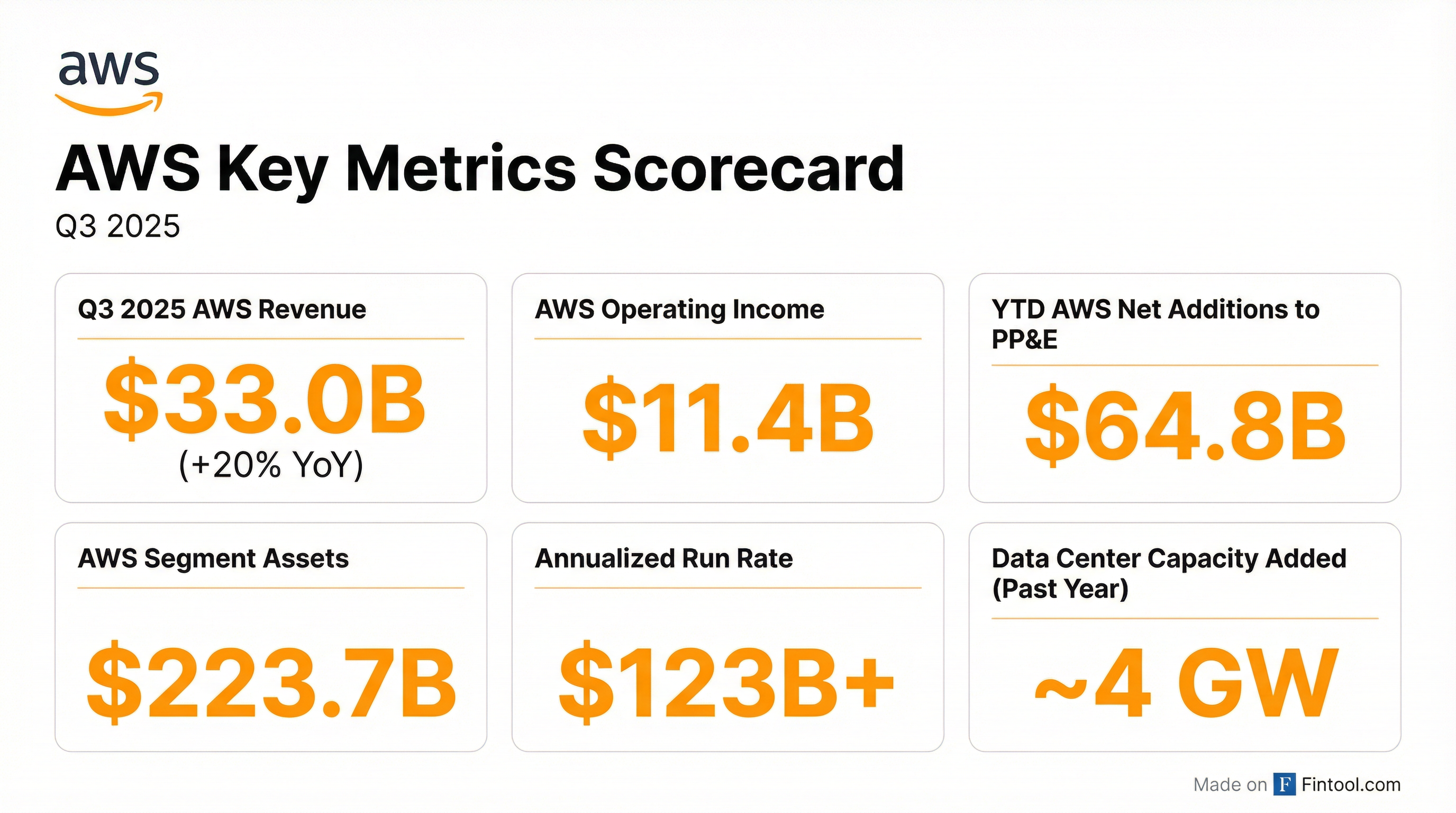
4 GW added in the past year: "In the last year, we added just south of 4 GW of new capacity in AWS for the data centers."
Long planning horizons: Data centers are 20-30 year assets. Servers last 5-6 years. Networking gear lasts 6-10 years. AWS makes power commitments for long periods and maintains complex supply chain risk assessments across all investment levels.
AWS generated $33.0 billion in Q3 2025 revenue, up 20% year-over-year, with $11.4 billion in operating income. AWS property and equipment assets reached $165.1 billion as of September 30, 2025, with net additions of $64.8 billion year-to-date.
Space Data Centers: "Pretty Far" From Reality
When asked about space data centers—which would offer unlimited solar power and easy cooling—Garman was skeptical:
"I don't know if you've seen a rack of servers recently. They're heavy. And... the last I checked, like, humanity has yet to ever build a structure, a permanent structure in space on the Moon or anywhere like that."
He acknowledged the theoretical benefits—"infinite amount of power that's always available" and "easy cooling"—but noted that current transport economics make it impossible. "If you think about the cost of getting a payload in space today, it's massive... There's no way it's gonna be economical."
Asked whether Blue Origin (Amazon founder Jeff Bezos's space company) might help, Garman said: "It would be great, but they have to get their costs way down. Like, it is just not economical today."
He also pointed to latency concerns for any space-based infrastructure.
EU Sovereign Cloud: Addressing "What If the U.S. Government Turns Me Off?"
Garman described growing anxiety among European customers about U.S. control over cloud infrastructure—a concern that dominated his conversations at Davos just two weeks prior.
"Probably nearly every single conversation I had with a European company was started with, like, 'Look, we trust you. I don't know if I can trust your country.'... I don't know how many times I literally had the question of, like, 'How do I, you know, what if the U.S. government decides to turn me off?'"
AWS launched its European Sovereign Cloud on January 14, 2026, with the first region in Brandenburg, Germany. The infrastructure is operated by a separate EU subsidiary under German law, with an independent governing board of EU citizens. All data—including metadata and account logins—remains within the EU, and AWS has tested disconnecting the region from the AWS backbone to prove it can operate independently.
The EU Sovereign Cloud was co-designed with Germany's Federal Office for Information Security (BSI). Amazon plans to invest more than €7.8 billion in the infrastructure and will expand to Belgium, the Netherlands, and Portugal.
"For EU, this is actually gonna be a fantastic [solution]," Garman said. "But I think we are exploring with a bunch of different things like that to help a bunch of companies around the world grapple with this, where there's obvious trade-offs, but it's hard questions."
Ask Fintool AI AgentSecurity Concerns Blocking Agentic AI
Beyond defining success criteria upfront, Garman identified security as the primary barrier preventing enterprises from deploying AI agents at scale.
"The other thing that blocks people from rolling out, and this is a more fundamental piece, which is, and this particularly gets into agents... people are super worried about security. They're worried that the agents are gonna go off and do things that they're not supposed to. They're worried about the sprawl of agents. They're worried about agent identity."
He shared an internal example: an agent was about to delete infrastructure because it thought that was the fastest way to complete a task. "And they're like, 'No, no, no, no, no. Like, that's like that will actually cause, like, production issues if you go do that.'"
AWS is addressing this with Agent Core, designed to provide "guardrails that allow you to go fast" and give teams "safe places to run fast, in a production setting."
Garman used an analogy: walking across a board over a canyon, you move slowly and carefully. "All of a sudden, if you, like, put handrails up and you put, like, walls and guardrails, you can run across it... Part of what slows people down is they're worried."
The Success Metrics Gap
Garman identified a fundamental problem preventing AI proof-of-concepts from reaching production: lack of clear success criteria.
He shared a story from the J.P. Morgan Health Conference about two hospital administrators who had deployed ambient listening AI for doctor notes. One was disappointed—"I've dinner with their families. I haven't saved a single dollar. So, like, what am I getting out of this?"—while the other was thrilled because the technology reduced attrition risk.
"Having that metric as to, like, what the real thing and the value you want out of that, I think, is a huge thing that blocks a bunch of companies 'cause they initially say, 'I'm not saving any money with this thing.' And that may be true, but it may also not be the goal."
Customer service and coding have well-defined metrics, Garman said. "For the rest of the workforce where it's kind of a general productivity fuzzy metric, I think people don't really have a good sense there."
What to Watch
AI Coding Timeline: Garman predicted AWS will crack the legacy code challenge within 6-9 months, which would dramatically expand AI coding's addressable market. Watch for announcements at AWS re:Invent 2026.
Trainium4 Launch: With NVLink Fusion support enabling NVIDIA interoperability, Trainium4 could change the competitive dynamics in AI infrastructure. No launch date announced, but AWS typically operates on 18-24 month chip cycles.
EU Sovereign Cloud Expansion: Local Zones in Belgium, the Netherlands, and Portugal will address BSI's 200km geo-redundancy requirement, expanding the addressable market to financial services and other regulated industries.
Agent Core Adoption: AWS is building security and identity infrastructure for AI agents. Watch for enterprise adoption metrics in upcoming earnings calls.
Ask Fintool AI AgentAWS Financial Snapshot
| Metric | Q4 2024 | Q1 2025 | Q2 2025 | Q3 2025 |
|---|---|---|---|---|
| AWS Revenue ($B) | $28.8 | $29.3 | $30.9 | $33.0 |
| AWS YoY Growth | 19% | 17% | 17.5% | 20% |
| AWS Operating Income ($B) | $10.6 | $11.5 | $10.2 | $11.4 |
| AWS PP&E Net Additions ($B) | $14.5 | $17.5 | $19.0 | $28.3 |
Values retrieved from company filings