BHP's Copper Moment: Record $8B EBITDA Surpasses Iron Ore for First Time as $4.3B Silver Deal Funds Growth
February 16, 2026 · by Fintool Agent


BHP delivered a milestone earnings report that marks a strategic inflection point: copper is now the company's largest profit driver. The world's biggest miner reported H1 2026 underlying attributable profit of $6.2 billion, beating consensus estimates of $6.03 billion, with copper EBITDA reaching a record $8 billion—more than half of group earnings for the first time in company history.
The results triggered a 7% rally in BHP shares to an all-time high, the stock's best single-day performance since March 2020.
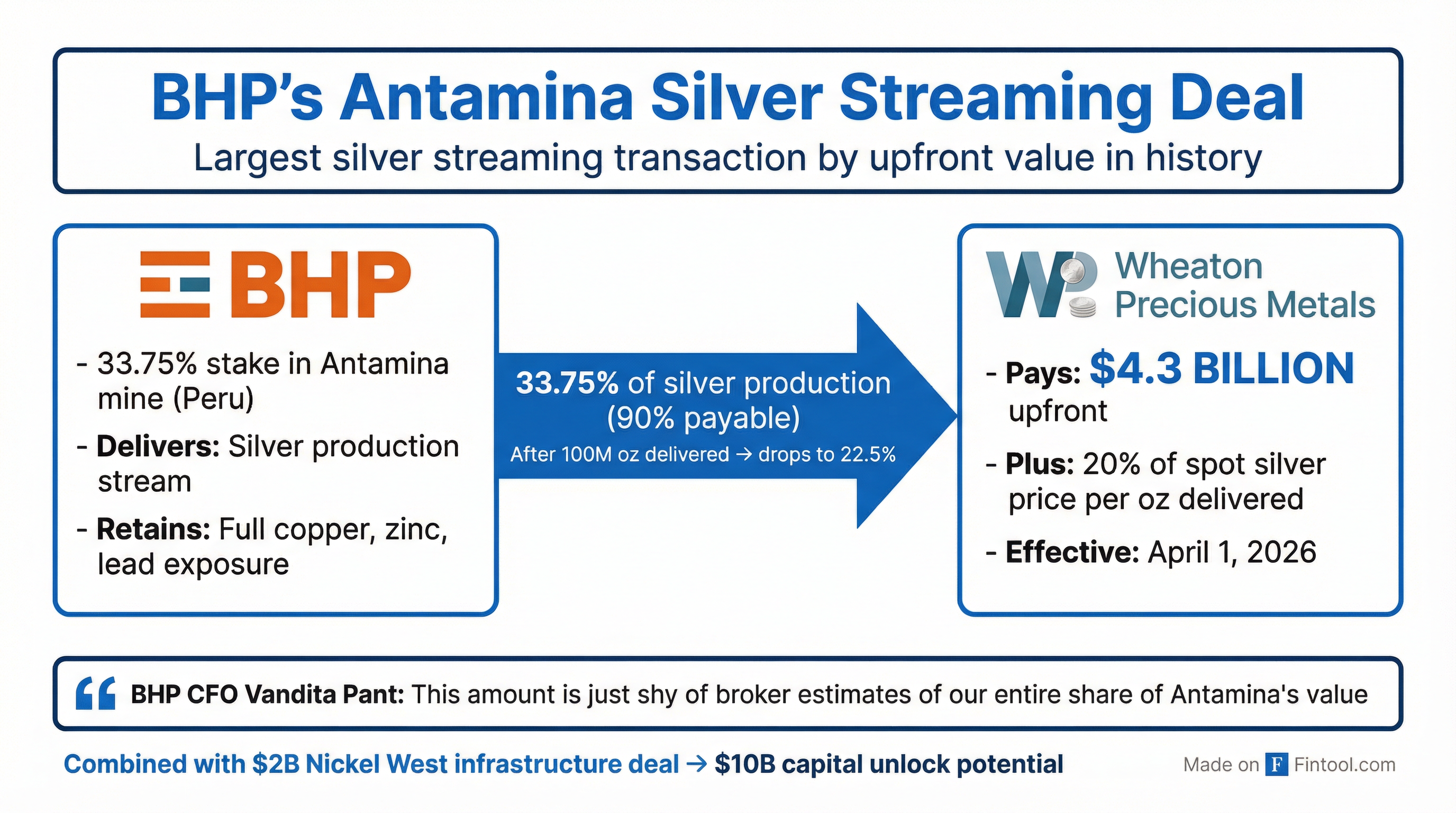
Simultaneously, BHP announced the largest silver streaming agreement ever by upfront value: a $4.3 billion deal with Wheaton Precious Metals for its share of silver production at Peru's Antamina mine. CFO Vandita Pant noted the upfront consideration is "just shy of broker estimates of our entire share of Antamina's value"—a shrewd capital unlock that funds copper expansion while BHP retains full exposure to Antamina's copper production.
 Ask Fintool AI Agent
The Numbers: Copper Takes the Crown
| Metric | H1 2026 | H1 2025 | Change |
|---|---|---|---|
| Revenue | $27.9B | $25.2B | +11% |
| Underlying EBITDA | $15.5B | $12.4B | +25% |
| Underlying Profit | $6.2B | $5.1B | +22% |
| Dividend Per Share | $0.73 | $0.51 | +44% |
| Payout Ratio | 60% | 65% | - |
| Copper EBITDA | $8.0B | $5.2B | +54% |
| Copper % of Total EBITDA | 51% | 42% | +9pp |
Data from BHP H1 2026 earnings call.
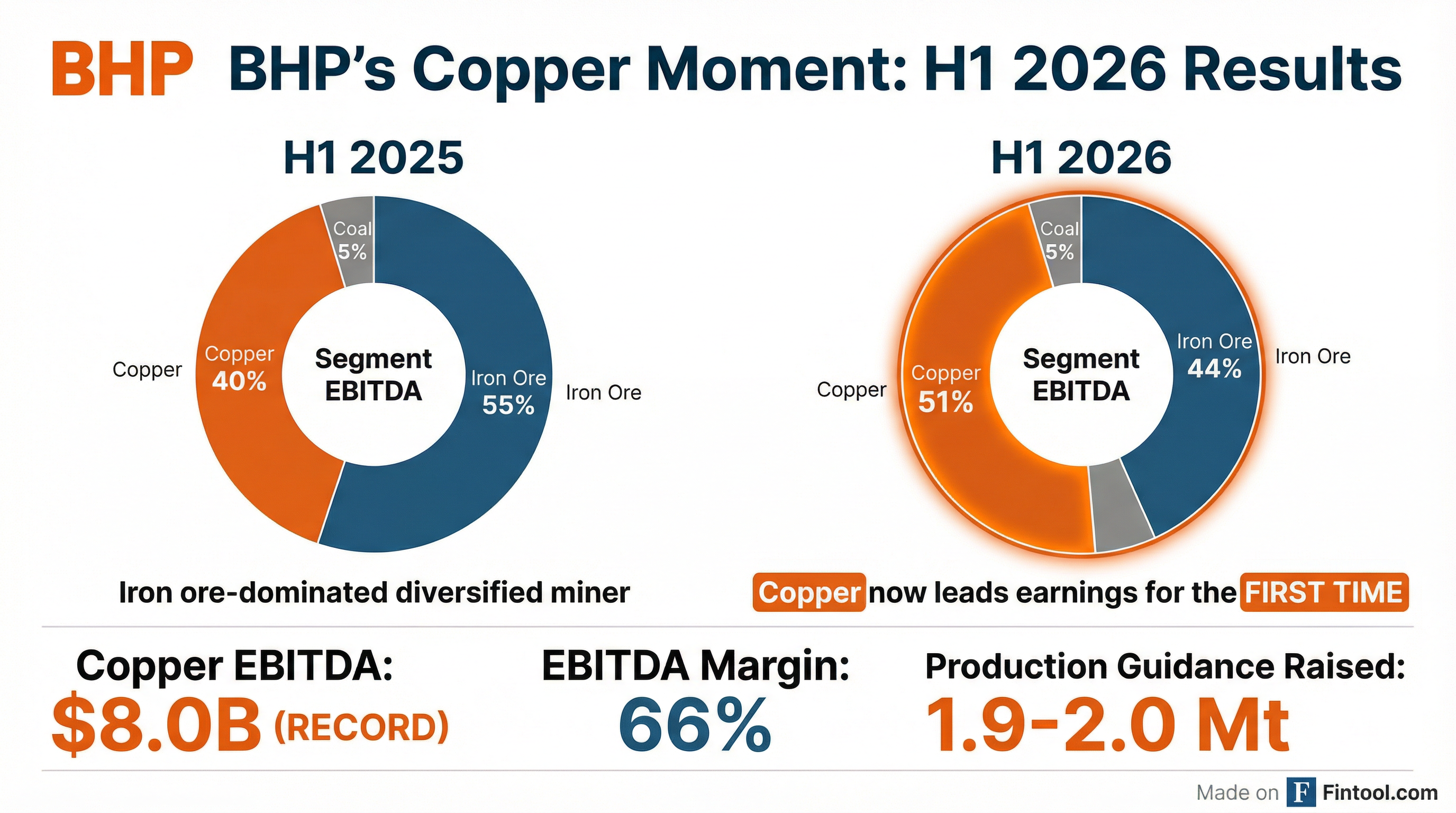
The copper segment's 66% EBITDA margin reflects both operational excellence and favorable pricing. CEO Mike Henry highlighted that BHP is "not only the world's largest copper producer, but also a global top 20 gold producer and the world's third-largest uranium producer"—byproducts that substantially reduce copper unit costs.
At Escondida, the world's largest copper mine, record concentrator throughput offset a 10% decline in ore grade. Copper South Australia delivered a 50% reduction in unit costs, driven primarily by strong gold production at Olympic Dam.
The Silver Streaming Deal: Capital Allocation Masterclass
BHP's $4.3 billion streaming agreement with Wheaton represents a textbook example of unlocking embedded value from non-core commodities at peak market conditions.
Deal Structure
| Term | Details |
|---|---|
| Upfront Payment | $4.3 billion |
| Silver Delivered | 33.75% of Antamina production (BHP's share) |
| Payable Rate | 90% fixed |
| Step-Down | After 100M oz delivered, drops to 22.5% |
| Production Transfer | 20% of spot silver price per oz |
| Effective Date | April 1, 2026 |
The streaming structure is particularly elegant: BHP monetizes future silver production—a non-core byproduct—while retaining full exposure to copper, zinc, and lead at Antamina. For Wheaton, the deal doubles its Antamina silver stream (it already has a 33.75% stream from Glencore's stake), consolidating control over one of the world's most prolific silver sources.
Combined with a previously announced $2 billion deal with Global Infrastructure Partners for a 49% stake in BHP's Nickel West power infrastructure, BHP expects to unlock over $10 billion in capital.
"These agreements are examples of BHP's razor-sharp approach to capital portfolio and asset management," CFO Pant stated. "They improve our financial flexibility, unlock value, and benefit BHP's shareholders."
Ask Fintool AI AgentWhy Copper Matters: The AI and Electrification Supercycle
BHP's transformation into a copper-first company coincides with a structural demand surge that analysts believe could define the next decade of commodity markets.
S&P Global's January 2026 report, Copper in the Age of AI, forecasts copper demand will reach 42 million metric tons annually by 2040—a 50% increase from current levels. Without new mines and expanded recycling, nearly a quarter of that demand will go unmet.
Key Demand Drivers:
-
AI Data Centers: A single major data center requires 40,000-50,000 tonnes of copper for wiring, cooling infrastructure, and power transmission.
-
Electric Vehicles: EVs use 3-4x more copper than internal combustion vehicles, with the ICE fleet expected to peak in 2026.
-
Grid Expansion: Global electricity demand grew 4.3% in 2024, requiring massive grid infrastructure investment. Electrification and decarbonization now represent approximately 30% of total copper demand.
LME copper prices have surged above $12,000 per metric ton, with JPMorgan forecasting $12,500/mt in Q2 2026. The market faces a forecast refined copper deficit of 330,000 tonnes in 2026, exacerbated by supply disruptions including a massive mudslide at Indonesia's Grasberg mine that knocked out capacity through late 2026.
"Every 25 years or so, we go through these large generational societal changes in the way the economy moves," noted Steve Schoffstall of Sprott ETFs. "AI, EVs and renewables are working together to fuel that demand."
Operational Performance: Record Production, Lower Costs
BHP's operational results underscore the value of its world-class copper assets:
Escondida (Chile)
- Record concentrator throughput despite 10% lower ore grade
- Cathode production ramping up via Full SaL leaching project
- FY26 guidance: 1,150-1,250 kt (weighted to H1)
Copper South Australia
- Copper production: 72.6 kt (stable)
- Gold production up 24%
- Unit costs down 50%+ due to strong byproduct credits
Western Australia Iron Ore
- Record H1 production and shipments
- C1 costs: $17.66/t (+1%)—lowest among major iron ore producers
- Car Dumper 3 rebuild completed 8% ahead of schedule
The company raised copper production guidance for FY26 to 1.9-2.0 million tonnes, reflecting confidence in operational performance across the portfolio.
Ask Fintool AI AgentBalance Sheet and Cash Flow: Funding the Copper Future
BHP's capital allocation framework prioritizes copper growth while maintaining shareholder returns:
| Metric | H1 2026 |
|---|---|
| Attributable Free Cash Flow | $3.7B |
| 5-Year FCF (at spot prices) | $60B projected |
| Net Debt / EBITDA | 0.4x |
| Total Debt | $25.6B |
| Cash | $11.9B |
| Dividend | $3.7B (60% payout) |
Data from BHP H1 2026 results.
Management emphasized resilience: "Even in an extreme and prolonged low-price environment, one in which prices fell 20%-40% below current levels and stayed there for 5 years, we would generate around $10 billion in attributable free cash flow over that period."
The $10 billion unlocked from streaming and infrastructure deals will fund BHP's copper expansion pipeline:
- Escondida New Concentrator: Permit submission expected H2 FY26
- Laguna Seca Expansion: Environmental approval secured September 2025
- Vicuna and Copper SA: Development-stage projects in pipeline
- Jansen Stage 1 (Potash): First production expected mid-CY27
Market Reaction and Valuation Gap
BHP shares rallied 7% to an all-time high following the results—the stock's best day since March 2020. Yet analysts argue the market still prices BHP primarily as an iron ore company, creating a potential rerating opportunity as copper's contribution grows.
"Despite their massive copper output, the market continues to price BHP and Rio primarily as iron ore companies," noted David Tuckwell of ETF Shares. "If copper stays above US$12,000/t in 2026, I believe the market will be forced to re-rate BHP and Rio up, or re-rate the pure plays down."
Pure-play copper miners trade at significantly higher multiples:
| Company | P/E (LTM) | Dividend Yield |
|---|---|---|
| BHP | 12x | 5.0% |
| Freeport-McMoRan | 18x | 1.2% |
| Southern Copper | 22x | 3.5% |
| Antofagasta | 20x | 2.8% |
The valuation gap offers BHP shareholders both "copper price torque" and superior yield—a combination that may narrow as the market recognizes BHP's transformation.
What to Watch
Near-term catalysts:
- Escondida New Concentrator DIA permit submission (H2 FY26)
- Wheaton streaming deal completion (~April 1, 2026)
- GIP Nickel West infrastructure deal completion
- Q2 operational review
Structural themes:
- China economic recovery and copper demand trajectory
- AI data center buildout pace (hyperscaler capex guidance)
- Copper price sustainability above $12,000/mt
- Mine supply disruptions (Grasberg recovery timing)
Risks:
- Iron ore price volatility from China steel demand weakness
- Queensland coal royalties impacting steelmaking coal returns
- Chile permitting and labor relations
- Copper price correction if recession fears materialize
Ask Fintool AI Agent